
Selection of furnace for Cl₂・HCl special atmosphere sintering | Corresponding to chlorination reaction and corrosion evaluation

Organize the firing conditions and safety specifications using corrosive gases.
Are you considering sintering, chlorination reactions, and corrosion evaluation in a special atmosphere such as Cl₂ and HCl? In sintering using corrosive and reactive gases like Cl₂ and HCl, it is necessary to consider specifications not only for temperature and gas concentration but also for materials inside the furnace, jig materials, sealing materials, piping, valves, exhaust piping, pollution control devices, and safety interlocks. In particular, for chlorination reactions and volatile separation, the volatility of the generated chlorides, condensation location, recovery methods, insulation of exhaust piping, and pollution control capabilities are important. Additionally, since corrosive gases are handled, leak prevention measures, gas detection, exhaust routes, and safety shutdown conditions significantly impact equipment specifications. This document organizes the treatment objectives, gas conditions, furnace type selection, and key points for confirming jigs, piping, exhaust, pollution control, and safety measures in Cl₂ and HCl special atmosphere sintering. - For sintering and reaction evaluation in Cl₂ and HCl atmospheres - For consideration of chlorination reactions, volatile separation, and impurity removal - For removal of deposits from jigs and components, and evaluation of corrosion and durability - For insulation of exhaust, condensation measures, and specification review of pollution control devices - For sintering tests and condition exploration before equipment installation
Inquire About This Product
basic information
Publication Content: Points for Confirming Equipment Specifications for Cl₂ and HCl Special Atmosphere Sintering ■Purpose of Treatment We will organize the objectives of chlorination reactions, volatile separation, removal of metal impurities, removal of residues from jigs and parts, corrosion and durability evaluation, and confirmation of products, exhaust gases, and recovery methods. ■Gas Conditions We will confirm the presence of Cl₂, HCl, mixed gases, and N₂ dilution. Concentration and flow rate affect reactivity, safety, exhaust volume, and decontamination capability. Temperature and pressure influence the volatility of generated chlorides and the condensation location. ■Important Specifications for Special Atmosphere We will check the corrosion resistance of furnace materials and jig materials, material selection for seals, piping, and valves, insulation of exhaust piping, measures against condensates, compatibility with decontamination devices and scrubbers, leak prevention, interlocks, and gas detection. Guidelines for Furnace Type Selection ■Small Chlorine Furnace Applicable for Cl₂ and HCl treatment, chlorination reactions, and corrosion evaluation. Specifications will be considered including corrosion-resistant materials, exhaust insulation, decontamination, and safety interlocks.
Price information
Estimates will be provided each time based on test content, gas type, furnace type, emission control, and safety measures.
Delivery Time
※It varies due to gas type, concentration, flow rate, temperature, pressure, furnace materials, exhaust piping, pollution control devices, and safety measures.
Applications/Examples of results
Recommended for such considerations. ■ Special atmosphere sintering in Cl₂・HCl atmosphere ■ Exploration of conditions for chlorination reactions, selective chlorination, and volatile separation ■ Evaluation of the feasibility of removing metal impurities ■ Examination of the removal of adherents on jigs, parts, and substrates ■ Corrosion evaluation and durability assessment in Cl₂/HCl atmosphere ■ Confirmation of the volatility, condensation location, and recovery methods of generated chlorides ■ Verification of exhaust gases, generated gases, and corrosive components ■ Consideration of insulation for exhaust piping, measures against condensates, and specifications for scrubbers and detoxification devices ■ Confirmation of leak detection, gas detection, safety interlocks, and abnormal stop conditions ■ Sintering tests before equipment installation and exploration of conditions using a small chlorine furnace We can consult with you from the stage where conditions are not yet determined, such as "I want to confirm if it reacts with Cl₂ or HCl," "I want to check the volatility, condensation, and recovery methods of generated chlorides," and "I want to consider whether the equipment can be established including safety measures."
catalog(1)
Download All Catalogs
Company information

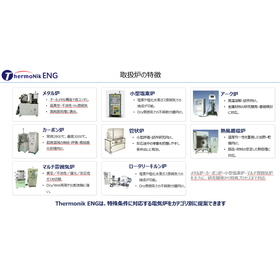
Our company integrates three technologies: "electricity," "equipment," and "chemistry," using our unique know-how to develop innovative heating furnaces and other equipment. We handle various electric furnaces (heating furnaces) such as carbon furnaces, multi-atmosphere furnaces, metal furnaces, and chlorine furnaces, leveraging our proprietary high-temperature electric furnace technology. We are not just an equipment manufacturer; we are a strategic development partner that supports innovative manufacturing with advanced heating, looking ahead to the standards of the next decade alongside our customers.


