Tohoku Univ. Technology:Magnetic Powder Core process optimization system:T25-026
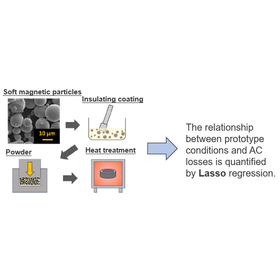
Quantified prototype conditions and AC losses and proposed design guidelines
Magnetic Powder Cores, possessing both high saturation magnetic flux density and high degree of shape freedom, are widely used as core materials for motors, transformers, and other applications. However, increased losses in the high-frequency range are a challenge for Magnetic Powder Cores, necessitating the development of design guidelines for reducing losses. Conventional Magnetic Powder Cores design often relied on experience and intuition, but in recent years, machine learning-based AC loss estimation methods and mechanism analysis methods have been proposed, leading to increased accuracy in material design. Nevertheless, Magnetic Powder Cores have numerous design parameters, and optimizing process conditions, in particular, has been difficult. The present invention constructs an estimation system that accurately predicts AC losses when prototype conditions are input, by utilizing Lasso regression and dividing the dataset into multiple parts. By appropriately modifying the prototype conditions according to the prediction function obtained in this invention, it can be used to develop design guidelines for Magnetic Powder Cores.
Inquire About This Product
basic information
For details, please contact us or refer to the PDF.
Price range
Delivery Time
Applications/Examples of results
For details, please contact us or refer to the PDF.
catalog(1)
Download All Catalogs
Company information
The revenue generated from technology transfer is reinvested into universities and researchers as new research funding, which is used to create further research outcomes. To ensure the smooth operation of this cycle, known as the "Intellectual Creation Cycle," we will actively promote technology transfer. The types of seeds we handle include patents, know-how, databases, and programs. We have established a collaborative framework by concluding basic technology transfer agreements with the following universities (as of April 1, 2026): - Tohoku University - Hirosaki University - Iwate University - Akita University - Fukushima University - Yamagata University - Tohoku Gakuin University - Iwate Medical University - Fukushima Medical University - Aizu University - Miyagi University - Hokkaido University - Muroran Institute of Technology - Showa Medical University - Asahikawa Medical University