

Evaluation and tuning of brake systems – from simulation to the test bench
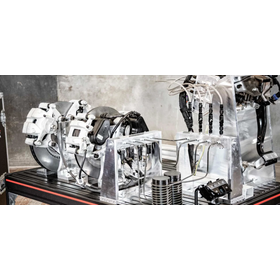
MXbrakeHiL: A Hardware-in-the-Loop Test Environment for Brake System Development and ESC Validation MXbrakeHiL is a Hardware-in-the-Loop (HiL) test system that integrates a complete physical brake assembly—from the brake pedal through to the brake calipers—directly into a real-time vehicle simulation environment. This enables the testing, evaluation, and tuning of ESC ECUs and safety-critical braking functions before a vehicle prototype is available. And it reduces simulation complexity and supports systematic validation at each stage of the V-model. Electric and automated vehicles require precise development of braking functions and vehicle dynamics controllers. Pure simulation models have limitations in replicating the hydraulic nonlinearities, friction, and valve dynamics present in physical brake systems. MXbrakeHiL addresses this by substituting real hardware into the control loop, removing the need to model those physical effects mathematically. Hardware-Coupled Testing: Physical Response, Repeatable Conditions, Objective Evaluation Physical Fidelity Through Unmodified Hardware Components: Unmodified hardware components reproduce authentic pressure build-up rates, dynamic hysteresis, and ABS modulation profiles — behavior that parametric simulation models cannot reliably replicate. Repeatable Scenario Testing: Road surface conditions, vehicle speeds, and environmental factors are defined in the simulation model and varied systematically to validate functions including Autonomous Emergency Braking (AEB) and ESC, with consistent initial conditions across every run. Open Architecture for Parameter Optimization: The test bench supports complex parameter sweeps and calibration variant evaluations. Full observability of the hardware chain and integration with MXeval allow engineers to evaluate criteria such as stability, brake blending logic, and hardware interaction in a single test cycle.
Inquire About This Product
basic information
Key Facts of MXbrakeHiL ■Brake system compatibility: Full wet physical brake assembly integrated into the loop — from brake pedal to brake calipers ■Test coverage: Supports HiL-DiL test configurations — from early ESC software integration through system-level validation in the V-model ■High precision: Authentic reproduction of pressure build-up dynamics, dynamic hysteresis, and ABS modulation profiles through real hardware components ■Modular, scalable design: Open, modular design with quick-swap setups; configurable with additional sensors, actuators, or universal emulation modules ■Real-time integration: Compatible with all EtherCAT-supporting real-time systems including VI-grade AutoHawk, Concurrent Real-Time iHawk, Vector VN & VT, dSpace Scalexio, IPG Xpack and more ■Software compatibility: Full integration with MXeval for automated, KPI-based evaluation of brake system performance ■Plug & Play: Straightforward commissioning through pre-configured interfaces ■Vehicle models: Supports commercial vehicle models including Vector DYNA4, IPG CarMaker, dSpace ASM, and custom MATLAB/Simulink vehicle models ■Measurement: Full observability of the hardware chain throughout each test run ■Optimisation: Supports complex parameter sweeps and calibration variant evaluations ■V-model coverage: Supports testing and validation across all maturity levels of the V-mode
Price range
Delivery Time
Applications/Examples of results
Benefits of MXbrakeHiL for Development and Validation Teams ■Removes hydraulic modelling dependency: unmodified physical hardware in the loop eliminates the need to build and validate hydraulic simulation models for each hardware variant ■Reduces prototype dependency: ESC ECU software can be tested and validated against real brake hardware before a vehicle prototype is available ■Repeatable, controlled test conditions: road surface, speed, and environmental parameters are defined in simulation, removing variability from test execution ■Automated regression testing: parameter or software changes can be evaluated against the same test scenarios without continuous manual bench operation ■Objective, structured KPI outputs: MXeval integration produces consistent evaluation results covering pedal force progression, stability, and pressure build-up dynamics but also complex KPIs for slalom or lane change maneuvers ■Compatibility with existing toolchains: direct interfacing with RT Systems and vehicle models from VI-Grade, Vector, IPG, dSpace, and MATLAB/Simulink ■Configurable hardware platform: modular architecture supports additional sensors, actuators, or emulation modules to match project-specific requirements ■Earlier error detection: functional issues in brake control logic or ESC calibration are identified at the bench, earlier in the V-model where correction is less costly ■Full hardware chain observability: all signals throughout the brake hardware assembly are accessible for analysis during each test run
catalog(1)
Download All Catalogs
Company information

NewtonDynamiX was established as a subsidiary of NewtonWorks, an innovative leader in the 1D and 3D CAE industry. Centered on its role as the Japanese distributor for Germany-basedMdynamiX, the company conducts diverse engineering operations supporting the evolution of automotive technology. Simultaneously conducting subjective and objective evaluations of steering and braking systems related to vehicle dynamics, and quantifying these assessments, enables improved efficiency in vehicle development.


![[Test Equipment Manufacturing Example] EV Motor Bench](https://image.mono.ipros.com/public/product/image/250/2001102095/IPROS00327164907507102895.png?w=280&h=280)

