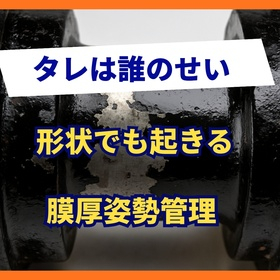
The sauce is generated not only by the skill of the operator but also by three conditions: film thickness, viscosity, and component posture.
Dripping defects are visual defects where the paint flows and leaves streaks. At customer sites, this can become an issue not only in terms of appearance but also as dimensional defects around holes and fitting areas. The cause is not solely the way the operator applies the paint. When three conditions—film thickness, viscosity, and component orientation—overlap, the paint tends to accumulate in one spot. Areas such as corners, downward surfaces, and around holes are particularly prone to dripping. Initially, we check the location of the drips, the direction of painting, how the jig is applied, and the drying time. Countermeasures include determining the discharge amount, gun distance, viscosity, jig orientation, and holding time before drying for each component. By documenting the locations of occurrence with photos or records, we can reflect on which shapes are prone to dripping in future productions. Reducing drips also helps prevent issues like hole filling and film thickness defects. Please utilize verification materials for reviewing painting conditions. Instead of stopping at operator training, reflecting the prone positions for dripping in standard documents for each component will make it easier to prevent recurrence in the next lot.
Inquire About This Product
Related Videos
basic information
Dripping measures, excessive film thickness, paint viscosity, jig posture, appearance defects, metal coating.
Price range
Delivery Time
Applications/Examples of results
Improvement of defects in automotive parts, construction hardware, industrial machinery, and metal products, as well as film thickness management.
catalog(3)
Download All Catalogs
Company information

We are not just a "subcontracted painting factory." Established in 1958, our company has a foundation of painting technology and also specializes in chemical treatment, stripping, and cleaning, functioning as the "external surface treatment department" in your organizational chart. Based on our philosophy of "preparation is eight-tenths of the work," we emphasize participation from the "upstream process" before the drawings are finalized. We conduct test painting on a wide range of metals and difficult materials, and we produce the entire process from assembly, packaging, to delivery, thereby reducing your management workload. Additionally, by being able to perform zinc phosphate treatment in-house, we achieve stable painting quality. Furthermore, our micro-heating stripping technology, which does not use chemicals, maintains the electrical state of the "jigs (hangers)" that influence painting quality. Our approach of "pre-treatment determines painting quality" ensures the stability of the paint film during mass production. Rather than simply "applying specified standards," we work backwards to achieve optimal painting specifications and prevent scratches during transportation, sparing no effort in thorough discussions from the outset. This diligent preparation is the shortest path to preventing rework and minimizing total costs. From the development stage, please utilize the expertise of our specialists as part of your production line.