Paint adhesion to the screw parts or contact points can lead to assembly defects or electrical conduction issues, even if it occurs in just one location.
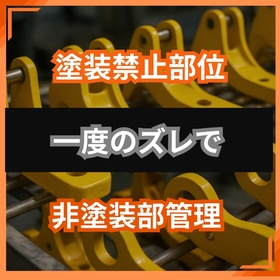
Masking defects are failures where paint adheres to areas that should not be painted. Areas such as screw parts, contact points, fitting parts, grounding parts, and drainage holes can cause the customer's assembly process to stop even with just one instance of adhesion. Even if it appears as a small overflow visually, it directly leads to functional defects such as screws not fitting, lack of electrical conductivity, or parts not fitting together. Initially, we check the drawing instructions for unpainted areas, the position of masking materials, any lifting, and the number of times they can be reused. The countermeasures involve standardizing four points: masking range, materials used, application procedures, and inspection methods. Additionally, separating pre-work checks from post-painting checks makes it easier to identify forgotten areas, lifting, and misalignment. When reusing masking materials, it is also necessary to check for deterioration and loss of adhesive strength. Please utilize check materials for managing unpainted areas. Since issues with unpainted areas often arise in later processes, having a system to verify them as functional parts before shipment is effective.
Inquire About This Product
Related Videos
basic information
Countermeasures for masking defects, management of unpainted areas, protection of screw parts, protection of contact areas, metal painting.
Price range
Delivery Time
Applications/Examples of results
Improvement of masking defects in automotive parts, construction hardware, industrial machinery, and metal products, and prevention of assembly defects.
catalog(3)
Download All Catalogs
Company information

We are not just a "subcontracted painting factory." Established in 1958, our company has a foundation of painting technology and also specializes in chemical treatment, stripping, and cleaning, functioning as the "external surface treatment department" in your organizational chart. Based on our philosophy of "preparation is eight-tenths of the work," we emphasize participation from the "upstream process" before the drawings are finalized. We conduct test painting on a wide range of metals and difficult materials, and we produce the entire process from assembly, packaging, to delivery, thereby reducing your management workload. Additionally, by being able to perform zinc phosphate treatment in-house, we achieve stable painting quality. Furthermore, our micro-heating stripping technology, which does not use chemicals, maintains the electrical state of the "jigs (hangers)" that influence painting quality. Our approach of "pre-treatment determines painting quality" ensures the stability of the paint film during mass production. Rather than simply "applying specified standards," we work backwards to achieve optimal painting specifications and prevent scratches during transportation, sparing no effort in thorough discussions from the outset. This diligent preparation is the shortest path to preventing rework and minimizing total costs. From the development stage, please utilize the expertise of our specialists as part of your production line.