Tohoku Univ. Technology:FPGA-Based Highly Parallel Architecture:T25-012

Enabling real-time autonomous control for mobile agents in dynamic environments
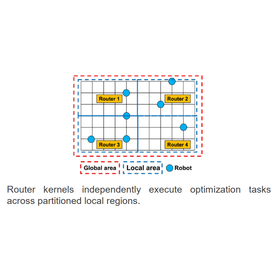
Japan faces a severe driver shortage, with 36% of logistics demand potentially stagnating by 2030. While AGVs are a key solution, conventional path planning faces computational bottlenecks and high costs for proximity sensors. This technology implements a proprietary NoC-inspired architecture on FPGA, replacing "global batch computation" with "highly parallel local region processing." By dividing the domain into areas managed by router kernels, the system emulates agent movements significantly faster than real-time. This allows pre-emptive collision and deadlock detection, enabling safe, low-cost, real-time autonomous control in large-scale environments with minimal sensor dependency.
Inquire About This Product
basic information
For details, please contact us or refer to the PDF.
Price range
Delivery Time
Applications/Examples of results
For details, please contact us or refer to the PDF.
catalog(1)
Download All Catalogs
Company information

The revenue generated from technology transfer is reinvested into universities and researchers as new research funding, which is used to create further research outcomes. To ensure the smooth operation of this cycle, known as the "Intellectual Creation Cycle," we will actively promote technology transfer. The types of seeds we handle include patents, know-how, databases, and programs. We have established a collaborative framework by concluding basic technology transfer agreements with the following universities (as of April 1, 2026): - Tohoku University - Hirosaki University - Iwate University - Akita University - Fukushima University - Yamagata University - Tohoku Gakuin University - Iwate Medical University - Fukushima Medical University - Aizu University - Miyagi University - Hokkaido University - Muroran Institute of Technology - Showa Medical University - Asahikawa Medical University