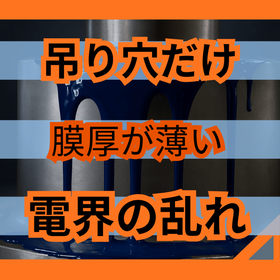
What is the cause of the thin area around the hole? Static electricity and film thickness distribution.

The film thickness gauge is acceptable, but the coating is thin only around the hanging hole. I will explain the relationship between the escape path of static electricity and posture.
The film thickness inspection passes, but the area around the hanging hole is discolored. Changing the measurement location results in different numbers. ────────────── ■Cause of Occurrence In electrostatic painting, the charge concentrates at the hanging points where electricity flows most easily. The surrounding electric field becomes disturbed, making it difficult for the paint to adhere. ■Truth The area around the hanging hole may have only about half the film thickness of the flat surface. Since the film thickness gauge measures the center of the flat surface, this deficiency passes the inspection. Rust begins in the thin areas and leads to complaints a few months later. ■Improvement Measures Move the hanging position away from the visible surface and, if possible, shift it towards the waste hole side. Change the posture to apply the paint in two separate applications or partially add more paint. Please utilize the materials on hanging methods and film thickness distribution.
Inquire About This Product
Related Videos
basic information
Corresponding construction method: Powder coating, solvent baked coating / Film thickness: Flat 20-40 microns / Measurement: Multiple point measurement near flat areas and suspension points / Jig: Custom hanger production for each product / Maximum supported dimensions: 2000mm
Price range
Delivery Time
Applications/Examples of results
General components for hanging painting, such as sheet metal covers, industrial machine parts, building materials, and exterior materials. We have a track record of reviewing the hanging position and posture as a countermeasure against rust formation around the hanging holes.
catalog(1)
Download All Catalogs
Company information

We are not just a "subcontracted painting factory." Established in 1958, our company has a foundation of painting technology and also specializes in chemical treatment, stripping, and cleaning, functioning as the "external surface treatment department" in your organizational chart. Based on our philosophy of "preparation is eight-tenths of the work," we emphasize participation from the "upstream process" before the drawings are finalized. We conduct test painting on a wide range of metals and difficult materials, and we produce the entire process from assembly, packaging, to delivery, thereby reducing your management workload. Additionally, by being able to perform zinc phosphate treatment in-house, we achieve stable painting quality. Furthermore, our micro-heating stripping technology, which does not use chemicals, maintains the electrical state of the "jigs (hangers)" that influence painting quality. Our approach of "pre-treatment determines painting quality" ensures the stability of the paint film during mass production. Rather than simply "applying specified standards," we work backwards to achieve optimal painting specifications and prevent scratches during transportation, sparing no effort in thorough discussions from the outset. This diligent preparation is the shortest path to preventing rework and minimizing total costs. From the development stage, please utilize the expertise of our specialists as part of your production line.