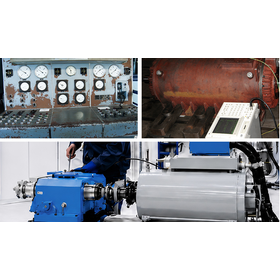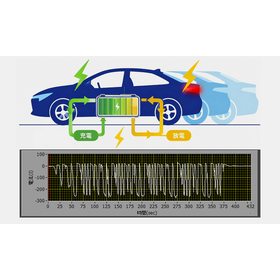
Moving away from engine testing, reproducing vehicle launch behavior on a test stand.
The company introducing this case study is a major automotive OEM with a presence overseas. This company is engaged in durability and performance testing that replicates the behavior during actual vehicle operation in the department responsible for the development and evaluation of drive system components such as auxiliary devices and belts around the engine. They faced challenges in reproducing the load behavior that occurs during vehicle launch when evaluating drive system components like auxiliary devices and belts around the engine. The crankshaft experiences periodic fluctuations in speed and torque due to the combustion motion of the piston. Particularly during vehicle launch, these fluctuations are significant, placing a heavy load on the belts and auxiliary components. However, traditional testing environments have been limited to constant-speed rotation or controlled patterns, making it difficult to adequately replicate such unsteady rotational behavior. Seagull Co., Ltd. proposed an extension of control functions through software modifications to establish a test environment that can replicate the evaluation of drive system components like auxiliary devices and belts, which had relied on engine-based testing. The core of this proposal is a control technology that utilizes rotation data from the crankshaft obtained during actual vehicle operation, including the unsteady speed fluctuations that occur during vehicle launch.
Inquire About This Product
basic information
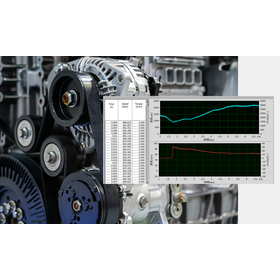
First, we obtained the crankshaft rotation data at vehicle start-up, which was collected from the actual vehicle as time-series data in formats such as CSV. Our company imports this measured data into testing software and converts it into speed command data that can be reproduced in bench tests. Specifically, the imported data is transformed into data with millisecond time resolution by the CPU and FPGA within the embedded controller, allowing for the reproduction of sharp speed fluctuations that occur during vehicle start-up. The converted data is sequentially sent to the inverter at millisecond intervals by the embedded controller equipped with a CPU and FPGA. Based on these command values, the inverter controls the motor's speed, thereby reproducing the crankshaft's rotational behavior on the test bench. This enables the reproduction of non-steady behaviors during vehicle start-up, which could not be achieved with conventional constant speed or simplified patterns, in a manner close to that of the actual vehicle. Furthermore, sensors attached to the crankshaft and auxiliary components/belts collect data on speed, torque, angular acceleration, and more. This data is sent to a PC, and by consistently handling everything from visualization on the HMI to report generation, we have achieved greater efficiency in the evaluation and analysis process.
Price range
Delivery Time
Applications/Examples of results
In this case, we have established an environment that allows for repeated durability testing under conditions close to those of actual vehicles. The reproducibility of evaluations for drive system components such as belts and auxiliary equipment has greatly improved, making it possible to efficiently conduct long-term durability tests on the order of thousands or tens of thousands of cycles. Previously, tests required the use of standalone engines extracted from actual vehicles, which imposed significant burdens in terms of fuel consumption due to firing, preparation of specialized equipment, and safety management. With the introduction of this system, we have moved away from engine-dependent testing to fuel-free bench testing, achieving both "cost reduction" and "improved safety" simultaneously. Furthermore, traditional tests using engines required constant monitoring for safety reasons. However, the transition to bench testing has enabled unmanned operation, allowing for long-duration continuous testing.
Detailed information
-
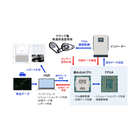
First, we obtained the crankshaft rotation data at vehicle start-up, collected from the actual vehicle, as time-series data in formats such as CSV. Our company imports this measured data into testing software and converts it into speed command data that can be reproduced in bench tests. Specifically, the imported data is converted into data with millisecond time resolution by the CPU and FPGA within the embedded controller, allowing for the reproduction of sharp speed fluctuations that occur during vehicle start-up. The converted data is sequentially sent to the inverter at millisecond intervals by the embedded controller equipped with a CPU and FPGA. The inverter controls the motor's speed based on these command values, thereby reproducing the crankshaft's rotational behavior on the bench. This enables the reproduction of non-steady behaviors during vehicle start-up, which could not be achieved with traditional constant speed or simplified patterns, in a manner close to that of the actual vehicle. Furthermore, sensors attached to the crankshaft and auxiliary components/belts collect data on speed, torque, angular acceleration, and more. This data is sent to a PC, and by consistently handling everything from visualization on the HMI to report generation, we have achieved greater efficiency in the evaluation and analysis process.
Company information

Our company is engaged in measurement and control applications, test simulation proposals, replacement and functional enhancement of test equipment and measurement, and the provision of original hardware. With the mission of "making the world simpler and better" through software and electronics technology, we create value through technological development and will continue to contribute sustainably to various industrial fields. Please feel free to contact us when you need our services.