
Solving the dependency of EV battery charge and discharge tests on real vehicles through the reproduction of charge and discharge currents.
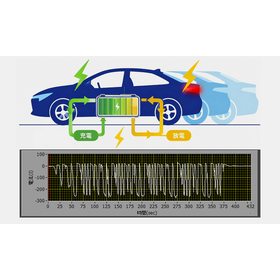
The company introducing this case study is a manufacturer developing electric vehicles (EVs) in Japan. They are engaged in various testing and evaluation tasks daily to assess the performance and durability of lithium-ion batteries installed in their vehicles. To evaluate battery behavior in the actual operating environment of electric vehicles, they required tests that replicate the fluctuations of charge and discharge associated with acceleration and deceleration during driving. Particularly for EVs, the discharge during acceleration and regenerative charging during deceleration occur repeatedly in a short time, making it essential to reproduce and repeatedly evaluate such dynamic charge and discharge behaviors. However, traditionally, reproducing these behaviors relied on driving tests using actual vehicles, which required significant labor and costs for driving on test courses, vehicle preparation, installation of measurement equipment, and securing test drivers and measurement personnel. Seagull Co., Ltd. proposed software modifications to existing testing facilities to create a testing environment capable of reproducing battery evaluations that were previously dependent on actual vehicle operation. The core of this approach is a control technology that utilizes charge and discharge current data measured during actual driving to faithfully reproduce the time axis with high resolution.
Inquire About This Product
basic information
First, we obtain the battery charge and discharge current waveform data that changes according to the driving conditions, such as discharge during acceleration and regenerative charging during deceleration, in a time-series format like CSV, collected during actual vehicle operation. Our company imports this measured waveform data into testing software and converts it into control data that can be reproduced in standalone battery tests. Specifically, the current data is converted on the controller side into data with millisecond time resolution, allowing for the reproduction of rapid current fluctuations and fine load changes that occur during actual vehicle operation. The converted data is sent to an embedded controller equipped with a CPU and FPGA, where it is processed sequentially at millisecond intervals. The controller outputs this data as command values for charge and discharge to the battery tester in real-time, and the tester applies current to the test subject, which is a lithium-ion battery, based on those commands. This allows the battery to repeatedly charge and discharge in response to current changes at millisecond intervals, thereby reproducing the same current behavior as during actual vehicle operation.
Price range
Delivery Time
Applications/Examples of results
This initiative has made it possible to conduct battery charge and discharge tests, which previously relied on actual vehicle operation, in an environment where only the battery is used. As a result, preparations such as swapping batteries in vehicles, securing test courses, and arranging test drivers and measurement personnel are no longer necessary, significantly reducing the labor and costs associated with testing. Furthermore, since tests of charge and discharge current behavior under the same conditions can be repeatedly executed, continuous testing and comparative verification, which were previously difficult, have become easier, greatly improving the reproducibility and reliability of evaluations.
Detailed information
-
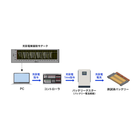
At Sea Goat Co., Ltd., we proposed software modifications to existing testing equipment to create a test environment that can reproduce battery evaluations previously reliant on actual vehicle operation. The core of this approach is a control technology that utilizes charge and discharge current data measured during real driving to faithfully reproduce the time axis with high resolution. First, we acquire the charge and discharge current waveform data of the battery, which varies according to driving conditions such as discharge during acceleration and regenerative charging during deceleration, in a time-series format like CSV from the data collected by the customer during actual vehicle operation. Our company incorporates this measured waveform data into testing software and converts it into control data that can be reproduced in standalone battery tests. Specifically, the current data is converted on the controller side into data with millisecond-level time resolution, allowing us to replicate rapid current fluctuations and subtle load changes that occur during actual vehicle operation. The converted data is then transmitted to an embedded controller equipped with a CPU and FPGA, where it is processed sequentially at millisecond intervals.
Company information

Our company is engaged in measurement and control applications, test simulation proposals, replacement and functional enhancement of test equipment and measurement, and the provision of original hardware. With the mission of "making the world simpler and better" through software and electronics technology, we create value through technological development and will continue to contribute sustainably to various industrial fields. Please feel free to contact us when you need our services.
![[Case Study] Backup Battery Charge and Discharge Testing System](https://image.mono.ipros.com/public/product/image/8f8/2001110780/IPROS46270011733042675464.png?w=280&h=280)