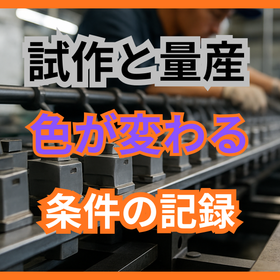
The color approved in the prototype changes in mass production. I will explain the specific methods for transferring conditions from prototype to mass production.
The color approved during the prototype has changed in mass production. Even though the paint is the same, the conditions have not been carried over. ────────────── ■ Cause of Occurrence The application method changes from hand spraying in the prototype to automatic in mass production. If the application method changes, the film thickness changes, and if the film thickness changes, the color also changes. ■ Truth In the prototype, the paint is applied carefully over a longer period, resulting in a thicker film. In mass production, the speed increases, and even with the same settings, it becomes a few microns thinner. Light colors and metallics can change in appearance with this few microns. ■ Improvement Measures Record the film thickness and curing conditions numerically during the prototype phase and pass them directly to mass production. Choosing a company that can perform both prototypes and mass production on the same equipment prevents discrepancies. Eiwa Kogei handles everything from a single prototype to mass production on the same line.
Inquire About This Product
Related Videos
basic information
Corresponding lot: From prototype of 1 piece to mass production / Equipment: Handling both prototype and mass production on the same line / Records: Process records of film thickness, curing temperature, and curing time / Color management: Color sample matching, color difference measurement / Film thickness: 20-40 microns
Price range
Delivery Time
Applications/Examples of results
Transitioning from prototype production of new parts to mass production, reproducing approved colors, and providing consistent contract services for small-scale prototypes and mass production. We record the film thickness and curing conditions during prototyping and pass them on to mass production.
catalog(3)
Download All Catalogs
Company information

We are not just a "subcontracted painting factory." Established in 1958, our company has a foundation of painting technology and also specializes in chemical treatment, stripping, and cleaning, functioning as the "external surface treatment department" in your organizational chart. Based on our philosophy of "preparation is eight-tenths of the work," we emphasize participation from the "upstream process" before the drawings are finalized. We conduct test painting on a wide range of metals and difficult materials, and we produce the entire process from assembly, packaging, to delivery, thereby reducing your management workload. Additionally, by being able to perform zinc phosphate treatment in-house, we achieve stable painting quality. Furthermore, our micro-heating stripping technology, which does not use chemicals, maintains the electrical state of the "jigs (hangers)" that influence painting quality. Our approach of "pre-treatment determines painting quality" ensures the stability of the paint film during mass production. Rather than simply "applying specified standards," we work backwards to achieve optimal painting specifications and prevent scratches during transportation, sparing no effort in thorough discussions from the outset. This diligent preparation is the shortest path to preventing rework and minimizing total costs. From the development stage, please utilize the expertise of our specialists as part of your production line.