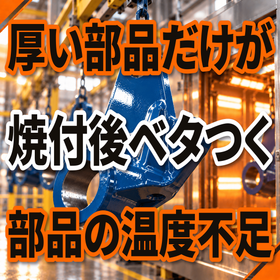
Thin parts are fine, but thick parts remain sticky even after baking. The cause is not the furnace temperature, but how the parts themselves heat up.
Even though they were baked in the same furnace, only the thick parts have a sticky surface. The furnace thermometer shows the usual numbers. 【First, please look here】 □ Only the thick parts and castings are sticky → The baking time has ended before the parts have fully warmed up □ Only the back side or the inside of the parts are sticky → They are not exposed to hot air and the temperature has not risen □ Only the parts close to the entrance of the furnace are sticky → There are temperature variations in different locations within the furnace 【Why does this happen】 The curing of the paint is determined by the surface temperature of the parts, not the temperature of the furnace. Thick parts take longer to warm up because they retain heat. 【Countermeasures you can take starting today】 1. Attach temperature recorders to the parts to measure the actual temperature 2. For thick parts, extend the baking time or bake them in a separate batch 3. Record the temperature for each location within the furnace 【Free materials】 You can download a guide summarizing how to identify and address painting troubles for free from the related catalog on this page. Eiwa Kogei handles baking paint for all types of metals, including iron, aluminum, and zinc die casting.
Inquire About This Product
Related Videos
basic information
Defect type: Poor hardening (stickiness). Management items: Surface temperature of parts, curing time, temperature distribution in the furnace, record of placement location.
Price range
Delivery Time
Applications/Examples of results
Powder coating of thick metal parts such as castings, thick plates, and brackets. Review of curing conditions by the quality control department, temperature management of the furnace, and training materials for new employees.
catalog(1)
Download All Catalogs
Company information

We are not just a "subcontracted painting factory." Established in 1958, our company has a foundation of painting technology and also specializes in chemical treatment, stripping, and cleaning, functioning as the "external surface treatment department" in your organizational chart. Based on our philosophy of "preparation is eight-tenths of the work," we emphasize participation from the "upstream process" before the drawings are finalized. We conduct test painting on a wide range of metals and difficult materials, and we produce the entire process from assembly, packaging, to delivery, thereby reducing your management workload. Additionally, by being able to perform zinc phosphate treatment in-house, we achieve stable painting quality. Furthermore, our micro-heating stripping technology, which does not use chemicals, maintains the electrical state of the "jigs (hangers)" that influence painting quality. Our approach of "pre-treatment determines painting quality" ensures the stability of the paint film during mass production. Rather than simply "applying specified standards," we work backwards to achieve optimal painting specifications and prevent scratches during transportation, sparing no effort in thorough discussions from the outset. This diligent preparation is the shortest path to preventing rework and minimizing total costs. From the development stage, please utilize the expertise of our specialists as part of your production line.