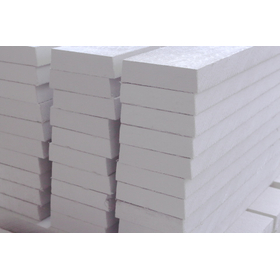
High-performance microporous insulation material for high-temperature equipment that achieves a slim design and high thermal insulation.

To sites where increasing insulation thickness does not allow for space-saving! By suppressing thermal conductivity with a fine pore structure, we achieve both thinness and energy savings, reducing heat loss from high-temperature equipment!
Do you have any of these concerns? - You want to increase the thickness of insulation, but the internal space of the equipment is limited and cannot accommodate it. - Heat is escaping from industrial furnaces and heat treatment equipment, leading to rising energy costs. - Every time you stop the furnace for insulation replacement or repair, it disrupts the production schedule. Microporous insulation material fundamentally solves these issues. ◇ Extremely low thermal conductivity: Its structure with fine pores suppresses convection and gas conduction. It achieves a low thermal conductivity of 0.019 W/(m·K) at room temperature, contributing to reduced heat loss. ◇ Thin and space-saving design: It can achieve high insulation performance with a thinner composition than conventional insulation materials, effectively utilizing the limited internal space of the equipment. ◇ Suitable for high-temperature equipment: Available in board type, high-temperature specifications, and flexible types. The heat resistance temperature is around 1,000°C depending on the specifications, making it suitable for industrial furnaces, heat treatment equipment, and high-temperature piping. This high-performance insulation material helps reduce heat loss and promote energy savings while also enabling the thinning and miniaturization of equipment. We are currently offering a free catalog that details product specifications and selection and processing according to applications. Download it now to check it out!
Inquire About This Product
basic information
Microporous insulation materials are high-performance insulators with a fine porous structure that binds fine particles such as amorphous silica (silicon dioxide). The internal nano-level fine pores restrict the movement of air molecules, suppressing heat transfer due to convection and gas conduction. Typical physical property values are thermal conductivity of 0.019 W/(m·K) (at room temperature), 0.021 W/(m·K) (average temperature of 200°C), and 0.03 W/(m·K) (average temperature of 600°C). The density is 0.23 g/cm³ for board type and 0.3 g/cm³ for flex type. The heat resistance temperature is 950°C for board type, 1,050°C for high-temperature specification board type, and 1,100°C for flex type. The shrinkage rate is 0.5% (one side, 1,000°C × 12 hours), with a compressive strength of 1.1 N/mm² and a bending strength of 0.16 N/mm². The shapes available include board type, flex type, and slat type, and coating treatments can be applied according to the application. Note that the above values are representative and not guaranteed. In actual selection, factors such as operating temperature, required insulation performance, thickness, presence of moisture, and construction methods must be considered. Microporous insulation materials are susceptible to moisture, so water-repellent and moisture-proof measures tailored to the usage environment are also important.
Price range
Delivery Time
Applications/Examples of results
Microporous insulation materials are suitable for processes that want to minimize internal space while ensuring insulation performance, as well as for sites that aim to reduce heat loss from high-temperature equipment for energy conservation. They are primarily used for insulation applications in heat treatment equipment and devices exceeding temperatures of 500°C to 1,000°C, such as industrial furnaces, electric furnaces, heat treatment furnaces, heating devices, and high-temperature piping. They are particularly effective for challenges such as "making insulation thicker would not fit in the equipment," "wanting to make effective use of furnace space," "reducing heat radiation to the outside to minimize energy loss," and "advancing the miniaturization and thinness of equipment." Additionally, they are being considered for use in equipment like semiconductor manufacturing devices, where temperature management is required in limited spaces. In addition to board and flexible types, they also accommodate coating treatments. Miyahara Industries supports material selection based on applications, temperatures, dimensions, and construction conditions, as well as precision processing such as cutting, small lot production, and prototypes.
catalog(1)
Download All Catalogs
Company information

As environmental destruction progresses on a global scale, in order to build a future society, we must effectively utilize limited resources and continue to create products that are friendly to both people and the environment. In particular, while fire-resistant and heat-resistant materials are influenced by their usage environment, they need to be replaced regularly, and the old ones become industrial waste. We aim to create products that are as reusable as possible. Miyahara Industries will continue to be an expert company in fire-resistant and heat-resistant materials across all industries, consistently providing high-quality products with consideration for the environment.