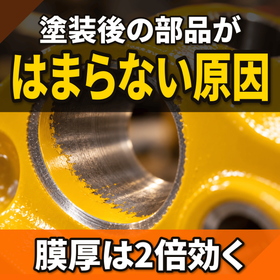
After painting, the pin does not fit into the hole and does not fit into the corresponding part. The cause is the thickness of the paint film. This explains the masking and film thickness that should be specified in the drawings.
Before painting, there were no issues, but after painting, the parts do not fit. Did you notice this for the first time on the assembly line and are you in a hurry? 【First, please check here】 □ Pins or bolts do not fit into the holes → The inner sides of the holes have paint film, reducing the diameter □ Only the fitting surfaces are tight → The fitting areas were not masked □ Depending on the lot, some fit and some do not → There is a large variation in film thickness 【Why does this happen?】 The diameter of the holes becomes smaller by twice the thickness of the paint film. Even a slight thickness can affect parts where fitting precision is critical. 【Countermeasures you can implement starting today】 1. Indicate the masking surfaces and holes on the drawings 2. Specify the upper limit of film thickness with numbers 3. Confirm the fit with actual parts in the first lot 【Free materials】 We have compiled the management standards for film thickness and masking in the related catalog "Eiwa Kogei_Paint Quality Control Guidelines_Process Management Standards." You can download it for free from this page.
Inquire About This Product
Related Videos
basic information
Defect target: Poor fit. Management items: Masking range, upper limit of film thickness, variation in hole diameter (twice the film thickness), confirmation of the actual product for the initial lot.
Price range
Delivery Time
Applications/Examples of results
Painting of machine parts with fits and threaded sections, brackets, and frames. Coordination of drawing instructions from the design department and external specifications with purchasing and sales representatives.
catalog(1)
Download All Catalogs
Company information

We are not just a "subcontracted painting factory." Established in 1958, our company has a foundation of painting technology and also specializes in chemical treatment, stripping, and cleaning, functioning as the "external surface treatment department" in your organizational chart. Based on our philosophy of "preparation is eight-tenths of the work," we emphasize participation from the "upstream process" before the drawings are finalized. We conduct test painting on a wide range of metals and difficult materials, and we produce the entire process from assembly, packaging, to delivery, thereby reducing your management workload. Additionally, by being able to perform zinc phosphate treatment in-house, we achieve stable painting quality. Furthermore, our micro-heating stripping technology, which does not use chemicals, maintains the electrical state of the "jigs (hangers)" that influence painting quality. Our approach of "pre-treatment determines painting quality" ensures the stability of the paint film during mass production. Rather than simply "applying specified standards," we work backwards to achieve optimal painting specifications and prevent scratches during transportation, sparing no effort in thorough discussions from the outset. This diligent preparation is the shortest path to preventing rework and minimizing total costs. From the development stage, please utilize the expertise of our specialists as part of your production line.