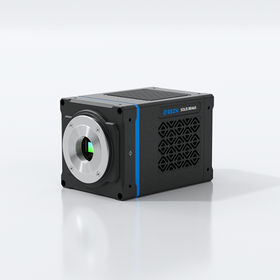
Capture weak fluorescence with high sensitivity and low noise. Supports plant cell observation with reduced light exposure.
I want to capture the weak fluorescence of plant cells. I want to minimize the burden on the sample from the excitation light. The "Solis-B0465" from SinceVision is a back-illuminated sCMOS camera that meets these observation needs. ■ Efficient detection of weak fluorescence Equipped with a sensor that has a quantum efficiency of 95% (560nm). It captures weak fluorescence signals and supports observation with reduced excitation light. ■ Observe details with low noise Readout noise of 1.1e⁻ (median). Suitable for capturing weak signals. ■ Reduced dark current through cooling Adopts multi-stage TEC cooling and vacuum-sealed structure. It suppresses dark current during long exposures, supporting fluorescence imaging of plant cells. Please contact us regarding connection to microscopes and shooting conditions.
Inquire About This Product
basic information
Model: Solis-B0465 Sensor: Back-illuminated sCMOS / Monochrome Resolution: 2048 × 2048 pixels Pixel Size: 6.5 μm Quantum Efficiency: 95% (560 nm) Readout Noise: 1.1 e⁻ (median) Full Well Capacity: 45,000 e⁻ Exposure Time: 7.2 μs to 60 s Bit Depth: 11 / 12 / 16 bit ROI: Supported *Please verify the conditions for each specification individually.
Price range
Delivery Time
Applications/Examples of results
【Applications】 - Fluorescence imaging of plant cells - Observation of weak fluorescence signals - Observation of living cells with reduced burden from excitation light - Low-light imaging using long exposure 【Examples of Fluorescence Observation in Plant Cells】 In plant cells, autofluorescence from structures like chloroplasts can create background signals, making it difficult to observe weak fluorescence. In this case, the Solis-B0465 equipped with a back-illuminated sensor was used. By leveraging its high detection sensitivity, low readout noise, and reduced dark current through cooling, fluorescence imaging of plant cells was performed. Below are examples of attachment to a microscope and fluorescence observation images.
Detailed information
-
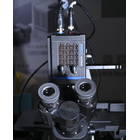
Example of Attachment to Microscope Installation example of Solis-B0465 used for fluorescent observation of plant cells. It is combined with a microscope to capture weak fluorescent signals.
-
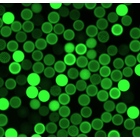
Example 1 of Fluorescent Imaging of Plant Cells Fluorescent observation image using Solis-B0465. It visualizes the shape of the sample and the distribution of fluorescence. *The color representation in the published image does not indicate that the camera has a color sensor.
-
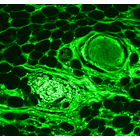
Example 2 of Fluorescent Imaging of Plant Cells Fluorescent observation image of plant samples. You can confirm the distribution of fluorescence along the cellular and tissue structures. *Observation results may vary depending on the sample, optical system, lighting, and shooting conditions.
Company information

SinceVision, established in 2014, is a manufacturer that provides industrial sensing and imaging technologies. We engage in research, development, manufacturing, and sales of industrial sensors, high-speed imaging systems, and high-sensitivity cameras. Our main products include 3D laser profilers, high-speed cameras, laser displacement sensors, spectral confocal displacement sensors, color sensors, transmission edge sensors, and sCMOS cameras. Our products are utilized in a wide range of fields, including automotive, lithium-ion batteries, semiconductors, electronics, solar power generation, and scientific research. Our technologies are employed in manufacturing sites around the world, including companies like Apple, Tesla, Samsung, LG, CATL, BYD, and Foxconn. Additionally, as a supporting member of the Japan Industrial Imaging Association (JIIA), we are also involved in the development and standardization activities in the field of industrial imaging and machine vision. Through high-precision measurement and inspection technologies, we contribute to improving product quality, automating inspection processes, enhancing production efficiency, and reducing costs.