World MLCC Screen Printing Mesh Industry Outlook 2026-2032: Analyzing the Background of Increased Demand and a Growth Rate of 6.5%
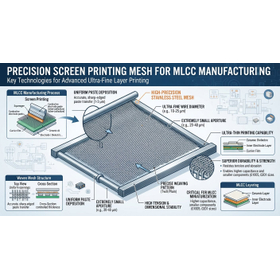
Screen printing mesh for MLCC refers to a high-precision mesh material used in the manufacturing process of multilayer ceramic capacitors (MLCC) to transfer electrode paste and ceramic paste onto a specified pattern. It is used for printing internal electrodes, external electrodes, and some functional layers, with uniformity of opening dimensions, tension, dimensional stability, and wear resistance affecting print quality. According to the latest research report published by Global Reports titled "Global Market Size, Share, Company Rankings, Sales, and Demand Trend Forecast for Screen Printing Mesh for MLCC (2026-2032)," the global market is expected to expand from 56.63 million USD in 2025 to 62.98 million USD in 2026, growing at a compound annual growth rate (CAGR) of 6.5% from 2026 to 2032, and is projected to reach 916.9 million USD by 2032. The global production volume in 2025 is estimated to be approximately 343,000 square meters, with an average market price of about 165 USD per square meter.
Inquire About This Product
basic information
High Precision and Material Properties of Screen Printing Mesh for MLCCs With the miniaturization, high capacitance, thinning of dielectric layers, and increase in the number of layers of MLCCs, there is a demand for technology that can form internal electrodes with finer line widths and thinner paste layers with high reproducibility. As a result, high precision meshes exceeding 500 mesh, particularly those exceeding 700 mesh, are becoming increasingly important for advanced products. The main materials include stainless steel, nickel-based alloys, and polyester, with stainless steel mesh being central for high-end MLCCs due to its ability to balance fine openings and strength. Variations in wire diameter, uneven opening shapes, fluctuations in tension, and adhesion of foreign substances can lead to defects in electrode patterns and reduced printing yields, making precise management of material design and manufacturing processes essential.
Price range
Delivery Time
Applications/Examples of results
Manufacturing Process and Technical Barriers of Screen Printing Mesh for MLCCs Upstream in the supply chain are stainless steel wire, nickel wire, polyester monofilament, special alloys, precision weaving machines, surface treatment materials, and materials for plate making and stretching. Midstream, mesh manufacturers ensure product quality through the production of ultra-fine wires, precision weaving, cleaning, heat treatment, surface treatment, tension adjustment, and defect inspection. Downstream, the mesh is processed into screen plates and used for printing nickel paste, copper paste, silver paste, and ceramic-based pastes. As mesh density increases, it becomes difficult to maintain the opening rate and paste permeability, and even slight changes in tension or dimensions can affect printing accuracy. Whether it is possible to achieve both miniaturization and stable mass production becomes a major technical barrier.
Company information

Global Reports integrates industrial information from around the world and provides highly accurate market intelligence to support corporate decision-making. We deliver in-depth analyses based on numerical data and facts, including market size, share, industry structure, price trends, growth forecasts, rankings of major companies, and competitive trends, with clear information categorized by country, region, and application. Leveraging a rich database that has supported the business growth of over 65,000 companies and an international research network, we accompany our clients in their global expansion and continuous growth.