Whether to expose the cooling water to the outside air or to confine it within the pipes. If the evaporating water is different, the places where contamination and concentration occur will also change.
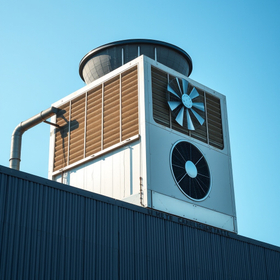
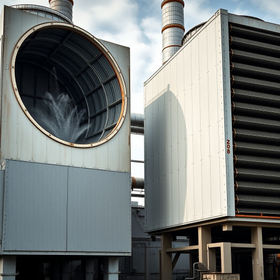
Cooling towers are devices that cool water, which has absorbed heat from equipment such as air conditioning chillers, using outside air and then return it to the equipment. They can be classified into open and closed types based on the method of cooling. The main difference between the two is whether the cooling water circulating through the equipment comes into direct contact with outside air. Therefore, the open type is also referred to as "direct contact," while the closed type is called "indirect." ■ Does the open type evaporate the cooling water itself? In the open type, cooling water is allowed to flow down from the top, coming into direct contact with outside air. When a portion of the cooling water evaporates, it absorbs heat, cooling the remaining water. ■ Does the closed type evaporate water outside the pipes? In the closed type, the cooling water flows inside the pipes of a heat exchanger and does not come into contact with outside air. When another water (spray water) is sprayed on the outside of the pipes and exposed to outside air, the spray water evaporates, absorbing heat from the cooling water inside through the pipe walls. ■ Both use evaporation The closed type also utilizes the power of evaporation, just like the open type. The difference lies in whether the evaporating water is the cooling water circulating through the equipment or the separately prepared spray water. Please feel free to consult us first.
Inquire About This Product
basic information
■Why is open cooling water prone to contamination? In an open system, the cooling water is exposed to the outside air, allowing dust and gases in the air to dissolve into the cooling water. Additionally, factors such as sunlight, oxygen supply, exposure to the atmosphere, and the concentration of organic matter due to evaporation create an environment conducive to the growth of microorganisms and algae, including Legionella bacteria. ■Which water becomes more concentrated?! The water lost through evaporation contains very few dissolved components, so the remaining water becomes concentrated with those components, making it more susceptible to scale buildup and corrosion. Therefore, a portion of the concentrated water is discharged (blown down), and the amount lost through evaporation, blowdown, drift, and leakage is replenished with makeup water. In a closed system, the water that evaporates is the spray water, so the concentration of components also progresses on the spray water side. ■What are the differences in size and cost? A closed system cools indirectly through the walls of pipes, which tends to make the tower larger and more expensive compared to an open system. On the other hand, the cooling water is less prone to contamination, reducing maintenance burdens. Conversely, an open system has higher cooling efficiency and simpler structure, making it easier to keep the tower small and inexpensive.
Price range
Delivery Time
Applications/Examples of results
■If it's a closed system, is water management unnecessary?! That is not the case. In the United States, both open and closed systems are treated as equipment that releases air containing water droplets into the atmosphere, and the basic operating and maintenance procedures are the same. ■Legionella prevention is necessary for both Even in a closed system, the spray water evaporates while being exposed to outside air, and the dissolved components become more concentrated. Conditions such as sunlight, oxygen supply, and organic matter concentration are the same as for cooling water, making the spray water an environment conducive to microbial growth. Therefore, managing the water quality of the spray water is also essential. In the United States, it is required to automatically monitor and adjust the residual concentration of disinfectants. ■Guidelines for choosing between the two Closed systems are adopted for equipment that dislikes dirty cooling water. On the other hand, if you want to minimize installation space and costs, an open system becomes a candidate. 1. Is it equipment that dislikes dirty cooling water? 2. The size of the installation space and equipment costs 3. Can you continue to treat the evaporating water (cooling water or spray water)? Our company offers consultations on water treatment for cooling water and spray water, as well as inspections and cleaning of cooling towers. Please feel free to contact us first.
catalog(1)
Download All Catalogs
Company information

Since our founding, we have continued to provide flexible services with the motto of accurately supplying a diverse range of products that respond to changes in the times and the diversification of consumer needs, tailored to various applications and requirements. With the corporate slogan "Chemical Engineering Partner," we, as a group of experts in chemical technology, actively discover ideas to solve our customers' problems from advanced technologies both domestically and internationally, and propose them.