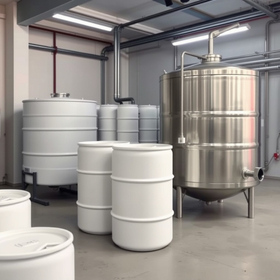
Why is chlorine dioxide produced on-site? This explains its properties in water treatment, how it is generated, the byproduct chlorous acid, and management guidelines.
Chlorine dioxide (ClO2) is a reddish-yellow gas with a pungent odor. It has a low boiling point of 11°C and dissolves 0.8g in 100ml of water at 20°C. The density of its vapor relative to air is 2.3, making it a heavier gas than air. Its main uses are for water disinfection and taste control, as well as bleaching in paper pulp and other applications. The concentration used in water treatment is typically 1 to 2 mg/L. ■ What are the differences from sodium hypochlorite? 1. Form of supply: Sodium hypochlorite is transported as a liquid chemical and stored in tanks. Chlorine dioxide is generated at the point of use. 2. Trihalomethanes: Chlorine dioxide produces almost none even in the presence of organic matter in the source water. 3. By-products to be cautious of: Hypochlorous acid (chlorine dioxide) and chloric acid (sodium hypochlorite). ■ How is it handled in water supply? In water supply systems, chlorine dioxide is used as a disinfectant. Both chlorine dioxide and hypochlorous acid, which is produced during its decomposition, are not included in the water quality standards but are part of the water quality management goals. Hypochlorous acid can also arise from sodium hypochlorite that has been stored for a long time. Please feel free to consult us first.
Inquire About This Product
basic information
■Why produce it on-site? Chlorine dioxide is a gas that requires careful handling, with an explosive limit of 10 vol% in the air. Because it is unstable when compressed, it is avoided to transport it after production, and it is usually produced at the site where it will be used. It is not a chemical that is stored, but rather one that is produced and injected in the necessary amount on-site. This is a significant difference from sodium hypochlorite, which can be transported in liquid form. ■What is it made from? The main raw material used is sodium chlorite, and a typical method involves reacting its aqueous solution with an acid such as hydrochloric acid to generate chlorine dioxide. Sodium chlorite itself is a white crystalline substance that dissolves 39g in 100ml of water at 17°C. ■What happens after it dissolves in water? Chlorine dioxide rapidly hydrolyzes in the aqueous solution to become chlorite ions. These chlorite ions are the main by-products that are subject to regulation. Chlorine dioxide itself decreases through self-decomposition and can also be removed by activated carbon. The threshold for detecting its odor is 0.4mg/L, which serves as a reference point when considering the injection concentration. Compared to the typical concentration of 1-2mg/L used in water treatment, this is a low value.
Price range
Delivery Time
Applications/Examples of results
■What are the management targets? The target values for management are 0.6 mg/L for both chlorine dioxide and chlorous acid. Chlorate is set at a water quality standard of 0.6 mg/L or less. Additionally, liquid sodium hypochlorite can increase in chlorate levels when stored for a long time, and special care is required for storage at high temperatures. ■What should be measured for management? When using chlorine dioxide, in addition to chlorine dioxide itself, chlorous acid and chlorate are also subject to management. The concentrations of the three substances should be measured regularly, and if they exceed the target values, immediate measures such as stopping the injection should be taken. ■How long does chlorous acid remain? According to the drinking water quality guidelines provided by WHO (World Health Organization), when chlorine dioxide is used as the final disinfectant at normal injection rates, the remaining concentration of chlorous acid is typically less than 0.2 mg/L, which is lower than the target value of 0.6 mg/L. The chlorous acid remaining in the treated water can be removed through treatment with ozone or activated carbon. At Torii, we offer consultations on the selection of chemicals used in water treatment, such as sodium hypochlorite. Please feel free to contact us for inquiries.
catalog(3)
Download All Catalogs
Company information

Since our founding, we have continued to provide flexible services with the motto of accurately supplying a diverse range of products that respond to changes in the times and the diversification of consumer needs, tailored to various applications and requirements. With the corporate slogan "Chemical Engineering Partner," we, as a group of experts in chemical technology, actively discover ideas to solve our customers' problems from advanced technologies both domestically and internationally, and propose them.