
List of lens products
- classification:lens
151~165 item / All 529 items


It won't break even after 1 million repetitions! A mat switch with reliable operation, high durability, and low price. Suitable for options in machine tools as well. Please consult us about delivery t...
- Sensors


We can accommodate high resistance over 10,000 ohms, with diameters ranging from approximately 30 mm to 8 inches, and we also offer thinning and chip processing arrangements!
- Other semiconductors
- Processing Contract
- Wafer


Adjustable actual field of view size. A lineup of telecentric lenses, non-telecentric lenses, and fixed magnification lenses.


- lens

High-resolution lens that achieves high contrast compatible with cameras up to 20 megapixels! C-mount compatible to meet the stringent demands of industrial inspection applications.

- lens

Telecentric lenses for inspection systems that achieve an ultra-compact design. Suitable for both standalone inspection systems and high-volume inspection systems!


- lens


155mm ultra-wide field of view! Capable of detecting the features of large inspection objects all at once, achieving high efficiency 'STS18215380CL'
- lens

The processing range is Φ5-330mm, with AR coating applied! We offer a variety of products, including flat concave lenses.
- lens

Adopts telecentric optical path design! It features a deep depth of field and high resolution.
- lens

A lineup of products with various ultra-long operating distances! Meeting a wide range of vision requirements!
- lens

Adopts standard C mount! The telecentric design on both sides provides a very deep depth of field and high resolution.
- lens


Compatible with 4/3 type large area sensors. Capable of capturing high-resolution images with fine details. Distortion is also minimal.
- lens


This is an ultra-wide fisheye lens that can shoot at a 200-degree field of view!
- lens

This is an ultra-wide fisheye lens compatible with mirrorless cameras that can shoot at a 250-degree field of view!
- lens

M12/P0.5 (S mount) ultra-wide fisheye lens. Field of view 220 degrees / 250 degrees / 280 degrees, compatible with 20MP.
- lens

Ultra-wide fisheye lens with a field of view of 220°. PL mount.
- lens


It is a special anti-reflective coating (AR coat) that can have peaks at multiple wavelengths. It is a filter that can be optimally designed for various optical devices.
- Sensors
- Other optical parts
- lens
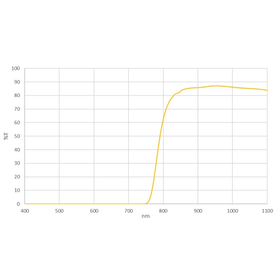
Added ITO/Near Infrared AR Coat to the Aronics sheet.
A technology that simultaneously imparts conductivity and near-infrared optical properties to rigid resin optical components. In recent years, with the proliferation of automotive LiDAR and various infrared sensors, the demand for optical components that achieve both high transmittance and low reflectance in the 905nm band has rapidly increased. Especially in sensing using ToF methods or pulsed lasers, even slight reflection losses or scattering directly affect detection accuracy, making wavelength-specific optical design essential. On the other hand, the cover materials that protect these sensors from external environments require specific characteristics of resin materials, such as mechanical strength, impact resistance, dimensional stability against temperature changes, processability, and suitability for mass production, making the coexistence of optical and mechanical properties a significant design challenge. At Adachi New Industries, we have established a composite thin-film process that combines the acrylic resin material "Alonix Sheet" from Toa Gosei Co., Ltd. with the following. Please check our company website for more details.

