We have compiled a list of manufacturers, distributors, product information, reference prices, and rankings for Quenching.
ipros is IPROS GMS IPROS One of the largest technical database sites in Japan that collects information on.

Quenching Product List and Ranking from 37 Manufacturers, Suppliers and Companies | IPROS GMS

Last Updated: Aggregation Period:Feb 18, 2026~Mar 17, 2026
This ranking is based on the number of page views on our site.

Quenching Manufacturer, Suppliers and Company Rankings

Last Updated: Aggregation Period:Feb 18, 2026~Mar 17, 2026
This ranking is based on the number of page views on our site.

  1. 富士高周波工業 Osaka//Manufacturing and processing contract
  2. 横浜高周波工業 本社工場 Kanagawa//Manufacturing and processing contract
  3. 富士電子工業 Osaka//Industrial Machinery
  4. 武藤工業 Kanagawa//Manufacturing and processing contract
  5. 5 遠州熱研 Shizuoka//Manufacturing and processing contract

Quenching Product ranking

Last Updated: Aggregation Period:Feb 18, 2026~Mar 17, 2026
This ranking is based on the number of page views on our site.

  1. High-frequency hardening 横浜高周波工業 本社工場
  2. Measures against soft zones using laser hardening 富士高周波工業
  3. Carburizing heat treatment 武藤工業
  4. [Processing Technology] Flame Hardening (Frame Hard) 遠州熱研
  5. Case study of laser hardening of convex end surfaces. 富士高周波工業

Quenching Product List

121~150 item / All 156 items

Displayed results

Benefits of High-Carbonitriding Quenching "FCD Carbonitriding Treatment"

High wear resistance and impact resistance, making it less prone to chipping! Introducing our uniquely developed high-concentration carburizing quenching technology.

We would like to introduce the benefits of Kunitomo Thermal Engineering's unique development technology, "FCD Carburizing Heat Treatment." The surface of chromium-molybdenum steel transforms into alloy tool steel, allowing for a wide range of applications from chromium-molybdenum steel to SUS and various mold steels. Our company has commercialized high-concentration carburizing quenching FCD carburizing quenching, which has excellent characteristics, with the aim of applying these properties to various mechanical components. We have received high praise from many customers. 【Features】 ■ Wide compatibility from chromium-molybdenum steel to SUS and various mold steels ■ High wear resistance and impact resistance, making it less prone to chipping ■ Higher heat resistance compared to gas carburizing ■ Surface hardness of treated products can be set as desired *For more details, please refer to the PDF document or feel free to contact us.

  • Other surface treatment equipment
  • Quenching

Added to bookmarks

Bookmarks list

Bookmark has been removed

Bookmarks list

You can't add any more bookmarks

By registering as a member, you can increase the number of bookmarks you can save and organize them with labels.

Free membership registration

Features of gas carburizing

"Gas carburizing nitriding hardening" allows for low-temperature treatment at around 800°C! Introducing the features of gas carburizing.

"Gas carburizing" is a treatment that involves infiltrating and diffusing carbon into the surface of steel in a high-temperature gas primarily composed of hydrocarbon gas, followed by rapid cooling to form a hardened surface layer. It is mainly performed to improve the wear resistance and fatigue strength of components. Our company offers "gas carburizing hardening" and "gas carburizing nitriding hardening," accommodating a wide range from micro parts such as precision components for machining tools to large items like shield cutters for shield tunneling and gear reducers for heavy machinery and industrial machines, including both shallow and deep carburizing of alloy steel and carbon steel. [Features] ■ Gas carburizing hardening - Improved surface hardness - Enhanced toughness in the core - Increased strength and wear resistance *For more details, please refer to the PDF materials or feel free to contact us.

  • Other surface treatment equipment
  • Surface treatment contract service
  • Quenching

Added to bookmarks

Bookmarks list

Bookmark has been removed

Bookmarks list

You can't add any more bookmarks

By registering as a member, you can increase the number of bookmarks you can save and organize them with labels.

Free membership registration

Flame hardening in electronic science and technology

Highly regarded and widely trusted craftsmanship! Flame hardening by Electronic Science Industry.

Flame hardening in electronic science and industry uses a gas flame as a heat source to rapidly heat the surface of the hardened area for quenching. At first glance, it may seem like a primitive method, but similar to high-frequency heat treatment that utilizes Joule heating, the short heating time prevents decarburization and minimizes surface peeling, which is one of its characteristics. It excels in processing complex shapes and large components, but requires advanced technology for temperature management. To produce industrial products that demand uniformity in small lots with a variety of types and short delivery times, skilled craftsmanship is essential. Our flame hardening has been certified by manufacturers for improving the mechanical properties of automotive parts, aerospace and defense industry components, and main components for observatories, earning us widespread trust. [Features] - Uses a gas flame as a heat source to rapidly heat the surface of the hardened area for quenching. - The short heating time prevents decarburization and minimizes surface peeling. - Collaborates with public research institutions for the "visualization of skilled craftsmanship." *For more details, please refer to the PDF document or feel free to contact us.

  • Other Auto Parts
  • Quenching

Added to bookmarks

Bookmarks list

Bookmark has been removed

Bookmarks list

You can't add any more bookmarks

By registering as a member, you can increase the number of bookmarks you can save and organize them with labels.

Free membership registration

Harden only the necessary parts or surfaces! High-frequency hardening.

No worries about decarburization or grain coarsening! We provide optimal metal heat treatment technology with scientific knowledge, skills, and maturity of techniques.

For hardness, dimensions, and other inquiries, please contact us. 【Materials Suitable for High-Frequency Hardening】 Carbon Steel ▸ S45C, S50C, S55C Alloy Steel ▸ SCM435, SCM440, SNCM439 Bearing Steel ▸ SUJ2 Stainless Steel ▸ SUS420J2, SUS440C Carbon Tool Steel ▸ SK3 Alloy Tool Steel ▸ SKS3, SKD11

  • others
  • Quenching

Added to bookmarks

Bookmarks list

Bookmark has been removed

Bookmarks list

You can't add any more bookmarks

By registering as a member, you can increase the number of bookmarks you can save and organize them with labels.

Free membership registration

Information on atmosphere heat treatment (batch type) contract services.

We meet the needs of carburizing that provides exceptional strength and wear resistance to special materials.

Maruwa Heat Treatment Co., Ltd., which conducts gas carburizing, gas nitriding, quenching, and tempering, offers atmosphere heat treatment (batch type). Atmosphere heat treatment (batch type) is a surface hardening method that introduces carbon from the surface at high temperatures of 900 to 930°C. The surface is highly hard while the interior remains flexible, making it resistant to breaking even under impact. 【Features】 ■ Provides exceptional strength and wear resistance to special materials ■ A surface hardening method that introduces carbon from the surface ■ Resistant to breaking even under impact *For more details, please download the PDF or feel free to contact us.

  • Processing Contract
  • Quenching

Added to bookmarks

Bookmarks list

Bookmark has been removed

Bookmarks list

You can't add any more bookmarks

By registering as a member, you can increase the number of bookmarks you can save and organize them with labels.

Free membership registration

What are the characteristics and roles of quenching, tempering, annealing, and normalizing?

We will introduce the four basic patterns of heat treatment that bring out the properties of iron!

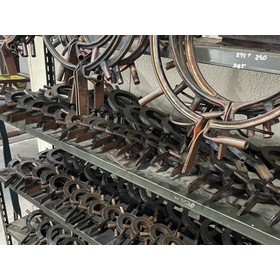
There are four main methods of heat treatment. The toughness we discussed last time is imparted by performing "tempering." It is often said "quenching and tempering," and it is common to perform these together to give steel surface hardness and toughness. Annealing and normalizing are not frequently used in the processing we mainly handle, but the photo of the handle shows that annealing was performed to soften the iron and bend it. The base part of the bend has undergone annealing. *For more detailed information, you can view it through the related links. Please feel free to contact us for more details.*

  • Processing Contract
  • Quenching

Added to bookmarks

Bookmarks list

Bookmark has been removed

Bookmarks list

You can't add any more bookmarks

By registering as a member, you can increase the number of bookmarks you can save and organize them with labels.

Free membership registration

What are the characteristics and roles of hardening, tempering, annealing, and normalizing?

Introducing four basic patterns of heat treatment that bring out the properties of iron in a blog!

There are four main methods of heat treatment. The toughness I mentioned last time is imparted by performing "tempering." It is often said "quenching and tempering," and it is common to carry out these processes together to give steel surface hardness and toughness. Annealing and normalizing are not frequently used in the processing we mainly handle, but the photo of the handle at the beginning shows that annealing was performed to soften the iron and bend it. The root part of the bend has undergone annealing. Without annealing, it would be hard, and cracks would occur during bending, or it would break. *You can view the detailed content of the blog through the related links. For more information, please download the PDF or feel free to contact us.*

  • Steel
  • Processing Contract
  • Quenching

Added to bookmarks

Bookmarks list

Bookmark has been removed

Bookmarks list

You can't add any more bookmarks

By registering as a member, you can increase the number of bookmarks you can save and organize them with labels.

Free membership registration

Flame hardening

Selecting the range and depth of the hardened layer after quenching is relatively easy! Introducing heat treatment using fire.

"Flame (Flame Hardening)" is a quenching method that has been used for a long time as one of the surface hardening methods for steel or cast iron. It improves wear resistance, enhances mechanical properties, and allows for partial hardening. Due to rapid heating and rapid cooling treatment, there is little oxidation, decarburization, or deformation, and it is not restricted by the shape or dimensions of the workpiece. Please feel free to contact us when you need our services. 【Features】 ■ No restrictions on the shape or dimensions of the workpiece ■ Localized heating is possible ■ Setup for hardening is easy and work can be done quickly ■ Selection of the hardened layer range and depth is relatively easy ■ Little oxidation, decarburization, or deformation due to rapid heating and cooling treatment *For more details, please refer to the related links or feel free to contact us.

  • Contract manufacturing
  • Processing Contract
  • Quenching

Added to bookmarks

Bookmarks list

Bookmark has been removed

Bookmarks list

You can't add any more bookmarks

By registering as a member, you can increase the number of bookmarks you can save and organize them with labels.

Free membership registration

浸炭焼入

コンロッド・クランク・ギヤ・社内製作治具等の多彩な製品に柔軟に対応!

株式会社藤田鐵工所では、『浸炭焼入』を行っております。 金属(特に低炭素鋼)の加工において、表面層の硬化を目的として炭素を 添加する処理。 ペースメーカ型ガス浸炭焼入れ炉5基、洗浄、焼戻し、及び組織確認の付帯設備と 現代の匠・熱処理技能士による高度な技術で品質を保証しています。 【使用設備】 ■ペースメーカ型ガス浸炭焼入れ炉 ■自動防炭乾燥機 ■高周波焼入れ装置 ※詳しくはPDF資料をご覧いただくか、お気軽にお問い合わせ下さい。

  • Incinerators and incinerators
  • Quenching

Added to bookmarks

Bookmarks list

Bookmark has been removed

Bookmarks list

You can't add any more bookmarks

By registering as a member, you can increase the number of bookmarks you can save and organize them with labels.

Free membership registration

N Quench (Nitriding Hardening)

The finishing skin is good! The processing time is short, and a 20μ curing layer can be obtained in 40 minutes.

"N-Quench (Nitriding Quenching)" is a treatment method that allows nitrogen to penetrate and dissolve in steel within the austenite region of the Fe-N phase diagram, followed by rapid cooling to obtain hard nitrogen martensite. In nitriding quenching, the nitrided layer hardens into nitrogen martensite due to rapid cooling, but the interior does not harden because it is cooled from below the transformation temperature of the Fe-C system. Furthermore, the thermal treatment distortion (dimensional change) is comparable to that of gas soft nitriding. 【Features】 ■ Hardness of HV800 or higher can be achieved even with low carbon steel. ■ The amount of gas used is extremely small, about 1/10 of that used in gas soft nitriding. ■ Processing time is short, with a hardened layer of 20μ obtained in 40 minutes. ■ The finish is good. ■ The treatment is environmentally friendly. *For more details, please refer to the PDF document or feel free to contact us.

Added to bookmarks

Bookmarks list

Bookmark has been removed

Bookmarks list

You can't add any more bookmarks

By registering as a member, you can increase the number of bookmarks you can save and organize them with labels.

Free membership registration

N-hard (gas soft nitriding hardening)

A 20μ curing layer can be obtained with a 40-minute treatment! This is a processing method that can reduce operating costs.

"N-Hard (Gas Soft Nitriding)" is a treatment method where gas soft nitriding is performed just above the A1 transformation temperature on the Fe-N phase diagram, followed by rapid cooling to obtain a mixed phase of nitrides and nitrogen martensite. The surface forms an extremely hard layer compared to the nitrided layer, consisting of a mixed phase of nitrides (or carbonitrides) and nitrogen martensite. However, the interior undergoes rapid cooling below the A1 transformation of the Fe-C system, so it does not harden. 【Features】 ■ Thermal treatment distortion (dimensional change) is small, comparable to gas soft nitriding. ■ Hardness of HV800 or higher can be achieved even with low carbon steel, and HV1000 or higher with SK5. ■ Processing time is shorter compared to gas soft nitriding, achieving a hardened layer of 50μm in 90 minutes. ■ Processing time is short, achieving a hardened layer of 20μm in 40 minutes. ■ The finish is good. *For more details, please refer to the PDF document or feel free to contact us.

Added to bookmarks

Bookmarks list

Bookmark has been removed

Bookmarks list

You can't add any more bookmarks

By registering as a member, you can increase the number of bookmarks you can save and organize them with labels.

Free membership registration

Netsuren "Induction Heating Equipment" High-Frequency Hardening

We provide a wide range of equipment globally, from fully automatic hardening machines for various applications in automobiles, construction machinery, and industrial machinery to simple manual hardening machines.

We design, manufacture, and engineer equipment and systems to achieve inline induction heating, energy saving, and labor saving in various industrial fields such as the automotive, construction machinery, machine tool, steel, chemical, and home appliance industries. As service bases, we have locations in Kanagawa and Nagoya, as well as overseas in the United States, China, Indonesia, Mexico, and South Korea, providing global support and services. We commercialize high-frequency power supply devices using SCR, IGBT, MOSFET, and SiC semiconductors, with a frequency range of 0.5 to 400 kHz and power output from 2.5 to 2,000 kW. Additionally, we have practical applications for CAE analysis up to metal transformation and "low (constant) deformation contour quenching technology" for gears and shafts, enabling us to provide equipment with high quality stability in heat treatment. *Induction heating (IH) technology uses green electricity as a heat source and contributes to the reduction of CO2 emissions.

  • Other surface treatment equipment
  • Quenching

Added to bookmarks

Bookmarks list

Bookmark has been removed

Bookmarks list

You can't add any more bookmarks

By registering as a member, you can increase the number of bookmarks you can save and organize them with labels.

Free membership registration

Mokuhon Electronic Industry Co., Ltd. Heat Treatment Division

We accommodate everything from ultra-small shafts to large shafts! We have received strong trust in our products from numerous customers.

High-frequency hardening is regarded as a special technology that boasts excellent wear resistance. Our high-frequency hardening has specifications that can accommodate everything from ultra-small shafts with a diameter of φ3 and a length of 500mm to large shafts with a diameter of φ450 and a length of 2000mm. This is the result of the strong trust we have received from numerous customers regarding our products, and we take pride in being involved with critical components that relate to human safety. In order to further improve the product accuracy of high-frequency hardening, we are committed to daily progress with five principles aimed at "eliminating hardening defects." 【Five Principles for the Hardening Department and Hardening Site】 ■ Check the cooling water volume and pressure by hand after each setup change. ■ Replace the strainer for machines other than Machine No. 3 at least once a week and record it on the regular inspection checklist. ■ Allow gaps for pins and shafts to achieve tempering effects. ■ Correct coils after use and place them in the coil correction box. ■ Organize, arrange, and clean your surroundings (3S). *For more details, please refer to the related link page or feel free to contact us.

  • Processing Contract
  • Quenching

Added to bookmarks

Bookmarks list

Bookmark has been removed

Bookmarks list

You can't add any more bookmarks

By registering as a member, you can increase the number of bookmarks you can save and organize them with labels.

Free membership registration

Carburizing heat treatment

We will carefully respond to detailed carbonization treatment.

Our company supports heat treatment for a wide variety of small lots, performing heat treatment on various products such as precision parts, automotive parts, and industrial equipment parts. For areas that require secondary processing, such as screw holes and keyways, we carefully implement carburizing prevention measures. ● For complex shapes and thin-walled items that are prone to distortion, we devise processes and setups to minimize warping. ● Long shafts are finished using a dedicated distortion removal device after quenching. ● We can accommodate short delivery times. Suitable for small quantities of various types; please consult us even for just one piece.

  • Steel
  • Quenching

Added to bookmarks

Bookmarks list

Bookmark has been removed

Bookmarks list

You can't add any more bookmarks

By registering as a member, you can increase the number of bookmarks you can save and organize them with labels.

Free membership registration

Flame hardening

Local heating for processing complex shapes. Suitable for small-batch production of various types.

By applying high-temperature flames such as oxy-acetylene flames to locally heat the surface of steel parts, it is less affected by the shape of the workpiece. Skilled craftsmen accurately control the temperature using the color of the flame. Additionally, it is economical because it does not require fixtures or coils like high-frequency heat treatment (quenching) for the same localized heating process. ● It is used for processing complex machined parts that cannot be handled by high-frequency quenching. ● We conduct thorough prior discussions and perform heat treatment suitable for the material. ● It is economical because it does not require the cost of manufacturing special fixtures.

  • Steel
  • Quenching

Added to bookmarks

Bookmarks list

Bookmark has been removed

Bookmarks list

You can't add any more bookmarks

By registering as a member, you can increase the number of bookmarks you can save and organize them with labels.

Free membership registration

【Processing Technology】Glowing Quenching

Prevents oxidation and decarbonization, and can protect luster! It also leads to a reduction in post-processing such as shot blasting.

"Radiant Hardening" is a hardening method that finishes with the surface maintaining a metallic luster. By processing in a non-oxidizing atmosphere, it prevents oxidation and decarburization, allowing for the protection of the radiant quality. This also leads to a reduction in subsequent processes such as shot blasting. Please feel free to contact us when you need our services. 【Features】 ■ A hardening method that finishes with the surface maintaining a metallic luster ■ Prevents oxidation and decarburization ■ Can protect the radiant quality ■ Leads to a reduction in subsequent processes such as shot blasting ■ JIS processing symbol: HQB *For more details, please refer to the PDF document or feel free to contact us.

  • Processing Contract
  • Quenching

Added to bookmarks

Bookmarks list

Bookmark has been removed

Bookmarks list

You can't add any more bookmarks

By registering as a member, you can increase the number of bookmarks you can save and organize them with labels.

Free membership registration

[Processing Technology] Carburizing Quenching and Carburizing Nitriding Quenching

It is widely applied to various machine parts, including automotive parts and marine parts!

"Carburizing hardening" is a treatment that allows carbon to penetrate and diffuse from the surface of a metal, hardening only the surface. The surface becomes hard and wear-resistant, while the interior maintains lower hardness, providing high toughness and improved fatigue resistance. "Carburizing nitriding" is a treatment that allows both carbon and nitrogen to penetrate and diffuse into the surface of steel, hardening only the surface layer. This improves wear resistance. 【Features】 ■ Carburizing hardening - The surface becomes hard and wear-resistant - The interior maintains lower hardness, providing high toughness - Fatigue resistance can also be improved ■ Carburizing nitriding - A treatment that hardens only the surface layer - Wear resistance is improved *For more details, please refer to the PDF document or feel free to contact us.

  • Other surface treatment equipment
  • Quenching

Added to bookmarks

Bookmarks list

Bookmark has been removed

Bookmarks list

You can't add any more bookmarks

By registering as a member, you can increase the number of bookmarks you can save and organize them with labels.

Free membership registration

[Processing Technology] Flame Hardening (Frame Hard)

Partial hardening of small parts! It is possible to have a hard surface with high wear resistance and a tough core!

"Flame hardening" is a process that involves heating the surface of steel with a high-temperature flame, followed by quenching to harden the surface layer. Using a torch, the steel is heated partially and then rapidly cooled. This process allows for a hard surface layer with high wear resistance and a tough core, resulting in significant residual compressive stress on the surface, which improves fatigue strength. It is suitable for partial hardening of small items (approximately Φ30 or smaller). 【Features】 ■ A process that heats the surface of steel with a high-temperature flame and then hardens the surface layer. ■ Capable of producing a hard surface layer with high wear resistance and a tough core. ■ The generation of significant residual compressive stress on the surface improves fatigue strength. ■ Suitable for partial hardening of small items (approximately Φ30 or smaller). ■ JIS processing symbol: HQF *For more details, please refer to the PDF document or feel free to contact us.

  • Other surface treatment equipment
  • Quenching

Added to bookmarks

Bookmarks list

Bookmark has been removed

Bookmarks list

You can't add any more bookmarks

By registering as a member, you can increase the number of bookmarks you can save and organize them with labels.

Free membership registration

Mikawa Electric Wave Industry Co., Ltd.

Leave metal heat treatment, including high-frequency hardening and distortion correction, to us.

Our company was founded in 1967 and specializes in high-frequency hardening, adhering to the motto of "high quality, short delivery times, and low cost." Among the various metal heat treatment processes, we have deepened our collaboration with specialized contractors over the years for overall hardening methods such as vacuum, carburizing, and salt hardening, as well as nitriding treatments like tuftriding and gas softening, and annealing shots. We are equipped to meet any needs related to heat treatment in general. ■ Dedicated to "High-Frequency Hardening" We handle products of special sizes, complex shapes, and even thin plate products that tend to warp significantly when heated—items that may be deemed unacceptable or for which we might receive refusals from others. We address these high-difficulty products with our own coils and the skilled techniques of our artisans. ■ Confident in Our Skills "Warp Correction" With over half a century of experience and achievements, we take pride in our ability to correct warping caused by hardening to a level of 0.1mm, skillfully manipulating pressing and heat as part of our high technical capabilities. ■ We Deliver "Short Delivery Times" Our ability to provide a consistent service from hardening and tempering to warp correction allows us to deliver on the same day as drop-off in the shortest possible time. We strive to meet our customers' deadlines to the fullest extent.

  • 三河電波工業株式会社2.jpeg
  • 三河電波工業株式会社3.jpg
  • 三河電波工業株式会社4.jpg
  • Processing Contract
  • Quenching

Added to bookmarks

Bookmarks list

Bookmark has been removed

Bookmarks list

You can't add any more bookmarks

By registering as a member, you can increase the number of bookmarks you can save and organize them with labels.

Free membership registration

Screw Strengthening Manual (Vol. 41) Sometimes it can be partially hardened!

Introducing a method to heat only the surface of materials that can be hardened, in a blog format!

This time, I will talk about high-frequency hardening. It is a heat treatment method where a copper wire coil, called a high-frequency coil, is wrapped around a product that you want to harden, and heat is applied by passing an electric current to harden only the surface. While one might think that general heat treatments like quenching or annealing would suffice for hardening, there are valid reasons for choosing high-frequency hardening. *For more detailed content, you can view it through the related links. Please feel free to contact us for more information.*

  • Other consumables
  • Quenching

Added to bookmarks

Bookmarks list

Bookmark has been removed

Bookmarks list

You can't add any more bookmarks

By registering as a member, you can increase the number of bookmarks you can save and organize them with labels.

Free membership registration

To suppress distortion and increase surface hardness, nitriding hardening is used.

Compared to carbonization, deformation and dimensional changes are minimal!

- It is possible to achieve a surface hardness of 800 HV or higher even with low carbon steel. - The amount of gas used is about 1/10 of that for gas nitriding. - There is a high resistance to temper softening. - The finish is better compared to carburizing and similar processes. - Corrosion resistance is better than that of carburizing.

  • Processing Contract
  • Quenching

Added to bookmarks

Bookmarks list

Bookmark has been removed

Bookmarks list

You can't add any more bookmarks

By registering as a member, you can increase the number of bookmarks you can save and organize them with labels.

Free membership registration

[Latest Edition] Laser Hardening Case Studies

This is a collection of laser hardening case studies that addresses various projects with top-class domestic facilities. Collections of past case studies Volumes 1 to 30, as well as case studies by processing type, are also available!

We will introduce examples of laser hardening that prevent distortion and cracking, making it possible to harden precision parts and complex-shaped components. 【Example Lineup】 ■ Laser hardening of chuck jaws ■ Laser hardening of large tapered rolls ■ Laser hardening of truck plate tips ■ Laser hardening of small holders ■ Laser hardening of M2 rack gears ■ Laser hardening of thin-walled V-rings ■ Laser hardening of indexing pins ■ Laser hardening of spiral bevel gear tooth surfaces ■ Laser hardening of thin-walled cam plates ■ Laser hardening of φ600 mold inner diameters

  • Processing Contract
  • Quenching

Added to bookmarks

Bookmarks list

Bookmark has been removed

Bookmarks list

You can't add any more bookmarks

By registering as a member, you can increase the number of bookmarks you can save and organize them with labels.

Free membership registration

[Metal Heat Treatment Guide] What is Quenching?

Heat treatment that changes the state of martensitic structure! A method used when forging Japanese swords!

"Quenching" is a heat treatment process that involves heating steel to an austenitic structure and then rapidly cooling it in water or oil, transforming it into a martensitic structure. Depending on the cooling medium, it is referred to as water quenching or oil quenching, and it is also a method used in the forging of Japanese swords. This process is performed to increase the hardness of the steel, but it reduces toughness, so it is common to perform tempering after quenching to achieve ductility. 【What is Quenching】 ■ A process that changes the state of steel from an austenitic structure to a martensitic structure by heating it and then rapidly cooling it in water or oil. ■ A method used in the forging of Japanese swords. ■ The quenching effect cannot be expected unless the carbon content is 0.3% or higher. *For more details, please refer to the PDF document or feel free to contact us.

  • Heating device
  • Quenching

Added to bookmarks

Bookmarks list

Bookmark has been removed

Bookmarks list

You can't add any more bookmarks

By registering as a member, you can increase the number of bookmarks you can save and organize them with labels.

Free membership registration

Leave it to Daiwa Seiko Co., Ltd., with years of trust and proven results.

If you have requested heat treatment and distortion correction from another company and are not getting the results you expected, please feel free to consult with us!

Our company has a long-standing reputation and track record, particularly in the quenching of HSS (high-speed tool steel), where we have achieved significant results. If you are facing issues such as inability to achieve quenching hardness, excessive distortion making processing difficult, or frequent cracking, or if you want to extend the lifespan of your molds, experience significant changes over time after heat treatment, or cannot meet specified hardness, please feel free to consult with us. Additionally, if you are currently outsourcing heat treatment and distortion correction to other companies and are not getting the desired results, please reach out to us. [For concerns like these] ■ Inability to achieve quenching hardness ■ Excessive distortion making processing difficult ■ Frequent cracking ■ Wanting to extend the lifespan of molds ■ Significant changes over time after heat treatment ■ Not meeting specified hardness *For more details, please download the PDF or feel free to contact us.

  • Processing Contract
  • Quenching

Added to bookmarks

Bookmarks list

Bookmark has been removed

Bookmarks list

You can't add any more bookmarks

By registering as a member, you can increase the number of bookmarks you can save and organize them with labels.

Free membership registration

Colette Double Tempering

The lower back has low hardness, while the clamp section has high hardness, allowing for hardening not only on the surface but also throughout the center!

At Yamato Seiko Co., Ltd., we perform two-stage hardening of collets. The waist section is hardened to a low hardness, while the clamping section is hardened to a high hardness, allowing hardening not only on the surface but also throughout the center. The two-stage hardening of collets is only available when combined with parts processing and heat treatment processing. Please feel free to consult us when you need our services. 【Business Activities】 ■ Design and manufacturing of precision tools ■ Manufacturing of various industrial equipment parts (including discontinued parts for food and packaging manufacturing equipment) ■ Heat treatment processing (requests for heat treatment processing only are also possible) *For more details, please download the PDF or feel free to contact us.

  • Chuck
  • Processing Contract
  • Quenching

Added to bookmarks

Bookmarks list

Bookmark has been removed

Bookmarks list

You can't add any more bookmarks

By registering as a member, you can increase the number of bookmarks you can save and organize them with labels.

Free membership registration

Netsuren Komatsu Co., Ltd.

Stronger and more flexible - Fine Heat Technology - A top manufacturer of high-frequency surface hardening. This is the Hokuriku base of the Netsuren Group.

Netsuren Komatsu Co., Ltd. is a leading manufacturer of high-frequency surface hardening, providing stronger and more flexible products. Our main products include heat treatment for a wide range of components such as swing wheels, sprockets, idlers for construction machinery, shafts, connecting rods, spindles, gears for machine tools, hubs, bearings for automobiles, and push rods for internal combustion engines. Our core technologies include large gear one-shot hardening with an output of 600 kW, one-tooth movement hardening for medium and large gears, constant and low distortion hardening for automotive parts, and continuous automatic hardening for shaft-type components.

Added to bookmarks

Bookmarks list

Bookmark has been removed

Bookmarks list

You can't add any more bookmarks

By registering as a member, you can increase the number of bookmarks you can save and organize them with labels.

Free membership registration

Wahong Precision Co., Ltd.

We prioritize quality, delivery time, and cost, aiming to be a company that competes at the micron level in heat treatment.

Wahong Precision Co., Ltd. is a company that prioritizes quality, delivery, and cost, aiming for precise heat treatment at the micron level. We handle parts in a wide range of fields, including construction machinery, machine tools, automobiles, and textile machinery, and we specialize in processes such as gas carburizing hardening, gas carburizing nitriding hardening, non-oxidizing hardening, material tempering, annealing, carbon removal treatment, cleaning treatment, distortion correction, and shot blasting treatment. Our strength lies in having obtained ISO 9001:2015 certification and having many employees with heat treatment technician qualifications.

Added to bookmarks

Bookmarks list

Bookmark has been removed

Bookmarks list

You can't add any more bookmarks

By registering as a member, you can increase the number of bookmarks you can save and organize them with labels.

Free membership registration

The composition and structure of spring steel, the changes in strength due to carbon content, and the importance of quenching.

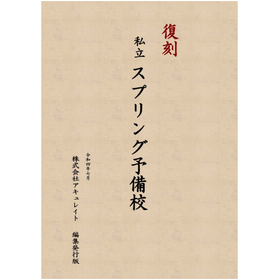
[Reproduction of Private Spring Preparatory School Lecture 53] Study of heat treatment that creates spring hardness! Explanation of carbon that strengthens steel.

I plan to study the heat treatment that creates spring hardness. That said, since there are new students, let's also study the structure beforehand. Pure iron is surprisingly soft, so it is not useful in the machinery industry. However, if you add a tiny amount of carbon to this iron, it becomes something very useful called carbon steel. The amount of carbon increases in the order of mild steel, medium carbon steel, hard steel, and ultra-hard steel, with the carbon steel for springs (SUP3 and 4) belonging to the ultra-hard steel category. Even in this ultra-hard steel, the carbon content is only about 1.5%. I apologize for the repetition, but let's take another look at the JIS spring steel material table here. *For detailed content of the article, you can view it in the PDF. For more information, please feel free to contact us.*

Added to bookmarks

Bookmarks list

Bookmark has been removed

Bookmarks list

You can't add any more bookmarks

By registering as a member, you can increase the number of bookmarks you can save and organize them with labels.

Free membership registration

[Case Study] Increase Hardness of S55C!

Proposal for Ensuring Hardness! Introduction of Case Studies on Increasing Hardness by Changing to Heat Treatment "Salt Quenching"

This is a case study that succeeded in extending the lifespan by changing the heat treatment method of S55C to "salt quenching." [Consultation Details] The S55C shaft was being hardened using vacuum oil quenching, but hardness could not be secured. [Solution Case] We proposed changing to salt quenching, which has good heat transfer, and upon performing the quenching, we were able to secure the hardness. Additionally, the salt quenching eliminated uneven hardening and resulted in a fine hardened structure, contributing to the extended lifespan of the product.

  • Other surface treatment equipment
  • Quenching

Added to bookmarks

Bookmarks list

Bookmark has been removed

Bookmarks list

You can't add any more bookmarks

By registering as a member, you can increase the number of bookmarks you can save and organize them with labels.

Free membership registration

[Case Study] Successful Reduction of Distortion in the Quenching of Leaf Springs!

We propose a processing method with minimal distortion! Introduction of case studies on distortion reduction through the change to heat treatment "salt quenching."

This is an introduction to a case where changing the heat treatment of leaf springs to "salt quenching" successfully reduced distortion. 【Consultation Details】 We want to perform quenching on leaf springs that cannot be corrected for distortion, aiming for minimal distortion. 【Solution Case】 We proposed changing the quenching method from oil quenching to the less-distorting "salt quenching." We succeeded in reducing the distortion after quenching.

  • Other surface treatment equipment
  • Quenching

Added to bookmarks

Bookmarks list

Bookmark has been removed

Bookmarks list

You can't add any more bookmarks

By registering as a member, you can increase the number of bookmarks you can save and organize them with labels.

Free membership registration