- Publication year : 2026
1~5 item / All 5 items
Displayed results

Added to bookmarks
Bookmarks listBookmark has been removed
Bookmarks listYou can't add any more bookmarks
By registering as a member, you can increase the number of bookmarks you can save and organize them with labels.
Free membership registration
Contact this company
Inquiry Form1~5 item / All 5 items
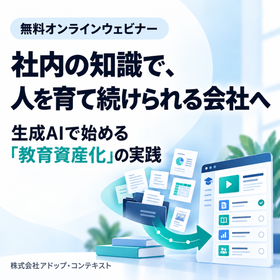
Companies have a wealth of knowledge that can be utilized for human resource development, including methods of conducting business, criteria for decision-making, insights into customer interactions, and the know-how of experienced personnel. On the other hand, there are not a few challenges such as having a limited number of people responsible for creating training programs, being unable to keep educational materials updated, and relying on specific individuals for training. In this webinar, we will explain the concept and approach of "educational assetization," which involves organizing internal knowledge so that employees can understand it and apply it in their judgments and actions, and continuously utilize it. Recommended for those who: Have knowledge within the company but are not fully leveraging it for human resource development. - Materials are scattered and not organized in a usable format for education. - The creation of training and guidance relies on specific individuals. - Even if educational materials are created, there is no capacity for updates or ongoing utilization. What you will learn in this webinar: 1. What is educational assetization? We will explain the concept of organizing internal knowledge so that employees can understand it and apply it in their actions. 2. Five steps for implementation We will specifically introduce which materials to use and in what order to create educational content. 3. Demonstration using generative AI You will see how internal materials transform into learning content and reach employees.
Added to bookmarks
Bookmarks listBookmark has been removed
Bookmarks listYou can't add any more bookmarks
By registering as a member, you can increase the number of bookmarks you can save and organize them with labels.
Free membership registration
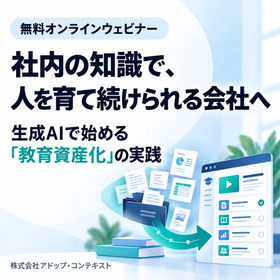
Companies possess a wealth of knowledge that can be utilized for human resource development, including methods of conducting business, criteria for decision-making, insights into customer interactions, and the know-how of experienced professionals. On the other hand, there are not a few challenges such as having a limited number of personnel responsible for creating training, being unable to keep up with updating materials, and relying on specific individuals for education. In this webinar, we will explain the concept and approach of "educational assetization," which involves organizing internal knowledge so that employees can understand it and apply it to their judgments and actions, and continuously utilize it. Recommended for those who: Have knowledge within the company but are not fully leveraging it for human resource development. - Materials are scattered and not organized in a usable format for education. - Training development and instruction rely on specific personnel. - Even if materials are created, there is no capacity for updates or continuous utilization. What you will learn in this webinar: 1. What is educational assetization? We will explain the concept of organizing internal knowledge so that employees can understand it and apply it to their actions. 2. Five steps for implementation We will specifically introduce which materials to use and in what order to create educational content. 3. Demonstration using generative AI You will see how internal materials transform into learning content and reach employees.
Added to bookmarks
Bookmarks listBookmark has been removed
Bookmarks listYou can't add any more bookmarks
By registering as a member, you can increase the number of bookmarks you can save and organize them with labels.
Free membership registration
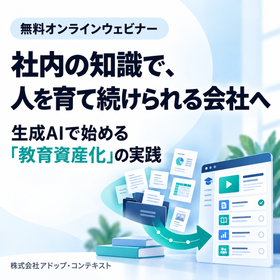
Companies possess a wealth of knowledge that can be utilized for human resource development, including methods for conducting business, criteria for decision-making, insights into customer interactions, and the know-how of experienced personnel. On the other hand, there are not a few challenges, such as having a limited number of personnel responsible for creating training programs, being unable to keep educational materials updated, and relying on specific individuals for training. In this webinar, we will explain the concept and approach of "educational assetization," which involves organizing internal knowledge so that employees can understand it and apply it in their judgments and actions, and continuously utilize it. Recommended for those who: Have knowledge within the company but are not fully leveraging it for human resource development. - Materials are scattered and not organized in a usable format for education. - Training development and guidance rely on specific individuals. - Even if educational materials are created, there is not enough capacity for updates and ongoing utilization. What you will learn in this webinar: 1. What is educational assetization? We will explain the concept of organizing internal knowledge into a form that employees can understand and apply in their actions. 2. Five steps for implementation We will provide specific guidance on which materials to use and in what order to create educational content. 3. Demonstration using generative AI You will see how internal materials transform into learning content and reach employees.
Added to bookmarks
Bookmarks listBookmark has been removed
Bookmarks listYou can't add any more bookmarks
By registering as a member, you can increase the number of bookmarks you can save and organize them with labels.
Free membership registration
PRESS RELEASE|Adop Context Inc. A company providing training has systematized its employee education Kurala Bo Co., Ltd. officially introduces "Context AI" Generating teaching materials and assessment tests from existing rulebooks, leading to security education and the inheritance of on-site experience. Adop Context Inc. (Headquarters: Tokyo, Representative Director: Masahisa Ishikawa) announces that Kurala Bo Co., Ltd. (Headquarters: Chuo-ku, Tokyo, Representative Director: Mitsuru Nishikawa), which engages in educational business, instructor services, and educational content production, has officially introduced the BtoB SaaS "Context AI" on September 1, 2026, to generate and distribute learning courses from internal materials and has begun its use within the company. Kurala Bo has experts in various fields, including training instructors and IT engineers. Meanwhile, while training for customers and on-site responses are prioritized, education for its own employees has primarily been handled through the distribution of existing materials, self-reported qualification studies, and study sessions held as needed. With this introduction, the company aims to connect existing rulebooks to teaching materials, assessment tests, and monitoring of participation, thereby advancing the establishment of a sustainable employee education system.
Added to bookmarks
Bookmarks listBookmark has been removed
Bookmarks listYou can't add any more bookmarks
By registering as a member, you can increase the number of bookmarks you can save and organize them with labels.
Free membership registration
We have released a product called "Context AI," a B2B SaaS that automatically generates training courses by simply uploading corporate internal materials (PDF, Word, PowerPoint, txt), now equipped with an AI voice narration automatic generation feature. The generated training courses can be instantly distributed by issuing a URL, allowing participants to learn at their own pace with slides and voice narration. ■ Background: The challenge of training lies not in "how to create" but in "designing" - There are no personnel with expertise in educational design within the company. - While manuals and business documents exist, they are not in the form of "learnable materials." - The creation of educational materials relies on the experience and workload of specific personnel, leading to a lack of scalability. ■ Service Overview: Contextualization Method (5 Steps) Knowledge Extraction — Extract terminology definitions, procedures, and practical tips from materials. Learning Objective Design — Set learning objectives based on Bloom's taxonomy in levels of introductory, practical, and mastery. Sequence Design — Design a logical order for easy understanding of the learning process. Content Generation — Generate slides, voice narration, and assessment quizzes. Effectiveness Measurement — Visualize participants' progress and scores on a dashboard.
Added to bookmarks
Bookmarks listBookmark has been removed
Bookmarks listYou can't add any more bookmarks
By registering as a member, you can increase the number of bookmarks you can save and organize them with labels.
Free membership registration