1~20 item / All 20 items
Displayed results
Filter by category

Added to bookmarks
Bookmarks listBookmark has been removed
Bookmarks listYou can't add any more bookmarks
By registering as a member, you can increase the number of bookmarks you can save and organize them with labels.
Free membership registration
Contact this company
Inquiry Form1~20 item / All 20 items
Filter by category
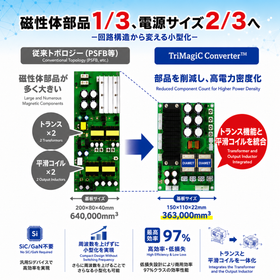
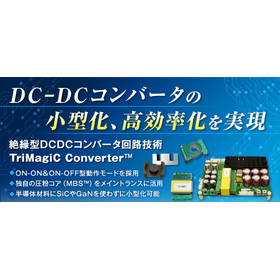
Solving issues such as "limitations of substrate area" and "cost increase due to SiC adoption." Our unique operating mode reduces magnetic component size by one-third without increasing frequency. We achieve dramatic downsizing while suppressing heat and noise. 【Challenges and Applications We Can Address】 ◎ Space Constraints: Reducing substrate area by two-thirds and magnetic components (such as transformers) by one-third (for applications like in-vehicle chargers, robotic joints, and 1U-sized communication boards). ◎ Cost Control: Achieving high efficiency using general-purpose silicon without relying on expensive SiC/GaN. ◎ Heat and Noise Mitigation: Halving ripple current and reducing magnetic flux density (ΔB) for low loss and low noise. 【Features of Our Unique Topology】 Adopting low permeability powder core "MBS" with "ON-ON / ON-OFF" modes. By suppressing the amplitude of the excitation current, we have made it possible to minimize transformers and capacitors. ★【Free Offer】Simple Calculation Tool & Technical Materials We are distributing a tool that allows you to instantly estimate "how much smaller it can get under your conditions." You can view detailed measurement data and more from the <Catalog Download>.
Added to bookmarks
Bookmarks listBookmark has been removed
Bookmarks listYou can't add any more bookmarks
By registering as a member, you can increase the number of bookmarks you can save and organize them with labels.
Free membership registration
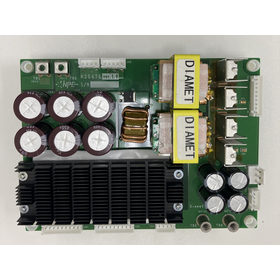
This method uses a low permeability powder core "MBS" in the main transformer and adopts ON-ON / ON-OFF operating modes, enabling the miniaturization of magnetic components to about 1/3 and the power board size to about 2/3 compared to conventional circuits (according to our estimates). In addition to achieving space-saving in the power circuit without increasing the operating frequency, further miniaturization is possible by increasing the operating frequency. It is possible to achieve a compact and high-efficiency DC-DC converter without using SiC or GaN, while still using general-purpose Si. 【Features】 ■ Realizes miniaturization and high efficiency of DC-DC converters (power circuits) ■ By suppressing the amplitude of the excitation current, it also achieves a reduction in ΔB (change in magnetic flux density) and the resulting low loss ■ The output ripple current is approximately halved compared to conventional technology, allowing for a reduction of the output capacitor by half ★ We are currently offering a simple calculation tool. Please contact us if you are interested. You can also view technical materials by clicking the "Download Catalog" button. ★ We will be exhibiting at the Techno Frontier Power System Exhibition and will also be speaking at the organizer's seminar. For more details, please refer to the basic information section.
Added to bookmarks
Bookmarks listBookmark has been removed
Bookmarks listYou can't add any more bookmarks
By registering as a member, you can increase the number of bookmarks you can save and organize them with labels.
Free membership registration
As data centers become more densely packed, improving power efficiency and saving space are important challenges. To operate more servers in a limited space, miniaturization and high efficiency of power units are essential. Our "Isolated TriMagiC Converter (TM)" addresses these challenges. 【Usage Scenarios】 - High-density server racks - Blade servers - Power systems for data centers 【Benefits of Implementation】 - Reduction in power board size - Improved power efficiency - Increased number of servers due to space savings
Added to bookmarks
Bookmarks listBookmark has been removed
Bookmarks listYou can't add any more bookmarks
By registering as a member, you can increase the number of bookmarks you can save and organize them with labels.
Free membership registration
This method uses a low permeability powder core in the main transformer and adopts ON-ON and ON-OFF operating modes, enabling the miniaturization of magnetic components to about one-third and the power board size to about two-thirds compared to conventional circuits (according to our estimates). Additionally, the reduction of the amplitude of the excitation current leads to a decrease in ΔB (change in magnetic flux density), achieving low loss. Instead of increasing the operating frequency to achieve miniaturization, we contribute to space-saving in power circuits by innovating the handling of magnetic components. It is also possible to further miniaturize by increasing the operating frequency. High efficiency and compactness of DC-DC converters can be achieved without using SiC or GaN, while still utilizing general-purpose Si. We offer our unique powder core "MBS" series suitable for this circuit method. 【Features】 ■ Miniaturization and efficiency improvement of DC-DC converters are achievable. ■ ΔB (change in magnetic flux density) can be suppressed, enabling low loss. ■ The output composite ripple current is about half that of conventional technology, allowing for a reduction of output capacitors by half. ★ We are currently offering a simple calculation tool. Please contact us if you are interested. You can also view technical materials from the download button.
Added to bookmarks
Bookmarks listBookmark has been removed
Bookmarks listYou can't add any more bookmarks
By registering as a member, you can increase the number of bookmarks you can save and organize them with labels.
Free membership registration
Achieving miniaturization of passive components in ON-ON converters necessitates increasing the operating frequency, but this also leads to a decline in power conversion efficiency. The new circuit topology proposed by our company, the isolated “TriMagiC Converter(TM),” replaces ferrite with our proprietary magnetic material “MBS,” which features low permeability, high saturation magnetic flux density, and low loss. Powdered cores are used for the magnetic components of the transformer and resonant inductor. Our prototype testing has confirmed that by utilizing “MBS” in an ON-ON & ON-OFF operating mode circuit, we can simultaneously achieve high conversion efficiency and significant size reduction—reducing the total volume of magnetic components to one-third of conventional designs while still handling high power. The isolated “TriMagiC Converter(TM) achieves miniaturization and high efficiency of Switched Mode Power Supplies without the use wide band-gap devices such as SiC or GaN, even utilizing conventional Si switching devices. Moreover, replacing conventional phase-shifted converters with this new topology is straightforward. This document provides an overview of the features of the new circuit topology.
Added to bookmarks
Bookmarks listBookmark has been removed
Bookmarks listYou can't add any more bookmarks
By registering as a member, you can increase the number of bookmarks you can save and organize them with labels.
Free membership registration
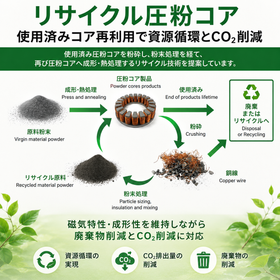
Amid demands for addressing CO₂ emissions and resource circulation of products, there are cases where companies hesitate to switch materials due to concerns such as "I want to use recycled materials, but will the magnetic properties decrease?" and "Will there be constraints on shape design and strength?" Balancing environmental impact reduction with product performance is a challenge in design and procurement. Daimat proposes a recycling technology that crushes used powder cores, processes them into powder, and then reshapes and heat-treats them back into powder cores. ■ Maintaining properties even with recycled materials ▼ Magnetic properties are equivalent to virgin materials ▼ Mechanical properties are also equivalent to virgin materials ▼ Molding properties are comparable, allowing for three-dimensional shape formation ■ Addressing resource circulation ▼ Used powder cores are crushed and processed for reuse as raw materials ▼ Connecting waste to reuse contributes to the realization of a circular economy ▼ Can be proposed as a material option for CO₂ reduction We also anticipate applications in areas requiring three-dimensional shapes, such as cores for axial gap motors. Documents summarizing the re-resource process of used powder cores and a comparison of properties with virgin materials, as well as more detailed benefits of introducing and utilizing recycled materials, can be downloaded below.
Added to bookmarks
Bookmarks listBookmark has been removed
Bookmarks listYou can't add any more bookmarks
By registering as a member, you can increase the number of bookmarks you can save and organize them with labels.
Free membership registration
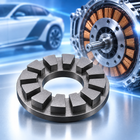
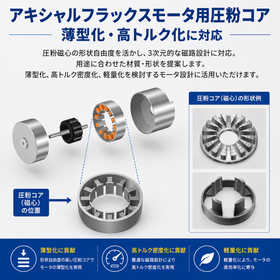
While we want to promote the miniaturization and lightweight design of motors, we face challenges such as "increasing shaft length and weight when securing the necessary torque" and "difficulty in accommodating three-dimensional magnetic circuit shapes with electromagnetic steel sheets." In response to these design challenges, reconsidering magnetic materials and core shapes becomes a viable option. Daimet's powder core for axial flux motors takes advantage of the design flexibility of powder magnetic cores, enabling three-dimensional magnetic circuit design. We propose materials and shapes tailored to specific applications. ■ Supporting thin and high-torque designs ▼ Accommodates three-dimensional core shapes with powder cores ▼ In prototype machines, shaft length is reduced by half compared to conventional RFM ratios ▼ Maximum torque of 30Nm and maximum torque density of 8.48Nm/kg in prototype machines ■ Compatible with various motor shapes ▼ Core for axial flux motors ■ Application examples ▼ EVs, industrial robots ▼ Aircraft, eVTOL, generators This can be utilized in motor designs considering thinness, high torque density, and lightweight construction. Documents summarizing the structural and performance comparisons of AFM using powder cores, as well as more detailed benefits of achieving thinner and higher torque density motors, can be downloaded from the link below.
Added to bookmarks
Bookmarks listBookmark has been removed
Bookmarks listYou can't add any more bookmarks
By registering as a member, you can increase the number of bookmarks you can save and organize them with labels.
Free membership registration
In machine parts that require high strength, there are challenges such as "wanting to increase strength while keeping material costs down" and "wanting to review part costs while ensuring wear resistance and load-bearing capacity." In conventional Ni (nickel) alloy materials, even if the required strength is met, material costs can be an issue. DIA-MET's Fe-Cu-C series high-density, high-strength sintered materials enhance strength through increased density and can be used as an alternative to Ni alloy high-strength materials. We propose their application in machine parts such as sprockets for VVT. ■ Features of high-density materials ▼ Utilization of inertial force due to increased mass ▼ Improved wear resistance and rigidity ■ Features of high-strength materials ▼ Enhanced load-bearing capacity ▼ Improved resistance to impact and fatigue, leading to longer lifespan ■ DIA-MET's manufacturing method ▼ High density can be achieved only in necessary areas ▼ Compared to conventional Ni alloy materials, it can achieve 1.6 times higher strength and a 30% reduction in cost ▼ Materials can be proposed according to required specifications By increasing the density in necessary areas, it is possible to consider a balance between required characteristics and costs. Documents summarizing the characteristics of Fe-Cu-C series high-density, high-strength materials compared to conventional Ni alloy materials, as well as more detailed benefits from their introduction and utilization in machine parts, can be downloaded below.
Added to bookmarks
Bookmarks listBookmark has been removed
Bookmarks listYou can't add any more bookmarks
By registering as a member, you can increase the number of bookmarks you can save and organize them with labels.
Free membership registration
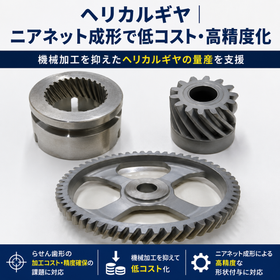
Helical gears are easy to suppress torque fluctuations while maintaining low noise and low vibration, but it is necessary to impart a helical tooth shape with high precision. Balancing the desire to "reduce processing steps and control costs" with the need to "ensure required precision" is a design challenge. Daiamet utilizes dedicated mold design and molding technology to achieve near-net shaping of helical shapes. Depending on the required precision, additional processing can be combined to propose a shape that considers the balance between cost and precision. ■ Cost reduction through near-net shaping ▼ Imparting helical tooth shapes with dedicated molds and molding technology ▼ Supporting mass production of helical gears with reduced machining ■ High precision according to required specifications ▼ Responding to high-precision shape imparting through additional processing as needed ▼ Combining molding and processing based on application and required precision ■ Proposal from shape design ▼ Designing and proposing helical shapes suitable for near-net shaping ▼ Developing partial helical shapes for near-net shaping This can be utilized in gear design that aims to achieve both low noise, low vibration, and reduced mass production costs. Documents summarizing the near-net shaping and shape imparting technology for helical gears, as well as more detailed benefits from reducing processing steps and achieving high precision, can be downloaded below.
Added to bookmarks
Bookmarks listBookmark has been removed
Bookmarks listYou can't add any more bookmarks
By registering as a member, you can increase the number of bookmarks you can save and organize them with labels.
Free membership registration
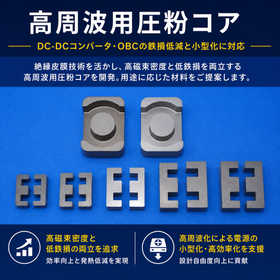
In the high-frequency operation of DC-DC converters and onboard chargers, challenges arise such as "wanting to reduce core iron losses" and "wanting to miniaturize magnetic components." In the range of tens to hundreds of kHz, material selection according to frequency significantly affects efficiency and size. At Diamet, we leverage insulation coating technology to develop high-frequency pressed powder cores that achieve both high magnetic flux density and low iron losses. We propose materials tailored to specific applications. ■ Support for high-frequency range ▼ Developing alloy cores that can handle tens to hundreds of kHz ▼ Pursuing the balance of high magnetic flux density and low iron losses ▼ Supporting miniaturization and high efficiency of power supplies through high-frequency operation ■ Material lineup ▼ Standard material MBS-RXA6 offers low loss and high permeability ▼ MBS-RXA61 improves upon MBS-RXA6 with lower loss and higher permeability ▼ MBS-RXA7 is a high-frequency low iron loss material for resonant coils *For more details, please download the PDF or feel free to contact us.
Added to bookmarks
Bookmarks listBookmark has been removed
Bookmarks listYou can't add any more bookmarks
By registering as a member, you can increase the number of bookmarks you can save and organize them with labels.
Free membership registration
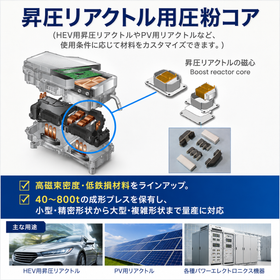
In boost circuits for HEVs and PVs, there are challenges such as the desire to "miniaturize and lighten the reactor" while accommodating large currents and "reducing iron losses." Additionally, core designs that consider heat resistance and assembly strength are necessary. Daiamet's powdered core for boost reactors offers a lineup of high magnetic flux density and low iron loss materials. We possess molding presses ranging from 40 to 800 tons, capable of mass production from small, precise shapes to large, complex shapes. ■ Miniaturization and High Efficiency ▼ Supports miniaturization and weight reduction through high magnetic flux density ▼ Accommodates large current applications ▼ Achieves high efficiency through reduced eddy currents and minimized gaps ■ Material Proposals Based on Applications ▼ Offers pure iron-based, alloy-based, and pure iron + alloy-based options ▼ Development examples that enhance heat resistance, usable up to 240°C ▼ Development examples for gapless designs through reduced permeability ▼ Development examples aimed at increasing mechanical strength to prevent chipping during assembly Materials can be customized according to usage conditions, such as for boost reactors for HEVs or reactors for PVs. Documents summarizing the material lineup, magnetic properties, and development examples, as well as more detailed benefits of miniaturization and high efficiency of reactors, can be downloaded from the link below.
Added to bookmarks
Bookmarks listBookmark has been removed
Bookmarks listYou can't add any more bookmarks
By registering as a member, you can increase the number of bookmarks you can save and organize them with labels.
Free membership registration
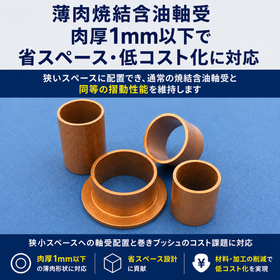
As equipment becomes more compact, challenges arise such as "the gap between the shaft and housing is narrow, making it impossible to place bearings" and "we want to replace bushings to reduce costs." Balancing space-saving and sliding performance becomes a key point in bearing selection. DIA-MET's thin-walled sintered oil-impregnated bearings can be manufactured with a wall thickness of less than 1mm for both inner and outer diameters. They can be placed in tight spaces while maintaining sliding performance equivalent to that of standard sintered oil-impregnated bearings. ■ Space-saving design through thin-walling ▼ Can be manufactured with a wall thickness of less than 1mm ▼ Can be inserted into a 1mm gap between the shaft and housing ▼ Suitable for narrow spaces where ball bearings are difficult to place ■ Replacement of bushings ▼ Ensures good sliding performance through base material properties and oil impregnation in pores ▼ No sliding treatment required, which is necessary for unlubricated bushings ■ Cost reduction ▼ Net shape forming that does not require machining ▼ Maintains sliding performance equivalent to that of standard sintered oil-impregnated bearings This can be utilized in the bearing design of equipment aimed at miniaturization and reducing component costs. Documents comparing thin-walled bearings with bushings and ball bearings, as well as more detailed benefits from space-saving and cost reduction, can be downloaded from the link below.
Added to bookmarks
Bookmarks listBookmark has been removed
Bookmarks listYou can't add any more bookmarks
By registering as a member, you can increase the number of bookmarks you can save and organize them with labels.
Free membership registration
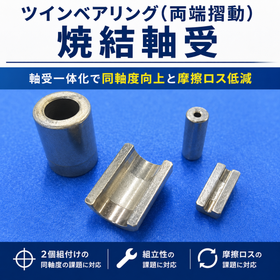
When two bearings are arranged with shaft support, challenges arise such as "difficulty in ensuring coaxiality during assembly" and "the desire to reduce the number of parts." On the other hand, long straight bearings can increase the contact area of the inner diameter, leading to greater friction loss. DIA-MET's twin bearing integrates the bearing functions that were traditionally supported by two separate units. By making both ends sliding parts and the central part a relief shape, it maintains the shaft holding length while minimizing the contact area. ■ Integration of two bearings ▼ Improved inner diameter coaxial accuracy through integrated manufacturing ▼ Easier assembly compared to using two separate units ▼ Maintains contact area during assembly with an outer diameter straight shape ■ Reduced friction loss ▼ The central part is designed as a relief shape, reducing the inner diameter contact area ▼ The sliding parts at both ends ensure the shaft holding length ▼ Good pore condition is maintained on the sliding surface ■ Compatibility with small diameters ▼ Can be manufactured with inner diameters from approximately φ10 to φ1.5 The integration of bearings allows for a comprehensive review of the number of parts, assembly efficiency, coaxiality, and friction loss, making it useful for designs that aim to address these aspects. Documents summarizing the structure, inner diameter shape, and comparisons with conventional products of the twin bearing, as well as more detailed benefits of improved assembly efficiency and reduced friction loss due to bearing integration, can be downloaded below.
Added to bookmarks
Bookmarks listBookmark has been removed
Bookmarks listYou can't add any more bookmarks
By registering as a member, you can increase the number of bookmarks you can save and organize them with labels.
Free membership registration
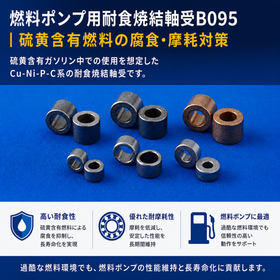
The fuel pump bearings continuously rotate while always being immersed in gasoline. Particularly with fuels containing impurities such as sulfur, the challenges in material selection that affect long-term durability are whether "the bearing performance will not degrade due to corrosion" and "whether wear can be minimized even in harsh sliding environments." DIA-MET's B095 is a corrosion-resistant sintered bearing made of a Cu-Ni-P-C alloy, designed for use in sulfur-containing gasoline. Compared to the conventional material B031, it enhances both sulfur resistance and wear resistance. ■ Corrosion resistance to sulfur-containing fuel ▼ Conducted a 200-hour immersion test in sulfur-added gasoline (333K) ▼ B095 maintained a good appearance even under conditions where corrosion was observed with the conventional material B031 ■ Wear resistance ▼ Reduced wear amount in durability tests with a contact pressure of 1.4 N/mm² and a sliding speed of 1.8 m/s ▼ The condition of the counterpart shaft after testing was also good ■ Application examples ▼ Fuel pump Considering the differences in fuel quality, this can be utilized for material selection and design considerations for fuel pump bearings that require measures against both corrosion and wear. Documents summarizing the sulfur resistance and wear resistance tests of B095 compared to conventional materials, as well as more detailed benefits from its introduction and utilization in fuel pumps, can be downloaded from the link below.
Added to bookmarks
Bookmarks listBookmark has been removed
Bookmarks listYou can't add any more bookmarks
By registering as a member, you can increase the number of bookmarks you can save and organize them with labels.
Free membership registration
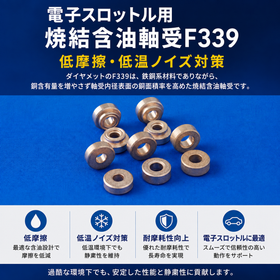
In automotive motors such as electronic control throttles, in addition to low friction, stable operation at room temperature and noise reduction during low-temperature starts are required. When selecting copper-based materials to enhance performance, balancing material costs can also be a challenge. Daiamet's F339 is a sintered oil-bearing bearing made from iron-copper-based material that increases the copper area ratio of the bearing inner diameter surface without increasing the copper content. It improves friction characteristics compared to the conventional material F336. ■ Material Design Supporting Low Friction ▼ Improved copper area ratio on the surface from the conventional 20-50% to over 80% ▼ Strengthened copper alloy phase with uniform dispersion of graphite in the matrix ▼ Improved static and dynamic friction characteristics at room temperature ■ Performance Required for Automotive Motors ▼ Suppression of startup noise at low temperatures ▼ Material design targeting the sliding characteristics of copper-based materials using iron-copper-based materials ■ Application Examples ▼ Electronic control throttle motors ▼ Power seat motors, EPB motors This can be utilized for selecting bearings for automotive motors that prioritize friction characteristics and quietness during low-temperature starts. Documents summarizing the material structure, copper area ratio, and friction characteristics of F339, as well as more detailed benefits from its introduction and use in automotive motors, can be downloaded from the link below.
Added to bookmarks
Bookmarks listBookmark has been removed
Bookmarks listYou can't add any more bookmarks
By registering as a member, you can increase the number of bookmarks you can save and organize them with labels.
Free membership registration
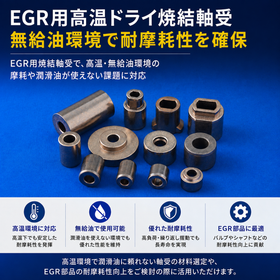
The bearings for EGR (Exhaust Gas Recirculation) are used in the valve that directs a portion of the exhaust gas to the intake side, and they are utilized in a wide range of exhaust gas environments, from atmospheric temperatures to high temperatures where lubricating oil cannot be used. Therefore, by adding a large amount of solid lubricants to the bearing material itself, we have achieved a material that excels in self-lubrication at high temperatures and has excellent oxidation resistance, contributing to the reduction of NOx and improved fuel efficiency in automobiles. Please feel free to contact us if you have any inquiries. *For more details, please download the PDF or feel free to contact us.
Added to bookmarks
Bookmarks listBookmark has been removed
Bookmarks listYou can't add any more bookmarks
By registering as a member, you can increase the number of bookmarks you can save and organize them with labels.
Free membership registration
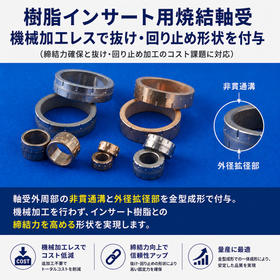
In the design of inserting bearings into resin parts, the challenges are "how to prevent the bearings from coming out during use" and "how to prevent misalignment in the rotation direction." Adding additional processing for retention and rotation prevention increases the number of processes and leads to higher costs. Daimet's sintered bearings for resin inserts feature a non-through groove on the outer circumference and an outer diameter expansion section formed by molding. This achieves a shape that enhances the fastening force with the insert resin without the need for machining. ■ Shapes for resin inserts ▼ Non-through grooves on the outer circumference formed by molding ▼ An outer diameter expansion section to prevent axial displacement ▼ Outer shape to prevent rotation misalignment ■ Support for irregular inner and outer diameters ▼ Irregularities in the inner or outer diameter achieved through molding ▼ Utilized for preventing shaft rotation in thrust sliding parts ■ Cost reduction ▼ Eliminates additional machining processes, balancing shape formation and cost reduction This can be utilized for rationalizing designs that include fastening with resin and preventing shaft rotation, among other peripheral components. Documents summarizing the shapes and functions of sintered bearings with irregular inner diameters for resin inserts, as well as more detailed benefits of process reduction and enhanced fastening force without machining, can be downloaded below.
Added to bookmarks
Bookmarks listBookmark has been removed
Bookmarks listYou can't add any more bookmarks
By registering as a member, you can increase the number of bookmarks you can save and organize them with labels.
Free membership registration
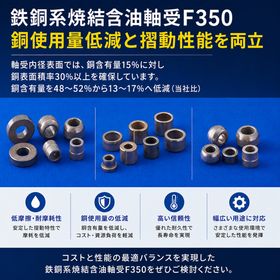
In automotive and home appliance motors, there is a challenge to ensure stable sliding performance while also keeping material costs down. In particular, copper-based sintered oil-impregnated bearings are susceptible to fluctuations in copper prices, and reducing the amount of copper used raises concerns about whether friction characteristics will deteriorate during material selection. The Diamet F350 is an iron-copper-based sintered oil-impregnated bearing that achieves a high copper coating rate on the sliding surface while keeping the copper content low by using special copper powder. On the inner diameter surface of the bearing, it maintains a copper content of 15% with a copper surface area ratio of over 30%. ■ Balancing material cost reduction and sliding performance ▼ Material cost ratio of 0.6 compared to the comparative material F336 ▼ Reduction of copper content from 48-52% to 13-17% ▼ Improvement of copper coating rate on the sliding surface through special copper powder ■ Friction characteristics ▼ Maintains friction characteristics equivalent to the comparative material F336 ▼ The bearing itself is impregnated with lubricating oil, exhibiting self-lubricating functionality This can be utilized in the material selection for motor components where there is a desire to reduce copper usage while maintaining bearing performance. Documents summarizing the material composition, copper coating rate, and friction characteristics of the F350, as well as more detailed benefits from material cost reduction and maintenance of sliding performance, can be downloaded from the link below.
Added to bookmarks
Bookmarks listBookmark has been removed
Bookmarks listYou can't add any more bookmarks
By registering as a member, you can increase the number of bookmarks you can save and organize them with labels.
Free membership registration
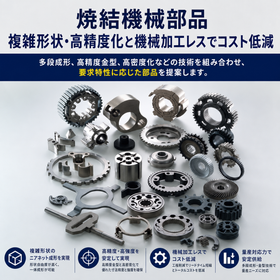
In the design of mechanical parts, there are challenges such as "wanting to mass-produce complex shapes with high precision" and "wanting to reduce machining while ensuring strength." As the shape becomes more complex, the number of processing steps increases, making it difficult to balance cost and productivity. Daimet's sintered mechanical parts combine technologies such as multi-stage forming, high-precision molds, and high-density manufacturing to propose parts that meet the required characteristics. ■ Complex Shapes and High Precision ▼ Responding to complex shapes with multi-stage forming technology ▼ Supporting reduction of machining through shape impartation with high-precision molds ▼ Addressing high strength through high-density manufacturing ■ Product Lineup ▼ Components of variable valve timing mechanisms ▼ Sprockets for roller chains and silent chains ▼ Machining-free pulleys ▼ IPR oil pump rotors with high discharge efficiency, low friction, and low noise ■ Design Proposals ▼ Proposing IPR tooth profiles and port shapes according to requirements This can be utilized for cost reduction considerations of mechanical parts that require complex shapes, high precision, and high strength. Documents summarizing examples of sintered mechanical parts, forming technologies, and design proposals, as well as more detailed benefits of reducing machining and achieving high precision, can be downloaded from the link below.
Added to bookmarks
Bookmarks listBookmark has been removed
Bookmarks listYou can't add any more bookmarks
By registering as a member, you can increase the number of bookmarks you can save and organize them with labels.
Free membership registration
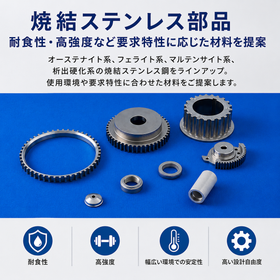
When designing components used in exhaust systems and water systems, the selection of materials becomes more challenging as the required characteristics increase, such as "the need for materials that can withstand corrosive environments" and "the desire to achieve both high strength and magnetism." It is necessary to consider the material for each application while also taking into account the costs during mass production. Daimet offers a lineup of sintered stainless steels, including austenitic, ferritic, martensitic, and precipitation-hardened types. We can suggest materials tailored to the usage environment and required characteristics. ■ Material selection based on required characteristics ▼ Outboard motors, automotive exteriors, water systems, and chemical industries requiring corrosion resistance and ductility ▼ Automotive exterior parts and ABS sensor rings requiring magnetism and corrosion resistance ▼ Exhaust parts and welded components requiring magnetism, corrosion resistance, and airtightness ▼ High-strength components requiring high strength and wear resistance ▼ Various bolts and shafts requiring corrosion resistance, high strength, and ductility You can also check reference values for density, hardness, tensile strength, Charpy impact value, elongation, thermal expansion coefficient, and corrosion resistance for each material, which can be utilized for material comparison during the design phase. Documents summarizing the characteristics and application examples of sintered stainless steels by material type, as well as more detailed benefits of material selection based on required specifications, can be downloaded from the link below.
Added to bookmarks
Bookmarks listBookmark has been removed
Bookmarks listYou can't add any more bookmarks
By registering as a member, you can increase the number of bookmarks you can save and organize them with labels.
Free membership registration