Solving the inefficiency issues of motor efficiency measurement based on the TN curve through automatic control.
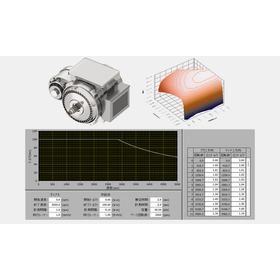
The company introducing this case study is a Tier 1 supplier to a major domestic automotive OEM. As electrification progresses, the company is responsible for the development and evaluation of permanent magnet (IPM) motors for HEVs (hybrid electric vehicles), and there was a need to establish a high-precision verification system for motor performance. In particular, they regularly conducted efficiency measurements along the TN curve, making it essential to balance the improvement of testing accuracy with the efficiency of evaluation operations. In their current operation for efficiency measurement along the motor's TN curve, the company manually inputs command values for the rotational speed and load torque at several hundred operating points for measurement. Additionally, manual operation leads to fluctuations in input values and measurement timing, resulting in a lack of reproducibility and an unrealistic situation where it takes more than a day to complete testing. Thus, the current efficiency measurement operation based on the TN curve faces challenges in both workload increase and reproducibility and safety, making the automation of testing highly sought after. Seagull Co., Ltd. has newly established a control system that consistently executes everything from generating speed and torque commands at each operating point to control, measurement, and data acquisition in order to automate motor efficiency measurement along the TN curve.
Inquire About This Product
basic information
First, define the TN curve on the HMI and set the command values for speed and torque corresponding to each operating point. The configured data is sequentially transmitted via the embedded CPU to the inverters on both the specimen side and the testing machine side, allowing the specimen motor to be driven at the specified rotational speed while the corresponding load torque is applied by the dynamo on the testing machine side. Specifically, for conditions such as "1000rpm・5Nm," the specimen motor is rotated up to 1000rpm, and a load of 5Nm is applied from the testing machine side to reproduce the operating point on the TN curve. In this way, by automatically reproducing the rotation (speed) and load (torque) at each point on the TN curve in sequence, continuous testing is achieved without manual intervention.
Price range
Delivery Time
Applications/Examples of results
At each action point, when the set speed and torque conditions are reproduced, data such as voltage, current, torque, and rotational speed are automatically acquired by the power analyzer. Based on this data, power and motor efficiency are calculated, and the measurement results are stored in a computer. This system automatically executes control and measurement at each point as a series of sequences, allowing for the continuous acquisition of efficiency data at all action points on the TN curve under stable conditions. Furthermore, the acquired data is directly output as a report, streamlining the evaluation and analysis process. With the introduction of this system, the efficiency measurement based on the motor's TN curve, which previously took more than a day, has been significantly reduced to about one hour. The operation has become such that tests are completed with a single click, greatly reducing the workload and stress on the testing personnel. Additionally, the reduction and stabilization of the time required for motor efficiency evaluation tests contribute to shortening the development cycle and reducing testing man-hours, ultimately leading to cost savings. Moreover, the risk of overload due to manual input errors is also minimized, making it effective in protecting the test motors and testing equipment.
Detailed information
-
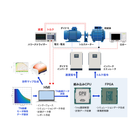
At SeaGoTo Co., Ltd., we have newly constructed a control system that automates the measurement of motor efficiency along the TN curve, executing everything from the generation of speed and torque commands at each operating point to control, measurement, and data acquisition in a consistent manner. This enables a testing environment where operations and measurements at each point, which were previously done manually, can now be automatically executed with a single click from the software. First, the TN curve is defined on the HMI, and the command values for speed and torque corresponding to each operating point are set. The configured data is sequentially transmitted via an embedded CPU to the inverters on both the specimen side and the testing machine side, driving the specimen motor at the specified rotational speed while simultaneously applying the corresponding load torque from the dynamometer on the testing machine side. Specifically, for conditions such as "1000rpm and 5Nm," the specimen motor is rotated up to 1000rpm, and a load of 5Nm is applied from the testing machine side to reproduce the operating point on the TN curve. By sequentially and automatically reproducing the rotation (speed) and load (torque) at each point on the TN curve in this manner, continuous testing is achieved without manual intervention.
Company information

Our company is engaged in measurement and control applications, test simulation proposals, replacement and functional enhancement of test equipment and measurement, and the provision of original hardware. With the mission of "making the world simpler and better" through software and electronics technology, we create value through technological development and will continue to contribute sustainably to various industrial fields. Please feel free to contact us when you need our services.