Improving the accuracy and efficiency of motor evaluation through torque ripple measurement and control.
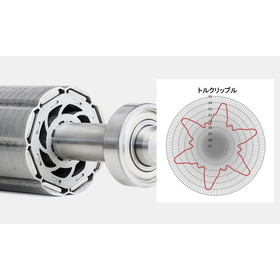
The company introducing this case study is a Tier 1 supplier supporting a major domestic automotive OEM. This company is responsible for the development and manufacturing of permanent magnet synchronous motors (IPM motors), primarily for hybrid vehicles, and has been facing increasing demands for more advanced performance evaluation and quality verification as electrification progresses. In the development of hybrid IPM motors, the need for more precise evaluation of motor characteristics has grown, but the company has been challenged by the lack of an environment capable of accurately measuring torque ripple. While existing testing equipment allowed for basic performance evaluation during rotation, it could not quantitatively capture torque variations, such as "torque ripple," which are directly related to the quality of motor rotation. Seagoat Co., Ltd. developed a dedicated measurement control application that integrates rotational control and torque measurement in angle units to accurately evaluate torque ripple in hybrid IPM motors. This system establishes an evaluation environment that quantitatively visualizes torque variations at different angles by integrally controlling the rotational angle of the test motor, torque measurement, and data acquisition and storage.
Inquire About This Product
basic information
In this system, based on commands from a PC, the motor on the testing machine is controlled via cRIO, allowing the specimen to be rotated in small angular increments. For example, after rotating by 0.5 degrees, the axis is stopped and held at that position, and the torque at that angle is measured. The torque measurement is performed by a torque meter installed between the specimen motor and the testing machine, and the values are acquired and recorded by a power analyzer. By repeating this process from 0 degrees to 360 degrees, it is possible to obtain a torque distribution around the entire circumference, allowing for a high-precision understanding of the periodicity and variation characteristics of torque ripple. Additionally, the angular resolution can be flexibly set in units such as 0.1 degrees or 0.5 degrees, enabling measurements at finer steps and accommodating the acquisition of high-resolution torque data. In this application, operations from the PC allow for integrated control of the testing machine's rotational angle control, torque measurement, and data acquisition and storage. The control system centered on cRIO sends commands to the inverter, achieving the rotational angle operation of the testing machine motor, while the measurement values from the torque meter are fed back to the PC via the power analyzer.
Price range
Delivery Time
Applications/Examples of results
The introduction of this system has made it possible to quantitatively grasp the differences between the torque ripple anticipated during the motor design phase and the actual measured values in the real machine. This feedback of the factors causing the discrepancies into the design contributes to improving the accuracy of motor design. Furthermore, with the automation of the measurement process, torque measurements based on the set angular resolution can now be continuously executed simply by issuing a start command for the tests. This has led to increased efficiency in evaluation tasks. In addition, the automation of testing has also contributed to reducing stress for workers on-site. As a result, it has enabled the stabilization of evaluation tasks and a shift of resources towards more advanced analysis and examination work.
Detailed information
-
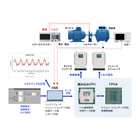
At SeaGoTo Co., Ltd., we have developed a dedicated measurement control application that integrates rotational control in angular units and torque measurement to accurately evaluate the torque ripple of hybrid IPM motors. This system creates an evaluation environment that quantitatively visualizes the torque variation at each angle by controlling the rotation angle of the test motor, torque measurement, and data acquisition and storage in an integrated manner. In this system, based on commands from a PC, the motor on the testing machine is controlled via cRIO, and the specimen is rotated in incremental small angles. For example, after rotating by 0.5 degrees, the axis is stopped and held at that position to measure the torque at that angle. Torque measurement is performed using a torque meter installed between the specimen motor and the testing machine, and the values are acquired and recorded by a power analyzer. By repeating this from 0 degrees to 360 degrees, we can obtain the torque distribution over a full rotation, allowing for a high-precision understanding of the periodicity and variation characteristics of torque ripple. Additionally, the angular resolution can be flexibly set in units such as 0.1 degrees or 0.5 degrees, enabling the acquisition of high-resolution torque data by measuring in finer steps.
Company information

Our company is engaged in measurement and control applications, test simulation proposals, replacement and functional enhancement of test equipment and measurement, and the provision of original hardware. With the mission of "making the world simpler and better" through software and electronics technology, we create value through technological development and will continue to contribute sustainably to various industrial fields. Please feel free to contact us when you need our services.