Exporting Cosmetics (Export Notification and Certificates of Free Sale)
CC-06 | PMD Act | Cosmetics | Export notification and certificates
When you export cosmetics. The export notification for cosmetics and obtaining the certificates of free sale requested by the importing country.
When manufacturing or importing cosmetics for export, an export notification (Form 114) may be required. Products notified for export are exempt from the statutory container labeling under Article 61, but some provisions still apply. When the importing country requests a certificate of free sale, the usual route is a certificate issued by the Japan Cosmetic Industry Association. There are five forms, chosen according to what the importing country requires. A certificate from the Ministry of Health, Labour and Welfare may also be needed. We learn about the destination and your products, determine whether an export notification is needed, prepare it, and select the certificate form matching the importing country's request and apply for issuance.
Inquire About This Product
basic information
[For] Businesses exporting cosmetics [Services] Determining whether the export notification is required and preparing it / selecting the certificate form and applying for issuance / procedures for changes [Legal basis] PMD Act Enforcement Order Article 74; Enforcement Regulations Article 265
Price information
Please see our fee table via the QR code in the catalog (PDF). Government fees are charged separately. The first consultation is free.
Price range
P2
Delivery Time
※Please contact us once you know what documents the importing country requires.
Applications/Examples of results
Typical situations: - An overseas customer asked for a certificate of free sale - You want to make products with export-specific labeling - You are unsure which certificate form to obtain - You are unsure whether an export notification is needed
catalog(1)
Download All Catalogs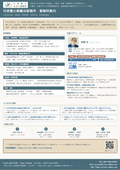
Company information
Our office is run by an administrative scrivener (gyoseishoshi) who completed a master's course at Kyoto University Graduate School of Engineering and then worked as a researcher at a chemical manufacturer, developing cosmetics, detergents, adhesives, semiconductor and optical materials. Hands-on experience also includes SDS preparation, waste liquid management and risk assessment. Because we can read structural formulas, SDSs and process flow diagrams as they are, you do not need to spend time explaining your technology. We prepare documents grounded in both science and law, and handle communication with the authorities. As a Class A Hazardous Materials Engineer and a 1st Grade Certified Skilled Worker of Financial Planning, we also support capital investment subsidies and business plans from the perspective of profitability and cash flow. The first consultation is free.