

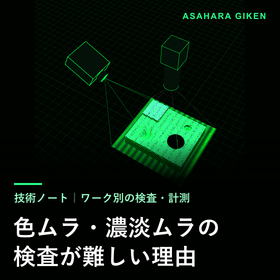
Reasons and Approaches for the Difficulty of Inspecting Color Variations and Shade Variations
Color variations and gradation inconsistencies do not have clear boundaries like scratches or chips. People assess the gently changing shades based on the angle of view and the lighting. To inspect images, it is necessary to maintain consistent lighting and convert the variations into numerical values. The process of converting the limit samples into numbers determines the success or failure of the inspection. [Key Points] ■ Variations have no boundaries, making it difficult to draw a standard line. ■ The appearance changes depending on the lighting and viewing angle, so conditions are fixed. ■ Measure the limit samples and convert them into numerical standards. *For detailed explanations, please refer to the technical notes and downloadable materials in the related links.
Inquire About This Product
basic information
【Contents of this Technical Note】 ■ Color unevenness is difficult to define because there are no clear boundaries. ■ Factors that influence appearance. ■ To quantify unevenness, examine the differences from the reference surface. ■ Measure the limit sample to determine the reference line. ■ Cases where it is unsuitable and appropriate uses of AI. ■ Common mistakes in color unevenness inspection. ■ Take a limit sample of color unevenness and check if a line can be drawn. 【Consultation】 I will confirm whether it can be measured or captured with the actual item. Please consult with one photo.
Price information
The technical notes can be read by anyone from the related links. We will discuss the costs of development and testing based on the details you provide.
Delivery Time
※It varies depending on the content. Please contact us.
Applications/Examples of results
【Frequently Asked Questions】 Q. Can the variations seen by the human eye be directly translated into numbers? A. If the lighting and shooting method are fixed, it may be possible to get close. Areas where the appearance changes with viewing angles require multiple shooting methods. We will verify with a limit sample. Q. Does the method of measuring color change with the type of camera? A. Yes, it does. The characteristics of the camera and lighting affect the color numbers. The color numbers from the camera are meant for comparison within that device. They cannot be directly compared to the values from dedicated color measurement instruments. If the equipment is changed, the same sample should be measured again. Q. Is AI necessary for color variation inspection? A. It is not needed if lines can be drawn with numbers. In cases where there are patterns and it is difficult to quantify, AI becomes an option.
catalog(2)
Download All Catalogs![[Technical Document] Automation of Visual Inspection: Approach and Common Pitfalls, How to Capture Images and Choose Lighting Before AI](https://image.mono.ipros.com/public/catalog/image/2115800/IPROS9310882243773939791.png?w=120&h=170)
![[Sample Test Information] Before the estimate, we will let you know whether it can be measured (visual inspection and 3D measurement).](https://image.mono.ipros.com/public/catalog/image/2115800/IPROS16473448823474693670.png?w=120&h=170)
Company information

We specialize in 2D and 3D inspection and measurement technologies using cameras. We possess a wide range of knowledge in optics, mechanics, electronics, and software, enabling us to provide technical support for both hardware and software. Not only do we have personnel with experience working as researchers at image inspection device manufacturers, major electronic component manufacturers, and universities, but we also have numerous successful implementations of developed products in actual production environments, making our ability to adapt advanced technology to on-site needs a strong point. Additionally, we are skilled not only in developing proprietary algorithms but also in using off-the-shelf products such as image processing controllers from Keyence and Omron, allowing us to excel in selecting and utilizing the most suitable equipment for specific needs. In recent years, while AI technology has garnered attention, there are cases where utilizing 2D and 3D technologies can be implemented more easily than AI, and cases where optical devices and mechanical jigs can improve performance and reduce software load. We offer services related to image systems, including "equipment selection," "implementation support," "performance improvement of existing equipment," "technology development," and "joint development," so please feel free to consult with us first.


![[Analysis Case 14] Radioactive Material Inspection](https://image.mono.ipros.com/public/product/image/dcc/2000641502/IPROS73268535361508313513.jpeg?w=280&h=280)

