
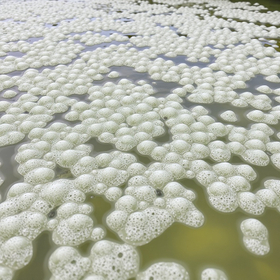
Aeration involves sending air into the drainage to deliver oxygen and mix the contents of the tank. This introduces the types of diffusers and explains how the dissolution of oxygen varies with the size of the bubbles and the water depth.
Aeration refers to the process of introducing air or other gases into wastewater to supply oxygen to the water. In aerobic biological treatment methods like the activated sludge process, aerobic microorganisms that decompose organic matter require oxygen, which is supplied through aeration tanks (reaction tanks). ■ Is the role of aeration only to provide oxygen? The basic functions of aeration equipment are as follows: 1. Oxygen supply: Blowing air to dissolve oxygen in the water. 2. Mixing: Stirring the tank to prevent activated sludge from settling. If there is insufficient oxygen, the activity of microorganisms decreases, and if mixing is inadequate, activated sludge accumulates at the bottom of the tank. Using underwater mixers in aerobic tanks requires additional power for mixing, in addition to the power for the blowers. ■ There is more than one way to aerate There are several methods of aeration, including: 1. Diffused aeration (fine bubble type, coarse bubble type, etc.) 2. Mechanical surface aerators (fixed type, floating type) 3. Submerged aerators 4. Ejector devices The choice of method depends on factors such as mixing method, cost-effectiveness, ease of maintenance, and site conditions. Please feel free to consult with us first.
Inquire About This Product
basic information
■Representative Devices of Aeration Type The main aeration devices of the aeration type are as follows: 1. Aeration plates and aeration tubes: These are made by forming particles of ceramic or synthetic resin into a porous structure. 2. Membrane type: This uses a membrane with fine holes that is inflated by air pressure to release ultra-fine bubbles through the holes. ■What Changes When Bubbles Are Smaller? Oxygen transfers into the water through the surface where the bubbles and water meet (gas-liquid interface). For the same volume of air, the smaller the bubbles, the larger the surface area that comes into contact with the water. With ultra-fine bubbles, the surface area for oxygen transfer increases, resulting in a higher oxygen transfer efficiency. ■How Much of the Supplied Oxygen Dissolves? Oxygen transfer efficiency represents the proportion of oxygen in the supplied air that dissolves in the water. In a calculation where the conventional type is set at 15% and the ultra-fine bubble type at 30%, the required air volume is halved. Actual values may vary depending on conditions. If it is 15%, it is calculated that 85% of the supplied oxygen does not dissolve. ■Does Efficiency Increase with Depth? The deeper the aeration water depth, the higher the oxygen transfer efficiency; however, it is also necessary to increase the discharge pressure of the blower, so a standard depth is set at 6 meters or less.
Price range
Delivery Time
Applications/Examples of results
■Is the performance value based on clear water?! The design value for the oxygen transfer efficiency of the aeration device is based on clear water at 20°C and 101.3 kPa. Since the rate of oxygen transfer differs in wastewater compared to clear water, corrections are made using the ratio of oxygen transfer rate to clear water (α value). The α value varies with the characteristics of the wastewater, with examples calculating it to be around 0.9 for food factory wastewater. ■Where is electricity used? In a survey of 33 wastewater treatment plants, the proportion of energy consumption attributed to blowers was 32% in plants without incineration facilities and 20% in other plants. The required air volume is determined by the treated water volume, inflow water quality, and MLSS concentration, and it increases if the MLSS is excessive. ■Be careful of clogging in aeration devices! Aeration plates and aeration tubes are designed to experience increased pressure loss (resistance to air flow) over time. On the other hand, low-pressure loss membrane types that are less prone to clogging during shutdown have also been developed. ■Equipment located at the bottom of the pond Aeration devices are underwater equipment used submerged near the bottom of the pond. Our company has experience updating aeration devices (diffusers) in aeration tanks. Please feel free to consult us first.
catalog(3)
Download All Catalogs
Company information

Since our founding, we have continued to provide flexible services with the motto of accurately supplying a diverse range of products that respond to changes in the times and the diversification of consumer needs, tailored to various applications and requirements. With the corporate slogan "Chemical Engineering Partner," we, as a group of experts in chemical technology, actively discover ideas to solve our customers' problems from advanced technologies both domestically and internationally, and propose them.