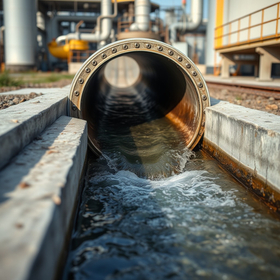
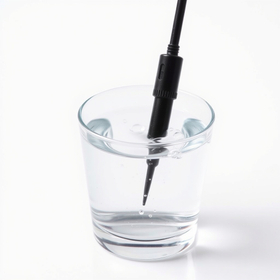
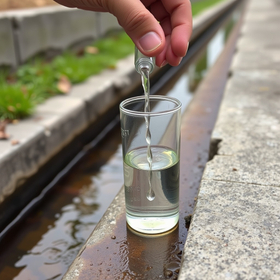
Self-monitoring by measuring and recording wastewater within the company. We will organize the number of measurements, the time and location of sampling, and the duration of record retention, which vary depending on whether the water is discharged into a river or a sewer.
In the water quality testing of factory effluent, there are requirements set by law for businesses to measure and record the data themselves. According to materials from the Ministry of the Environment, this is referred to as self-monitoring. The specific law governing the measurements depends on whether the effluent is discharged into public water bodies such as rivers or seas, or into public sewage systems. The former falls under the Water Pollution Prevention Act, while the latter is governed by the Sewage Act. ■ How are the measurement items determined? Under the Water Pollution Prevention Act, measurements are taken for the items listed in the notification form (Appendix 4 of Form 1) regarding the establishment of specific facilities among the effluent standards. Items not reported may be measured as necessary. If there are any discrepancies in the reported items, a change notification must be submitted. The items measured are linked to the content of the notification. ■ Which factories discharge into sewage systems? The Sewage Act requires businesses that continuously discharge effluent into sewage systems after establishing specific facilities to measure and record water quality. The measurement methods are determined according to the ministerial ordinance concerning the testing methods for sewage water quality. ■ Is there a significant difference in frequency even for the same factory? When the discharge destination changes, the required frequency of measurements can vary greatly. We will compare them side by side in the next section. Please feel free to consult us first.
Inquire About This Product
basic information
■Number of measurements that change at the release point 1. Water Pollution Control Act: The reported items must be measured at least once a year for each discharge outlet. 2. Sewerage Act: During the discharge period, temperature and pH must be measured at least once a day, BOD within 14 days, dioxins within one year, and other items at least once within 7 days. 3. Facilities in designated areas under total load regulation: COD, nitrogen, and phosphorus pollution load must be measured daily for average discharge volumes of 400 cubic meters or more, within 7 days for 200 to 400 cubic meters, within 14 days for 100 to 200 cubic meters, and within 30 days for 50 to 100 cubic meters. ■Can the number of measurements exceed the national requirements? Under the Water Pollution Control Act, if prefectures or other authorities establish a higher frequency through ordinances, measurements will be taken at that frequency. The Sewerage Act also allows sewerage managers to set separate frequencies for items other than dioxins. ■When to collect samples? Under both laws, samples are collected when the water quality is presumed to be the worst. The Water Pollution Control Act specifies the timing and time, while the Sewerage Act specifies the time. ■Where to collect samples? Under the Sewerage Act, samples must be collected from a location just before entering the sewer, at a point unaffected by the sewer, and from the mid-depth of the water column.
Price range
Delivery Time
Applications/Examples of results
■How to Keep Records 1. Water Pollution Prevention Act: Record in the Form No. 8 water quality measurement record sheet and keep it for 3 years along with related materials such as charts from the measurements. 2. Sewerage Act: Record in the Form No. 13 water quality measurement record sheet and keep it for 5 years. 3. Total Load Regulation: Record in the Form No. 9 pollution load measurement record sheet and keep it for 3 years. ■Is the retention period not the same?! When organizing documents to match the 3 years of the Water Pollution Prevention Act, there is a risk that the records under the Sewerage Act may not meet the retention period. It is reassuring to verify the years for each discharge destination. ■What happens if you don’t keep records? If the measurement results under the Water Pollution Prevention Act are not recorded or saved, or if false records are made, you may be subject to a fine of up to 300,000 yen. ■In sites with frequent measurements In cases where daily measurements are required, such as for pH under the Sewerage Act or pollution load under total load regulation, the frequency is determined by the discharge destination and wastewater volume. Therefore, the starting point is to first confirm which category applies to each of your company's discharge points. Our company also offers consultations on renting measurement devices for COD, total nitrogen, and total phosphorus, as well as inspections of wastewater treatment facilities. Please feel free to contact us.
catalog(2)
Download All Catalogs

Company information

Since our founding, we have continued to provide flexible services with the motto of accurately supplying a diverse range of products that respond to changes in the times and the diversification of consumer needs, tailored to various applications and requirements. With the corporate slogan "Chemical Engineering Partner," we, as a group of experts in chemical technology, actively discover ideas to solve our customers' problems from advanced technologies both domestically and internationally, and propose them.