From the raw water tank to the reaction tank, sedimentation tank, and monitoring tank. This explains the order of the equipment lined up in the factory's wastewater treatment facility and the inspection points that should be checked daily at each stage.
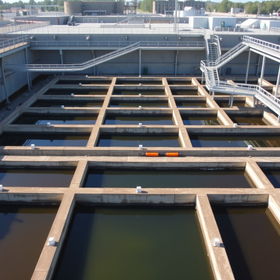
A wastewater treatment plant is a collection of facilities within a factory or business that processes wastewater to meet the quality standards for discharge. In facilities that discharge into the sewer system, it is also referred to as a pollution control facility. The arrangement of the equipment varies depending on the nature of the wastewater, but a tank for collecting wastewater at the entrance and a tank for checking treated water at the exit are commonly included as basic components. Below, we will examine the process from the entrance to the exit. ■ Does the raw water tank reduce pollution? The concentration and volume of wastewater vary depending on the production time. Even if the wastewater is mixed and equalized in the raw water tank (equalization tank), the total amount of pollution does not decrease. However, the peaks in concentration are smoothed out, which stabilizes the subsequent treatment and makes operation easier. It is important to note that if highly concentrated waste liquid is discharged all at once, there is a risk of exceeding the standards even after equalization, so it is collected for separate disposal or stored in a dedicated tank for gradual treatment. ■ What is the guideline for storage time? For continuous treatment, some municipalities recommend a storage time of more than two hours of maximum wastewater volume or a retention time of more than two hours. It is important to check that these guidelines may vary by region and can be revised. Please feel free to consult us first.
Inquire About This Product
basic information
■Sequence of wastewater containing heavy metals The typical flow of the coagulation and sedimentation method is as follows: 1. Raw water tank: Equalize the volume and concentration 2. pH adjustment tank: Adjust the pH to a suitable level for insolubilization using acids or alkalis 3. Coagulation tank: Create flocs with coagulants 4. Sedimentation tank: Settle the flocs and separate them from the water 5. Final pH adjustment tank and monitoring tank: Adjust and verify the pH before discharge ■Stir quickly, then slowly! Immediately after adding the coagulant, stir rapidly for a while to mix, and after adding the polymer coagulant, stir gently to promote the growth of the flocs. ■Return sludge for biological treatment? In wastewater with a high organic content, air is supplied in the reaction tank to allow microorganisms in the activated sludge to decompose it. The activated sludge separated in the sedimentation tank is partially returned to the reaction tank, while the remainder is withdrawn as excess sludge. ■Where to place the pH meter? Near the chemical injection point, there is a risk of measuring values from water that has not yet mixed completely. Therefore, the electrode should be positioned near the outlet of the tank, where the wastewater and chemicals have mixed sufficiently and reacted. Since the electrode can easily give erroneous readings due to contamination, regular cleaning and calibration are essential.
Price range
Delivery Time
Applications/Examples of results
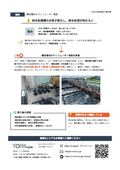
■What does the export monitoring tank do? The monitoring tank is the final tank that checks the water quality of the treated water. By equipping it with an automatic pH measurement device that has recording and alarm functions, and by providing piping to return the water to the raw water tank in case of poor treatment, it ensures that water that does not meet standards is not released directly. ■Can you detect malfunctions by the decrease in chemicals?! The remaining amount of chemicals in the chemical tank is checked and recorded daily. If the usage is abnormally high, it may indicate a malfunction in the pH meter, while if there is no decrease at all, it could be a clue to a blockage in the piping or a failure of the injection pump. ■The sedimentation tank observes the accumulation of sludge If sludge accumulates too much, there is a risk that it will flow into the treated water and deteriorate its quality. We monitor the accumulation situation and appropriately remove it. We also visually check to ensure that floc does not flow into the treated water. ■What to record in the daily report We record the operating time, amount of treated water, instrument readings, equipment operating status, amount and remaining quantity of chemicals, amount of sludge, and results of simple tests on treated water every day. It is desirable for not only the person in charge but also supervisors and related departments to review the daily report. We also offer consultations regarding adjustments to the amount of chemicals added and inspections of the drainage facility, including pumps. Please feel free to consult with us first.
catalog(2)
Download All Catalogs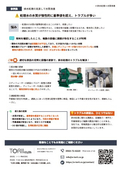
Company information

Since our founding, we have continued to provide flexible services with the motto of accurately supplying a diverse range of products that respond to changes in the times and the diversification of consumer needs, tailored to various applications and requirements. With the corporate slogan "Chemical Engineering Partner," we, as a group of experts in chemical technology, actively discover ideas to solve our customers' problems from advanced technologies both domestically and internationally, and propose them.