We have compiled a list of manufacturers, distributors, product information, reference prices, and rankings for Coating.
ipros is IPROS GMS IPROS One of the largest technical database sites in Japan that collects information on.

Coating Product List and Ranking from 566 Manufacturers, Suppliers and Companies

Last Updated: Aggregation Period:Dec 31, 2025~Jan 27, 2026
This ranking is based on the number of page views on our site.

Coating Manufacturer, Suppliers and Company Rankings

Last Updated: Aggregation Period:Dec 31, 2025~Jan 27, 2026
This ranking is based on the number of page views on our site.

  1. 吉田SKT Aichi//Manufacturing and processing contract
  2. 大阪ガスケミカル株式会社 奈良表面加工センター Nara//Other manufacturing
  3. null/null
  4. 4 エンジニアリング・ラボ 本社、テクニカルセンター、品川ショールーム Nagano//Industrial Machinery
  5. 5 トーカロ Hyogo//Manufacturing and processing contract

Coating Product ranking

Last Updated: Aggregation Period:Dec 31, 2025~Jan 27, 2026
This ranking is based on the number of page views on our site.

  1. Advantages and disadvantages of re-coating a non-stick frying pan. 吉田SKT
  2. Causes of Teflon coating peeling and how to address them. 吉田SKT
  3. Twin-air tabletop robot system (dispenser) エンジニアリング・ラボ 本社、テクニカルセンター、品川ショールーム
  4. 4 Exhibition participation! Outstanding non-stick properties 'Ognas' and wear resistance 'Solnas X' 大阪ガスケミカル株式会社 奈良表面加工センター
  5. 5 Non-stick coating "Toshical(R) S Coating"

Coating Product List

1006~1020 item / All 2414 items

Displayed results

[Case Study] Coating that extends the lifespan of polypropylene heat-welded sheets by five times.

We will introduce examples of the use of non-stick coatings that last five times longer in release effect compared to fluoropolymer coatings.

■Concern In the heat plate welding of polypropylene sanitary products, thread pulling is likely to occur, making a non-stick (release) coating on the heat plate essential. The customer was using a PFA coating, but it deteriorated quickly, requiring the heat plate to be replaced in about a week. ■Background In this case, where repeated contact/release with components occurs at high temperatures, the effectiveness of the coating diminished rapidly. Replacing the heat plate and reprocessing the coating requires adjustments to the equipment and preparation of spare parts. A coating that excels in non-stick properties and lasts longer in high-temperature environments was needed. ■Adopted Coating FSR (Fluoro Super Release) HR-372AP ■Adoption Process and Effects Yoshida SKT prepared several samples, including the "FSR coating," which was developed with the concept of excellent release properties at high temperatures. Before the actual machine test, we confirmed the release properties of these samples at our company, and it was decided to conduct a practical test with the "FSR coating," which has a proven track record in high-temperature environments. The release effect lasted over five times longer compared to the previous PFA coating. The lifespan of the coating was excellent, and it was adopted.

  • Surface treatment contract service
  • Coating

Added to bookmarks

Bookmarks list

Bookmark has been removed

Bookmarks list

You can't add any more bookmarks

By registering as a member, you can increase the number of bookmarks you can save and organize them with labels.

Free membership registration

Surface Treatment Case Studies: "Speeding Up Production Lines Using Adhesives"

Enabling the transport of products coated with hot melt adhesive! Utilizing surface treatment can solve various production challenges and troubles. Samples are currently available.

Troubles such as the following can occur at any time on the production line: ■ Line stoppage ■ Delay in takt time ■ Increase in defects etc… While prompt response and investigation of the causes are important when such issues arise, learning preventive measures in advance can help avoid emergencies. By imparting "release properties and slip properties" through surface treatment, we are currently offering free "Coating Sample Books" and "Process Improvement Case Studies" that have actually improved production processes. ■ The cleaning efficiency of adhesives that do not fully solidify is significantly enhanced by a higher level of non-stickiness. For more details on the cases, please download the "Process Improvement Case Studies" and check them out. You can apply for a free trial set of surface treatment samples from the "Related Links." We encourage you to take this opportunity to apply.

  • Other surface treatment equipment
  • Coating

Added to bookmarks

Bookmarks list

Bookmark has been removed

Bookmarks list

You can't add any more bookmarks

By registering as a member, you can increase the number of bookmarks you can save and organize them with labels.

Free membership registration

Surface treatment case: Coating that solved the stringing issue of polyethylene hot welding.

CHC technology has succeeded in maintaining the non-stick properties of heat plates compared to conventional fluoropolymer coatings (PTFE coatings)!

■Customer Request We want to eliminate stringing that occurs on the heating plate during the thermal welding of polyethylene containers. We aim to reduce product defects caused by stringing without changing the takt time and to decrease the frequency of heating plate replacement. ■Conditions for Process Selection As a result of considering cost-effectiveness, we require a lifespan that is double that of the current coating. ■Achieved Effects By adopting CHC technology for the coating, we have successfully balanced release effect and lifespan. *You can download a PDF summarizing the product information. For more details, please contact us.

  • FireShot Capture 492 - 【新開発】表面処理CHC(セラミックハードコート)のご紹介 - コーティングマガジン - 吉田SKT - www.y-skt.co.jp.png
  • Resin mold
  • Coating

Added to bookmarks

Bookmarks list

Bookmark has been removed

Bookmarks list

You can't add any more bookmarks

By registering as a member, you can increase the number of bookmarks you can save and organize them with labels.

Free membership registration

What types of materials are used for molds? An introduction to surface treatments as well.

We will introduce the main materials used for molds, as well as surface treatments and case studies that can solve molding troubles.

There are various types of materials used for molds, but generally, the following are common: - Tool Steel: A type of steel that excels in wear resistance, heat resistance, and strength, used for the main parts of molds and cutting edges. - Cold Work Tool Steel: Known for its high hardness and dimensional stability, used for small parts of molds and complex-shaped components. - Hot Work Tool Steel: Maintains strength and dimensional stability even at high temperatures, used for large mold components and parts used under high temperatures. - Aluminum Alloy: A lightweight and highly workable material used for molds in low-pressure casting and high-pressure casting. - Copper Alloy: Possesses high electrical and thermal conductivity, used for molds in plastic injection molding and die casting. - Ceramics: A material that excels in heat resistance and wear resistance, used for molds that operate at high temperatures and for precision molding. As such, various materials are used for molds depending on their applications. Choosing the appropriate material is essential, but selecting the right surface treatment is also important for the mold's lifespan and product quality. Do you have any concerns regarding surface treatment for molds? <Molding Equipment> - Mold damage - Mold dimensional accuracy - Coating peeling

  • シーラー.png
  • NYK-01 (4)_edited.jpg
  • edit_edited.jpg
  • 2021-05-16 (2).png
  • s-0181UC_edited.jpg
  • Other molds
  • Coating

Added to bookmarks

Bookmarks list

Bookmark has been removed

Bookmarks list

You can't add any more bookmarks

By registering as a member, you can increase the number of bookmarks you can save and organize them with labels.

Free membership registration

[Presentation of Materials] A Comprehensive Guide to Fluororesin Coating from Basics to Applications in One Volume

Packed with content that connects theory to practice, this comprehensive 38-page book covers everything you need to know about fluororesin coating from the basics to advanced applications.

We are currently offering a textbook that allows you to learn the basics of "fluoropolymer coating" from our company, a specialist manufacturer of surface treatment and fluoropolymer coatings! This document, consisting of 38 pages, is packed with content that connects the fundamentals of fluoropolymers to their applications. With this single book, you can learn the basics of fluoropolymers, practical case studies, and tips for selecting coatings. [Contents (excerpt)] ■ What is fluoropolymer? ■ Explanation of the characteristics of fluoropolymers ■ What is fluoropolymer coating? ■ Processing methods for fluoropolymer coatings ■ Tips for selecting fluoropolymer coatings ■ Suitable substrates for fluoropolymer coatings ■ Case studies of fluoropolymer coatings If you are interested, please download the document from the link below and take a look.
  • intro.jpg
  • index.jpg
  • p3.jpg
  • p5.jpg
  • Surface treatment contract service
  • Coating

Added to bookmarks

Bookmarks list

Bookmark has been removed

Bookmarks list

You can't add any more bookmarks

By registering as a member, you can increase the number of bookmarks you can save and organize them with labels.

Free membership registration

Surface treatment case: Solving adhesive adhesion on electronic component transport plates!

We will introduce a case where a highly precise fluorine-based coating solved the adhesion problem of electronic component transport plates.

We will introduce a case study on solving the problem of epoxy adhesive sticking out from electronic components. ■Consultation Details The consultation was regarding a problem where adhesive that protruded from the components was sticking to the plate used for transporting the electronic parts. ■Background for Selection The process included a curing step at 150°C, and precision of the transport plate was also required. ■Coating Adopted 'Nano Process TLS-200' ■Reason for Adoption and Effects We proposed two types of coatings with good surface treatment precision that do not allow epoxy adhesive to stick. After testing, they chose to adopt the Nano Process. *For more details, please refer to the materials or contact us directly.*

  • Surface treatment contract service
  • Coating

Added to bookmarks

Bookmarks list

Bookmark has been removed

Bookmarks list

You can't add any more bookmarks

By registering as a member, you can increase the number of bookmarks you can save and organize them with labels.

Free membership registration

Surface treatment case study: Improvement case of molding dies for dog toys.

We will introduce examples of surface treatments that improve production efficiency with release properties and smoothness that surpass fluoropolymer coatings.

We would like to introduce a case of surface treatment for molding molds that ensure the quality of dog toys. ■Consultation Details We received an inquiry from a customer who molds toys that pets chew and play with. The mold already had a fluororesin coating applied, and they were seeking further improvements. ■Background of Selection The mold had a fluororesin coating applied to prevent material adhesion. Additionally, by processing a surface treatment that could further reduce adhesion, they were expecting improvements in production efficiency, and it was necessary to consider the smoothness of the mold as well. ■Adopted Coating 'MRS Coating' ■Adoption Background and Effects We proposed 'MRS-102', which excels in release properties and smoothness. Compared to the existing fluororesin coating, the release properties were significantly improved, and the customer was satisfied. *For more details, please refer to the materials or contact us directly.

  • Surface treatment contract service
  • Coating

Added to bookmarks

Bookmarks list

Bookmark has been removed

Bookmarks list

You can't add any more bookmarks

By registering as a member, you can increase the number of bookmarks you can save and organize them with labels.

Free membership registration

Causes of Teflon coating peeling and how to address them.

Teflon coating, which is widely used on frying pans and hot plates, will be explained regarding the causes of peeling and how to address them.

Teflon coating is applied to frying pans and hot plates to prevent sticking. This explains the causes of peeling and how to address them. ■ Causes of Peeling Teflon is a brand name for fluoropolymer. Fluoropolymer is a type of plastic, making it softer and more prone to scratches compared to metal. The continuous use temperature is also lower, at up to 260°C, compared to metal. Therefore, simply scraping with a metal spatula or scrubbing hard with an abrasive sponge can cause scratches and lead to peeling. Additionally, extreme high-temperature environments, such as dry heating, can cause degradation or decomposition, so caution is necessary. Use a spatula made of resin, clean with a soft sponge, and if using a neutral detergent, it is important to rinse thoroughly. Residual surfactants can make the surface more prone to sticking. ■ Solutions In principle, Teflon coatings and fluoropolymer coatings cannot be partially repaired. Therefore, if it is a frying pan, we recommend replacing it. For industrial parts, reprocessing for peeling may be considered. Please contact us regarding the peeling methods and suitable base materials. Teflon-coated products can be used for a long time depending on how they are used. We recommend utilizing their features effectively.

  • s-2021-04-27 (43).jpg
  • 3313543_s.jpg
  • Surface treatment contract service
  • Coating

Added to bookmarks

Bookmarks list

Bookmark has been removed

Bookmarks list

You can't add any more bookmarks

By registering as a member, you can increase the number of bookmarks you can save and organize them with labels.

Free membership registration

Corrosion-resistant and rust-proof coating suitable for stainless steel pipes.

Introducing a coating that excels in rust prevention and corrosion resistance for stainless steel pipes.

**Coating for Improved Rust and Corrosion Resistance** Stainless steel is inherently a material with excellent corrosion resistance, but if you want to further enhance its rust and corrosion resistance, it is necessary to apply a coating. Generally, coatings are applied using paints such as epoxy resin or polyurethane. These paints are known for their durability and weather resistance, providing high rust prevention effectiveness even in environments with corrosive gases or saltwater. For use in even harsher environments, it is also possible to coat with highly corrosion-resistant fluoropolymer resins. For example, resins like PFA and PTFE excel in chemical resistance and can be used in environments with strong acids or strong alkalis. If you are considering improving the corrosion resistance of stainless steel pipes used in harsh environments, we recommend fluoropolymer coating. *For more details on fluoropolymer coatings, please refer to the materials or feel free to contact us.*

  • s-00718Nedit.gif
  • Surface treatment contract service
  • Coating

Added to bookmarks

Bookmarks list

Bookmark has been removed

Bookmarks list

You can't add any more bookmarks

By registering as a member, you can increase the number of bookmarks you can save and organize them with labels.

Free membership registration

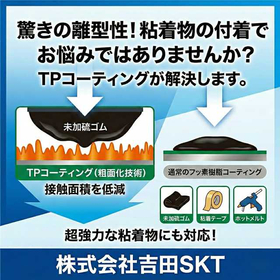
TP Coating: A fluororesin coating that innovates release properties on convex surfaces.

Forming fine convex surfaces with fluororesin to reduce contact area and improve release properties.

By forming a unique fine convex surface structure on the fluororesin coating, we solve challenges in high-temperature and high-load environments that conventional smooth coatings struggle to address. This is an innovative surface treatment technology that does not require processes like spraying or blasting and can be applied to thin plates and delicate components. 【Features】 ■ Reduces contact area with fine convex surface structure, achieving excellent release and lubricating properties ■ Durability over 10 times greater than conventional fluororesin coatings (based on case studies) ■ No need for spraying or blasting, suitable for thin plates and delicate components ■ Three series available to choose from according to application (TP-3○○ series, TP-4○○ series, TP-7○○ series)

  • Surface treatment contract service
  • Coating

Added to bookmarks

Bookmarks list

Bookmark has been removed

Bookmarks list

You can't add any more bookmarks

By registering as a member, you can increase the number of bookmarks you can save and organize them with labels.

Free membership registration

Serashield F CAU" realizes "functionality for heat-sensitive materials.

We will provide the option of water and oil repellency to the substrate that was given up on.

"I want to add oil-repellent properties to resin products, but high-temperature firing is not possible." "I want to impart water-repellent properties to rubber parts." "I want to coat without removing existing equipment." Cerashield F CAU solves these challenges. Through room temperature processing, it provides excellent water-repellent, oil-repellent, and chemical-resistant properties to substrates and products that were previously given up on. It can also be applied on-site, minimizing equipment downtime. 【Features of Cerashield F CAU】 ■ Significantly improved water-repellent and oil-repellent properties ■ Easier to wipe off oil stains and improved liquid drainage ■ Room temperature processing allows application to heat-sensitive materials like resin and rubber ■ On-site application is possible 【Examples of Applications for Cerashield F CAU】 ■ Food machinery ■ Pharmaceutical machinery ■ Electronic devices ■ Building materials ■ Automotive parts *For more details, please refer to the PDF document or feel free to contact us.

  • IMG_1855_edited.jpg
  • Surface treatment contract service
  • Coating

Added to bookmarks

Bookmarks list

Bookmark has been removed

Bookmarks list

You can't add any more bookmarks

By registering as a member, you can increase the number of bookmarks you can save and organize them with labels.

Free membership registration

Coating for Preventing Adhesion of Uncured Rubber for the Rubber Manufacturing Industry

Solving the "stickiness" of rubber before vulcanization. Preventing adhesion to conveying equipment for an extended period.

In the rubber manufacturing industry, the issue of "stickiness," where uncured rubber adheres to conveying equipment, is a factor that decreases production efficiency. Particularly when the formulation of rubber materials is changed for environmental measures or to improve durability, processing at higher temperatures than before becomes necessary, making adhesion more likely. Yoshida SKT's coating prevents the adhesion of uncured rubber for an extended period, contributing to the stable operation of manufacturing lines. 【Usage Scenarios】 - Conveying rolls after rubber extrusion - Conveying equipment in curing ovens - Weather strip manufacturing lines - S-SBR (solution polymerized styrene-butadiene rubber) manufacturing equipment - Hose curing fixtures 【Benefits of Implementation】 - Prevention of uncured rubber adhesion - Reduction in cleaning and maintenance frequency - Stable operation of manufacturing lines - Reduction in costs and working time *For more details, please refer to the PDF document or feel free to contact us.

  • Surface treatment contract service
  • Coating

Added to bookmarks

Bookmarks list

Bookmark has been removed

Bookmarks list

You can't add any more bookmarks

By registering as a member, you can increase the number of bookmarks you can save and organize them with labels.

Free membership registration

ECC - Electroceramic Coating

Patent technology for forming a titanium oxide film on the metal surface of aluminum and aluminum alloys.

Patents obtained in 10 countries including Japan ● For aluminum and aluminum alloys ● Corrosion resistance ● Heat resistance ● Wear resistance The management of the processing steps is simple, achieving the formation of a high-precision and uniform film thickness.

  • glue
  • Coating

Added to bookmarks

Bookmarks list

Bookmark has been removed

Bookmarks list

You can't add any more bookmarks

By registering as a member, you can increase the number of bookmarks you can save and organize them with labels.

Free membership registration

Bridge fluororesin coating

Contributing to various fields such as medicine, semiconductors, and food due to its advanced purity and heat resistance characteristics!

The "Bridge Fluororesin Coating (FCXTRA Series)" is our unique technology that enhances wear resistance without compromising the properties of fluororesin coatings (Teflon coatings). Its durability is over 1,000 times greater than that of PTFE, which is known to have lower wear resistance compared to conventional materials. It is a non-filled PTFE with several times improved deformation resistance. It particularly excels in sliding parts, leveraging its low friction coefficient and low dust generation, making it suitable for use in sealing materials for pumps and compressors, as well as air valves. 【Features】 ■ Durability is over 1,000 times that of PTFE ■ Excels in sliding parts ■ Possesses high purity, heat resistance, and other characteristics ■ Contributes to various fields, including medical, semiconductor, and food industries *For more details, please refer to the related link page or feel free to contact us.

  • 2022-03-09_09h55_13.png
  • 2022-03-09_09h55_23.png
  • 2022-03-09_09h55_32.png
  • Surface treatment contract service
  • Other surface treatment equipment
  • Coating

Added to bookmarks

Bookmarks list

Bookmark has been removed

Bookmarks list

You can't add any more bookmarks

By registering as a member, you can increase the number of bookmarks you can save and organize them with labels.

Free membership registration

What is the contact angle (wetting property) in interface science theory?

The phenomenon of "wetting" affects many phenomena not only in the field of engineering but also in the natural world.

The term that quantifies the degree of wetting is "contact angle." A well-cleaned "clean" glass surface wets well with water, while surfaces treated with fluorine coatings repel water. This phenomenon of "wetting" affects many phenomena not only in the field of engineering but also in the natural world. The "contact angle" is a very intuitive and easy-to-understand indicator of "wetting," and it is adopted as a surface evaluation method in various industrial fields. Our company continues to provide high-performance scientific instruments that allow customers to confidently publish the values indicated by measurements of "wetting" and "surface tension," contributing to the development of industries and the promotion of academia. Please feel free to contact us when needed. *For more details, please refer to the PDF materials or feel free to reach out to us.

  • Contract manufacturing
  • Other physicochemical equipment
  • Contract measurement
  • Coating

Added to bookmarks

Bookmarks list

Bookmark has been removed

Bookmarks list

You can't add any more bookmarks

By registering as a member, you can increase the number of bookmarks you can save and organize them with labels.

Free membership registration