We have compiled a list of manufacturers, distributors, product information, reference prices, and rankings for Coating.
ipros is IPROS GMS IPROS One of the largest technical database sites in Japan that collects information on.

Coating Product List and Ranking from 567 Manufacturers, Suppliers and Companies | IPROS GMS

Last Updated: Aggregation Period:Aug 05, 2026~Sep 01, 2026
This ranking is based on the number of page views on our site.

Coating Manufacturer, Suppliers and Company Rankings

Last Updated: Aggregation Period:Aug 05, 2026~Sep 01, 2026
This ranking is based on the number of page views on our site.

  1. 吉田SKT Aichi//Manufacturing and processing contract
  2. フロロテクノロジー Aichi//Chemical
  3. NIPPON FUSSO CO.,LTD. Osaka//Electronic Components and Semiconductors
  4. 4 SANYO-CYP Osaka//Printing Industry
  5. 5 大阪ガスケミカル株式会社 奈良表面加工センター Nara//Other manufacturing

Coating Product ranking

Last Updated: Aggregation Period:Aug 05, 2026~Sep 01, 2026
This ranking is based on the number of page views on our site.

  1. Film Thickness Management Device (Transparent Ink Dedicated Reflectance Densitometer) 'MKS-1000' SANYO-CYP
  2. We supply OEM fluorine water and oil repellent agents, release agents, and coating agents. フロロテクノロジー
  3. Super non-stick coating 'S-8010' with reduced roughness. 大阪ガスケミカル株式会社 奈良表面加工センター
  4. 4 Fluororesin coating and lining for quartz. NIPPON FUSSO CO.,LTD.
  5. 5 Release agent rubber molding case: Successful continuous molding that is difficult with conventional release agents. フロロテクノロジー

Coating Product List

2041~2070 item / All 2989 items

Displayed results

[Example] Adhesion prevention coating for a device that automatically applies adhesive tape.

Introducing examples of coatings that prevent adhesive from sticking, enabling the transport of duct tape.

■Problems We Wanted to Solve We received a consultation regarding the accumulation of adhesive on the feed roll of a device that automatically applies tape, which caused line stoppage issues that needed to be resolved. ■Background / Conditions for Choosing Treatment Initially, a knurling process was implemented as a countermeasure, but it was not very effective. Therefore, we proposed a coating that prevents tape adhesion. ■Adopted Treatment MRS Coating ■Achieved Effects After processing and testing with a prototype roller, there was no longer any adhesive accumulation or tape sticking, and they are considering expanding this solution to other lines. For detailed information on the surface treatment, please download the materials or contact us.

  • ホットメルト_edited.jpg
  • s-CIMG3371_edited_edited.jpg
  • Surface treatment contract service
  • Coating

Added to bookmarks

Bookmarks list

Bookmark has been removed

Bookmarks list

You can't add any more bookmarks

By registering as a member, you can increase the number of bookmarks you can save and organize them with labels.

Free membership registration

Does fluoropolymer dissolve in hydrochloric acid? Explanation.

Does fluoropolymer, which has excellent chemical resistance, dissolve in hydrochloric acid?

Fluororesin is a material that exhibits excellent chemical resistance to almost all chemicals. Hydrochloric acid is a strong acid that can dissolve many metals, but fluororesin does not dissolve in hydrochloric acid. Fluororesin is generally not affected by hydrochloric acid on its own; however, caution is necessary when used as linings or coatings intended to protect metals. Hydrochloric acid can penetrate fluororesin linings or coatings depending on its concentration and temperature. This penetration can lead to blistering, which impairs corrosion resistance. Additionally, thin fluororesin coatings may leave pinholes, allowing hydrochloric acid to infiltrate and directly corrode the substrate. If you want to protect metals from chemical solutions like hydrochloric acid, please consult us when considering measures involving fluororesin.

  • シートライニング1_edited_edited.jpg
  • IMG_7868_edited.jpg
  • others
  • Coating

Added to bookmarks

Bookmarks list

Bookmark has been removed

Bookmarks list

You can't add any more bookmarks

By registering as a member, you can increase the number of bookmarks you can save and organize them with labels.

Free membership registration

What is the difference between lining and fluororesin (Teflon) coating?

I will explain the differences between fluororesin (Teflon) coating and lining.

■Difference Between Lining and Coating Lining is a method that protects the substrate with a relatively thick film, enhancing its corrosion resistance. The differences from coating include the thickness of the film, the presence of pinholes, and the intended use. There are no clear standards, but thick films used for corrosion protection are referred to as lining. ■What is Fluororesin Coating? Coating is a surface treatment technology that can impart the properties of fluororesin to the surface of a substrate, primarily using a baking paint method. The film thickness is generally around several tens of micrometers. ■What is Fluororesin Lining? Fluororesin lining can be processed using the same method as coating. It is particularly used for corrosion protection applications that leverage chemical resistance, and the film thickness is several hundred micrometers, making it thicker than coating. Additionally, to enhance corrosion resistance, processing without pinholes is possible. *You can download a document summarizing information about lining. *For more details, please click on "PDF Download" or feel free to contact us.

  • s-020100.gif
  • ETFE_edited.jpg
  • IMG_7868_edited.jpg
  • others
  • Coating

Added to bookmarks

Bookmarks list

Bookmark has been removed

Bookmarks list

You can't add any more bookmarks

By registering as a member, you can increase the number of bookmarks you can save and organize them with labels.

Free membership registration

What is delamination? Introducing surface treatments that excel in delamination resistance.

[Presentation of Materials] What is release property? We will introduce methods to improve release property and coatings that are particularly excellent in release property.

Release properties refer to the characteristic of materials or products that allows them to be easily removed from molds or forming tools without sticking. This property is important in the manufacturing process and affects product quality and production efficiency. ■ Methods to Improve Release Properties By applying a release agent to the surface, a thin film is created between the mold and the product, preventing adhesion. Silicone and fluorine-based release agents provide excellent release properties for many materials. ■ Resin Coating Applying a resin coating to the surface exhibits non-stick properties, making it easier to remove the product. Fluororesin coatings are commonly used. ■ Metal Plating For example, chrome plating has high hardness and is less reactive with other substances, aiding in product removal. Fluororesin-containing types of plating also exhibit non-stick properties. ■ Surface Roughness Adjustment By designing the surface with fine uneven structures, the contact area is reduced, thereby decreasing adhesion. As mentioned above, there are various methods, but we will introduce surface treatment technologies and coatings that are particularly effective in enhancing release properties, reducing product defects, and improving productivity. For more details, please download the PDF document or feel free to contact us.

  • s-2021-06-22 (3).gif
  • ホットメルト_edited.jpg
  • IMG_9472_edited2.jpg
  • s-ロール.jpg
  • IMG_9363_edited.jpg
  • s-0197UJedit.jpg
  • DSC04626_edited.jpg
  • Processing Contract
  • Coating

Added to bookmarks

Bookmarks list

Bookmark has been removed

Bookmarks list

You can't add any more bookmarks

By registering as a member, you can increase the number of bookmarks you can save and organize them with labels.

Free membership registration

What is the heat resistance temperature of fluorine coatings? An explanation of the varying heat resistance by type.

I will explain the heat resistance of fluororesin coatings.

There are various types of fluorine coatings, even if we refer to them simply as such. Typical examples include PTFE, FEP, PFA, and ETFE. In practice, the heat resistance varies depending on the application, but the continuous use temperatures for fluororesins are defined. ■ Continuous Use Temperatures - PTFE: 260℃ - FEP: 200℃ - PFA: 260℃ - ETFE: 150℃ For example, when used as an anti-corrosion coating, the practical heat resistance will be at a much lower temperature. Additionally, when considering applications that involve friction or physical contact, further considerations are necessary. Fluorine coatings (fluororesin coatings) possess various properties such as non-stickiness, low friction, chemical resistance, electrical characteristics, and weather resistance, and it is essential to consider the type and thickness according to each application. *For more details, please click on "PDF Download" or feel free to contact us.

  • Resin mold
  • Coating

Added to bookmarks

Bookmarks list

Bookmark has been removed

Bookmarks list

You can't add any more bookmarks

By registering as a member, you can increase the number of bookmarks you can save and organize them with labels.

Free membership registration

Regulations on Teflon? Regarding the PFAS regulation proposal.

The regulation of Teflon resin explains the proposed PFAS regulations.

Teflon is a trademark of Chemours and refers to fluoropolymer. Fluoropolymers include types such as PTFE, PFA, and FEP, but currently, the use of fluoropolymers like PTFE, PFA, and FEP is not regulated in Japan. On the other hand, within the EU, regulatory proposals are being considered to minimize the emissions of PFAS. The following substances are also mentioned as targets: - Fluorinated surface treatment agents: water and oil repellents, release agents, fluoropolymer-containing coatings, etc. - Coatings: PTFE, PFA, FEP, ETFE, and other fluoropolymers (for applications such as corrosion lining, non-stick, lubrication, etc.) - Molding and processed products: PTFE, PFA, FEP, ETFE, and other fluoropolymers (such as lining sheets, fabric sheets, etc.) - Fluorinated surfactants, fluorinated oils, low molecular weight PTFE, fluorinated molding aids, etc. The regulatory proposals include fluoropolymers, which are considered to be extremely stable and pose no toxicological or environmental concerns. For more details, please download the materials or check our website through the related links.

  • others
  • Coating

Added to bookmarks

Bookmarks list

Bookmark has been removed

Bookmarks list

You can't add any more bookmarks

By registering as a member, you can increase the number of bookmarks you can save and organize them with labels.

Free membership registration

Understand the differences between PTFE, PFA, FEP, and ETFE! Technical materials available.

A detailed explanation of the differences between PTFE and PFA, which are surprisingly not well known, including their molecular structures and properties!

The technical document "Differences Between PTFE and PFA" provides a detailed explanation of PTFE, PFA, FEP, and ETFE, covering everything from molecular structure to properties. Fluoropolymers are well-known for their functionality, such as being non-stick and slippery, but many people may not be aware of their various types and differences. This single volume allows for a thorough understanding of the differences and characteristics of each. If you are interested, please feel free to download it. [Contents (excerpt)] ■ Types and properties of fluoropolymers ■ Differences between PTFE and PFA / Overview of FEP and ETFE ■ Differences among four types of fluoropolymer coatings

  • Surface treatment contract service
  • Coating

Added to bookmarks

Bookmarks list

Bookmark has been removed

Bookmarks list

You can't add any more bookmarks

By registering as a member, you can increase the number of bookmarks you can save and organize them with labels.

Free membership registration

Introducing the features and types of non-stick coatings.

Non-stick means that things do not stick. Non-stick coatings can prevent the sticking and adhesion of items.

"Non-stick" can be rephrased as non-adhesive. By processing a non-stick coating, it becomes easier to release from strongly adhesive substances, resulting in surfaces that either do not adhere or are difficult to adhere to. Such properties can be achieved through fluoropolymer coatings or silicone coatings. Not only for household frying pans but also for improving the release properties and reducing adhesion of jigs and component parts used in production environments. Here are some examples of non-stick coatings. 【Selected Coatings (Partial)】 ■ Non-adhesive, slippery, chemical-resistant - Fluoropolymer coating ■ Release properties, high hardness, dimensional stability (durable parts, molds) - Bi-coat ■ Resin release at high temperatures - FSR coating ■ Prevention of adhesion of high-adhesion substances - Adhesive release coating - MRS coating (silicone-based coating) ■ Release properties, precision (precision parts, precision molds) - Nano process *For more details, please refer to the PDF materials or feel free to contact us.

  • IMG_8557_edited_edited.jpg
  • ホットメルト_edited.jpg
  • Processing Contract
  • Coating

Added to bookmarks

Bookmarks list

Bookmark has been removed

Bookmarks list

You can't add any more bookmarks

By registering as a member, you can increase the number of bookmarks you can save and organize them with labels.

Free membership registration

PFAS-free (non-use) abrasion-resistant coating, urethane coating

[Presentation of Materials] PFAS-free abrasion-resistant resin coating! All types are processed at room temperature and can be applied to metal, chemical wood, and plastic.

"Urethane coating" is a resin coating that does not use PFAS. It excels in abrasion resistance and soundproofing, and is a room-temperature curing type that can be processed onto any material, excluding liquids and gases. The usable temperature range is -30°C to 100°C, and depending on the grade, there are types that can be used for surface treatment of various transport equipment, as well as types that enhance slip performance and include measures against static electricity. Additionally, if you require a specific color, we can accommodate your request. [Features] ■ Excellent abrasion resistance and soundproofing ■ Can be processed in various locations ■ Protects materials and equipment with coating ■ Cures at room temperature, making it suitable for various materials *For more details, please click "PDF Download" or feel free to contact us.

  • image_04.png
  • s-カタログ用(8)_edited.jpg
  • Coating Agent
  • Coating

Added to bookmarks

Bookmarks list

Bookmark has been removed

Bookmarks list

You can't add any more bookmarks

By registering as a member, you can increase the number of bookmarks you can save and organize them with labels.

Free membership registration

PFAS-free (non-use) abrasion-resistant, release, and slip-resistant coating

[Presentation of Materials] We will introduce a coating that provides release properties and slip properties without the use of PFAS.

"Bycoat Exceed HR↑" achieves PFAS-free, non-stick properties, improved slip characteristics, and enhanced heat resistance. For example, it provides reliable release properties even when using molds made from highly adhesive resins. Additionally, like conventional Bycoat, it offers excellent dimensional accuracy, making it suitable for areas requiring micron-level precision. 【Features of Bycoat Exceed HR↑】 - High hardness, long lifespan, dimensional stability of Bycoat × enhanced heat resistance grade *For more details, please click on "PDF Download" or feel free to contact us. For information regarding coatings considering PFAS regulations, please contact our company.

  • IMG_8528_edited_edited.jpg
  • Other surface treatment equipment
  • Coating

Added to bookmarks

Bookmarks list

Bookmark has been removed

Bookmarks list

You can't add any more bookmarks

By registering as a member, you can increase the number of bookmarks you can save and organize them with labels.

Free membership registration

PFAS-free (non-use) anti-corrosion coating 'Cerashield'

[Information Presentation] PFAS-free anti-corrosion coating! It can be used for corrosion prevention measures against corrosive gases and chemicals, as well as for penetration measures.

The organic-inorganic oxirane oligomer coating system "Cerashield" is a PFAS-free coating that prevents corrosion and permeation, serving as a corrosion-resistant coating that reduces the frequency of updates for industrial equipment such as tanks. It is a hardening-type paint with excellent corrosion prevention effects, forming a coating film with high crosslink density. Additionally, it can be applied to a wide range of substrates including metal, plastic, wood, concrete, and ceramics, demonstrating excellent adhesion. There are two types available: the room temperature curing type "Cerashield CST-1108" and the heat curing type "Cerashield CST-1508." 【Features】 ■ Reliable corrosion resistance ■ All-around chemical resistance (heat curing type) ■ Room temperature processing available (room temperature curing type) ■ Excellent hardness ■ Electrical insulation ■ Advantageous for aftercare *For more details, please refer to the PDF materials or feel free to contact us. For inquiries about PFAS-free coatings, please contact our company.

  • Coating Agent
  • Coating

Added to bookmarks

Bookmarks list

Bookmark has been removed

Bookmarks list

You can't add any more bookmarks

By registering as a member, you can increase the number of bookmarks you can save and organize them with labels.

Free membership registration

[Data Download] Surface Treatment "By Application" Chosen in the Semiconductor and Electronics Field

We will introduce surface treatment technologies chosen for semiconductor manufacturing and electronic component manufacturing.

■Applications such as plating jigs, soldering jigs, and semiconductor manufacturing lines - Selected surface treatment 'TEFLON (TM) fluoropolymer coating' ■Applications such as precision molds - Selected surface treatment 'Bicoat (R)' 'Nanoprocess (R)' ■Applications such as wafer and glass handling - Selected surface treatment 'Saflon (R)' 'PBI, PI coating' ■Applications such as precision nozzles, MEMS components, and optical lenses - Selected surface treatment 'Nanoprocess (R)' ■Applications such as chemical supply tanks - Selected surface treatment 'TEFLON (TM) fluoropolymer coating' 'Saflon (R) AP+' 'MY Lining (R)' ■Applications such as clean room walls, experimental equipment, and various jigs - Selected surface treatment 'SeraShield F' *You can download the PDF of the introduced surface treatment products. Please download the materials and contact us for more details.*

  • Surface treatment contract service
  • Coating

Added to bookmarks

Bookmarks list

Bookmark has been removed

Bookmarks list

You can't add any more bookmarks

By registering as a member, you can increase the number of bookmarks you can save and organize them with labels.

Free membership registration

What is "STP-HS"? An explanation of Yoshida SKT's coating.

Yoshida SKT's coating 'STP-HS' is a revolutionary fluororesin coating that reduces contact surface area.

There are various types of resin for fluoropolymer coatings depending on the application environment. At Yoshida SKT, we specify materials and processing based on the product number. 'STP-HS' is a type of fluoropolymer coating designed to reduce contact area and is one of the 'Super TP Coating Hemisphere Graphics'. Super TP Coating uniquely forms a convex surface using only fluoropolymer, characterized by excellent release properties and slip resistance against adhesives. For more details, please download the materials or contact us.

  • Secondary Cells/Batteries
  • Coating

Added to bookmarks

Bookmarks list

Bookmark has been removed

Bookmarks list

You can't add any more bookmarks

By registering as a member, you can increase the number of bookmarks you can save and organize them with labels.

Free membership registration

[Sample Presentation] Surface Treatment and Coating to Prevent Troubles with Conveying Equipment

With Yoshida SKT's convex coating, transportation becomes smoother.

We solve product jams and adhesion issues that occur in conveying devices with Yoshida SKT's surface treatment. Surface treatment (coating) helps reduce problems that arise in conveying devices and improve efficiency. Specifically, we can address the following issues: - Jamming of conveyed items - Adhesion of products - Wear of conveying devices Yoshida SKT's surface treatment offers a combination of various technologies to solve these problems. For example, we provide coatings that prevent wear and dirt, coatings that prevent adhesion, and coatings that enhance sliding. [We offer a collection of case studies on improvements through coating] If you are interested, please request a "trial set" through the related link!

  • s-IMG_0164_edited_edited.jpg
  • s-IMG_9503_edited_edited.jpg
  • s-IMG_9517_edited_edited.jpg
  • s-IMG_9422_edited.jpg
  • s-IMG_9476_edited_edited.jpg
  • s-IMG_9448_edited.jpg
  • Conveyor
  • Coating

Added to bookmarks

Bookmarks list

Bookmark has been removed

Bookmarks list

You can't add any more bookmarks

By registering as a member, you can increase the number of bookmarks you can save and organize them with labels.

Free membership registration

Solve vacuum forming release defects with super TP coating.

We would like to introduce a coating that improves release defects caused by vacuum forming of films.

■Customer's Issue In vacuum forming of films, the formed film was difficult to detach from the mold, resulting in release failure. ■Background / Conditions for Choosing Treatment The cause was uneven heating and poor air release due to inadequate adhesion between the mold and the film. ■Adopted Coating Super TP Coating ■Achieved Effects The Super TP Coating forms a smooth convex surface with fluororesin. The convex surface of the coating created an appropriate gap between the mold and the film, improving air release and resolving the issue of uneven heating, resulting in better release properties. For details about the coating, please download the materials or contact us.

  • Secondary Cells/Batteries
  • Coating

Added to bookmarks

Bookmarks list

Bookmark has been removed

Bookmarks list

You can't add any more bookmarks

By registering as a member, you can increase the number of bookmarks you can save and organize them with labels.

Free membership registration

What is the flame retardancy of plastics? An explanation of flame retardant grades and material characteristics.

We will provide a detailed explanation of the elements of combustion, the flame retardancy of plastics, and flame-retardant materials made from plastics.

This document is intended for those who want to learn more about the flame retardancy of plastics and those interested in the flame retardancy of fluororesins. ■INDEX■ 1. What is flame retardancy? 2. The three elements of combustion 3. Flame retardancy of plastics from the perspective of oxygen index and standards 3-1. Oxygen Index 3-2. UL94 standard 4. Characteristics of flame retardant materials (fluororesin PTFE) 4-1. Strong C-C bonds 4-2. Low reactivity with oxygen 5. Applications of fluororesin flame retardancy If you would like to know more about flame retardancy, please download the document or check the related links.

  • 燃焼.png
  • 難燃.png
  • Surface treatment contract service
  • Coating

Added to bookmarks

Bookmarks list

Bookmark has been removed

Bookmarks list

You can't add any more bookmarks

By registering as a member, you can increase the number of bookmarks you can save and organize them with labels.

Free membership registration

Improving the efficiency of pharmaceutical manufacturing lines! Solving problems with non-stick coatings.

Improving manufacturing line efficiency! Solving sticking problems with non-stick "MRS coating."

This manufacturer was facing a problem in the manufacturing process of pain-relieving and anti-inflammatory adhesive patches (wet compresses), where products were sticking to the transport equipment, leading to line stoppages and product defects. The product consists of a three-layer structure, with an effective ingredient-containing paste layered on a supporting substrate and a release film. This paste was coming into contact with the transport guide, causing adhesion, which resulted in line stoppages and product bending defects. In response, we proposed the "MRS Coating," which excels in non-adhesiveness. This coating is effective even against adhesives like those found in duct tape. As a result of evaluations conducted with actual products and samples, it was confirmed that there was no sticking, and it was adopted for use in the actual machines. As a result, the sticking issues were eliminated, leading to a reduction in defective products, an improvement in the good product rate, and a decrease in maintenance time associated with line stoppages. Are you facing similar issues? The "MRS Coating" may contribute to improving the efficiency of your manufacturing line. Please feel free to contact us for more information.

  • ホットメルト_edited.jpg
  • s-CIMG3371_edited_edited.jpg
  • Surface treatment contract service
  • Coating

Added to bookmarks

Bookmarks list

Bookmark has been removed

Bookmarks list

You can't add any more bookmarks

By registering as a member, you can increase the number of bookmarks you can save and organize them with labels.

Free membership registration

New type of water-repellent and oil-repellent coating that can be processed at room temperature.

A new era of coating technology that enhances water and oil repellency without being constrained by the heat resistance of the substrate.

The "Cerashield F CAU" developed by Yoshida SKT is a functional coating that can be processed at room temperature, excelling in water and oil repellency. Unlike conventional fluororesin coatings, it does not require a high-temperature baking process, making it applicable to substrates with low heat resistance, large products, and installed equipment. Additionally, compared to the existing "Cerashield F," the water and oil repellency has been significantly improved, enhancing its dirt resistance. As a result, the oil wiping performance and liquid drainage performance have greatly improved. **Features of Cerashield F CAU** - Significantly improved water and oil repellency - Enhanced ease of wiping off oil stains and liquid drainage - Can be processed at room temperature, making it applicable to heat-sensitive materials such as resins and rubber - On-site application is also possible **Examples of Applications for Cerashield F CAU** - Food machinery - Pharmaceutical machinery - Electronic devices - Building materials - Automotive parts Yoshida SKT also offers a variety of functional coatings that can be processed at room temperature. For more details, please refer to the PDF materials or feel free to contact us.

  • IMG_1855_edited.jpg
  • Surface treatment contract service
  • Coating

Added to bookmarks

Bookmarks list

Bookmark has been removed

Bookmarks list

You can't add any more bookmarks

By registering as a member, you can increase the number of bookmarks you can save and organize them with labels.

Free membership registration

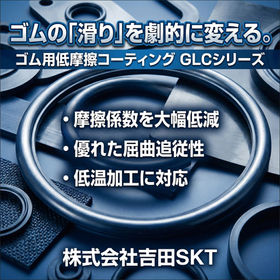
A coating that significantly reduces the friction coefficient of rubber and improves slip resistance.

The GLC series significantly reduces the friction coefficient of rubber, improving its slip resistance.

The GLC series is a "low-friction coating for rubber" that imparts low friction (slipperiness) to rubber materials with grip. By applying this coating, the friction coefficient of the rubber is significantly reduced. This is because it forms a slippery film on the surface of the rubber, which reduces the friction between the rubber and other objects. The reduction in friction coefficient improves slipperiness, allowing rubber products to move smoothly and function as expected. *For more details, please download the materials and check them.

  • Surface treatment contract service
  • Coating

Added to bookmarks

Bookmarks list

Bookmark has been removed

Bookmarks list

You can't add any more bookmarks

By registering as a member, you can increase the number of bookmarks you can save and organize them with labels.

Free membership registration

Fluororesin coating that achieves both functionality and dimensional stability with a 10μm thin film.

A revolutionary thin-film fluororesin coating that achieves thin-film application while maintaining the performance of fluororesin coatings!

Solving the challenges of fluoropolymer coatings! Conventional fluoropolymer coatings required a thickness of 20-50μm to maintain good appearance and performance. However, the thick film affected the dimensional stability of the substrate. With its unique technology, 10under has achieved processing with a thin film of about 10μm. ■Features Processable with a film thickness of less than half of conventional coatings! (10μm) Reduces dimensional changes Suppresses transparency even with a thin film, achieving a beautiful appearance Available in two types: PFA and FEP, in two colors: black and green *For more details, please download the materials or contact us.

  • 2_家比較全体.jpg
  • Surface treatment contract service
  • Coating

Added to bookmarks

Bookmarks list

Bookmark has been removed

Bookmarks list

You can't add any more bookmarks

By registering as a member, you can increase the number of bookmarks you can save and organize them with labels.

Free membership registration

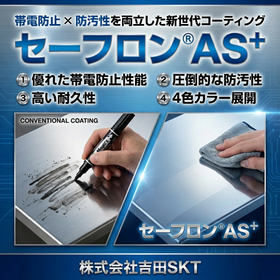
Eliminate static electricity troubles! Improve dirt resistance with "Safron AS+"

Suppresses static electricity and makes it easy to wipe off dirt! Anti-static fluororesin coating 'Safron AS+'.

■Losses Due to Static Electricity Troubles - Decreased productivity due to product adhesion, dust accumulation, mesh clogging, and fiber entanglement - Decreased safety due to fires, electric shocks, and equipment malfunctions - Increased running costs due to higher cleaning expenses ■Challenges of Conventional Anti-Static Coatings - Low dirt resistance - Limited color variations ■Newly Developed "Safron AS+" - Significantly improved dirt resistance while maintaining equivalent anti-static performance to conventional products - Easily wipes off magic stains - Four color variations tailored to different applications ■Benefits of "Safron AS+" - Reduces static electricity troubles, leading to increased productivity, equipment protection, and enhanced safety - Improved dirt resistance results in reduced cleaning time and lower running costs - Abundant color variations *For more details, please refer to the PDF document or feel free to contact us.

  • 2021-06-02 (11).png
  • 2021-06-02 (18)-1.png
  • 2021-06-02 (18).png
  • Surface treatment contract service
  • Coating

Added to bookmarks

Bookmarks list

Bookmark has been removed

Bookmarks list

You can't add any more bookmarks

By registering as a member, you can increase the number of bookmarks you can save and organize them with labels.

Free membership registration

Electrostatic discharge prevention coating for the flow path of special ink used in organic EL.

Improved flow of special ink used for organic EL with newly developed antistatic fluororesin coating!

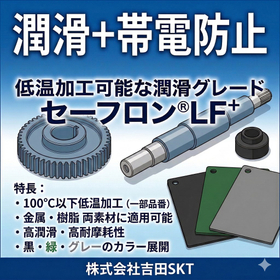
■Problems we wanted to solve and things we wanted to achieve We received a consultation from a customer handling ink, who wanted to improve ink contamination in the pans and tanks used for ink. Since the ink used in this case is flammable, fire prevention measures were essential. Therefore, we were looking for a coating that could provide dirt resistance and also had anti-static properties. ■Coating adopted Safron LF+ ■Achieved effects The coating previously considered showed variability in anti-static properties during preliminary tests, which raised concerns. Therefore, we tested Safron LF+, which has excellent anti-static performance, and found both anti-static and dirt resistance properties to be satisfactory, leading to its adoption. By maintaining stable conductivity, we were able to provide anti-static performance. We also improved ink contamination, resulting in customer satisfaction. If you have any questions about detailed information or other products, please feel free to contact us.

  • 2021-06-02 (11).png
  • 2021-06-02 (18)-1.png
  • 2021-06-02 (18).png
  • Surface treatment contract service
  • Coating

Added to bookmarks

Bookmarks list

Bookmark has been removed

Bookmarks list

You can't add any more bookmarks

By registering as a member, you can increase the number of bookmarks you can save and organize them with labels.

Free membership registration

Evolved thin film fluoropolymer coating '10under'

This is a groundbreaking fluororesin coating that has achieved thin film processing at a film thickness of 10μm, which was previously difficult.

10under is a fluororesin coating that enables thin film processing at a film thickness of 10μm, which was previously difficult to achieve. Traditional fluororesin coatings required a thickness of about 20-50μm, but 10under can be processed with a thin film of about 10μm. **Benefits of 10UNDER** - Reduction of dimensional changes The thinning of the film can reduce dimensional changes in the substrate. - Suppression of transparency Despite being a thin film, it suppresses transparency and prevents appearance defects. - Minimization of thin plate deformation It can minimize the deformation of thin plate substrates. If you want the same non-stick properties as standard fluororesin coatings while suppressing transparency and preventing appearance defects, and if you want to minimize the deformation of thin plate substrates, please consider 10UNDER. You can check specific comparisons and detailed information via the link.

  • 2_家比較全体.jpg
  • Surface treatment contract service
  • Coating

Added to bookmarks

Bookmarks list

Bookmark has been removed

Bookmarks list

You can't add any more bookmarks

By registering as a member, you can increase the number of bookmarks you can save and organize them with labels.

Free membership registration

A coating that eliminates the wear resistance of parts where surface wear occurs.

Incredible durability that surpasses fluoropolymer coatings! Surface treatment suitable for applications with mechanical loads. *Product and case materials available.

Super Durable Fluoropolymer-based Organic Coating System "Bicoat(R)" "Surface treatment of inorganic materials with hardness and wear resistance, such as metals and ceramics" + "Surface treatment of organic materials with release and slip properties, such as fluorine and silicone" With our unique surface treatment technology, we have achieved an ideal durability of "sliding + release + wear resistance" in our coating system. It withstands harsh usage areas such as injection molds, providing reliable release and sliding properties. Additionally, due to its excellent dimensional accuracy, it is suitable for areas requiring micron-level precision. 【Features】 ■ Incredible durability ■ High hardness and scratch resistance ■ Excellent wear resistance ■ Superior non-stick and release properties ■ Safe for use in molds requiring micron-level dimensional accuracy *For more details, please refer to the PDF materials or feel free to contact us.

  • TYS-03K_edited.jpg
  • NYF-11-S 1_edited.jpg
  • 2021-05-22 (4)_edited.jpg
  • IMG_8528_edited_edited.jpg
  • Other surface treatment equipment
  • Coating

Added to bookmarks

Bookmarks list

Bookmark has been removed

Bookmarks list

You can't add any more bookmarks

By registering as a member, you can increase the number of bookmarks you can save and organize them with labels.

Free membership registration

European PFAS regulations! PFAS-free release and slip coatings.

We will introduce coatings that do not use substances subject to the European PFAS regulation proposal.

"Bycoat Exceed HR↑" achieves improved non-stick properties, slip resistance, and heat resistance without using PFAS. It provides reliable release properties and durability even with molds that use strong adhesive resins. Additionally, like traditional Bycoat, it has excellent dimensional accuracy, making it suitable for areas that require micron-level precision. 【Features of Bycoat Exceed HR↑】 - High hardness, long lifespan, dimensional stability of Bycoat × enhanced heat resistance grade *For more details, please refer to the PDF document or feel free to contact us. For coatings considering PFAS regulations, please contact our company.

  • IMG_8528_edited_edited.jpg
  • Other surface treatment equipment
  • Coating

Added to bookmarks

Bookmarks list

Bookmark has been removed

Bookmarks list

You can't add any more bookmarks

By registering as a member, you can increase the number of bookmarks you can save and organize them with labels.

Free membership registration

Coating that solves the problem of adhesive substances sticking to the cutter blade.

We will introduce a coating that can solve the problem of cutter blade adhesion, along with examples.

As a problem with the packaging machine, the adhesive film was sticking to the cutter, impairing its sharpness and causing misalignment of the film. This resulted in the production line being halted, leading to a situation where production could not proceed as planned. Initially, a release agent was used, but its effect was temporary, requiring frequent reapplication. The introduction of "MRS Coating" resolved the sticking issues. MRS Coating can be processed at temperatures below 250°C and maintains sharpness due to its 1-micron thickness. In this case, MRS Coating achieved stabilization of quality and operation, improved work speed, and addressed safety and environmental requirements. MRS Coating realizes non-stick properties and has a long-lasting effect. [Key Points of the Case] ■ Purpose of Surface Treatment: Stabilization of Quality and Operation, Speed Improvement, Safety and Environmental Compliance ■ Required Functions: Non-stick and Release Properties, Long Lifespan ■ Treatment Adopted: MRS Coating (Mold Release Silicone) ▼ Free samples and case studies on improving cutting processes are available on the website below! ▼

  • IMG_1880_edited.jpg
  • IMG_1889_edited2.jpg
  • Processing Contract
  • Coating

Added to bookmarks

Bookmarks list

Bookmark has been removed

Bookmarks list

You can't add any more bookmarks

By registering as a member, you can increase the number of bookmarks you can save and organize them with labels.

Free membership registration

Comparison of types of fluoropolymer coatings: Explanation of the differences between FEP and ETFE.

【Presentation of Materials】A detailed explanation of the differences between PTFE and PFA, as well as FEP and ETFE, which are surprisingly not well known!

The technical document "Differences Between PTFE and PFA" provides a detailed explanation of FEP and ETFE, covering everything from molecular structure to properties. It also discusses the differences in characteristics of fluoropolymer coatings at the end. With this single book, you can gain a solid understanding of the differences and features of each. If you are interested, please feel free to download it. [Contents (excerpt)] - Types and properties of fluoropolymers - Differences between PTFE and PFA / Overview of FEP and ETFE - Differences among four types of fluoropolymer coatings

  • Surface treatment contract service
  • Coating

Added to bookmarks

Bookmarks list

Bookmark has been removed

Bookmarks list

You can't add any more bookmarks

By registering as a member, you can increase the number of bookmarks you can save and organize them with labels.

Free membership registration

Materials that are helpful when you want to correctly choose the type of fluororesin.

【Presentation of Materials】A detailed explanation of the differences between PTFE and PFA, as well as the differences between FEP and ETFE, including molecular structures and properties!

The technical document "Differences Between PTFE and PFA" provides a detailed explanation of PTFE, PFA, FEP, and ETFE, covering everything from molecular structure to properties. Fluoropolymers are well-known for their non-stick and slippery characteristics, but many people may not be aware of their various types and differences. This single volume allows for a thorough understanding of the differences and features of each. If you are interested, please feel free to download it. [Contents (excerpt)] ■ Types and characteristics of fluoropolymers ■ Differences between PTFE and PFA / Overview of FEP and ETFE ■ Differences among four types of fluoropolymer coatings

  • Surface treatment contract service
  • Coating

Added to bookmarks

Bookmarks list

Bookmark has been removed

Bookmarks list

You can't add any more bookmarks

By registering as a member, you can increase the number of bookmarks you can save and organize them with labels.

Free membership registration

A perfect document for those who want to know about fluororesin lining is presented.

We are currently offering detailed materials explaining the types and processing methods of fluororesin lining.

■What is Fluororesin Lining? Fluororesin lining is one type of "resin lining." Resin lining includes those utilizing "polyethylene" and "nylon" resins, as well as "FRP lining," which combines glass fibers with resin. Among these, "fluororesin" is a material that is resistant to chemical corrosion in harsh environments. ■Types of Fluororesin Lining Types of fluororesin lining include PTFE lining, PFA lining, and ETFE lining. Each lining requires appropriate selection based on the usage environment, construction method, and application. ■Main Fluororesin Lining Methods There are three main methods: "sheet lining," "baked coating," and "rotolining." ■Various Lining Methods At Yoshida SKT, we can accommodate various processing methods according to the shape and thickness of the material, not only based on material differences but also using "sheet lining" with fluororesin sheets, "PFA lining" with baked coatings, and "rotolining" using rotational molding. *When considering lining, please check the materials and contact us for inquiries.

  • s-020100.gif
  • ETFE_edited.jpg
  • IMG_7868_edited.jpg
  • others
  • Coating

Added to bookmarks

Bookmarks list

Bookmark has been removed

Bookmarks list

You can't add any more bookmarks

By registering as a member, you can increase the number of bookmarks you can save and organize them with labels.

Free membership registration

Residual products in the mold! A coating that eliminates transfer of release agent to the molded products.

We will introduce coatings and release surface treatments that improve the release of rubber, resin, and elastomer products that are prone to sticking.

Introduction of Bycoat to meet needs such as: - Residual products on molds - Filling defects in thin-walled molding - Release agent transferring to molded products - Decorative sheets sticking to molds during transfer 'Bycoat' is a system that achieves the ideal functions of "release + wear resistance" by combining "surface treatment technology for inorganic materials" and "surface treatment technology for organic materials." It withstands harsh usage areas such as injection molds, providing reliable lubrication and release properties. Additionally, it is suitable for areas requiring micron-level dimensional accuracy due to its excellent processing dimensional precision. By processing with Bycoat, you can improve release properties, reduce product defects, and enhance productivity. *Product materials and case studies are available for PDF download.

  • 2021-05-22 (4)_edited.jpg
  • IMG_8528_edited_edited.jpg
  • s-0186XT.jpg
  • Surface treatment contract service
  • Coating

Added to bookmarks

Bookmarks list

Bookmark has been removed

Bookmarks list

You can't add any more bookmarks

By registering as a member, you can increase the number of bookmarks you can save and organize them with labels.

Free membership registration