We have compiled a list of manufacturers, distributors, product information, reference prices, and rankings for movie.
ipros is IPROS GMS IPROS One of the largest technical database sites in Japan that collects information on.

movie Product List and Ranking from 55 Manufacturers, Suppliers and Companies | IPROS GMS

Last Updated: Aggregation Period:Mar 18, 2026~Apr 14, 2026
This ranking is based on the number of page views on our site.

movie Manufacturer, Suppliers and Company Rankings

Last Updated: Aggregation Period:Mar 18, 2026~Apr 14, 2026
This ranking is based on the number of page views on our site.

  1. LinkStudio Fukuoka//Educational and Research Institutions
  2. 松井製作所 Osaka//Ferrous/Non-ferrous metals
  3. ベンカン機工 Gunma//Ferrous/Non-ferrous metals
  4. 4 リナック 日本支社 Kanagawa//Machine elements and parts
  5. 5 ペスコ Tokyo//Service Industry

movie Product ranking

Last Updated: Aggregation Period:Mar 18, 2026~Apr 14, 2026
This ranking is based on the number of page views on our site.

  1. Visualizing the reasons for the continued "labeling mistakes." LinkStudio
  2. Reasons and solutions for employees not following safety rules. LinkStudio
  3. A thorough explanation of the self-holding power and brakes of electric cylinders in a video! リナック 日本支社
  4. 4 The reason why "verbal warnings" have zero effect: examples of changing behavior through videos. LinkStudio
  5. 5 A video that explains the mandrel manufacturing process. ベンカン機工

movie Product List

181~210 item / All 743 items

Displayed results

Explaining the Basics of Parallelism for 3D Printers!

To improve the printing accuracy of 3D printers!

In the 3D printing industry, the accuracy of the printed objects greatly affects the quality of the products. Particularly in additive manufacturing, precise alignment of each layer is crucial, and understanding parallelism is essential. If parallelism is not properly managed, distortions and dimensional errors in the printed objects can occur, potentially negatively impacting the functionality and appearance of the products. This video explains the basics of "parallelism," a type of geometric tolerance. It covers the definition of parallelism, examples of its use, how it is represented in drawings, and points to consider when using it. Please use this video as a reference to improve the printing accuracy of your 3D printer. [Usage Scenarios] - When creating prototypes with a 3D printer - When manufacturing precise parts with a 3D printer - When conducting quality control of printed objects [Benefits of Implementation] - Improved accuracy of printed objects - Reduction of defective products - Realization of printed objects as per design specifications

  • others
  • movie

Added to bookmarks

Bookmarks list

Bookmark has been removed

Bookmarks list

You can't add any more bookmarks

By registering as a member, you can increase the number of bookmarks you can save and organize them with labels.

Free membership registration

[For Machine Manufacturing] Geometric Tolerances: Basic Explanation of Inclination

A clear explanation of the basics of slope in a video!

In the mechanical manufacturing industry, a precise understanding of geometric tolerances on drawings is essential to ensure product quality and accuracy. In particular, the slope significantly affects the assembly and functionality of parts, making it important to understand its definition, usage, and points of caution. An inaccurate understanding can lead to incorrect manufacturing of parts or assembly failures. This video explains the basics of "slope," a type of geometric tolerance. 【Application Scenarios】 - Design and manufacturing of mechanical components - Reading drawings in quality control - Technical education on the manufacturing floor 【Benefits of Introduction】 - Improved drawing comprehension - Reduction of manufacturing errors - Increased customer satisfaction through enhanced quality

  • others
  • movie

Added to bookmarks

Bookmarks list

Bookmark has been removed

Bookmarks list

You can't add any more bookmarks

By registering as a member, you can increase the number of bookmarks you can save and organize them with labels.

Free membership registration

[For Molds] Geometric Tolerances Inclination Basic Explanation Video

To improve the precision of mold design and manufacturing!

In the mold industry, the dimensional accuracy of products greatly affects quality. In particular, even a slight deviation in the angle of inclination can lead to molding defects or a decrease in product accuracy. This video explains the basics of "inclination," a type of geometric tolerance. By understanding the definition of inclination, examples of its use, how it is represented in drawings, and points to consider when using it, you can help solve challenges in mold design. This video will be a very effective resource for those aiming to improve accuracy in mold design. 【Usage Scenarios】 - I want to deepen my understanding of inclination in mold design. - I aim to improve the accuracy of molded products. - I want to learn how to interpret inclination indications in drawings. 【Benefits of Introduction】 - Improvement in the quality of mold design. - Reduction of molding defects. - Stabilization of product accuracy.

  • others
  • movie

Added to bookmarks

Bookmarks list

Bookmark has been removed

Bookmarks list

You can't add any more bookmarks

By registering as a member, you can increase the number of bookmarks you can save and organize them with labels.

Free membership registration

Basic Explanation of Geometric Tolerances for Precision Measurement: Inclination

Contributing to the efficiency of inspection operations!

In the field of precision measurement, it is important to confirm whether the product has the shape specified in the drawings to ensure quality. In particular, the slope significantly affects the product's functionality and assembly, requiring accurate understanding and measurement. Understanding the definition and measurement methods of slope is essential for improving inspection accuracy. This video explains the basics of "slope," a type of geometric tolerance, and supports the efficiency of inspection operations. 【Usage Scenarios】 - Product quality management - Streamlining inspection processes - Enhancing drawing interpretation skills 【Benefits of Implementation】 - Deepens understanding of slope and improves inspection accuracy - Enhances drawing interpretation skills, contributing to reduced inspection time - Promotes standardization of inspection operations

  • others
  • movie

Added to bookmarks

Bookmarks list

Bookmark has been removed

Bookmarks list

You can't add any more bookmarks

By registering as a member, you can increase the number of bookmarks you can save and organize them with labels.

Free membership registration

[Aerospace] Geometric Tolerances: Concentricity and Coaxiality Basic Explanation

Explaining the fundamentals of design in the aerospace field!

In the aerospace industry, there is a demand for lightweight products and high precision. Understanding concentricity and coaxiality in component design is essential for achieving both weight reduction and quality. By properly understanding these geometric tolerances and reflecting them in drawings, we can reduce waste in components and improve the overall performance of the product. This video will explain the definitions of concentricity and coaxiality, examples of their use, how they are applied in drawings, and points to note when using them. This video will serve as a resource for designers and engineers in the aerospace field to deepen their foundational knowledge of design and conduct more efficient designs. [Application Scenarios] - Component design for aircraft and spacecraft - Design focused on weight reduction - High-precision component manufacturing [Effects of Introduction] - Improvement in design quality - Weight reduction of components - Reduction in manufacturing costs

  • others
  • movie

Added to bookmarks

Bookmarks list

Bookmark has been removed

Bookmarks list

You can't add any more bookmarks

By registering as a member, you can increase the number of bookmarks you can save and organize them with labels.

Free membership registration

【For the Energy Industry】Explanation Video on Concentricity and Coaxiality

Contributing to the improvement of the quality of energy-related components!

In the energy industry, stable operation of equipment and efficient energy use are required. Particularly for rotating machinery such as generators and transmission equipment, precise positioning of components is crucial. Poor concentricity and coaxiality can lead to vibrations and friction, potentially resulting in equipment failure and decreased energy efficiency. This video explains the basics of "concentricity and coaxiality," which are types of geometric tolerances. 【Application Scenarios】 - Manufacturing of generators and turbines - Assembly of pumps and compressors - Maintenance of energy-related equipment 【Benefits of Implementation】 - Improved component quality - Stable operation of equipment - Enhanced energy efficiency

  • others
  • movie

Added to bookmarks

Bookmarks list

Bookmark has been removed

Bookmarks list

You can't add any more bookmarks

By registering as a member, you can increase the number of bookmarks you can save and organize them with labels.

Free membership registration

Positioning Explanation Video for Medical Devices

A clear explanation of the basics of positional degree!

In the medical device industry, precise dimensions and positional accuracy of components are crucial to ensure product safety. Especially in medical devices that involve human lives, even slight misalignments of parts can lead to malfunctions or performance degradation, potentially resulting in serious accidents. This video explains the basics of "position tolerance," a type of geometric tolerance, and contributes to enhancing safety in the design and manufacturing of medical devices. By deepening the understanding of the definition of position tolerance, examples of its use, how it is represented in drawings, and precautions for its application, we aim to strengthen quality management during the design and manufacturing stages and support the development of safer medical devices. 【Application Scenarios】 - Creating drawings during the design phase of medical devices - Quality control in manufacturing settings - Incoming inspection of components 【Benefits of Implementation】 - Deepening understanding of position tolerance and improving quality in design and manufacturing - Enhancing the safety of medical devices - Reducing defective products and cutting costs

  • others
  • movie

Added to bookmarks

Bookmarks list

Bookmark has been removed

Bookmarks list

You can't add any more bookmarks

By registering as a member, you can increase the number of bookmarks you can save and organize them with labels.

Free membership registration

Positioning Accuracy Explanation Video for Electronic Devices

"What is positional degree?" I will answer that!

In the electronics industry, as products become smaller, the precision of components becomes crucial. Understanding positional tolerance enables the accurate placement of parts during the design phase, contributing to product miniaturization and improved reliability. Misunderstanding positional tolerance can lead to assembly defects and decreased product performance. This video explains the basics of positional tolerance and supports problem-solving in the design and manufacturing of electronic devices. 【Application Scenarios】 - Design of electronic devices - Manufacturing of components - Quality control 【Benefits of Implementation】 - Deepen understanding of positional tolerance and improve design accuracy - Contribute to product miniaturization and enhanced reliability - Reduce quality issues in the manufacturing process

  • others
  • movie

Added to bookmarks

Bookmarks list

Bookmark has been removed

Bookmarks list

You can't add any more bookmarks

By registering as a member, you can increase the number of bookmarks you can save and organize them with labels.

Free membership registration

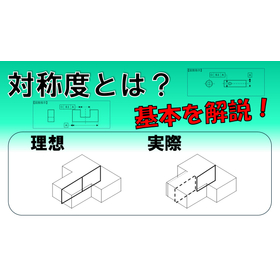
Basic Explanation of Geometric Tolerances for Symmetry in the Automotive Industry

Contributing to the improvement of precision in automotive parts!

In the automotive industry, high precision is required to ensure the quality and performance of parts. This is especially true for critical components such as engines and transmissions, where a precise understanding of symmetry and appropriate instructions are essential. Misinterpretation or incorrect instructions regarding symmetry can lead to functional failures or performance degradation of parts. This video explains the basics of "symmetry," a type of geometric tolerance, and supports problem-solving in the design and manufacturing of automotive parts. It covers the definition of symmetry, examples of use, how it is represented in drawings, and points to note when using it. [Application Scenarios] - Design of automotive parts - Quality control in manufacturing - Training for engineers [Benefits of Implementation] - Improvement in part quality - Reduction of design errors - Skill enhancement for engineers

  • others
  • movie

Added to bookmarks

Bookmarks list

Bookmark has been removed

Bookmarks list

You can't add any more bookmarks

By registering as a member, you can increase the number of bookmarks you can save and organize them with labels.

Free membership registration

[For Precision Machinery] Geometric Tolerance Symmetry Basic Explanation Video

Learn the basics of symmetry and apply them to quality control!

In the precision machinery industry, understanding geometric tolerances on drawings is essential for ensuring product accuracy. In particular, understanding symmetry is crucial for the precise positioning and assembly of parts, directly impacting the performance and reliability of the product. Misunderstanding symmetry can lead to defective parts or assembly errors, potentially compromising the quality of the final product. This video explains the basics of "symmetry," a type of geometric tolerance. It covers the definition of symmetry, examples of its use, how it is represented on drawings, and points to consider when using it, addressing the challenges faced by quality management personnel. 【Application Scenarios】 - Quality management in the manufacturing of precision machine parts - Improvement of drawing interpretation skills - Management of product accuracy 【Benefits of Introduction】 - Deepens understanding of symmetry and enhances drawing interpretation abilities. - Contributes to improved product quality. - Leads to a reduction in defective products.

  • others
  • movie

Added to bookmarks

Bookmarks list

Bookmark has been removed

Bookmarks list

You can't add any more bookmarks

By registering as a member, you can increase the number of bookmarks you can save and organize them with labels.

Free membership registration

【For Machine Tools】Geometric Tolerance Symmetry Basic Explanation Video

Explaining the basics of symmetry! It is useful for high-precision machining.

In the machine tool industry, high-precision parts processing is required. Particularly when micron-level precision is demanded, understanding symmetry is essential. If symmetry is not properly indicated, it can lead to assembly defects and performance degradation. This video explains the basics of "symmetry," which is a type of geometric tolerance. [Usage Scenarios] - Sites engaged in high-precision parts processing - Engineers who want to interpret drawings and provide appropriate indications - Those who want to learn the definition and usage of symmetry [Benefits of Introduction] - Deepens understanding of symmetry and improves drawing interpretation skills - Contributes to achieving high-precision parts processing - Enhances quality and reduces defect rates

  • others
  • movie

Added to bookmarks

Bookmarks list

Bookmark has been removed

Bookmarks list

You can't add any more bookmarks

By registering as a member, you can increase the number of bookmarks you can save and organize them with labels.

Free membership registration

Basic explanatory video on geometric tolerances for electronic devices: symmetry.

Helpful for designing electronic devices! An explanation of the basics of symmetry.

In the electronics industry, there is a demand for miniaturization and high precision of products. Understanding geometric tolerances at the design stage is essential for ensuring product quality and reliability. In particular, understanding symmetry is important for optimizing the arrangement and functionality of components. Improper tolerance settings can lead to decreased product performance and manufacturing issues. This video explains the basics of "symmetry," a type of geometric tolerance. 【Application Scenarios】 - Design of electronic devices - Creation of component drawings - Quality control 【Benefits of Implementation】 - Reduction of design errors - Improvement of product quality - Reduction of manufacturing costs

  • others
  • movie

Added to bookmarks

Bookmarks list

Bookmark has been removed

Bookmarks list

You can't add any more bookmarks

By registering as a member, you can increase the number of bookmarks you can save and organize them with labels.

Free membership registration

[For Automotive Quality Management] Explanation of Geometric Tolerances: Circular Runout and Total Runout

Video materials useful for quality control of automotive parts!

In the automotive industry's quality control, the precise dimensions and shapes of parts are crucial factors that influence the safety and performance of products. Particularly for rotating and sliding components, managing circular runout and total runout is essential. If these geometric tolerances are not properly managed, it can lead to abnormal noises, vibrations, premature wear, and even serious malfunctions. This video explains the basics of "circular runout and total runout," which are types of geometric tolerances. By understanding the definitions of circular runout and total runout, how they are used in drawings, and the precautions to take when using them, you can contribute to solving challenges in quality control. 【Usage Scenarios】 - Design and manufacturing departments of automotive parts - Quality control departments - Technical communication with suppliers 【Benefits of Implementation】 - Deepen understanding of geometric tolerances, contributing to early detection and countermeasures for quality issues - Improve drawing interpretation skills - Enhance the skills of quality control personnel

  • others
  • movie

Added to bookmarks

Bookmarks list

Bookmark has been removed

Bookmarks list

You can't add any more bookmarks

By registering as a member, you can increase the number of bookmarks you can save and organize them with labels.

Free membership registration

[For Medical Devices] Geometric Tolerance Circumferential Runout and Total Runout Explanation Video

Explaining the basics of geometric tolerances in the design and manufacturing of medical devices!

In the medical device industry, precise dimensions and shapes of components are required to ensure product safety. Particularly in medical devices that demand precise operation, even slight deviations in component dimensions can lead to malfunctions of the device or pose risks to patients. Understanding geometric tolerances, especially circular runout and total runout, is essential for ensuring quality during the design phase. This video will explain the definitions of circular runout and total runout, examples of their use, how they are represented in drawings, and precautions for their use. This will enable designers to create safer and more reliable medical devices. [Application Scenarios] - Design of medical devices - Manufacturing of medical devices - Quality control [Effects of Implementation] - Improvement in design quality - Reduction in defect rates during manufacturing processes - Enhancement of product safety

  • others
  • movie

Added to bookmarks

Bookmarks list

Bookmark has been removed

Bookmarks list

You can't add any more bookmarks

By registering as a member, you can increase the number of bookmarks you can save and organize them with labels.

Free membership registration

[For Molds] Geometric Tolerance Circumferential Runout and Total Runout Explanation Video

Explaining the basic knowledge of geometric tolerances useful for mold design and manufacturing!

In the mold industry, dimensional accuracy is crucial to ensure product quality and durability. Particularly, understanding geometric tolerances is essential to prevent wear and deformation of molds. Improper management of circular runout and total runout can lead to early deterioration of molds and a decrease in product accuracy. This video explains the basics of "circular runout and total runout," which are types of geometric tolerances. 【Usage Scenarios】 - Mold design phase - Mold manufacturing process - Mold quality control 【Benefits of Introduction】 - Improvement in quality during mold design and manufacturing - Increased durability of molds - Reduction of defective products

  • others
  • movie

Added to bookmarks

Bookmarks list

Bookmark has been removed

Bookmarks list

You can't add any more bookmarks

By registering as a member, you can increase the number of bookmarks you can save and organize them with labels.

Free membership registration

[For Semiconductor Manufacturing] Geometric Tolerances: Explanation Video on Circular Runout and Total Runout

Learn the basics of geometric tolerances in semiconductor manufacturing to improve yield!

In the semiconductor manufacturing industry, there is always a demand for improved product quality and yield. Particularly in areas where fine processing technology is crucial, the dimensional accuracy of components significantly affects product performance. A lack of understanding of geometric tolerances can lead to the occurrence of defective products and a decline in performance, potentially worsening yield. This video explains the basics of a type of geometric tolerance known as "circular runout and total runout," supporting the improvement of drawing interpretation skills. By watching this video, you can deepen your foundational knowledge of quality management in semiconductor manufacturing and potentially contribute to yield improvement. 【Usage Scenarios】 - Component design in semiconductor manufacturing - Education in quality control departments - Drawing interpretation on the manufacturing floor 【Effects of Implementation】 - Deepening understanding of geometric tolerances and improving drawing interpretation skills - Potential suppression of defective products and improvement in yield - Stabilization of product quality through enhanced knowledge of quality management

  • others
  • movie

Added to bookmarks

Bookmarks list

Bookmark has been removed

Bookmarks list

You can't add any more bookmarks

By registering as a member, you can increase the number of bookmarks you can save and organize them with labels.

Free membership registration

[For Robots] Geometric Tolerances: Circular Runout and Total Runout Basic Explanation

Contributing to the improvement of robot motion accuracy!

In the robotics industry, precise operation of products is essential. In particular, the precise movements of arms and joints are crucial factors that influence the quality and safety of the products. A lack of understanding of geometric tolerances can lead to design errors and manufacturing issues, potentially resulting in malfunctioning robots. This video explains the basics of a type of geometric tolerance known as "circular runout and total runout." By understanding the definitions of circular runout and total runout, how they are used in drawings, and the precautions to take when using them, you can contribute to improving the operational accuracy of robots. 【Application Scenarios】 - Design of robotic arms - Assembly of precision equipment - Training in quality control departments 【Benefits of Implementation】 - Improved operational accuracy of robots - Enhanced product quality - Problem-solving during design and manufacturing stages

  • others
  • movie

Added to bookmarks

Bookmarks list

Bookmark has been removed

Bookmarks list

You can't add any more bookmarks

By registering as a member, you can increase the number of bookmarks you can save and organize them with labels.

Free membership registration

[For Electronic Devices] Geometric Tolerance Circular Runout and Total Runout Explanation Video

Contributing to the improvement of electronic equipment reliability! Explaining the basics of geometric tolerances.

In the electronics industry, accurate dimensions and shapes of components are crucial to ensure product reliability. Particularly in electronic devices exposed to vibrations and shocks, the runout of components can significantly affect product performance. Understanding circular runout and total runout is essential for setting appropriate tolerances during the design phase, leading to improved product quality. This video explains the basics of "circular runout and total runout," which are types of geometric tolerances. 【Application Scenarios】 - Design of electronic devices - Quality control - Education in manufacturing sites 【Effects of Implementation】 - Improved product reliability - Reduced defect rates - Streamlined design and manufacturing processes

  • others
  • movie

Added to bookmarks

Bookmarks list

Bookmark has been removed

Bookmarks list

You can't add any more bookmarks

By registering as a member, you can increase the number of bookmarks you can save and organize them with labels.

Free membership registration

[For the watch industry] Geometric tolerance explanation video on circular runout and total runout.

Explaining the basics of geometric tolerances in watch manufacturing!

In the watch industry, precise processing of components is essential to achieve both product quality and luxury feel. Particularly in movements and exterior parts, not only dimensional accuracy but also geometric tolerances significantly affect the product's performance and appearance. Understanding geometric tolerances such as circular runout and total runout is a crucial factor in high-quality watch manufacturing. This video explains the basics of a type of geometric tolerance known as "circular runout and total runout," supporting problem-solving in watch manufacturing. 【Application Scenarios】 - Design and manufacturing of watch components - Education in quality control departments - Technical guidance for engineers 【Effects of Implementation】 - Deepening understanding of geometric tolerances, improving design and manufacturing quality - Reduction of defective products and cost savings - Skill enhancement for engineers

  • others
  • movie

Added to bookmarks

Bookmarks list

Bookmark has been removed

Bookmarks list

You can't add any more bookmarks

By registering as a member, you can increase the number of bookmarks you can save and organize them with labels.

Free membership registration

[For Optical Equipment] Explanation of Geometric Tolerances: Circular Runout and Total Runout

Explaining the basics of geometric tolerances that help maintain the performance of optical instruments!

In the optical equipment industry, understanding geometric tolerances is essential for maintaining product accuracy and reliability. Particularly in precision components such as lenses and mirrors, managing circular runout and total runout directly affects optical performance. If these tolerances are not properly managed, distortions can occur in light transmission and reflection, potentially leading to a decrease in equipment performance. This video explains the basics of "circular runout and total runout," which are types of geometric tolerances. 【Application Scenarios】 - Manufacturing optical lenses and mirrors - Designing precision measuring instruments - Quality control of optical systems 【Benefits of Introduction】 - Deepening understanding of geometric tolerances to improve design and manufacturing quality - Maintaining product performance and enhancing reliability - Reducing defective products and cutting costs

  • others
  • movie

Added to bookmarks

Bookmarks list

Bookmark has been removed

Bookmarks list

You can't add any more bookmarks

By registering as a member, you can increase the number of bookmarks you can save and organize them with labels.

Free membership registration

Reduce defects with a cause-and-effect diagram for the manufacturing industry!

Explaining the basics of the cause-and-effect diagram! This is a video resource that helps in reducing defects.

In the manufacturing industry, the occurrence of defective products is a significant challenge that leads to increased costs and a loss of trust from customers. To reduce defects, it is essential to identify the root causes of the problems and implement countermeasures. This video explains how to create a cause-and-effect diagram (fishbone diagram), which is fundamental to quality management. The cause-and-effect diagram is a powerful tool for systematically analyzing the causes of problems and developing effective countermeasures. This video material will serve as the first step in problem-solving for those in the manufacturing industry aiming to reduce defects. 【Usage Scenarios】 * Analyzing the causes of defects in the manufacturing site * Improving the quality management system * Enhancing problem-solving capabilities 【Effects of Implementation】 * Reducing the defect occurrence rate * Streamlining quality management * Improving problem-solving abilities

  • others
  • movie

Added to bookmarks

Bookmarks list

Bookmark has been removed

Bookmarks list

You can't add any more bookmarks

By registering as a member, you can increase the number of bookmarks you can save and organize them with labels.

Free membership registration

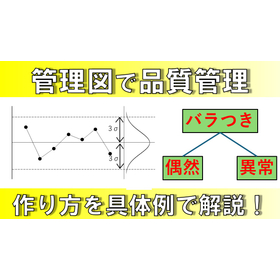
Explaining the basics of management charts for energy facilities!

Explaining the basics of control charts with examples! Useful for quality management in equipment maintenance.

In the energy equipment industry, stable operation of equipment is crucial for maintenance. Therefore, it is necessary to grasp daily inspection data and abnormal values to detect equipment anomalies early. Control charts help visualize the operational status of equipment and assist in the early detection of signs of abnormalities. This video explains the basics of control charts and supports the improvement of quality management in equipment maintenance. 【Usage Scenarios】 - Monitoring equipment operational status - Early detection of abnormal values - Improvement of quality management 【Effects of Implementation】 - Maintenance of stable equipment operation - Reduction of failure risks - Enhancement of quality management capabilities

  • others
  • movie

Added to bookmarks

Bookmarks list

Bookmark has been removed

Bookmarks list

You can't add any more bookmarks

By registering as a member, you can increase the number of bookmarks you can save and organize them with labels.

Free membership registration

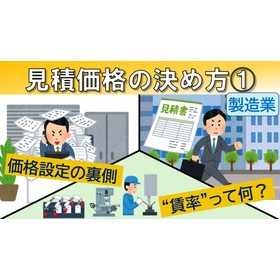
How to Determine Quotation Prices for the Manufacturing Industry 1

Explanation of how to calculate estimated prices!

In the manufacturing industry, accurate estimation of prices is crucial for improving yield. Understanding the method of calculating labor rates, in particular, forms the foundation of cost management. If labor rates are not calculated correctly, it can pressure profits and negatively impact management. This video explains the basic concepts of labor rates and suggests ways to enhance the transparency of estimation prices. 【Usage Scenarios】 - When creating estimates for new products - When aiming for cost reduction - When wanting to review the method of calculating labor rates 【Effects of Implementation】 - Accurate estimation of prices - Improved cost management capabilities - Enhanced profit margins

  • others
  • movie

Added to bookmarks

Bookmarks list

Bookmark has been removed

Bookmarks list

You can't add any more bookmarks

By registering as a member, you can increase the number of bookmarks you can save and organize them with labels.

Free membership registration

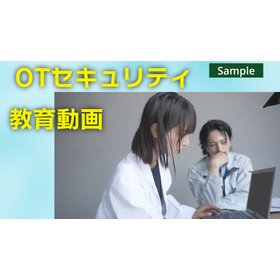
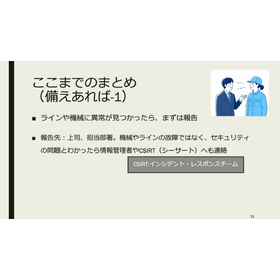
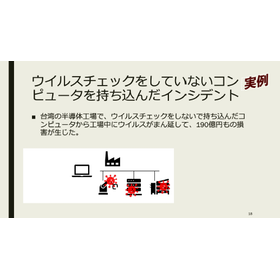
OT Security Training Video for the Manufacturing Industry

OT security training video to prevent line stoppages and improve productivity.

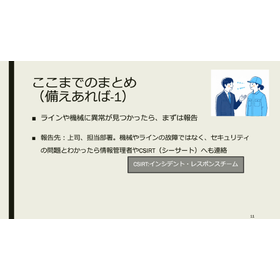
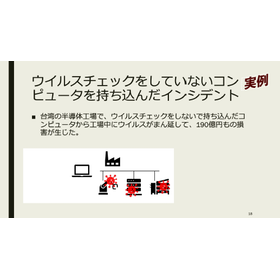
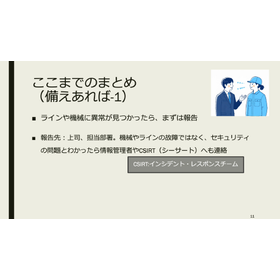
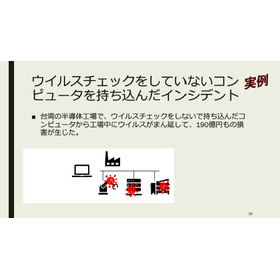
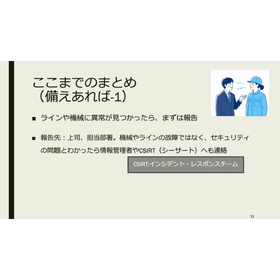
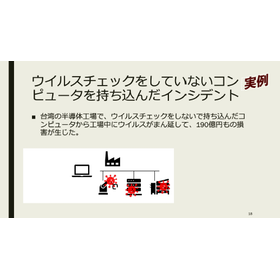
In the manufacturing industry, a halt in the production line can lead to significant losses. Vulnerabilities in OT security can cause unauthorized access to systems or malware infections, potentially resulting in line stoppages. The OT security training video has been created to help factory workers acquire basic knowledge of OT security, reduce the risk of incidents, and learn how to respond in the event of an incident. Through this video, viewers can understand the differences between OT and IT security, related terminology, and incident cases, as well as learn response measures for incidents. Even for participants with limited IT knowledge, the drama-style video is designed to keep them engaged while naturally acquiring knowledge of OT security. 【Usage Scenarios】 * Personnel responsible for the production line * Factory managers * All employees interested in OT security 【Benefits of Implementation】 * Reduced risk of line stoppages * Increased productivity * Enhanced employee security awareness * Improved response capabilities during incidents

  • Company:INJANET
  • Price:100,000 yen-500,000 yen
  • 02.png
  • 03.png
  • sambnOTsec.png
  • Other security
  • movie

Added to bookmarks

Bookmarks list

Bookmark has been removed

Bookmarks list

You can't add any more bookmarks

By registering as a member, you can increase the number of bookmarks you can save and organize them with labels.

Free membership registration

OT Security Training Video for Water Utility Operators

OT security training video for all employees to reduce the risk of safe water supply disruptions.

In the water supply industry, security measures for Operational Technology (OT) systems are essential to prevent water quality contamination and maintain a safe water supply. In particular, system outages or malfunctions caused by cyberattacks can lead to serious situations such as water quality contamination or supply interruptions. OT security training videos help in understanding these risks and taking appropriate measures. This video clearly explains the differences between OT and IT security, related terminology, and incident cases, contributing to the enhancement of employees' security awareness. 【Usage Scenarios】 - All facilities operating OT systems, such as water purification plants, distribution facilities, and pumping stations - Employees involved with water quality monitoring systems and control systems - Businesses that want to recognize the risks of water quality contamination due to cyberattacks and implement countermeasures 【Benefits of Implementation】 - Deepen knowledge and understanding of OT security, improving response capabilities during incidents - Reduce the risk of water quality contamination and continue to supply safe water - Enhance employees' security awareness and improve the overall security level of the organization

  • Company:INJANET
  • Price:100,000 yen-500,000 yen
  • 02.png
  • 03.png
  • sambnOTsec.png
  • Seminar
  • movie

Added to bookmarks

Bookmarks list

Bookmark has been removed

Bookmarks list

You can't add any more bookmarks

By registering as a member, you can increase the number of bookmarks you can save and organize them with labels.

Free membership registration

OT Security Training Video for Chemical Plants

OT security training video for all employees supporting safe operations of chemical plants.

In the chemical plant industry, ensuring stable operation and safety of the plant is the most important issue. In particular, cyber attacks on control systems can lead to accidents and operational shutdowns, potentially causing significant damage. There is a need to enhance employees' security awareness and ensure appropriate responses in the event of incidents. Our OT security training videos explain the differences between OT and IT security, as well as incident cases, in a way that is easy for factory workers to understand, even for those with little IT knowledge. 【Usage Scenarios】 * OT security measures in chemical plants * Enhancing employees' security awareness * Initial response during incidents 【Benefits of Implementation】 * Reduction of accident risks due to cyber attacks * Achieving stable operation of the plant * Improvement of employees' security knowledge and skills

  • Company:INJANET
  • Price:100,000 yen-500,000 yen
  • 02.png
  • 03.png
  • sambnOTsec.png
  • Seminar
  • movie

Added to bookmarks

Bookmarks list

Bookmark has been removed

Bookmarks list

You can't add any more bookmarks

By registering as a member, you can increase the number of bookmarks you can save and organize them with labels.

Free membership registration

OT Security Training Video for the Food Industry

OT security training video to reduce the risk of foreign substance contamination in food factories.

In the food industry, contamination and operational shutdowns during the manufacturing process are serious issues that can undermine a company's trust. Vulnerabilities in OT security can lead to unauthorized access to systems, which may also result in contamination or operational halts. It is essential for employees to understand the importance of OT security and to implement appropriate measures. Our OT security training videos are designed to help employees in food factories learn the basics of OT security and acquire knowledge to prevent incidents, even for those with limited IT knowledge, through engaging, drama-style videos. 【Usage Scenarios】 - Manufacturing lines in food factories - Processes requiring contamination prevention measures - Enhancing employees' security awareness 【Benefits of Implementation】 - Reduction of contamination risks - Stabilization of manufacturing processes - Improvement of corporate reliability

  • Company:INJANET
  • Price:100,000 yen-500,000 yen
  • 02.png
  • 03.png
  • sambnOTsec.png
  • Seminar
  • movie

Added to bookmarks

Bookmarks list

Bookmark has been removed

Bookmarks list

You can't add any more bookmarks

By registering as a member, you can increase the number of bookmarks you can save and organize them with labels.

Free membership registration

Why is technology transfer not progressing? An explanation of the challenges and solutions in the manufacturing industry!

We will solve issues such as 'decrease in veteran employees,' 'increased burden of education for technology transfer,' and 'changes in the work values of younger employees' through videos. *Case studies available.

In the BtoB manufacturing industry, automation through machinery has advanced, and compared to a decade ago, the reliance on human labor has certainly decreased. Large companies are also progressing towards smart factories, enabling the manufacturing process to produce high-quality products more effectively and efficiently through "full automation" and "visualization." While it is said that automation is advancing in manufacturing sites, a significant challenge on the ground is the "inheritance of technology to the next generation." This article will explain the challenges of technology transfer and the countermeasures using videos. *For more details, please refer to the attached catalog. Feel free to download it.

  • Other services
  • movie

Added to bookmarks

Bookmarks list

Bookmark has been removed

Bookmarks list

You can't add any more bookmarks

By registering as a member, you can increase the number of bookmarks you can save and organize them with labels.

Free membership registration

The "three roles" of video in content marketing.

I will explain branding videos, service introduction videos, and how-to videos!

In content marketing, videos mainly serve three roles: "branding videos," "service introduction videos," and "how-to videos." After clarifying your company's objectives, let's determine which type of video is most suitable. Video content can also be utilized for corporate branding. One advantage of video is its ability to appeal to the intuitive aspects, allowing for the communication of more information, making it a suitable means for corporate branding. However, there are not infrequent cases where the message is conveyed in a way that differs from the company's intentions. Therefore, it is important to clearly define "what kind of target the video is aimed at" and "what purpose it serves" in advance. *For more details on the column, please refer to the related links. For further inquiries, feel free to contact us.*

  • Other Media
  • movie

Added to bookmarks

Bookmarks list

Bookmark has been removed

Bookmarks list

You can't add any more bookmarks

By registering as a member, you can increase the number of bookmarks you can save and organize them with labels.

Free membership registration

Simply saying 'be careful' won't prevent it! What are the educational strategies to reduce accidents?

[Manufacturing Industry New Employee Training] [Safety Education Video] "Transforming Safety Awareness from the Ground Up with Experiential × Video Training! Case Studies Also Introduced"

Are you struggling with the issue of 'accidents not decreasing'? In the manufacturing industry, even with safety measures in place: ■ On-site workers often overlook safety reminders, leading to frequent near misses (Some companies report an average of over 100 near misses per year) ■ Pointing and confirming, as well as safety rules, have become mere formalities, resulting in low effectiveness ■ Foreign workers and newcomers may not correctly recognize risks These issues often lead to a continuous occurrence of accidents. *For more details, please feel free to contact us.

  • Distance learning/E-learning
  • Distance learning/E-learning
  • movie

Added to bookmarks

Bookmarks list

Bookmark has been removed

Bookmarks list

You can't add any more bookmarks

By registering as a member, you can increase the number of bookmarks you can save and organize them with labels.

Free membership registration