406~415 item / All 415 items
Displayed results
Added to bookmarks
Bookmarks listBookmark has been removed
Bookmarks listYou can't add any more bookmarks
By registering as a member, you can increase the number of bookmarks you can save and organize them with labels.
Free membership registration
Contact this company
Inquiry Form406~415 item / All 415 items

Endoscopic surgery in otology has been rapidly developing in recent years. However, otologic surgical procedures—such as suction, grasping, traction, dissection, cutting, facial nerve stimulation, and electrocautery for hemostasis to remove lesions and reconstruct the tympanic membrane or ossicular chain—are not easy to perform single-handedly. Conventionally, there is a two-handed operation using an endoscope fixing device, but the endoscope cannot be moved freely, and the patient's field of view becomes blurred when he moves. Another conventional method is three-hand surgery, in which an assistant holds the endoscope and the operator performs two-handed operation, but it is difficult to learn and cannot be applied to all procedures because of hand interference in the stenotic region. The endoscope assembly of the present invention enables the endoscope and surgical instrument to be stably held with one hand and freely operated. The endoscope and surgical instrument are connected by a movable connection, and the position of the endoscope can be easily adjusted with the fingers of the same hand while holding the surgical instrument. In addition, it is possible to operate the surgical instrument with one hand and simultaneously perform operations such as suction, grasping, pulling, peeling, and cutting with the other hand while securing the field of view.
Added to bookmarks
Bookmarks listBookmark has been removed
Bookmarks listYou can't add any more bookmarks
By registering as a member, you can increase the number of bookmarks you can save and organize them with labels.
Free membership registration
Bonding between components is a critical step in semiconductor packaging, especially as devices become more complex and sensitive. Traditional bump structures like pyramids or cones rely on stress concentration to achieve strong joints. However, this often results in damage to the device or substrate. Our novel hollow bump technology addresses this issue by allowing the bump to deform plastically under low loads. This exposes fresh metal surfaces, low-temperature bonding with minimal stress. This approach reduces the risk of mechanical damage while maintaining strong interconnect performance, offering a promising solution for semiconductor assembly.
Added to bookmarks
Bookmarks listBookmark has been removed
Bookmarks listYou can't add any more bookmarks
By registering as a member, you can increase the number of bookmarks you can save and organize them with labels.
Free membership registration
The average cancer recurrence rate is approximately 20%. For aggressive cancers, the recurrence rate within five years can be as high as 70%. Cancer stem cells, known for their resistance to radiation and drug therapies, are considered a key cause of recurrence. Recently, drug discovery research targeting cancer stem cells has attracted significant attention. However, the extremely low abundance of these cells within tumor tissues presents a major challenge for research. Several methods have been proposed to induce cancer stem cells from cancer cells. However, all require high culture costs and long induction times, making them impractical for clinical application. The present invention relates to a method of inducing cancer stem cells within 24 hours by culturing cancer cells on a double-network hydrogel (DN gel) without the use of drugs or genetic manipulation. Cancer stem cells induced by this method show increased expression of stem cell marker genes and exhibit tumor-forming ability even when injected in small numbers into mice. By enabling simple and rapid production of cancer stem cells, this method is expected to accelerate the development of cancer therapies. These therapies aim to achieve fundamental cures by preventing recurrence and metastasis.
Added to bookmarks
Bookmarks listBookmark has been removed
Bookmarks listYou can't add any more bookmarks
By registering as a member, you can increase the number of bookmarks you can save and organize them with labels.
Free membership registration
In recent years, CO₂ geological storage using mafic and ultramafic rocks—such as basalt and peridotite, which are rich in calcium and other metal elements that react with CO₂ to form carbonate minerals—has garnered global attention as a means of reducing atmospheric CO₂, a major contributor to global warming. However, subsurface environments for CO₂ storage are typically low in temperature and therefore have limited reactivity. Additionally, the amount and connectivity of pores as well as permeability of the subsurface rocks are not always sufficient, presenting significant challenges that require innovative technological solutions. In storage methods that involve dissolving CO₂ in water, the use of seawater is preferable. However, during the storage process, it is also necessary to temporarily suppress the reaction between metal ions in seawater and CO₂ until the CO₂ is securely stored. This invention promotes CO₂ geological storage and mineralization by using biobased, biodegradable chelating agents that enhance mineral dissolution and capture metal ions. By dissolving minerals in subsurface rocks using the chelating agents, the amount and connectivity of pores (CO₂ storage capacity) increase, and the permeability (CO₂ injectivity) is also improved. Furthermore, when CO₂-charged seawater containing the chelating agents is injected into subsurface rocks, it becomes possible to simultaneously store both CO₂ and the metal ions required for carbonate mineral formation with creating additional rock porosity.
Added to bookmarks
Bookmarks listBookmark has been removed
Bookmarks listYou can't add any more bookmarks
By registering as a member, you can increase the number of bookmarks you can save and organize them with labels.
Free membership registration
In the development of subsurface energy infrastructures—such as geothermal power generation, geological storages of carbon dioxide (CCS) and renewable- energy-based hydrogen—it is essential to artificially create highly permeable fractures in rocks at depths of 1,000 to 5,000 meters and temperatures ranging from approximately 30°C to 300°C, in order to secure fluid pathways. In recent years, there has been a growing demand for the development of safer, more efficient, and environmentally friendlier technologies. Conventional hydraulic fracturing is a purely mechanical technique that fractures rock by injecting high-pressure fluid through a wellbore. However, this method faces several technical and environmental limitations, including concerns over induced seismicity from high-pressure injections, and difficulty in maintaining fracture openings and fluid loss especially in moderately permeable rocks. These challenges have highlighted the need for innovative chemical-based approaches—particularly those grounded in green chemistry principles. This invention introduces an innovative fracturing technique that utilizes biobased reactive fluid having high viscosity. This method chemically weakens the rock while forming and propagating fractures at relatively low pressures. Furthermore, by dissolving and roughened the fracture surfaces, the method helps maintain fracture openings and improves permeability over time.
Added to bookmarks
Bookmarks listBookmark has been removed
Bookmarks listYou can't add any more bookmarks
By registering as a member, you can increase the number of bookmarks you can save and organize them with labels.
Free membership registration
With the advancement of the information society, there is increasing demand for devices with lower power consumption, higher speed, and smaller size. However, conventional semiconductor integrated circuits (CMOS) are approaching physical and technological limits in scaling and integration density. This is mainly because charge-based devices inevitably suffer from heat generation and signal delay due to electron transport. To overcome this, researchers have successfully demonstrated the proof-of-concept of information transmission technologies and logic devices that utilize spin waves—specifically magnons propagating in a magnetic insulator such as yttrium iron garnet (YIG)—as information carriers, thereby eliminating the need for electron transport. This invention relates to an address encoder/decoder circuit that employs magnons and uses a ring-shaped interference region to convert complex input signals into corresponding output addresses.
Added to bookmarks
Bookmarks listBookmark has been removed
Bookmarks listYou can't add any more bookmarks
By registering as a member, you can increase the number of bookmarks you can save and organize them with labels.
Free membership registration
To simulate quantum annealing on classical computers, Simulated Quantum Annealing (SQA) based on the Ising model has gained attention. The inventors have developed a parallel algorithm that enables multi-level parallel processing of SQA with a fully connected Ising model, implemented on a Field Programmable Gate Array (FPGA) (related work [1]). This invention supports sparse coupling models and proposes an algorithm that allows for faster analysis of classical spin systems based on the Ising model. This makes it possible to execute SQA at practical speeds using FPGA acceleration.
Added to bookmarks
Bookmarks listBookmark has been removed
Bookmarks listYou can't add any more bookmarks
By registering as a member, you can increase the number of bookmarks you can save and organize them with labels.
Free membership registration
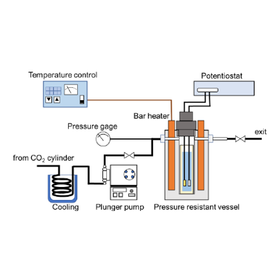
The electrochemical CO2 reduction reaction (CO2RR) process, in which CO2 is electrochemically converted, is attracting attention as a promising CO2 reduction method. However, the conventional method has a problem of low energy efficiency. The inventor has found that it is possible to improve the efficiency of the CO2RR process by utilizing a high-temperature high-pressure water environment called a hydrothermal conditions. When electrolysis is carried out in high-temperature high-pressure water at 150℃ and 100 atm pressurized with CO2, the high diffusion coefficient and solubility of CO2 in the water facilitating efficient CO2 supply to the electrode, and the energy efficiency is significantly enhanced. Additional assessment has shown that it is possible to synthesize "carbon-negative" basic chemical product (methanol), in which the amount of CO2 absorbed exceeds the amount of CO2 emitted, by leveraging low-temperature waste heat from industrial sources and renewable electricity.
Added to bookmarks
Bookmarks listBookmark has been removed
Bookmarks listYou can't add any more bookmarks
By registering as a member, you can increase the number of bookmarks you can save and organize them with labels.
Free membership registration
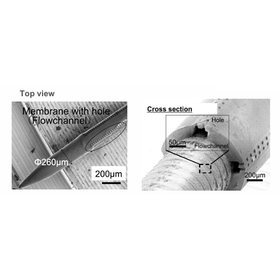
■Introduction of Tohoku University Technology (T11-045) In order to grasp the state of health, biological components (blood sugar, lactic acid, etc.) are measured by blood sampling. However, since continuous measurement is difficult and invasive, the burden on the user is large. Therefore, the present invention provides a biological component measuring sensor which can measure biological components in real time for a long time and does not cause pain to the user. Specifically, a probe for measuring biological components has been developed which collects subcutaneous tissue fluid like dialysis by applying special processing to an ultra-fine needle inserted into the skin. A micro reflux needle with a channel covered with a perforated membrane on the surface of the metal needle is inserted and placed in the skin, and reflux fluid (physiological saline) is circulated through the channel. Since a substance in the skin tissue enters the reflux fluid through the hole in the channel due to concentration diffusion (osmotic pressure), the substance is flowed outside the body and the blood concentration is estimated from the concentration in the reflux fluid measured by a sensor installed outside the body. The present invention enables non-invasive, low-pain continuous measurement equivalent to blood sampling simply by attaching a micro-needle to the skin. *Please refer to the PDF file for related patent (T25-009).
Added to bookmarks
Bookmarks listBookmark has been removed
Bookmarks listYou can't add any more bookmarks
By registering as a member, you can increase the number of bookmarks you can save and organize them with labels.
Free membership registration
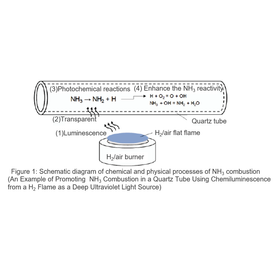
Since ammonia does not emit carbon dioxide when burned, its use is expanding as an alternative fuel to fossil fuels. However, the combustibility of ammonia is inferior to that of fossil fuels, so some combustion support method to promote the oxidation reaction of ammonia is required for the development of combustors for ammonia. As ammonia combustion support methods, intense preheating and the use of powerful igniters have been devised, but there are problems such as the need for high thermal energy, the increase in material cost for high thermal load, and the decrease in durability. Therefore, a low-cost and simple method has been required. The present invention has found that the combustibility of ammonia can be easily promoted only by irradiating deep ultraviolet light. As shown in FIG. 1, ammonia is excited by deep ultraviolet light, and the excited ammonia is decomposed into active radicals (NH₂ and H) to promote combustion reaction. Since deep ultraviolet light emission from a hydrogen flame is very weak, the energy required for deep ultraviolet light irradiation by an electric device is low, and the present invention is a simple and low-cost ammonia combustion supporting method.
Added to bookmarks
Bookmarks listBookmark has been removed
Bookmarks listYou can't add any more bookmarks
By registering as a member, you can increase the number of bookmarks you can save and organize them with labels.
Free membership registration