iPROS Manufacturing
  • Search for products by classification category

    • Electronic Components and Modules
      Electronic Components and Modules
      63019items
    • Machinery Parts
      Machinery Parts
      76249items
    • Manufacturing and processing machinery
      Manufacturing and processing machinery
      103096items
    • Scientific and Physics Equipment
      Scientific and Physics Equipment
      36988items
    • Materials
      Materials
      38215items
    • Measurement and Analysis
      Measurement and Analysis
      55122items
    • Image Processing
      Image Processing
      15532items
    • Control and Electrical Equipment
      Control and Electrical Equipment
      55211items
    • Tools, consumables, and supplies
      Tools, consumables, and supplies
      66174items
    • Design and production support
      Design and production support
      12763items
    • IT/Network
      IT/Network
      46739items
    • Office
      Office
      14252items
    • Business support services
      Business support services
      28574items
    • Seminars and Skill Development
      Seminars and Skill Development
      6647items
    • Pharmaceutical and food related
      Pharmaceutical and food related
      35570items
    • others
      68364items
  • Search for companies by industry

    • Manufacturing and processing contract
      7367
    • others
      5046
    • Industrial Machinery
      4502
    • Machine elements and parts
      3402
    • Other manufacturing
      2909
    • Trading company/Wholesale
      2809
    • IT/Telecommunications
      2582
    • Industrial Electrical Equipment
      2338
    • Building materials, supplies and fixtures
      1816
    • software
      1703
    • Electronic Components and Semiconductors
      1618
    • Resin/Plastic
      1505
    • Service Industry
      1501
    • Testing, Analysis and Measurement
      1141
    • Ferrous/Non-ferrous metals
      1006
    • environment
      697
    • Chemical
      654
    • Automobiles and Transportation Equipment
      622
    • Printing Industry
      517
    • Information and Communications
      485
    • Consumer Electronics
      414
    • Energy
      341
    • Rubber products
      322
    • Food Machinery
      309
    • Optical Instruments
      285
    • robot
      284
    • fiber
      264
    • Paper and pulp
      233
    • Pharmaceuticals and Biotechnology
      178
    • Electricity, Gas and Water Industry
      169
    • Warehousing and transport related industries
      151
    • Food and Beverage
      140
    • Glass and clay products
      140
    • CAD/CAM
      126
    • Educational and Research Institutions
      119
    • Medical Devices
      116
    • retail
      111
    • Ceramics
      98
    • wood
      86
    • Transportation
      84
    • Petroleum and coal products
      67
    • Medical and Welfare
      62
    • Shipbuilding and heavy machinery
      52
    • Aviation & Aerospace
      50
    • equipment
      46
    • Fisheries, Agriculture and Forestry
      43
    • Materials
      41
    • Research and development equipment and devices
      37
    • Public interest/special/independent administrative agency
      32
    • Government
      23
    • self-employed
      23
    • Finance, securities and insurance
      17
    • Mining
      17
    • cosmetics
      16
    • Restaurants and accommodations
      10
    • Individual
      10
    • Police, Fire Department, Self-Defense Forces
      7
    • Raw materials for reagents and chemicals
      5
    • Laboratory Equipment and Consumables
      5
    • Contracted research
      5
  • Special Features
  • Ranking

    • Overall Products Ranking
    • Overall Company Ranking
Search for Products
  • Search for products by classification category

  • Electronic Components and Modules
  • Machinery Parts
  • Manufacturing and processing machinery
  • Scientific and Physics Equipment
  • Materials
  • Measurement and Analysis
  • Image Processing
  • Control and Electrical Equipment
  • Tools, consumables, and supplies
  • Design and production support
  • IT/Network
  • Office
  • Business support services
  • Seminars and Skill Development
  • Pharmaceutical and food related
  • others
Search for Companies
  • Search for companies by industry

  • Manufacturing and processing contract
  • others
  • Industrial Machinery
  • Machine elements and parts
  • Other manufacturing
  • Trading company/Wholesale
  • IT/Telecommunications
  • Industrial Electrical Equipment
  • Building materials, supplies and fixtures
  • software
  • Electronic Components and Semiconductors
  • Resin/Plastic
  • Service Industry
  • Testing, Analysis and Measurement
  • Ferrous/Non-ferrous metals
  • environment
  • Chemical
  • Automobiles and Transportation Equipment
  • Printing Industry
  • Information and Communications
  • Consumer Electronics
  • Energy
  • Rubber products
  • Food Machinery
  • Optical Instruments
  • robot
  • fiber
  • Paper and pulp
  • Pharmaceuticals and Biotechnology
  • Electricity, Gas and Water Industry
  • Warehousing and transport related industries
  • Food and Beverage
  • Glass and clay products
  • CAD/CAM
  • Educational and Research Institutions
  • Medical Devices
  • retail
  • Ceramics
  • wood
  • Transportation
  • Petroleum and coal products
  • Medical and Welfare
  • Shipbuilding and heavy machinery
  • Aviation & Aerospace
  • equipment
  • Fisheries, Agriculture and Forestry
  • Materials
  • Research and development equipment and devices
  • Public interest/special/independent administrative agency
  • Government
  • self-employed
  • Finance, securities and insurance
  • Mining
  • cosmetics
  • Restaurants and accommodations
  • Individual
  • Police, Fire Department, Self-Defense Forces
  • Raw materials for reagents and chemicals
  • Laboratory Equipment and Consumables
  • Contracted research
Special Features
Ranking
  • Overall Products Ranking
  • Overall Company Ranking
  • privacy policy
  • terms of service
  • About Us
  • Careers
  • Advertising
  1. Home
  2. IT/Telecommunications
  3. 日本コンピュータ開発 
  4. Product/Service List
IT/Telecommunications
  • Added to bookmarks

    Bookmarks list

    Bookmark has been removed

    Bookmarks list

    You can't add any more bookmarks

    By registering as a member, you can increase the number of bookmarks you can save and organize them with labels.

    Free membership registration

日本コンピュータ開発 

EstablishmentSeptember 27, 1984
capital5000Ten thousand
number of employees100
addressKanagawa/Ebina-shi/3rd Floor, Nikko Building, 2-4-8 Chuo
phone046-234-7066
  • Special site
  • Official site
last updated:Jul 21, 2026
日本コンピュータ開発 logo
  • Contact this company

    Inquiry Form
  • Company information
  • Products/Services(135)
  • catalog(27)
  • news(19)

日本コンピュータ開発  Product Lineup

  • category

1~45 item / All 58 items

Displayed results

Filter by category

こんな課題ありませんか?「受注〜出荷の転記ミス多発」 こんな課題ありませんか?「受注〜出荷の転記ミス多発」
こんな課題ありませんか?「同じ赤字ミスが繰り返される」 こんな課題ありませんか?「同じ赤字ミスが繰り返される」
こんな課題ありませんか?「生産計画がベテラン依存で止まる」 こんな課題ありませんか?「生産計画がベテラン依存で止まる」
こんな課題ありませんか?「不良情報が社内で共有されない」 こんな課題ありませんか?「不良情報が社内で共有されない」
こんな課題ありませんか?「ロットトレースができていない」 こんな課題ありませんか?「ロットトレースができていない」
こんな課題ありませんか?「発注承認が属人化している」 こんな課題ありませんか?「発注承認が属人化している」
こんな課題ありませんか?「請求書が締日に間に合わない」 こんな課題ありませんか?「請求書が締日に間に合わない」
こんな課題ありませんか?「進行中の原価が見えない」 こんな課題ありませんか?「進行中の原価が見えない」
こんな課題ありませんか?「長納期部品の先行手配ができない」 こんな課題ありませんか?「長納期部品の先行手配ができない」
こんな課題ありませんか?「実績入力が面倒で現場が使わない」 こんな課題ありませんか?「実績入力が面倒で現場が使わない」
こんな課題ありませんか?「棚卸が手作業で工数がかかる」 こんな課題ありませんか?「棚卸が手作業で工数がかかる」
こんな課題ありませんか?「不要な手配・死蔵在庫の発生」 こんな課題ありませんか?「不要な手配・死蔵在庫の発生」
Production Scheduler "Freely" Production Scheduler "Freely"
こんな課題ありませんか?「締めてから赤字が判明する」 こんな課題ありませんか?「締めてから赤字が判明する」
こんな課題ありませんか?「図面が揃わないと手配できない」 こんな課題ありませんか?「図面が揃わないと手配できない」
こんな課題ありませんか?「進捗が見えず納期遅延が多発」 こんな課題ありませんか?「進捗が見えず納期遅延が多発」
こんな課題ありませんか?「欠品と過剰在庫が同時に発生」 こんな課題ありませんか?「欠品と過剰在庫が同時に発生」
こんな課題ありませんか?「設計変更が購買に伝わらない」 こんな課題ありませんか?「設計変更が購買に伝わらない」
見積がベテランの勘頼り 見積がベテランの勘頼り
導入事例 導入事例
お役立ち情報 お役立ち情報
RFID Utilization Platform 'FABRIGATE' RFID Utilization Platform 'FABRIGATE'
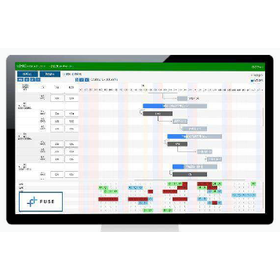
Semi-custom production management system 'FUSE' for small and medium-sized manufacturing industries. Semi-custom production management system 'FUSE' for small and medium-sized manufacturing industries.
Semi-custom

Semi-custom production management system 'FUSE' for small and medium-sized manufacturing industries.

"Isn't the introduction of an all-in-one system time-consuming and costly?" You might think so. However, 'FUSE', which can be implemented with a semi-custom approach, can be introduced without incurring significant costs or time, much to the delight of our customers. Here, we would like to introduce 'FUSE', which our company handles.

[FUSE Implementation Case] Foundry Industry

Delivery delays reduced to 1/3! Achieve input of results using tablets and real-time progress tracking.

We would like to introduce a case study of the production management system "FUSE," which combines only the necessary features from 20 functionalities and has been implemented in the casting industry. There were challenges such as a lack of process management, resulting in habitual delays in delivery due to the inability to see work progress, and the specialized casting techniques becoming tacit knowledge, making technical succession difficult. After implementation, the use of a large touch panel for progress sharing reduced delivery delays by one-third, and it became possible to register achievements from the site, allowing for real-time progress confirmation. [Case Overview (Partial)] ■Challenges - Lack of process management, leading to habitual delivery delays - Specialized casting techniques becoming tacit knowledge, hindering technical succession ■Results - Delivery delays reduced by one-third - Achievement input realized using tablets with dust covers *For more details, please refer to the PDF materials or feel free to contact us.

Added to bookmarks

Bookmarks list

Bookmark has been removed

Bookmarks list

You can't add any more bookmarks

By registering as a member, you can increase the number of bookmarks you can save and organize them with labels.

Free membership registration

[FUSE Implementation Case] Metal Bending Processing Industry

Link to the work instruction! Introducing examples of managing and registering technical know-how such as work videos.

We would like to introduce a case study of implementing "FUSE," a system that allows you to select functions and build a system tailored to your company's operations, in the metal bending processing industry. There were challenges such as the technical know-how of skilled workers becoming tacit knowledge, making it difficult to pass on skills effectively. After implementation, it became possible to register and manage technical know-how, such as work videos, linked to work instructions, allowing anyone to easily reference the necessary information. 【Case Overview】 ■Challenges - The technical know-how of skilled workers has become tacit knowledge, making skill transfer difficult. - Sharing and utilizing technical know-how has not been successful. ■Results - Technical know-how, such as work videos, can be registered and managed, making it easy to reference necessary information. - By searching based on material and shape, technical know-how can be utilized. *For more details, please refer to the PDF document or feel free to contact us.

Added to bookmarks

Bookmarks list

Bookmark has been removed

Bookmarks list

You can't add any more bookmarks

By registering as a member, you can increase the number of bookmarks you can save and organize them with labels.

Free membership registration

Four Benefits and Key Points of Going Paperless with Drawings in the Manufacturing Industry

Say goodbye to piles of drawings! We will also introduce the implementation method and its precautions.

Are those in the manufacturing industry struggling with managing drawings and documents at the workplace? If you are storing them printed on shelves, it may take a lot of time to find the drawings you need. In recent years, managing drawings and documents digitally instead of on paper, known as "paperless," has become mainstream. Why is paperless management necessary in the manufacturing industry? In this article, we will introduce the advantages and disadvantages of managing drawings in a paperless manner. *For more detailed information, please refer to the related links. For further details, please check the PDF materials or feel free to contact us.*

Added to bookmarks

Bookmarks list

Bookmark has been removed

Bookmarks list

You can't add any more bookmarks

By registering as a member, you can increase the number of bookmarks you can save and organize them with labels.

Free membership registration

Things to Know About 'ISO 22400' - Towards the Implementation of IoT in Manufacturing

What is the standardization indicator for production management ISO 22400? We will also introduce the benefits of its implementation.

As IoT and DX in manufacturing progress, many people may have heard the term "ISO 22400" in articles and books but may not fully understand it. In this article, we will explain what ISO 22400 is, provide an overview, and introduce the benefits of its implementation. *You can view the detailed content of the article through the related links. For more information, please refer to the PDF materials or feel free to contact us.*

Added to bookmarks

Bookmarks list

Bookmark has been removed

Bookmarks list

You can't add any more bookmarks

By registering as a member, you can increase the number of bookmarks you can save and organize them with labels.

Free membership registration

What is the production management method "Kanban"? Introduction to its advantages and disadvantages.

What is the mechanism to prevent excess inventory? Introducing the advantages and disadvantages of implementation.

In the manufacturing industry, proper inventory management is very important. When stockouts occur, sales opportunities are lost, and conversely, if too much is produced, it leads to excess inventory. Therefore, it is necessary to manufacture products in a well-balanced manner. The automobile manufacturer "Toyota Motor Corporation" has grown into a global manufacturer by reducing unnecessary inventory and wasteful work through its invented production method known as the "Kanban system." In this article, we will provide a brief explanation of the "Kanban system," along with its advantages and disadvantages. *For detailed content of the article, please refer to the related links. For more information, please check the PDF materials or feel free to contact us.*

Added to bookmarks

Bookmarks list

Bookmark has been removed

Bookmarks list

You can't add any more bookmarks

By registering as a member, you can increase the number of bookmarks you can save and organize them with labels.

Free membership registration

Current status and challenges of technology transfer in the manufacturing industry, along with examples utilizing IT.

We will provide a detailed introduction to the current state and issues of technology transfer, as well as examples of solutions.

One of the major challenges in the manufacturing industry, where the shortage of skilled labor is becoming serious, is the "transfer of skills from experienced workers to younger employees." While many in the manufacturing sector recognize the importance of skill transfer, they may feel uncertain about "how to proceed" or "how other companies are advancing skill transfer." This article introduces the current state of skill transfer in the manufacturing industry, the issues surrounding it, and examples of solutions to these problems. Please use this as a reference for analyzing your company's current skill transfer situation, building corporate strategies, and implementing IT systems. *For more detailed information, please refer to the related links. For further inquiries, feel free to contact us or check the PDF materials.*

Added to bookmarks

Bookmarks list

Bookmark has been removed

Bookmarks list

You can't add any more bookmarks

By registering as a member, you can increase the number of bookmarks you can save and organize them with labels.

Free membership registration

Four representative features of drawing management software.

Introducing the advantages and disadvantages of centralized management through integration with CAD and the shift to a paperless environment!

In the manufacturing industry, it is common to print product drawings and manage them on "paper." By introducing drawing management software, you can digitize paper drawings and manage them in a paperless manner. This article introduces examples of the functions of drawing management software, the benefits of implementing such software in the manufacturing industry, and points to consider when introducing drawing management software. *For detailed content of the article, you can view it through the related links. For more information, please refer to the PDF materials or feel free to contact us.*

Added to bookmarks

Bookmarks list

Bookmark has been removed

Bookmarks list

You can't add any more bookmarks

By registering as a member, you can increase the number of bookmarks you can save and organize them with labels.

Free membership registration

The purpose and benefits of implementing production management systems in the manufacturing industry.

Introducing the purpose of implementation, what can be done with the production management system, and its benefits!

As the introduction of IoT is becoming active, especially in the manufacturing industry, many people may be considering the implementation of production management systems. On the other hand, there are likely many companies that are hesitant to take the plunge into implementation due to questions such as, "What is the purpose of introducing a production management system?" and "What will change if we implement a production management system?" Therefore, in this article, we will explain the objectives of implementing production management systems in the manufacturing industry, what can be achieved with these systems, and their benefits. *For detailed content of the article, you can view it through the related links. For more information, please refer to the PDF materials or feel free to contact us.*

Added to bookmarks

Bookmarks list

Bookmark has been removed

Bookmarks list

You can't add any more bookmarks

By registering as a member, you can increase the number of bookmarks you can save and organize them with labels.

Free membership registration

Labor productivity is 1.7 times higher! Current status and challenges of system implementation in small and medium-sized manufacturing industries.

For understanding your company's situation and reviewing system implementation! We will also introduce IT implementation case studies from small and medium-sized manufacturing businesses.

In recent years, the review of working hours due to work style reforms and the decrease in the labor population caused by low birth rates and an aging society have made improving corporate productivity a significant challenge for companies. In the manufacturing industry, there is an increasing number of companies aiming to enhance productivity by introducing IT and systems on-site. This article will explain the current state of system implementation in small and medium-sized manufacturing businesses and the challenges they face. We hope you gain insights into the implementation status and challenges faced by other companies, which can be useful for understanding your own situation and reconsidering system implementation. *For detailed content of the article, please refer to the related links. For more information, please check the PDF materials or feel free to contact us.*

Added to bookmarks

Bookmarks list

Bookmark has been removed

Bookmarks list

You can't add any more bookmarks

By registering as a member, you can increase the number of bookmarks you can save and organize them with labels.

Free membership registration

Differentiate from competitors! We will explain the benefits of implementing DX (Digital Transformation).

What is DX in the manufacturing industry? An explanation of how to approach, advance, and utilize it.

Are you familiar with the term "DX (Digital Transformation)"? In recent years, it has become increasingly common to see it in news articles, books, and internet articles related to the manufacturing industry. The definition is broad, but it originally refers to the idea that "the penetration of IT changes people's lives for the better in various aspects." Once it began to be applied as a business term, it has been used to mean "transforming business into something better by introducing and utilizing IT." In this article, we will explain how to approach, advance, and utilize DX in the manufacturing industry. *For detailed content of the article, you can view it through the related links. For more information, please refer to the PDF materials or feel free to contact us.*

Added to bookmarks

Bookmarks list

Bookmark has been removed

Bookmarks list

You can't add any more bookmarks

By registering as a member, you can increase the number of bookmarks you can save and organize them with labels.

Free membership registration

What is 3S? The effects and objectives of activities to create a comfortable, safe, and efficient workplace.

By being aware, it is possible to reduce the risk of accidents! Introducing the meaning and purpose of 3S.

Is your production site paying attention to safety? Various machines are used in manufacturing, and various accidents can occur. Even in manual work that does not involve machines, there is still a possibility of injury from things falling or tripping. In some cases, serious accidents such as cuts or fatalities can occur. While there are dangers in manufacturing environments, it is possible to reduce the risk of accidents by being mindful of the 3S. What does the "3S" stand for? This article will introduce the meaning and purpose of 3S. *For more detailed information, please refer to the related links. For further details, please check the PDF materials or feel free to contact us.*

Added to bookmarks

Bookmarks list

Bookmark has been removed

Bookmarks list

You can't add any more bookmarks

By registering as a member, you can increase the number of bookmarks you can save and organize them with labels.

Free membership registration

What are the "7 Wastes"? The elements of cost improvement in the manufacturing field "Kazafutetsudo"

Measures to address the recent issue of labor shortages! Introducing "Kazafutetsudo."

"Eliminating waste" is very important in the operation of a company. It not only leads to cost reduction but also allows for a review of job responsibilities, resulting in more efficient business operations. The same applies in manufacturing settings, where improving work efficiency can also address the recent issue of labor shortages. Toyota Motor Corporation, known for its automobiles, has its own production method aimed at eliminating such waste. What kind of production methods are behind Toyota's rise to a major corporation? I will introduce "Kanzafutetsudou." *For detailed content of the article, please refer to the related links. For more information, please check the PDF materials or feel free to contact us.*

Added to bookmarks

Bookmarks list

Bookmark has been removed

Bookmarks list

You can't add any more bookmarks

By registering as a member, you can increase the number of bookmarks you can save and organize them with labels.

Free membership registration

What is IoB? IT technology that brings manufacturing sites closer to a more comfortable working environment.

IT technology that can be expected to achieve efficient work! I will explain about "IoB".

Are you familiar with the term "IoB"? You may have heard of a similar term, IoT (Internet of Things). However, many of you might not be familiar with the term "IoB." "IoB" is an IT technology that was selected as one of the top nine strategic technology trends of 2021 by Gartner, a company that conducts research in the IT field. It is still an emerging technology with both advantages and disadvantages, but I will explain the technology "IoB," which is attracting attention. *For more detailed information, you can view the related links. For more details, please refer to the PDF materials or feel free to contact us.*

Added to bookmarks

Bookmarks list

Bookmark has been removed

Bookmarks list

You can't add any more bookmarks

By registering as a member, you can increase the number of bookmarks you can save and organize them with labels.

Free membership registration

What are the elements that support quality control in the manufacturing industry: "4M," "5M + 1E," and "6M"?

Elements to consider in quality management! Explanation of the meanings of the added "M" and "E" to the 4Ms.

Quality control of products and services is undoubtedly one of the most important tasks in companies, not just in the manufacturing industry. The term "4M" is likely familiar to those involved in manufacturing as it represents a collection of elements that contribute to quality management. However, in recent years, there has been an increasing emphasis on concepts such as "5M+1E" and "6M," which build upon the original 4M framework. Let’s understand the meanings of the additional "M" and "E" and incorporate them into our own quality management practices as elements to consider in the quality control of products and services. *For more detailed information, please refer to the related links. For further inquiries, feel free to contact us or check the PDF materials.*

Added to bookmarks

Bookmarks list

Bookmark has been removed

Bookmarks list

You can't add any more bookmarks

By registering as a member, you can increase the number of bookmarks you can save and organize them with labels.

Free membership registration

Three reasons why careless mistakes don't go away and the first step to eliminate them.

What is a "poka-mist"? An explanation of the factors that prevent it from disappearing and the first steps to take.

"Pokamisu," which refers to mistakes that occur unintentionally, such as careless errors or human errors, originates from the term "poka," which originally meant making an unexpected bad move in games like Go or Shogi. In the manufacturing industry, it refers to producing defective products, complaints, or losses. *For more details, you can view the related links. For further information, please refer to the PDF document or feel free to contact us.*

Added to bookmarks

Bookmarks list

Bookmark has been removed

Bookmarks list

You can't add any more bookmarks

By registering as a member, you can increase the number of bookmarks you can save and organize them with labels.

Free membership registration

What are the causes of careless mistakes and how to address them? Three steps to prevent careless mistakes.

A detailed explanation of the causes of careless mistakes and specific countermeasures!

In the manufacturing industry, there is a term commonly used called "poka-mistake." This article explains the causes of poka-mistakes and their countermeasures. Poka-mistakes occur when unexpected errors are made due to human error (human mistakes), such as careless mistakes. These unexpected poka-mistakes can be difficult to recognize and address due to their sudden nature and frequency. *For more detailed information, please refer to the related links. For further details, please check the PDF materials or feel free to contact us.*

Added to bookmarks

Bookmarks list

Bookmark has been removed

Bookmarks list

You can't add any more bookmarks

By registering as a member, you can increase the number of bookmarks you can save and organize them with labels.

Free membership registration

What is the Kanban method? Explanation of the disadvantages of the Kanban method.

An efficient production method for advancing the manufacturing process! A detailed explanation of the disadvantages.

The Kanban method is a production management technique first invented by Toyota Motor Corporation in Japan, and it is an important part of the Just-In-Time system. Specifically, in manufacturing, it involves communicating the amount of materials used up in a later process back to the earlier process to ensure production, thus preventing excess inventory from unnecessary production. Here, it is like an order form that specifies what product to produce, by when, and in what quantity when placing an order for a certain process, which is why this method is called the Kanban method. *For more detailed information, please refer to the related links. For further details, please check the PDF materials or feel free to contact us.*

Added to bookmarks

Bookmarks list

Bookmark has been removed

Bookmarks list

You can't add any more bookmarks

By registering as a member, you can increase the number of bookmarks you can save and organize them with labels.

Free membership registration

What is the Kanban method? Explanation of the benefits of the Kanban method.

Efficient inventory management, stabilization, reduction of waste, etc.! A detailed explanation of the benefits.

The "Kanban method" is a production management method originally invented by Toyota Motor Corporation in Japan. Originally, Toyota adopted the "Just-in-Time" production method, and when actually utilizing this method, they specified information on a directive called a "kanban" to order the necessary parts from the subsequent process to the previous process, in the required quantity and at the required timing. *For more detailed information, you can view the related links. For further details, please refer to the PDF materials or feel free to contact us.*

Added to bookmarks

Bookmarks list

Bookmark has been removed

Bookmarks list

You can't add any more bookmarks

By registering as a member, you can increase the number of bookmarks you can save and organize them with labels.

Free membership registration

Just In Time for efficiently advancing the production process in the manufacturing industry.

What is Just-in-Time? An explanation of the three principles, benefits, and effects.

JIT, or Just-In-Time, is one of the production methods in manufacturing. This production method was introduced by Kiichiro Toyoda of Toyota Motor Corporation and is based on the concept of supplying what is needed, when it is needed, and in the necessary amount. As a result, it has become a management method for production processes that prevents waste, and it is now recognized not only in Japan but also around the world as a groundbreaking idea. By meticulously managing products and time, and using a method called "pull production," parts required at a certain stage are delivered from the previous stage in the appropriate quantity at the right timing, which helps reduce inventory and aims to minimize production costs. *For more detailed information, please refer to the related links. For further details, please check the PDF materials or feel free to contact us.*

Added to bookmarks

Bookmarks list

Bookmark has been removed

Bookmarks list

You can't add any more bookmarks

By registering as a member, you can increase the number of bookmarks you can save and organize them with labels.

Free membership registration

What are the methods to reduce the defect rate in manufacturing?

Common challenges in the manufacturing industry! An explanation of the six causes of defective products and their countermeasures.

"Reducing the defect rate from the current situation" is a common challenge for those in the manufacturing industry, but many may be struggling with the fact that the defect rate is not decreasing as expected. This article introduces the causes of defects and methods to reduce the defect rate. *For detailed content of the article, please refer to the related link. For more information, please check the PDF document or feel free to contact us.*

Added to bookmarks

Bookmarks list

Bookmark has been removed

Bookmarks list

You can't add any more bookmarks

By registering as a member, you can increase the number of bookmarks you can save and organize them with labels.

Free membership registration

Three Ways Small and Medium-sized Manufacturing Businesses Can Create Their Own Production Management Systems

How to create your own production management system! Introducing the advantages and disadvantages.

A production management system is a system that makes production management tasks easy to understand and efficient. By visualizing the business content, it allows for instant grasp of inventory, processes, and more. However, when trying to implement it, there is the issue of cost. It is said that outsourcing can require hundreds of thousands to millions of yen for implementation, leading some companies to abandon the idea. Despite this, it is actually possible to create a production management system on your own. *For more detailed information, please refer to the related links. Feel free to contact us for more details.*

Added to bookmarks

Bookmarks list

Bookmark has been removed

Bookmarks list

You can't add any more bookmarks

By registering as a member, you can increase the number of bookmarks you can save and organize them with labels.

Free membership registration

What is a production management system?

An explanation of the main functions of IT systems necessary for the manufacturing industry and the benefits of their implementation!

In manufacturing, management is very important. It requires management in various areas, not only information management such as inventory and customers, but also management of work processes, quality, and risk. Additionally, there are detailed tasks such as cost calculation and material ordering, so it is by no means just a matter of "simply making and selling." A production management system is designed to automate these various management tasks. By summarizing it in an easy-to-understand and user-friendly manner, it can lead to increased efficiency and cost reduction in operations. What functions are included in a production management system? We will introduce the benefits of implementation and points to consider. *For detailed content of the article, please refer to the related links. For more information, feel free to contact us.*

Added to bookmarks

Bookmarks list

Bookmark has been removed

Bookmarks list

You can't add any more bookmarks

By registering as a member, you can increase the number of bookmarks you can save and organize them with labels.

Free membership registration

[Manufacturing Industry DX] How to Choose a Production Management System Without Failure and the Benefits of Implementation

Free checklist summarizing the key points for selecting the optimal production management system for your company! Implementing a production management system is key to promoting DX in the manufacturing industry.

In 2024, the performance of factories that have achieved digital transformation (DX) is on the rise. To promote DX in the manufacturing industry, the introduction of a production management system is key. To avoid failures in implementing a production management system, it is important to: - Identify current problems and challenges - Clarify the priorities of the issues to be resolved - Determine whether the system is suitable for your company's industry, size, and production style Organizing the purpose of the implementation and your company's needs is crucial in selecting the right system. Production management systems are often expensive, and choosing one solely based on its multifunctionality can lead to issues such as only being able to use a portion of its features, not achieving cost-effectiveness, increasing workload by aligning business processes with the system's standard specifications, or the staff being unable to utilize it effectively. Therefore, we have prepared a guide titled "37 Checkpoints for Choosing a Production Management System," which summarizes the key points for selecting the most suitable production management system for your company. By simply checking off items on the checklist, you can organize the necessary features. We encourage you to make use of it. Additionally, we also offer a semi-customizable production management system called FUSE, which can be tailored to fit your business and challenges, so please take a look.

Added to bookmarks

Bookmarks list

Bookmark has been removed

Bookmarks list

You can't add any more bookmarks

By registering as a member, you can increase the number of bookmarks you can save and organize them with labels.

Free membership registration

37 Checkpoints to Avoid Failing in Choosing a Production Management System

Free checklist summarizing key points for selecting the optimal production management system for your company!

In 2024, factories that have achieved digital transformation (DX) are seeing an increase in performance. Implementing a production management system is key to promoting DX in the manufacturing industry. However, even when a production management system is implemented, we often hear about failure cases such as: - Only a few functions are being utilized, resulting in no cost-effectiveness. - Aligning business processes with the system has increased unnecessary man-hours. - On-site employees are unable to effectively use the system. Since production management systems are often expensive, failing to achieve the intended benefits can lead to losses, and some companies may hesitate to proceed with implementation. Therefore, we have prepared "37 Checkpoints to Avoid Failing in Choosing a Production Management System" for companies considering the implementation of such systems. Please make use of this guide during your implementation process. If you have any questions or concerns, feel free to contact us for assistance.

Added to bookmarks

Bookmarks list

Bookmark has been removed

Bookmarks list

You can't add any more bookmarks

By registering as a member, you can increase the number of bookmarks you can save and organize them with labels.

Free membership registration

Seven Methods and Three Elements of Quality Control in Manufacturing

A comprehensive explanation of the 7 major methods and 3 elements of quality management. A practical guide for optimizing QCD on-site using the 7 QC tools, PDCA, and 5S!

This document is a helpful resource for quality control (QC) in the manufacturing industry. It breaks down quality management into three elements: "process management," "quality verification," and "quality improvement," explaining the specific initiatives and importance of each. Furthermore, it introduces the essential "7 QC tools" for quality improvement, as well as the "new 7 QC tools" for handling language data, along with seven major methods such as the PDCA cycle, 5S activities, 4M/5M management, IE, and TQC/TQM. It also explains how to select and combine methods according to the nature and objectives of the challenges, as well as organizational points for achieving continuous quality improvement. Quality management is a management foundation directly linked to a company's credibility and survival, contributing to cost reduction and adherence to delivery deadlines (optimization of QCD). In the latter part of the document, it presents case studies of the production management system FUSE for small and medium-sized manufacturers, demonstrating how it addresses on-site challenges such as centralized data management, elimination of dependency on individuals, and technology transfer, achieving a 100% continuous usage rate. We encourage on-site leaders and personnel to utilize this resource to realize high-quality manufacturing and sustainable corporate growth.

Added to bookmarks

Bookmarks list

Bookmark has been removed

Bookmarks list

You can't add any more bookmarks

By registering as a member, you can increase the number of bookmarks you can save and organize them with labels.

Free membership registration

Presentation of Basic Knowledge Materials: What is DX in Manufacturing that 'the Field Can Agree With'?

The reason DX is "not becoming established" is that the field feels that "the workload has increased." This document specifically introduces the first step for the field to implement DX effectively!

DX will not progress unless the field is convinced. No matter how advanced the system is, there may be cases where consensus from the field cannot be obtained due to reasons such as: - It has nothing to do with our field - It increases our workload - The disadvantages outweigh the advantages This document specifically introduces the first step of introducing DX that the field can take on its own. Please use this document as a reference to acquire the know-how for promoting DX that will convince the field! The key is to execute "steadily from achievable steps" rather than immediately modifying all systems. [Recommended for those who] - Feel limited by management relying on paper and Excel - Are struggling to implement DX because it is not accepted in the field - Are anxious about whether DX can be successfully implemented when considering its introduction [Contents (excerpt)] ■ Reasons why DX does not take root in the field ■ Three conditions for DX that the field can agree on ■ Common failures and points to avoid *For more details, please feel free to download the PDF from "Download Catalog."

Added to bookmarks

Bookmarks list

Bookmark has been removed

Bookmarks list

You can't add any more bookmarks

By registering as a member, you can increase the number of bookmarks you can save and organize them with labels.

Free membership registration

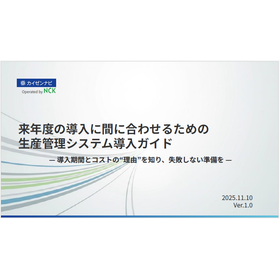
Production management system implementation guide to meet the introduction in the next fiscal year.

If you want to introduce a production management system next year, it's better to start thinking about it now! I can help you with that.

This document is a guide for the implementation of a production management system to meet the timeline for next year's introduction. We can help build a system that matches your business needs. We can assist you in organizing your goals and challenges together. This is recommended for managers (section heads) in the manufacturing department of the metal processing industry who are currently managing processes and providing on-site instructions using paper or Excel, leading to a reliance on individuals. They want to implement a system but are looking for information to alleviate their concerns about whether it will be accepted on-site. [Contents (excerpt)] ■ Introduction: Why is preparation necessary now? ■ Flow of production management system implementation ■ Why does it take time? ■ Why go to such lengths? (FUSE's design philosophy) ■ Common failure cases and their avoidance strategies *For more details, please download the PDF or feel free to contact us.

Added to bookmarks

Bookmarks list

Bookmark has been removed

Bookmarks list

You can't add any more bookmarks

By registering as a member, you can increase the number of bookmarks you can save and organize them with labels.

Free membership registration

Practical Guide to 6S Activities Supporting Quality Control in Manufacturing Sites

White paper for site leaders and improvement personnel in small and medium-sized manufacturing industries!

This document is a practical guide for 6S activities that support quality management in manufacturing sites. It provides a detailed explanation of the effects of 6S activities on QCD, the impact of 6S activities on corporate competitiveness, and more. Additionally, we also introduce the production management system FUSE, so please take a moment to read it. 【Contents (partial)】 ■ Why 6S activities are needed in manufacturing sites now ■ Basic understanding of 5S activities ■ Reasons why Toyota evolved 6S activities ■ The first element of 6S: Sort - Distinguishing between necessary and unnecessary items ■ The second element of 6S: Set in order - Achieving efficient arrangement ■ The third element of 6S: Shine - Inspection activities through cleaning *For more details, please download the PDF or feel free to contact us.

Added to bookmarks

Bookmarks list

Bookmark has been removed

Bookmarks list

You can't add any more bookmarks

By registering as a member, you can increase the number of bookmarks you can save and organize them with labels.

Free membership registration

How to Proceed with Parts Arrangement and Production Management Without Waiting for Drawing Completion in Custom Order Production

For sites that can't wait for all the drawings to be complete. We offer free materials that explain the system for prioritizing the procurement of confirmed parts! Supporting simultaneous design and manufacturing.

"From a conventional one-month delivery time to two weeks" — While the demand for shorter delivery times is becoming more stringent, the number of long-lead-time components, such as semiconductors and special motors, which take several months to deliver, continues to increase. The traditional approach of arranging parts only after the design is fully completed cannot physically meet the delivery deadlines. This is a challenge faced by many sites engaged in make-to-order production. The semi-order production management system FUSE was developed with the premise of simultaneously advancing design, procurement, and manufacturing. Even if the BOM (Bill of Materials) is incomplete, it allows for the sequential arrangement of units and long-lead-time components that have confirmed designs through a "drip delivery" method, eliminating time loss while waiting for drawings and shortening lead times. Additionally, by managing everything from order to purchasing, manufacturing, and cost with production numbers, it enables real-time understanding of actual performance and deficits without waiting for completion. Detailed features and case studies are summarized in the attached introductory materials. Please download and take a look.

Added to bookmarks

Bookmarks list

Bookmark has been removed

Bookmarks list

You can't add any more bookmarks

By registering as a member, you can increase the number of bookmarks you can save and organize them with labels.

Free membership registration

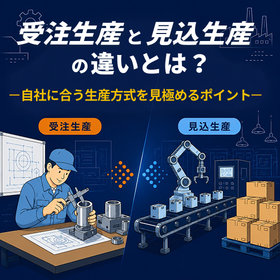
Differences Between Make-to-Order and Make-to-Stock Production and How to Choose|Production Method Guide

Explaining how to determine the suitable production method and improve the workplace for small and medium-sized manufacturers who are unsure whether to adopt made-to-order production or forecast production.

This document explains the differences between make-to-order (MTO) and make-to-stock (MTS) production methods, and provides a framework for identifying the production method that best suits your company. It compares the characteristics, advantages, and points of caution of both methods, starting from challenges such as excess inventory and stockouts due to demand fluctuations, responses to a wide variety of low-volume and short lead times, and the burden on the production site caused by changes in plans. In addition to the three perspectives of product characteristics, demand stability, and lead time requirements, it also introduces hybrid models that combine MTS and MTO, as well as the customer order decoupling point (CODP). In the latter part, it includes examples of inventory, progress, and performance recording and sharing using the production management system FUSE, visualization of the production site, and measures against reliance on specific individuals. This content is useful for small and medium-sized manufacturing companies looking to review their production methods and improve production management. *For more details, please download the PDF or feel free to contact us.*

Added to bookmarks

Bookmarks list

Bookmark has been removed

Bookmarks list

You can't add any more bookmarks

By registering as a member, you can increase the number of bookmarks you can save and organize them with labels.

Free membership registration

Quotation Management Function | FUSE Sales Management

Graduating from relying on the "veteran's intuition" for estimates! By utilizing copies of past "estimate data" and linking them to orders and sales, we can create profitable estimates quickly and without deviation.

Creating estimates for custom orders often relies on past drawings and memory, frequently guided by the "intuition of veterans," which leads to the risk of task dependency and the possibility of ending up in the red after a project is completed. The "estimate management" feature provided by FUSE's sales management package addresses these on-site challenges and offers a system that transforms past "proposal know-how" into guaranteed "profits." The most notable feature is the "reuse of past estimate data" that standardizes estimate accuracy. When referencing past similar projects, users can copy the estimate structure and calculation data from that time with the push of a button to create a new estimate. Even inexperienced young staff can generate highly accurate estimates without variance, based on reliable past estimate data, thus achieving a reduction in task dependency in the estimating process. Additionally, the created estimate data seamlessly links to orders, shipments, and invoicing, significantly reducing double entry and greatly improving the operational efficiency of administrative and sales departments. *For more details, please download the PDF or feel free to contact us.*

Added to bookmarks

Bookmarks list

Bookmark has been removed

Bookmarks list

You can't add any more bookmarks

By registering as a member, you can increase the number of bookmarks you can save and organize them with labels.

Free membership registration

Order Management Function | FUSE Sales Management

Eliminate double input of orders! Issue a "production number" simultaneously with order confirmation, serving as a command center that smoothly connects shipping, invoicing, and the manufacturing site.

In the field of custom order production, accurate "production number management" and the elimination of "double entry" for each order are lifelines for business efficiency. Manually transcribing order data from Excel or paper takes time and can lead to transcription errors, missed arrangements, and data fragmentation between departments. FUSE's "Order Management" function eliminates this chaotic input process and connects business operations seamlessly. With just one click, you can elevate and duplicate estimate data into orders, eliminating double entries. Furthermore, at the moment of order confirmation, the system automatically assigns a unique "production number (project number)," allowing for centralized management of the entire flow from shipping to billing, and serving as a powerful starting point for passing information directly to subsequent manufacturing sites. It also supports bulk import of order data from EDI and Excel, dramatically reducing the burden on sales administration. FUSE's order management serves as a reliable command center for the manufacturing industry, supporting everything from error-free shipping and billing to subsequent manufacturing preparations right from the entry point. *For more details, please download the PDF or feel free to contact us.

Added to bookmarks

Bookmarks list

Bookmark has been removed

Bookmarks list

You can't add any more bookmarks

By registering as a member, you can increase the number of bookmarks you can save and organize them with labels.

Free membership registration

Shipping Management Function | FUSE Sales Management

No more confusion with installment payments and shipping lot records! From issuing invoices and delivery notes based on shipping results to "red-black corrections" during returns, everything is automated seamlessly.

FUSE's "Shipping Management" feature simply integrates the processes from shipping instructions to performance registration, invoice issuance, and sales linkage. It allows real-time tracking of unshipped details from order data, and intuitive management of remaining quantities for partial shipments (shipping balance), lot numbers, and destination specifications. Creating shipping instructions and issuing documents such as receipts can be completed with a single click. By simply registering shipping performance, the order balance is automatically updated to shipped status, and invoices and receipts compatible with invoicing can be instantly generated. The greatest strength lies in its smart handling of "red and black corrections (cancellations and corrections)." Even if there are input errors or returns, the system automatically generates red and black slips. It seamlessly adjusts sales, billing data, and accounts receivable balances, completely eliminating the need for manual recalculations, handwritten red slips, and the hassle of double entries. *For more details, please download the PDF or feel free to contact us.

Added to bookmarks

Bookmarks list

Bookmark has been removed

Bookmarks list

You can't add any more bookmarks

By registering as a member, you can increase the number of bookmarks you can save and organize them with labels.

Free membership registration

Invoice Management Function | FUSE Sales Management

With just one button, you can close the billing at the end of the month and reconcile payments! It seamlessly connects everything from shipping to billing, payment reconciliation, and accounts receivable management, eliminating the chaos in accounting.

In custom order production, the delivery dates and closing dates vary for each production number (case), which places a significant burden on the accounting and management departments for month-end billing closures, payment reconciliations, and accounts receivable management. Manually creating total invoices from a large volume of shipping records increases the likelihood of transcription errors, and delays in complex payment reconciliations and accounts receivable balance confirmations are critical issues directly impacting cash flow. FUSE's "Billing Management" feature seamlessly connects shipping records to accounts receivable, dramatically streamlining financial operations. It centrally manages the billing status for each customer through a dashboard based on shipping data. With the push of a button, it can batch output total invoices in PDF format that correspond to the closing date. Additionally, the "Payment Reconciliation" feature can flexibly handle complicated transfer fees and discount adjustments, while the "Accounts Receivable Balance Management" visualizes everything from carryovers from the previous month to current month payments, allowing for real-time detection of missed collections and delays. This transforms the process from "not knowing until it's closed" to "reliable cash management that speaks through numbers." *For more details, please download the PDF or feel free to contact us.

Added to bookmarks

Bookmarks list

Bookmark has been removed

Bookmarks list

You can't add any more bookmarks

By registering as a member, you can increase the number of bookmarks you can save and organize them with labels.

Free membership registration

Procurement and Outsourcing Management Function | FUSE's Purchasing Management

Eliminate ordering mistakes and rework due to design changes! Visualize progress and outstanding orders to proactively manage procurement and outsourcing before the site comes to a halt.

In the field of custom order production, repeated design changes leading to "ordering mistakes" and "delays in material delivery" are the biggest factors that halt operations. With partial management using Excel or paper, changes may not be communicated to purchasing, resulting in unnecessary parts being delivered, or the progress of outsourced processing (backorders) may not be visible, leading to last-minute shortages and panic. FUSE's "Procurement and Outsourcing Management" function completely prevents such procurement troubles. The key feature is "automatic tracking of design changes." When a design change occurs, the system instantly identifies the affected "ordered but not yet delivered" parts and sends an automatic alert to the purchasing staff. This physically prevents rework and dead stock. Furthermore, as a centralized "command center" for managing the progress of purchased parts and outsourcing, it detects risks of backorders and delays early. This allows for proactive measures such as adjusting delivery dates or arranging alternatives before operations are halted. The entire process from order registration to automatic output of purchase orders, receiving, and inspection can be smoothly centralized, completely eliminating double entries and transcription errors. *For more details, please download the PDF or feel free to contact us.*

Added to bookmarks

Bookmarks list

Bookmark has been removed

Bookmarks list

You can't add any more bookmarks

By registering as a member, you can increase the number of bookmarks you can save and organize them with labels.

Free membership registration

Receiving and Inspection Management Function | FUSE Purchasing Management

Complete the process from receiving registration to inspection and acceptance confirmation using a tablet! Only the "correct quantity" that passes inspection is automatically recorded as acceptance results immediately.

In the procurement field of individual orders, are you experiencing chaos such as "the quantity confirmation and inspection of received materials have become dependent on individuals," "input delays prevent real-time understanding of incoming goods," and "defective products have mixed into production, causing rework"? FUSE's "Receiving and Inspection Management" function smartly completes everything from receiving registration to inspection and formal acceptance confirmation on-site. Linked with order data, it allows for easy registration of partial and complete deliveries and lot numbers from the on-site tablet. It also supports the "Inspection and Acceptance Flow," where quality checks are performed after receipt, enabling immediate registration of the number of accepted and rejected items. Only the "correct quantity" that passes inspection is automatically confirmed as the acceptance record, preventing rework due to quantity discrepancies or inspection errors. The entire process, including the issuance of acceptance reports, is automated, thoroughly eliminating the administrative burden and transcription errors associated with receiving and inspection. *For more details, please download the PDF or feel free to contact us.

Added to bookmarks

Bookmarks list

Bookmark has been removed

Bookmarks list

You can't add any more bookmarks

By registering as a member, you can increase the number of bookmarks you can save and organize them with labels.

Free membership registration

Payment Management Function | FUSE's Purchasing Management

Smartly handle complex "payment closing" and "offsetting"! Manage everything from accounts payable confirmation to payment scheduling and offsetting seamlessly, eliminating the risk of payment errors to zero.

In custom order production, suppliers and subcontractors vary widely for each project, and payment deadlines and due dates are also inconsistent. As a result, the monthly accounts payable aggregation, creation of payment schedules, reconciliation of bank transfer data, and clearing tasks become a labor-intensive process fraught with risks of errors for the accounting and management departments. FUSE's "Payment Management" feature seamlessly connects the accounts payable confirmation data to the completion of payments, dramatically improving the accuracy and speed of payment operations. The payment amounts and confirmation statuses for each supplier are centrally managed in real-time through the "Payment Closing Dashboard." Payment amounts are automatically calculated according to the closing date, and considerations for transfer fees, offset processing, and complex payment clearing can be smoothly executed on-screen. Additionally, it supports Excel output of payment list data that can be directly used for cash flow management and accounting integration. It completely eradicates "management oversights" and "rework" regarding payment deadlines and amounts, strongly supporting healthy cash flow management for businesses. *For more details, please download the PDF or feel free to contact us.*

Added to bookmarks

Bookmarks list

Bookmark has been removed

Bookmarks list

You can't add any more bookmarks

By registering as a member, you can increase the number of bookmarks you can save and organize them with labels.

Free membership registration

Inbound and Outbound Inventory Management Function | FUSE Inventory Management

Resolve the question "Where is that part?" Strengthen the linkage between production numbers and inventory, and manage inbound and outbound processes to simultaneously prevent shortages and excess stock through instant mutual transfers with free inventory!

In the field of custom order production, the management of material and parts "in and out" is extremely complicated. With management done through Excel or paper, it is not possible to see in real-time "where the parts for which production number (project) are currently located," leading to frequent losses and wasted time searching on-site. Additionally, the mixing of common parts (free stock) and project-specific parts (production number stock) can cause excessive inventory and sudden shortages. FUSE's "in and out management" function resolves this confusion and achieves both "zero shortages and inventory reduction." The key features are the "complete linking of production numbers and inventory" and "flexible inventory transfers." Common parts are managed as free stock and can be instantly transferred to specific production number stock as needed. The registration of in and out records is designed with "zero text input," requiring only the scanning of the instruction sheet's barcode and a few taps on a tablet, allowing even craftsmen who are not adept with PCs to record accurately. The in and out history can be completely tracked chronologically by production number (lot trace), enabling immediate identification of the cause in the event of a quality issue. *For more details, please download the PDF or feel free to contact us.

Added to bookmarks

Bookmarks list

Bookmark has been removed

Bookmarks list

You can't add any more bookmarks

By registering as a member, you can increase the number of bookmarks you can save and organize them with labels.

Free membership registration

Inventory Management Function | FUSE Inventory Management

Eliminate the waste of handwritten notes and Excel transcription! Inventory management that automatically calculates "inventory discrepancies" with tablet registration and bulk reading of Excel.

In the field of custom order production, the monthly "inventory management" is the most tedious and error-prone labor-intensive task. The analog operation of counting by hand with a paper list and manually entering the data into Excel leads to input errors and mysterious discrepancies between the books and actual inventory, resulting in overtime until late at night and mistakes in material arrangements. FUSE's "inventory management" feature dramatically simplifies this dreaded counting task. The biggest feature is the smart operation that completes the process with "zero data entry." With just one click, you can output an Excel sheet for inventory counting from the system, and by simply inputting the counted numbers and importing them, the system automatically and instantly calculates the "inventory discrepancies" and "impact on valuation" against the books. Furthermore, it fully supports a paperless operation where barcodes can be scanned from a tablet on-site, allowing for direct input of actual numbers right there. The confirmed inventory results are automatically reflected in the book inventory in real-time, calculating the latest inventory valuation instantly. It completely eliminates the waste of handwritten notes and double entries, always visualizing "the correct inventory that can truly be used on-site." *For more details, please download the PDF or feel free to contact us.

Added to bookmarks

Bookmarks list

Bookmark has been removed

Bookmarks list

You can't add any more bookmarks

By registering as a member, you can increase the number of bookmarks you can save and organize them with labels.

Free membership registration

Lot traceability management function | FUSE inventory management

Where was that lot used?" Solved in just a few minutes! Lot trace management that instantly identifies the impact range during malfunctions using "forward tracing and backward tracing.

In the event of product defects or complaints, are you losing a significant amount of time and costs because you cannot immediately trace "which lot of materials was used and in which products it was incorporated"? FUSE's "Lot Trace Management" feature dramatically improves the resolution of traceability by linking lot information from the arrival of parts to manufacturing and allocation to products with "product numbers" and "lot numbers." The biggest feature is "bidirectional tracing." It supports both "forward tracing," which instantly identifies products or product numbers used from a specific raw material lot, and "backward tracing," which traces back to the component lots used from the products. In the event of a quality issue, the affected range can be accurately identified in just a few minutes, minimizing damage and safeguarding the company's quality reputation. It eliminates the "hassle of lot tracking" by flipping through paper or Excel ledgers, strongly supporting reliable quality assurance and trustworthy manufacturing in small-batch, diverse production. *For more details, please download the PDF or feel free to contact us.

Added to bookmarks

Bookmarks list

Bookmark has been removed

Bookmarks list

You can't add any more bookmarks

By registering as a member, you can increase the number of bookmarks you can save and organize them with labels.

Free membership registration

Picking Management Function | FUSE Inventory Management

Collect parts that arrive separately without hesitation! With an easy-to-use picking list by production number and a tablet, we eliminate picking omissions and mistakes to zero.

In the case of custom orders and small-batch production, are you not losing a significant amount of labor to the picking of large quantities of parts that arrive sequentially? Issues such as "not knowing which parts belong to which production number," "spending too much time searching the shelves," and "frequent picking errors and omissions" are factors that lead to the personalization of shipping operations and delays in the manufacturing process. FUSE's "Picking Management" feature completely eliminates these wastes and mistakes during shipping. It directly links to production numbers and shipping instructions, automatically generating a picking list that covers necessary information such as item, quantity, production number, and storage location in Excel or PDF format instantly. On-site, tablets can be used to check "the parts that need to be gathered now" on the screen according to the list, allowing for one-tap operations to record picking results without the need for text input. This enables anyone to gather parts accurately and quickly without confusion, breaking away from reliance on experienced workers for shipping operations. It strongly supports a dramatic reduction in lead time for shipping preparation and improvement in quality. *For more details, please download the PDF or feel free to contact us.

Added to bookmarks

Bookmarks list

Bookmark has been removed

Bookmarks list

You can't add any more bookmarks

By registering as a member, you can increase the number of bookmarks you can save and organize them with labels.

Free membership registration

Inventory Dashboard Feature | FUSE Inventory Management

"Out of stock" and "too much excess" are resolved by the dashboard! With automatic detection of safety stock shortages and smooth replenishment coordination, optimal inventory is achieved.

In environments dealing with individual orders and common parts, are you experiencing a vicious cycle where "parts are out of stock only when needed, causing work to stop" and "fear of stockouts leads to holding excess inventory, putting pressure on cash flow"? FUSE's "Inventory Dashboard" feature smartly addresses these issues related to optimal inventory, bringing both stockouts and excess inventory closer to zero simultaneously. The key feature is the "real-time automatic monitoring" of safety stock and its "integration with replenishment arrangements." When the recorded inventory falls below the safety stock or reorder point set for each item, the system automatically notifies an alert on the dashboard. Additionally, it can automatically extract the parts that need replenishment with one click, smoothly linking to the ordering process. By moving away from "order and inventory management based on intuition" relying on paper ledgers or the visual checks of experienced staff, we achieve "proactive supply-demand optimization" that prepares what is needed at the right time. This significantly reduces unnecessary dead stock and strongly supports the improvement of factory cash flow. *For more details, please download the PDF or feel free to contact us.*

Added to bookmarks

Bookmarks list

Bookmark has been removed

Bookmarks list

You can't add any more bookmarks

By registering as a member, you can increase the number of bookmarks you can save and organize them with labels.

Free membership registration

Work Instruction Management Function | FUSE Production Process Management

Bulk automatic import of engineering and materials! Issue "instruction sheets with QR codes" linked to drawings and past caution information with the push of a button.

In the field of custom order production, manually creating "work instructions" with different processes and materials for each project is a breeding ground for enormous effort and arrangement errors. Transcribing from drawings and arrangement lists into Excel not only takes time but also leads to omissions in arrangements, mix-ups with drawings, and confusion on-site. FUSE's "Work Instruction Management" feature eliminates the chaos of creating these instructions and delivers accurate directives to the site as quickly as possible. By linking with registered process patterns and material information, it automatically generates work instructions by importing the necessary "processes" and "required materials" with the push of a button. Furthermore, it allows for one-click PDF output of work instructions with QR codes that are linked to the latest drawings, past similar caution information, and quality checklists. It also supports the creation of instructions for complex procedures that include outsourced processes and the linked creation of work instructions for subcomponents. This completely eradicates double entry and instantly establishes an environment where the site can operate without confusion. *For more details, please download the PDF or feel free to contact us.*

Added to bookmarks

Bookmarks list

Bookmark has been removed

Bookmarks list

You can't add any more bookmarks

By registering as a member, you can increase the number of bookmarks you can save and organize them with labels.

Free membership registration

Project Progress Management Function | FUSE's Production Process Management

"What’s happening with that project?" Zero it out. Thoroughly prevent delays with real-time progress tracking linked to tablet performance and a Kanban board!

In the field of custom order production, understanding the progress status is essential for deadline management. However, with analog management using Excel or whiteboards, data updates tend to lag, leading to inefficiencies where, in response to customer inquiries like "What's the status now?", one has to run around the site to directly confirm with the craftsmen to understand the situation. FUSE's "Process Progress Management" feature eliminates the distance between the site and the office, achieving "complete visualization" of real-time progress. Linked with "zero text input" achievement registration via tablets on-site, the progress for each project (production number) and each process is instantly reflected in the system. With visual progress kanban boards and progress overview screens, it becomes easy to see at a glance which parts are at which process, whether they are on schedule or delayed. Early detection of signs of deadline overruns and bottlenecks allows for proactive actions to be taken. Furthermore, data can be exported to Excel with a single click, making the preparation of production meeting materials and progress reports instantaneous. *For more details, please download the PDF or feel free to contact us.

Added to bookmarks

Bookmarks list

Bookmark has been removed

Bookmarks list

You can't add any more bookmarks

By registering as a member, you can increase the number of bookmarks you can save and organize them with labels.

Free membership registration

Work Performance Management Function | FUSE Production Process Management

Just scan the barcode and tap the large button! With a "zero text input" tablet UI, you can collect accurate work records without burdening the field.

In the field of custom order production, daily "performance input" is a significant hurdle and the main factor leading to the system's ineffectiveness. Complaints such as "the interface is complicated and input is cumbersome" and "forcing text input reduces on-site productivity" often result in blank daily reports piling up, leading to "rough estimates" of labor and working hours, doesn't it? FUSE's "Work Performance Management" feature minimizes the burden on the site to the utmost, enabling a zero-text input performance collection that makes the site want to "use it" on its own. On-site workers can instantly identify the relevant process by simply scanning the barcode on the instruction sheet with a tablet. Then, they can intuitively record tasks such as "start setup," "start production," and "complete" by tapping large buttons, allowing for easy collaboration and interruptions among multiple people. The entered performance data is automatically aggregated in real-time and visualized as "accurate work hours" for each worker and process. This data can be directly utilized as foundational data for labor cost calculations and work hour analysis, allowing for the accumulation of "live accurate data" without stopping the work on-site, fundamentally supporting the improvement of factory productivity. *For more details, please download the PDF or feel free to contact us.*

Added to bookmarks

Bookmarks list

Bookmark has been removed

Bookmarks list

You can't add any more bookmarks

By registering as a member, you can increase the number of bookmarks you can save and organize them with labels.

Free membership registration
Prev 12 Next
  • CADを持っていない他部門や取引先に! 専用アプリ不要! いつでもどこでも3Dデータをサクサク閲覧! iCAD 3D Browser
  • 部品の残数管理、トレーサビリティを効率化! 検証キット(プリンター×周辺機器)無料貸出中 手作業の裁断・記入から脱却!システム改修なしでスマートに
    • Contact this company

      Inquiry Form

    Products

    • Search for Products

    Company

    • Search for Companies

    Special Features

    • Special Features

    Ranking

    • Overall Products Ranking
    • Overall Company Ranking

    support

    • site map
    IPROS
    • privacy policy Regarding external transmission of information
    • terms of service
    • About Us
    • Careers
    • Advertising
    IPROS Services
    • >IPROS GMS | Search site for the manufacturing industry
    • >IPROS | Search site for the B2B industry
    COPYRIGHT © 2001-2026 IPROS CORPORATION ALL RIGHTS RESERVED.
    Please note that the English text on this page is automatically translated and may contain inaccuracies.