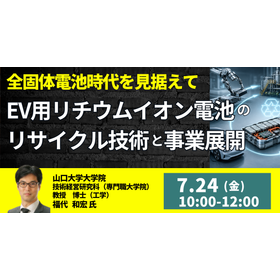
~Looking towards the era of all-solid-state batteries~
By the end of 2024, the number of electric vehicles (EVs) in the world reached 58 million. While market growth is said to have slowed in some areas, EV sales continue to expand, and the processing of a vast number of used lithium-ion batteries for EVs will become an unavoidable challenge in the future. 【Practical Insights Gained from the Seminar】 - Criteria for selecting dry, wet, and direct recycling methods and their profitability structure - Factors influencing the decision-making axis for reuse and recycling based on degradation and diagnostics - Design perspectives for resource recovery and business entry in the era of solid-state batteries 【Target Industries and Departments】 - Business planning and management planning departments in EV and battery-related businesses - Business development departments in recycling and resource circulation businesses - Resource strategy and investment departments in general trading companies and material manufacturers - Technical planning and sustainability departments in automotive and battery manufacturers 【Seminar Details】 ■ Date and Time: July 24 (Friday) 10:00 - 12:00 (Doors open at 9:30) ■ No in-person attendance ■ Participation Method: Live streaming, archived streaming ■ Instructor: Professor Kazuhiro Fukushiro, Doctor of Engineering, Graduate School of Technology Management, Yamaguchi University *For more details, please refer to the PDF document or feel free to contact us.
Inquire About This Product
basic information
**Lecture Overview** In this presentation, we will organize the structure, degradation, and reuse concepts of automotive lithium-ion batteries, and explain the full range of recycling technologies currently under development or in practical use, including dry and wet smelting and direct recycling. We will also discuss domestic and international trends surrounding EV battery recycling, as well as the significance of recovering and reusing critical minerals such as lithium, nickel, and cobalt, while considering the profitability of recycling businesses and their importance for resource security. Furthermore, we will introduce solid-state batteries, which are expected to be practical in the future, highlighting their structural differences from conventional lithium-ion batteries, the recovery and regeneration of solid electrolytes, and directions for designing batteries that are easier to recycle, while explaining the challenges and prospects for the next generation of battery technology. We will also explore the future potential of the EV battery recycling market and business opportunities in the era of solid-state batteries. **Lecture Items** ■ Market trends of EVs and lithium-ion batteries for EVs ■ Structure and materials of automotive lithium-ion batteries ■ Latest trends in current lithium-ion battery reuse and recycling technologies ■ Development status and recycling challenges of solid-state batteries ■ Current situation and future potential of the recycling business ■ Related Q&A ■ Business card and information exchange session
Price information
【Lecture Fee】 1 person: 37,420 yen (including tax) From 2 people onwards: 32,420 yen (including tax / same organization, simultaneous application) *For those belonging to local public organizations, up to 2 people: 11,000 yen (including tax / venue and live streaming only)
Delivery Time
Applications/Examples of results
For more details, please refer to the PDF document or feel free to contact us.
catalog(1)
Download All Catalogs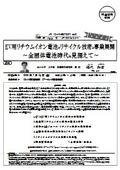
Company information

JPI Corporation (Japan Planning Institute) has been providing valuable information for executives and senior management involved in the execution of national policies and national projects, supporting the dissemination of state policies as a 'bridge of knowledge' between 'government', 'administration', and 'citizens' in the form of exclusive real seminars for participants for half a century, aiming to create national knowledge.