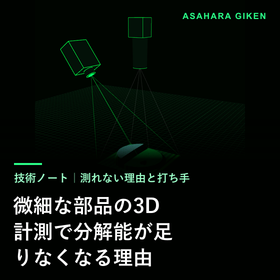
Reasons for insufficient resolution in 3D measurement of fine parts.
The reason why the resolution is insufficient for 3D measurement of fine parts is that the shape we want to see is smaller than the length that one pixel of the camera can capture or the fineness that the lens can resolve. As the field of view expands, the length that one pixel captures increases, causing fine shapes to be averaged out and disappear. The approaches are to narrow the field of view and magnify, to make the stripes finer and improve height readings, or to switch to a method that is strong in fineness. 【Points】 ■ The shape we want to see needs to be several times larger than one pixel. ■ Expanding the field of view also increases the size of one pixel. ■ When magnifying, the depth of field becomes narrower. *For detailed explanations, please refer to the technical notes and downloadable materials in the related links.
Inquire About This Product
basic information
【Contents of this Technical Note】 ■ If the shape you want to see is smaller than one pixel, it cannot be read. ■ The four elements that determine resolution are pixels, field of view, stripes, and lenses. ■ When magnified, there may not be enough depth. ■ Changing the method alters the way we think about fineness. ■ Limitations: the wavelength of light and the movement of the workpiece. ■ "High-precision sensors can measure fine objects" is not always true. ■ How to proceed when verifying with the actual object. 【Consultation】 We will confirm whether it can be measured or captured with the actual workpiece. Please consult us with a photo.
Price information
The technical notes can be read by anyone from the related links. We will discuss the costs of development and testing based on the details you provide.
Delivery Time
※It varies depending on the content. Please contact us.
Applications/Examples of results
【Frequently Asked Questions】 Q. If I double the camera's pixel count, will the detail also double? A. If the field of view is the same, the length of one pixel will decrease. However, if the lens resolution cannot keep up, the image will be blurred and the effect will not be achieved. Pixels and lenses should be considered as a pair. Q. Can you inspect parts measured in micrometers in 3D? A. It depends on the combination of the shape you want to measure and the method used. There are methods to read steps of a few micrometers, but the field of view becomes narrower and the speed decreases. I will confirm with a physical sample before answering. Q. Can image processing increase the level of detail? A. It is possible to fill in the gaps between pixels to make the image appear smoother. However, that is not a measured value. If you intend to use it for dimension judgment, you need to verify whether the original optical detail is sufficient.
catalog(2)
Download All Catalogs

Company information

We specialize in 2D and 3D inspection and measurement technologies using cameras. We possess a wide range of knowledge in optics, mechanics, electronics, and software, enabling us to provide technical support for both hardware and software. Not only do we have personnel with experience working as researchers at image inspection device manufacturers, major electronic component manufacturers, and universities, but we also have numerous successful implementations of developed products in actual production environments, making our ability to adapt advanced technology to on-site needs a strong point. Additionally, we are skilled not only in developing proprietary algorithms but also in using off-the-shelf products such as image processing controllers from Keyence and Omron, allowing us to excel in selecting and utilizing the most suitable equipment for specific needs. In recent years, while AI technology has garnered attention, there are cases where utilizing 2D and 3D technologies can be implemented more easily than AI, and cases where optical devices and mechanical jigs can improve performance and reduce software load. We offer services related to image systems, including "equipment selection," "implementation support," "performance improvement of existing equipment," "technology development," and "joint development," so please feel free to consult with us first.