
List of Pharmaceutical and food related products
- classification:Pharmaceutical and food related
5536~5550 item / All 33345 items


Reduce the workload from handling heavy objects! Here are five case studies that solved customer challenges! We are also accepting free consultations and tests tailored to your work!

- Other conveying machines


Support from product planning to filling, processing, and shipping for additives, cleaning agents, chemicals, deodorizing and disinfecting agents, etc.! For those who have raw materials but no place t...


- Other consumables
- Processing Contract
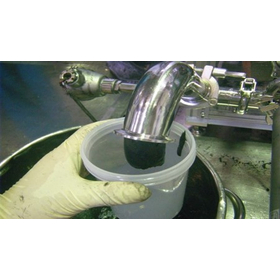

Supports CNT aggregation prevention and uniform dispersion. Assists in stabilizing the quality of conductive material slurry through continuous processing.
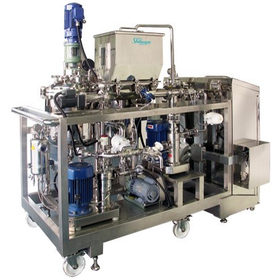
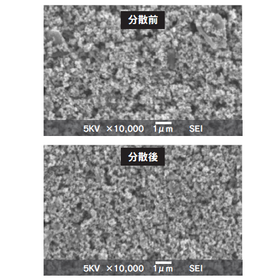
- Emulsifier/Disperser
- Powder Supply Device
- Dispersion/emulsification equipment/homogenizer

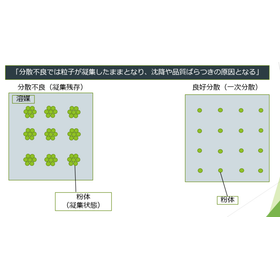
What causes clumping when adding powder? Design points for preventing and addressing poor dispersion.
In dispersion processes, the occurrence of agglomerates (clumps) during powder addition, which cannot be resolved in subsequent dispersion stages, is a common issue in many settings. The cause of this is that the powder does not wet uniformly in the liquid, leading to the formation of localized high-concentration areas. These agglomerates are also referred to as "fisheyes," and due to their internal unwetted structure, they are difficult to break apart. Once an agglomerate forms during powder addition, liquid has difficulty penetrating its interior, resulting in only the outer layer being wetted, which makes it hard for the internal particles to be disintegrated. Additionally, depending on the addition position and speed, the powder may float on the liquid surface or remain stagnant without following the flow within the equipment, promoting the formation of agglomerates. Particularly under conditions of high viscosity or high solid content, the low fluidity makes it challenging to achieve uniformity in the initial dispersion stage, leading to a higher likelihood of agglomerates remaining. Such agglomerates may not be completely resolved even with strong shear in subsequent processes, causing variations in the quality of the final product and introducing foreign substances. To prevent the formation of agglomerates, it is crucial to improve wettability during powder addition, ensure appropriate addition positions and flow design, and optimize the initial dispersion. By performing shear and mixing simultaneously right after addition, as in inline powder addition and simultaneous dispersion, it is possible to suppress the formation of agglomerates and achieve stable dispersion quality.
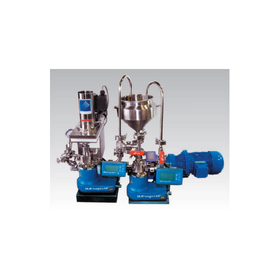
Easily agglomerated CNF, uniformly without clumping. The quality of dispersion is determined by process design.
- Emulsifier/Disperser
- Dispersion/emulsification equipment/homogenizer
- Emulsifying and dispersing machine
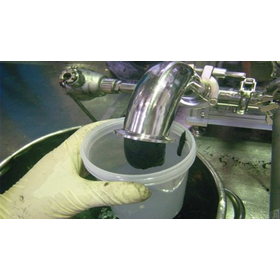
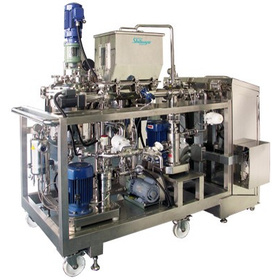
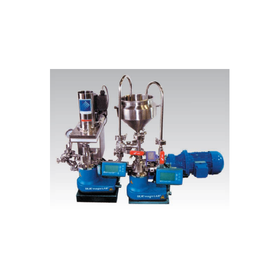
The negative electrode slurry's key is balancing viscosity and dispersion. Process design that can be reproduced up to mass production.
- Emulsifier/Disperser
- Vacuum degassing machine
- Dispersion/emulsification equipment/homogenizer
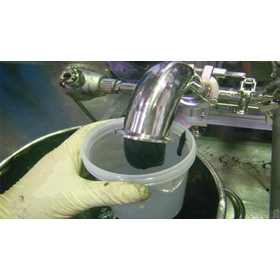
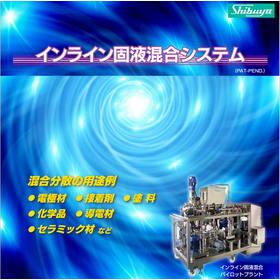
CNT dispersion is determined by the process. Control of aggregation stabilizes conductivity.
- Emulsifier/Disperser
- Vacuum degassing machine
- Dispersion/emulsification equipment/homogenizer
What are the reasons for the inability to disperse high solid content slurries? Causes of poor dispersion and design points for solutions.
In the dispersion process of high solid content slurries, problems such as "too high viscosity to mix" and "unable to break down agglomerates" occur. The main cause of these issues is the increased frequency of particle contact, which strengthens the cohesive forces. As the solid content concentration increases, the distance between particles decreases, leading to interference between particles that reduces fluidity and prevents sufficient dispersion energy from being transmitted. Additionally, the crowding of particles restricts flow and makes shear localized, resulting in the persistence of undispersed areas and agglomerates. Furthermore, in a high solid content state, the increase in viscosity also leads to poor circulation and stagnation, causing variability in the dispersion state within the process. Particularly in batch processing, mixing inconsistencies and differences in processing history directly translate into quality differences, making it difficult to ensure reproducibility. To achieve stable dispersion under high solid content conditions, it is important not only to increase shear force but also to consider dispersion design that takes into account inter-particle interactions, as well as process design that simultaneously controls flow and shear. By establishing a mechanism like inline continuous processing, where particles pass through the processing area under constant conditions, uniform and highly reproducible dispersion can be achieved even at high solid contents.
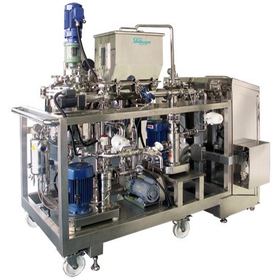
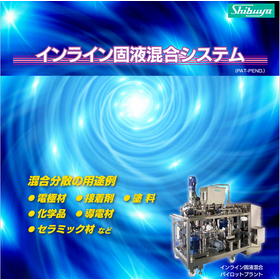
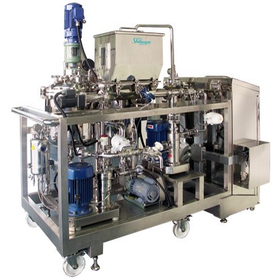
Inline continuous process that stabilizes CNT dispersion without disrupting its state.
- Emulsifier/Disperser
- Vacuum degassing machine
- Dispersion/emulsification equipment/homogenizer
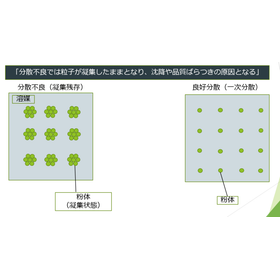
What are the causes of dispersion troubles? An explanation of the reasons for aggregation, sedimentation, and variation, as well as design points to reconsider in the dispersion process.
In dispersion engineering, issues such as unresolved agglomeration, sedimentation, and unstable particle size distribution occur frequently at many sites. These problems are caused not only by the performance of the equipment but also by inconsistencies in particle characteristics, dispersion conditions, and process design. For example, when there is insufficient dispersion energy, particles do not break down to primary particles, and agglomeration remains. Additionally, if the shear conditions or flow state are not appropriate, uniform dispersion cannot be achieved, leading to sedimentation and variations in quality. Particularly in high-viscosity systems or high solid content slurries, even slight differences in conditions can significantly impact the results. Furthermore, in batch processing, variations in mixing uniformity and residence time make it difficult to ensure reproducibility. To resolve these dispersion issues, it is important to optimize the entire process, including particle characteristics, dispersion energy, and flow design, rather than simply changing the equipment. By maintaining consistent conditions, as in inline continuous processing, stable dispersion quality and reproducibility can be achieved.

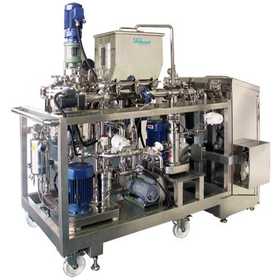
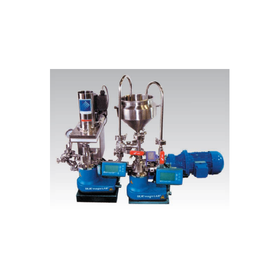
Thanks to our unique dispersion system, we can achieve the mixing and dispersion of fine powders in a short time without generating clumps! We can accommodate both continuous and batch processes.
- Emulsifier/Disperser
- Vacuum degassing machine
- Dispersion/emulsification equipment/homogenizer
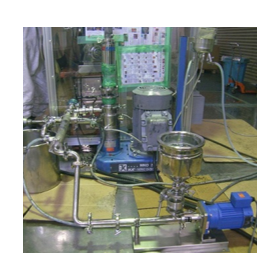
Verify before failing in mass production. Confirm the reproducibility of slurry dispersion in advance.
- Emulsifier/Disperser
- Vacuum degassing machine
- Dispersion/emulsification equipment/homogenizer
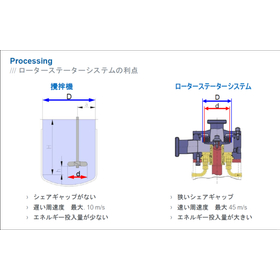
What are the reasons for changes in results from the lab to mass production? Causes and countermeasures for the deterioration of distributed quality during scale-up.
Despite obtaining good dispersion results in the lab, the challenge of unstable quality upon mass production occurs in many settings. The main cause of this is that the dispersion conditions are not replicated due to differences in scale. In lab equipment, the smaller size leads to higher energy density, making shear and flow more uniform, while in mass production equipment, the larger scale often results in insufficient dispersion energy at the same rotational speed and processing time. Additionally, differences in equipment structure and flow patterns can cause variations in the shear history and residence time experienced by particles, leading to differences in the dispersion state. Furthermore, simple scale-up does not ensure that critical parameters such as flow rate, residence time, and shear intensity match, making it difficult to reproduce the same results as in the lab. To address these challenges, it is essential to focus on process design based on dispersion energy density and flow conditions rather than merely increasing equipment size. By designing the system so that particles pass through the processing area under consistent conditions, it is possible to achieve reproducible dispersion quality even when the scale changes, as seen in inline continuous processing.
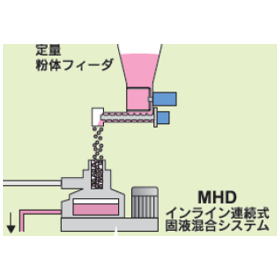
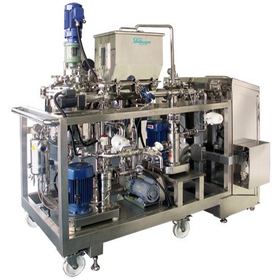
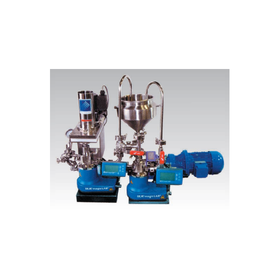
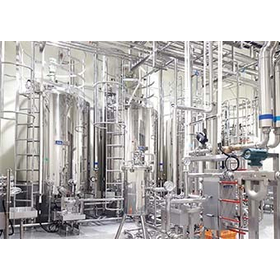
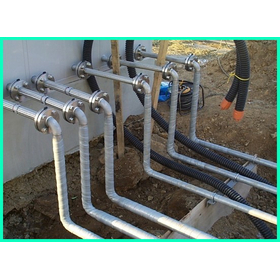
From powder supply to dispersion, defoaming, and transfer. A dispersion machine line compatible with high-viscosity slurries has been established.
- Emulsifier/Disperser
- Powder Supply Device
- Dispersion/emulsification equipment/homogenizer
What are the reasons for changes in results from the lab to mass production? Causes and countermeasures for the deterioration of distributed quality during scale-up.
Despite obtaining good dispersion results in the lab, the challenge of unstable quality upon mass production occurs in many settings. The main cause of this is that the dispersion conditions are not replicated due to differences in scale. In lab equipment, the smaller size leads to higher energy density, making shear and flow more uniform, while in mass production equipment, the larger scale often results in insufficient dispersion energy at the same rotational speed and processing time. Additionally, differences in equipment structure and flow patterns can cause variations in the shear history and residence time experienced by particles, leading to differences in the dispersion state. Furthermore, simple scale-up does not ensure that critical parameters such as flow rate, residence time, and shear intensity match, making it difficult to reproduce the same results as in the lab. To address these challenges, it is essential to focus on process design based on dispersion energy density and flow conditions rather than merely increasing equipment size. By designing the system so that particles pass through the processing area under consistent conditions, it is possible to achieve reproducible dispersion quality even when the scale changes, as seen in inline continuous processing.
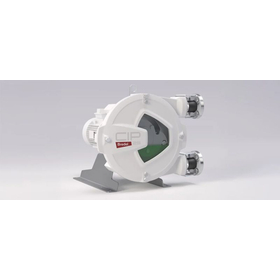

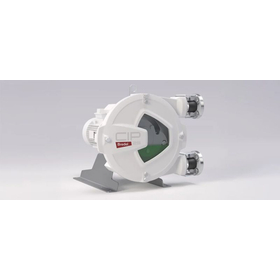
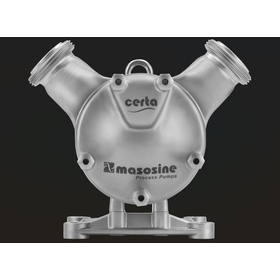
High performance × cost reduction × energy efficiency × improved maintainability!
- Other pumps
- Other Pumps
- pump
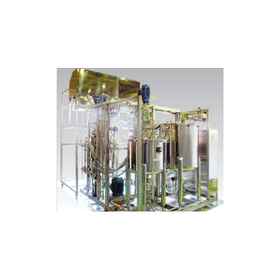
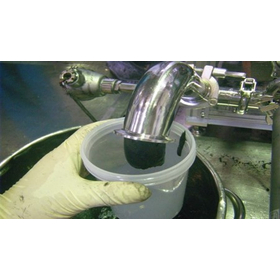
Inline dispersion system for continuous processing and stable dispersion of high-viscosity slurries.
- Emulsifier/Disperser
- Powder Supply Device
- Dispersion/emulsification equipment/homogenizer
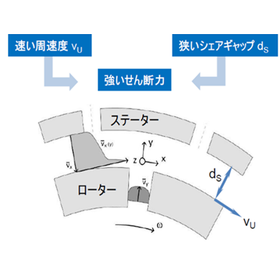
What is the relationship between viscosity and dispersion efficiency? The reason why dispersion becomes difficult under high viscosity conditions.
In dispersion processes, viscosity is an important factor that significantly affects dispersion efficiency. Generally, as viscosity increases, fluidity decreases, making it more difficult for dispersion energy to be transmitted to the particles. When viscosity is low, liquids flow easily, and shear energy is widely transmitted throughout the system, making it relatively easy to break apart particle agglomerates. On the other hand, as viscosity increases, flow becomes localized, and shear tends to be concentrated near the equipment. As a result, there is a mixture of particles that receive sufficient energy and those that do not, leading to variability in the dispersion state. Additionally, under high viscosity conditions, the movement of particles is also restricted, making collisions and breakdowns between agglomerates less likely. Consequently, even if the mixture appears homogeneous, there may be undispersed regions remaining internally. To enhance dispersion efficiency, it is crucial to implement appropriate shear conditions and flow designs according to viscosity. Particularly in inline continuous processing, it is possible to provide uniform shear to the particles within the flow, allowing for efficient transmission of dispersion energy even under high viscosity conditions. In dispersion processes, optimizing flow, shear, and processing time while considering the effects of viscosity is key to achieving stable dispersion quality.
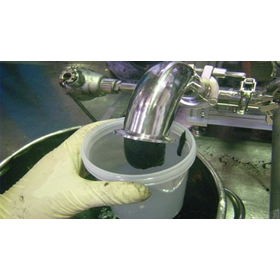
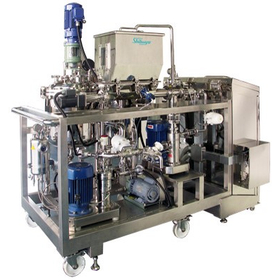
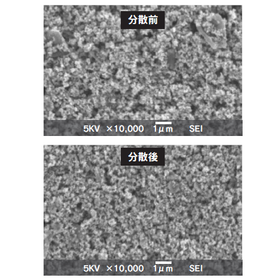
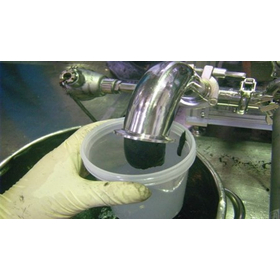
Supports high-viscosity dispersion of positive and negative electrode slurries. Assists in quality stabilization and mass production scale-up through continuous processing.
- Emulsifier/Disperser
- Powder Supply Device
- Dispersion/emulsification equipment/homogenizer
What is the relationship between viscosity and dispersion efficiency? The reason why dispersion becomes difficult under high viscosity conditions.
In dispersion processes, viscosity is an important factor that significantly affects dispersion efficiency. Generally, as viscosity increases, fluidity decreases, making it more difficult for dispersion energy to be transmitted to the particles. When viscosity is low, liquids flow easily, and shear energy is widely transmitted throughout the system, making it relatively easy to break apart particle agglomerates. On the other hand, as viscosity increases, flow becomes localized, and shear tends to be concentrated near the equipment. As a result, there is a mixture of particles that receive sufficient energy and those that do not, leading to variability in the dispersion state. Additionally, under high viscosity conditions, the movement of particles is also restricted, making collisions and breakdowns between agglomerates less likely. Consequently, even if the mixture appears homogeneous, there may be undispersed regions remaining internally. To enhance dispersion efficiency, it is crucial to implement appropriate shear conditions and flow designs according to viscosity. Particularly in inline continuous processing, it is possible to provide uniform shear to the particles within the flow, allowing for efficient transmission of dispersion energy even under high viscosity conditions. In dispersion processes, optimizing flow, shear, and processing time while considering the effects of viscosity is key to achieving stable dispersion quality.


Choose from pure hydrogen, oxygen, or HHO gas, with simultaneous inhalation for two people and continuous operation for 48 hours.
- Hydrogen Generator
![[FOOMA 2026 Exhibition] Sanitary an...](https://image.mono.ipros.com/public/product/image/2052109/IPROS14621447426860320050.png?w=280&h=280)
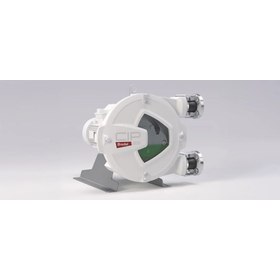
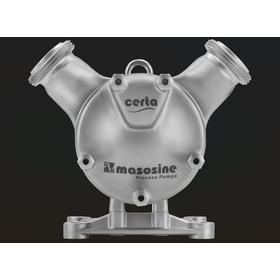
[FOOMA 2026 Exhibition] Pump solutions that contribute to high performance, cost reduction, energy efficiency, and improved maintainability!
- Other pumps
- Other Pumps
- pump