We have compiled a list of manufacturers, distributors, product information, reference prices, and rankings for Coating.
ipros is IPROS GMS IPROS One of the largest technical database sites in Japan that collects information on.

Coating Product List and Ranking from 565 Manufacturers, Suppliers and Companies | IPROS GMS

Last Updated: Aggregation Period:Jan 28, 2026~Feb 24, 2026
This ranking is based on the number of page views on our site.

Coating Manufacturer, Suppliers and Company Rankings

Last Updated: Aggregation Period:Jan 28, 2026~Feb 24, 2026
This ranking is based on the number of page views on our site.

  1. 吉田SKT Aichi//Manufacturing and processing contract
  2. トーカロ Hyogo//Manufacturing and processing contract
  3. null/null
  4. 4 フロロコート Saitama//others
  5. 5 null/null

Coating Product ranking

Last Updated: Aggregation Period:Jan 28, 2026~Feb 24, 2026
This ranking is based on the number of page views on our site.

  1. Advantages and disadvantages of re-coating a non-stick frying pan. 吉田SKT
  2. Causes of Teflon coating peeling and how to address them. 吉田SKT
  3. Explanation of the types of mold coatings, their purposes, and features. 吉田SKT
  4. 4 Fluororesin Coating: "Differences in Color and Selection Method" 吉田SKT
  5. 5 Water-repellent, non-stick, anti-adhesion coating "tt-kote series" トーカロ

Coating Product List

31~60 item / All 2532 items

Displayed results

Free booklet distribution: Improve manufacturing! The sites that know this are strong.

Explanation of the mechanism of anti-stick coating. Introduction of examples to prevent "sticking troubles" on the production line! Thorough explanation of surface treatments that enhance release properties.

We are offering a free technical explanation leaflet titled "Tips for Utilizing Surface Treatment - Permanent Edition," which summarizes surface treatments that solve "sticking troubles" on production lines, provided by our company, which specializes in a wide range of surface treatments, including functional coatings. The leaflet thoroughly explains countermeasures for issues such as: - "Materials sticking to jigs" - "Poor release properties of materials" - "Release tapes sticking or wrapping around" It includes case studies from manufacturers as well. [Overview of the Leaflet (Partial)] - Sticking troubles occurring on-site - Key points for surface treatment (how to choose the optimal release method) - Mechanisms of sticking - Mechanism of silicone release - Case studies (such as resolving sticking to molds during decorative sheet transfer) *For more details, please view the leaflet from the "Download" section!

  • Other surface treatment equipment
  • Coating

Added to bookmarks

Bookmarks list

Bookmark has been removed

Bookmarks list

You can't add any more bookmarks

By registering as a member, you can increase the number of bookmarks you can save and organize them with labels.

Free membership registration

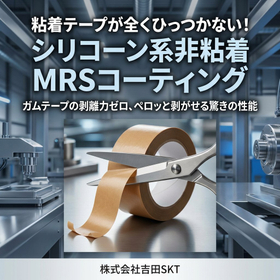
Blade release surface treatment | Release coating that cuts through tape smoothly.

In the strong double-sided tape release torque experiment, the peeling force is almost zero compared to other coating processes! Even with solvent cleaning, water repellency, oil repellency, and slip properties can be maintained!

The mold release silicone suitable for blade release coating (MRS series) exhibits excellent release properties against sticky substances and adhesive tapes, achieving top-level solvent resistance, film hardness, and heat resistance. This coating can reduce sticking when cutting adhesive materials during processes such as cutting labels and tapes. It leads to improved efficiency and productivity in cutting operations. Even after cleaning with solvents, the release properties remain unaffected, ensuring long-lasting effectiveness. Test results show overwhelmingly lower values compared to SUS304 and Teflon coatings. <Reasons to choose this product> - Reduces sticking when cutting adhesive materials - Expected to improve productivity in cutting processes - Release effect remains strong and long-lasting even with solvents *For more details, please download the materials or feel free to contact us.

  • 色付きコーティング(吉田SKT).GIF
  • Surface treatment contract service
  • Coating

Added to bookmarks

Bookmarks list

Bookmark has been removed

Bookmarks list

You can't add any more bookmarks

By registering as a member, you can increase the number of bookmarks you can save and organize them with labels.

Free membership registration

What is a coating that excels in non-stick and release properties?

Introducing a coating that is effective for applications where you want to reduce product release and adhesion, and simplifies equipment cleaning with its excellent non-stick and release properties!

"Non-stick" refers to the property of being easy to release from strongly adhesive materials, meaning it either does not adhere or adheres with difficulty. For example, fluoropolymer resins excel in water and oil repellency, have a large contact angle, and possess a property of being difficult to wet due to their molecular structure. The measure of wettability, known as "critical surface tension (γc)," is extremely low for fluoropolymer resins, making them resistant to liquid adhesion and difficult to wet. Coatings that leverage such functions are effective for release applications, applications where adhesion needs to be minimized, and for simplifying cleaning. 【Selected Coatings (Partial)】 ■ Release properties, high hardness, dimensional stability (durable parts, molds) - Bi-Coat ■ Resin release at high temperatures - FSR Coating ■ Prevention of adhesion of high-viscosity materials - Adhesive Release Coating - CTT Fabric Sheet - MRS Coating (Silicone-based coating) *For more details, please refer to the PDF materials or feel free to contact us.

  • IMG_8557_edited_edited.jpg
  • ホットメルト_edited.jpg
  • Processing Contract
  • Coating

Added to bookmarks

Bookmarks list

Bookmark has been removed

Bookmarks list

You can't add any more bookmarks

By registering as a member, you can increase the number of bookmarks you can save and organize them with labels.

Free membership registration

What is a coating that excels in rust prevention and corrosion resistance?

Fluororesin, which excels in chemical resistance among resins. It is ideal for protecting the substrate from corrosion caused by chemicals and gases! It is a material with extremely low water absorption.

It is a surface treatment to obtain properties that prevent deterioration or alteration caused by chemical substances (chemical resistance) and functions that protect against dirt by making it difficult for water to penetrate. Fluororesin, due to its structure, has extremely excellent chemical resistance against most acids, alkalis, and organic solvents, and it is also a material with very low water absorption. Therefore, fluororesin coatings are suitable for protecting substrates from corrosion caused by chemicals in an all-around manner. 【Selected Coatings (Partial)】 - Chemical resistance and heat resistance - Fluororesin coating (Teflon coating) - MY lining (R) *For more details, please refer to the PDF document or feel free to contact us.

  • s-0050YP.gif
  • 0055H2_edited.jpg
  • 0179TD_edited.jpg
  • Processing Contract
  • Coating

Added to bookmarks

Bookmarks list

Bookmark has been removed

Bookmarks list

You can't add any more bookmarks

By registering as a member, you can increase the number of bookmarks you can save and organize them with labels.

Free membership registration

What is a coating with excellent electrical properties?

Fluororesin is a high-performance insulating material that not only has high insulation properties (high resistivity) but also possesses an extremely low dielectric loss tangent (tan δ).

There is an electrical insulation coating with high electrical resistivity that has the function of blocking electric current. Fluororesin has high insulation properties, with a volume resistivity of Ω·cm or more, and its arc resistance is more than three times that of general-purpose resins, making it superior and stable in various electrical environments compared to other resins. On the other hand, if the coating surface is prone to charging, leading to issues such as the adhesion of foreign substances due to electrostatic attraction or electrostatic disasters, you can select a fluororesin coating with antistatic properties. [Coatings Being Selected] ■ Electrical Insulation - Fluororesin Coating (Teflon Coating) ■ Antistatic Properties - Saflon - Saflon AP+ *For more details, please refer to the PDF document or feel free to contact us.

  • Processing Contract
  • Coating

Added to bookmarks

Bookmarks list

Bookmark has been removed

Bookmarks list

You can't add any more bookmarks

By registering as a member, you can increase the number of bookmarks you can save and organize them with labels.

Free membership registration

[Resin Molding Solution Case] Non-stick Coating for PET Blow Molding Molds

No worries about the coating film peeling off and contaminating! The transparency of the PET bottle has also improved.

We would like to introduce a case study of surface treatment for molds used in blow molding PET resin. ■Challenges In the molds used for blow molding PET bottles, a coating was applied to improve release properties, making it easier for the resin to detach after molding. However, with the previous coatings, there were instances where the resin, softened by heat, would slightly adhere and remain, potentially leading to cloudiness in the PET bottles, necessitating frequent maintenance of the molds. ■Effects of the Adopted Coating We adopted our "Super Bi-Coat NYK-01-F05." This coating maintains performance characteristics such as film thickness precision and hardness comparable to previous bi-coats while improving release and slip properties during high-temperature molding. It reduces resin residue on the molds and enhances the transparency of the PET bottles. 【Key Points of the Case Study】 ■Purpose of Surface Treatment Reduction of work loss, stabilization of quality and operation ■Required Functions Non-stick and release properties, sliding and slip properties, wear resistance ■Adopted Treatment 'Super Bi-Coat NYK-01-F05' *For more details, please refer to the PDF document or feel free to contact us.

  • Processing Contract
  • Coating

Added to bookmarks

Bookmarks list

Bookmark has been removed

Bookmarks list

You can't add any more bookmarks

By registering as a member, you can increase the number of bookmarks you can save and organize them with labels.

Free membership registration

[Case Study in the Electronic Components Industry] Adhesion Prevention for Plating Jigs - Non-Stick Coating

Case study of surface treatment solutions in the electroplating process of electronic components! Introducing a successful case of cost reduction through improved adhesion of plating and better drainage of plating solution.

Here is an example of preventing plating adhesion to jigs used in the plating process. ■Concern In the process of applying electroplating to electronic components, plating was adhering to the jigs used to secure the products, resulting in time and costs for the peeling process. Additionally, when plating adhered, the jigs tended to deteriorate more easily, leading to an increased frequency of replacements. ■Coating Effect By providing insulation through our "fluororesin coating," the amount of plating adhesion to the jigs was significantly reduced. It also demonstrated excellent corrosion resistance, providing protection from plating solutions containing acids and alkalis. Furthermore, the lifespan of the jigs improved, and the amount of plating solution taken out was reduced. Our customers were pleased with the successful cost reduction. 【Key Points】 ■Purpose of Surface Treatment: Quality and operational stability, reduction of replacement and material costs, compliance with safety and environmental requirements ■Required Functions: Non-stick and release properties, rust and corrosion resistance, electrical properties ■Adopted Treatment: Fluororesin Coating (Teflon Coating) *For more details, please refer to the PDF document or feel free to contact us.

  • Processing Contract
  • Coating

Added to bookmarks

Bookmarks list

Bookmark has been removed

Bookmarks list

You can't add any more bookmarks

By registering as a member, you can increase the number of bookmarks you can save and organize them with labels.

Free membership registration

Fluororesin coating, suitable for room temperature processing, 'Cerashield F'

Can be processed at room temperature without the need for heat treatment such as entering a firing furnace! Protects against acids and alkalis.

"Serashield F" is a coating made from a fluorine-based material that can be applied at room temperature and has excellent chemical resistance. By protecting equipment and jigs from acids, alkalis, and dirt, it extends the replacement period, improves cleaning and maintenance, and leads to cost reduction. It can be applied to various materials, including metals, PVC, PET, and polycarbonate, making it suitable for a wide range of substrates. 【Features】 ■ Can be applied to various substrate materials ■ Coating is possible not only for various metals but also for resins such as PVC, PET, and polycarbonate ■ Fluorine-based material that can be processed at room temperature ■ No need for heat treatment such as placing in a furnace *For more details, please refer to the PDF document or feel free to contact us.

  • IMG_1855_edited.jpg
  • Surface treatment contract service
  • Coating

Added to bookmarks

Bookmarks list

Bookmark has been removed

Bookmarks list

You can't add any more bookmarks

By registering as a member, you can increase the number of bookmarks you can save and organize them with labels.

Free membership registration

Fluororesin Coating: "What is the Non-Stick Property of Fluororesin?"

What are the characteristics of the representative property of fluoropolymer coatings, specifically Teflon coatings, known as "non-stick"? Here, we will introduce the non-stick functionality.

■ The "Non-Stick Property" of Fluoropolymer Non-stick property refers to the characteristic of being easy to release and not adhere, or to adhere less, even to strongly adhesive substances. For example, fluoropolymers excel in water and oil repellency, have a large contact angle, and possess a property of being difficult to wet due to their molecular structure. The measure of wettability, "critical surface tension (γc)," is extremely low for fluoropolymers, making it easy for liquids to be repelled and difficult to wet. Coatings that utilize this functionality are effective for release applications, applications where adhesion needs to be minimized, and for simplifying cleaning. 【Reference Data on Non-Stick Property】 ■ Contact Angle of Water (°) PTFE ... 114 PFA ... 105-110 FEP ... 115 ETFE ... 96 ■ Contact Angle of n-HD (°) PTFE ... 34-45 PFA ... >45 FEP ... 41-45 ETFE ... 28 ■ Surface Free Energy of Solids (dyn/cm) PTFE ... 18.5 PFA ... 17.8 FEP ... 17.8 ETFE ... 22.1 *For detailed information on non-stick properties, please download the PDF or contact us.

  • Resin mold
  • Coating

Added to bookmarks

Bookmarks list

Bookmark has been removed

Bookmarks list

You can't add any more bookmarks

By registering as a member, you can increase the number of bookmarks you can save and organize them with labels.

Free membership registration

Fluororesin Coating: "Industries and Applications"

We have over half a century of processing experience with fluororesin coatings that excel in non-stick, water-repellent, and slip properties, as well as high heat resistance and chemical resistance.

■ Industries and Applications of Fluororesin Coating - Semiconductor Manufacturing Equipment Plating jigs / Semiconductor production lines / Vacuum chambers, etc. - Automotive Industry CFRP molding processes / Conveying equipment / Molding dies / Cutter blades, etc. - Food Equipment Automatic cooking lines / Baking molds, etc. - Industrial Fields Injection molding dies / Resin molding dies / Vacuum forming dies / Rolls, etc. - Chemical Plants Tanks / Piping / Mixers / Centrifuges, etc. - General Equipment Precision machine parts / Escalator guides / Vacuum pumps, etc. - Office Automation Equipment Fusing rolls / Separation claws, etc. - Aerospace Industry Equipment Aircraft parts, rocket parts and jigs, CFRP molding dies, etc. Yoshida SKT has been processing fluororesins since 1963 (Showa 38) and entered into a licensing agreement with DuPont's headquarters in the United States in 1968, providing Teflon fluororesin processing for various industries. *For more detailed information about fluororesin coating, please download our catalog or feel free to contact us directly.

  • tefron.png
  • 2021-06-02 (10).png
  • 2021-05-01 (2).png
  • s-0078ZLedit.gif
  • s-00718Nedit.gif
  • Surface treatment contract service
  • Coating

Added to bookmarks

Bookmarks list

Bookmark has been removed

Bookmarks list

You can't add any more bookmarks

By registering as a member, you can increase the number of bookmarks you can save and organize them with labels.

Free membership registration

[Presentation of Materials] Guidance on Surface Treatment Selection: What are the Key Points for Deciding on Surface Treatment?

How to choose the optimal surface treatment? A selection method for release surface treatments that leads to increased productivity, reduced defect rates, and cost reduction: "Non-stick and Release Properties Edition."

To maximize the effectiveness of surface treatment, it is important to select a surface treatment that is suitable for the application and conditions. - The first two points we would like to confirm for selection are as follows: (1) What kind of trouble are you experiencing? Or what is causing that trouble? (2) What does the ideal state look like after the trouble is resolved? - Furthermore, in order to derive the necessary specifications to move from the issues you are facing to the ideal state, we will confirm the following items: A. About the substrate to be treated B. About the counterpart material (products, etc.) (Do you want to prevent sticking or make it slippery?) C. Environmental conditions of use D. Processes before and after the point where the problem occurs E. Considerations regarding surface treatment - We will listen to your usage applications and environmental conditions to propose the most suitable coating for your application and usage conditions. - At Yoshida SKT, we aim to solve challenges together with our customers by optimizing various materials, not only fluororesins but also super engineering plastics, metals, and ceramics. *For more details, please download the PDF document or feel free to contact us.

  • Processing Contract
  • Coating

Added to bookmarks

Bookmarks list

Bookmark has been removed

Bookmarks list

You can't add any more bookmarks

By registering as a member, you can increase the number of bookmarks you can save and organize them with labels.

Free membership registration

[Surface Treatment Example] Solving the sticking of transport robots with release coating.

Achieving high-speed transport with robots. Improving adhesive troubles that hinder automation with fluorine and silicone-based release coatings.

■Sites Requiring Surface Treatment - Due to adhesion to transport claws and placement platforms for transported items, it has been difficult for grasped items to be released, hindering automation on the line. - Transport processes involving resin parts and hot melt adhesives before they cool and solidify, as well as label adhesive areas and food, are in a state that easily leads to sticking. ■Points of Innovation - By applying the appropriate coating, it is possible to prevent sticking of transported items. - Adhesion issues during transport are not easily resolved through soft solutions like teaching, and even if a release agent is applied to specific areas, its effectiveness can diminish quickly depending on the usage environment, necessitating frequent reapplication and increasing manual labor. In contrast, coatings improve sticking efficiently, have high functional durability, and expand the areas where robots can operate in fields requiring automation. ■Examples of Coatings for Improving Robot Transport Adhesion Issues - Bi-Coat(R) - MRS Coating (Silicone Coating) - Fluorine-based Silicone Convex Coating - Teflon(TM) Fluororesin Coating *For more details, please download the PDF or feel free to contact us.

  • IMG_9560_edited_edited2.jpg
  • IMG_9565_edited_edited2.jpg
  • IMG_9563_edited_edited2.jpg
  • IMG_9472_edited2.jpg
  • Surface treatment contract service
  • Coating

Added to bookmarks

Bookmarks list

Bookmark has been removed

Bookmarks list

You can't add any more bookmarks

By registering as a member, you can increase the number of bookmarks you can save and organize them with labels.

Free membership registration

[Surface Treatment Case] Improvement of Sliding in Robot Conveyance - Coating with Excellent Slipperiness

We solve transportation challenges with coatings that excel in lubricity and wear resistance to prevent robots from stalling.

- Smooth operation of the line is necessary for the automation of transport lines using robots. ■ Sites requiring surface treatment - Factories aiming for increased manufacturing efficiency and speed. - Sites where the transport line is being accelerated to match the high-speed movement of robots, raising concerns about jams and difficulties in flow. ■ Points of innovation - By applying surface treatments that improve slipperiness to guides and chutes on the transport line, we can prevent troubles such as jams and difficulties in flow. - For example, in lines where unstable shapes are supported by guides or in transport processes for products with grip, changing the slipperiness of contact surfaces through coating can smoothen transport and reduce the likelihood of sudden line stoppages. ■ Coatings to improve robot transport troubles - Bi-Coat® "Slipperiness + Wear resistance" - Convex coating for reduced contact area "Slipperiness + Reduced contact area" - Teflon™ fluororesin coating "Slipperiness + Prevention of product scratches" *For more details, please download the PDF or feel free to contact us.

  • 調整00000012_edited.jpg
  • 調整00000013_edited.jpg
  • 調整00000014_edited.jpg
  • 調整00000015_edited.jpg
  • 調整00000016_edited.jpg
  • Surface treatment contract service
  • Coating

Added to bookmarks

Bookmarks list

Bookmark has been removed

Bookmarks list

You can't add any more bookmarks

By registering as a member, you can increase the number of bookmarks you can save and organize them with labels.

Free membership registration

[CFRP Production Process Improvement] Achieving improvements through surface treatment - Non-stick coating

The production process of CFRP, which involves layering carbon fibers with resin, requires release properties and non-stick characteristics. Surface treatment technology enhances production efficiency! It also addresses the challenges of release agents.

Yoshida SKT offers "coating" and "functional surface treatment" that address concerns such as highly adhesive materials sticking to equipment and components, hindering production or reducing production efficiency. By providing surfaces with the function of being "less sticky," we aim to resolve these issues. 【Improve CFRP production processes with coating from Yoshida SKT】 ■Challenges - Cleaning tools during CFRP autoclave molding is burdensome. ■Solution - Features of optimal coating for cutting blades. ■Features of selectable coatings - Excellent release properties for epoxy resin. - Long-lasting coating effects. - Silicone-free treatment options available. ■Challenges - Release treatment during CFRP molding causes waste and unevenness. ■Solution - Features of high-release surface treatment. ■Features of selectable coatings - Low-temperature treatment minimizes damage to CFRP (mold). - Particularly strong grades with non-stick (release) properties. - Long-lasting coating effects. - Can also provide tackiness (properties that make surfaces less slippery). *For more details, please download the PDF or contact us.

  • CFRP 金型edit.png
  • IMG_9347_edited.jpg
  • IMG_9404_edited.jpg
  • 2021-05-15 (12).png
  • Surface treatment contract service
  • Coating

Added to bookmarks

Bookmarks list

Bookmark has been removed

Bookmarks list

You can't add any more bookmarks

By registering as a member, you can increase the number of bookmarks you can save and organize them with labels.

Free membership registration

Surface treatment on CFRP substrate: Coating on CFRP material roll.

CFRP, essential for the labor-saving and lightweighting of production equipment. Surface treatment possible even for materials with low heat resistance! Achieving non-stick properties, release properties, and wear resistance through coating.

To prevent noise in production sites and to reduce labor and weight of equipment, switching from metal to lightweight and high-strength CFRP materials is effective. However, changing materials is not always beneficial. In actual production environments, there may be challenges such as, "Once we switched to CFRP rollers, we could no longer perform the surface treatment to prevent adhesion." ■ With Yoshida SKT, improvements can be made even with CFRP rolls and jigs through coating. 【Effects of Coating on CFRP Rolls】 - Adhesive adhesion measures can be implemented, making cleaning easier. - No adhesive residue, eliminating negative impacts on products. - No line stoppages, improving production efficiency. ◆ Coatings Used ◆ ■ Super CTT Coating (Silicone-based contact area reduction coating) 【Features】 - Release properties - Cushioning properties - Tackiness ■ Super Alloy Coating (Flexible alloy coating) 【Features】 - Release properties - Slipperiness - Wear resistance; hardness: HV600 *For more details, please download the PDF or contact us.

  • SCTT ロール_edited2.jpg
  • アロイ ロール_edited_edited2.jpg
  • Surface treatment contract service
  • Coating

Added to bookmarks

Bookmarks list

Bookmark has been removed

Bookmarks list

You can't add any more bookmarks

By registering as a member, you can increase the number of bookmarks you can save and organize them with labels.

Free membership registration

[Automotive Industry Case] Mold Parts Release Surface Treatment - Strong Non-Stick Coating

Shortening of takt time, which seemed impossible. Increasing production by demolding before it solidifies. Coating to prevent adhesion of molten resin to the ejector pins.

In a certain automotive parts molding process, there was a request to shorten the molding time in order to accommodate increased production. ■Concern When attempting to demold the resin from the mold in a shorter time than usual, a problem occurred where the resin had not yet solidified sufficiently, causing the ejector pin to get stuck and not come out. Therefore, a coating that improves resin demolding was considered. ■Request This mold requires strict dimensional control, and under conditions where even slight dimensional changes such as thermal distortion are not permitted, the conventional Teflon (TM) coating was not selectable due to its high processing temperature of 400°C and insufficient dimensional accuracy. ■Challenges to be solved - Improvement of production efficiency - Reduction of defects - Shortening of work time ■Coating that solved the issue 'Bicoat (R)' *For details on how the issue was resolved, please download the PDF or contact us.

  • Plastic Mould
  • Coating

Added to bookmarks

Bookmarks list

Bookmark has been removed

Bookmarks list

You can't add any more bookmarks

By registering as a member, you can increase the number of bookmarks you can save and organize them with labels.

Free membership registration

[Automotive Industry Case] Soft rubber that doesn't adhere! Non-stick coating

Solve demolding troubles with silicone-free fluorine coating! Introducing a coating that prevents sticking for tire transport types.

We will introduce a case of surface treatment that improved rubber sticking troubles in tire manufacturing equipment. ■Problem During the transportation process of tire manufacturing, when removing the donut-shaped rubber from the transport mold, the rubber stuck and could not be removed smoothly. This frequently caused line stoppage troubles, resulting in decreased production efficiency. As a solution, we tried a standard Teflon coating, but because the coating surface was smooth and slippery, the still-soft rubber stuck like a suction cup, proving ineffective. ■Request Silicone coatings and silicone release agents, which excel in release force, cannot be used due to the issue of silicone transfer interfering with the subsequent rubber bonding process. Therefore, a silicone-free release coating was required. ■Challenges to be solved - Release troubles - Line stoppage troubles - Decreased productivity ■Coating that resolved the issues Super TP Hemisphere Graphic HS How the issues were resolved can be found in detail by downloading the PDF or by contacting us.

  • s-IMG_9909_edited.jpg
  • Surface treatment contract service
  • Coating

Added to bookmarks

Bookmarks list

Bookmark has been removed

Bookmarks list

You can't add any more bookmarks

By registering as a member, you can increase the number of bookmarks you can save and organize them with labels.

Free membership registration

[Automotive Industry Case] Cutting Blade Raw Rubber Adhesion Prevention - Fluorine Non-Stick Coating

Raw rubber does not stick. A silicone-free, fluorine non-stick coating prevents raw rubber from adhering to blades! We will introduce case studies of solutions through surface treatment.

We would like to introduce a case of surface treatment that improved the adhesion issues of cutting tools used for cutting raw rubber. ■Concern Typically, when cutting tools come into contact with the material, their sharpness deteriorates. In the process of cutting soft and sticky raw rubber, if the sharpness of the tool decreases, defects such as burrs on the product occur. Reducing defects requires cleaning the tools, which is labor-intensive. ■Request For materials like raw rubber that are soft and highly adhesive, standard Teflon coatings are smooth and slippery, causing them to stick like a suction cup. Additionally, since cutting raw rubber is performed at temperatures around 200°C, a coating that can withstand that environment was necessary. 【Issues to be resolved】 - Product defects due to burrs - Adhesion of raw rubber - Heat resistance - Cleaning costs and labor expenses ■Adopted Coating 'TP Coating TP-411' *For detailed solutions, please download the PDF or contact us.

  • Surface treatment contract service
  • Coating

Added to bookmarks

Bookmarks list

Bookmark has been removed

Bookmarks list

You can't add any more bookmarks

By registering as a member, you can increase the number of bookmarks you can save and organize them with labels.

Free membership registration

[Surface Treatment Case] Reduced line downtime by preventing sticking of rubber products!

Reduced maintenance work with an anti-adhesion coating inside the vacuum nozzle. Prevents nozzle clogging and improves productivity!

■Concern In the process of removing burrs generated when molding rubber products by sucking them in with a vacuum nozzle, there is a stickiness due to the freshly molded products, which causes them to adhere to the inner diameter of the nozzle. Each time the nozzle gets clogged, it is necessary to stop the line and clean it, which decreases work efficiency and productivity. ■Background of the Request Initially, we tested fluororesin coating, but during the testing phase, we observed some adhesion on the surface. After repeating the tests several times, we found that the adhesion worsened progressively. 【Issues to be Resolved】 - Reduction of cleaning time - Improvement of productivity - Cost reduction ■Adopted Coating 'MRS-102' ■Effects of Adoption We proposed the 'MRS coating,' which has effects comparable to the release agents used in rubber molding. In tests, there was no adhesion, and we began prototype testing with actual nozzles. By coating the inner diameter, adhesion of burrs to the inner surface of the nozzle was eliminated, resulting in no downtime for removal work and successfully improving production efficiency. *For more details on the coating, please download the PDF or contact us.

  • Surface treatment contract service
  • Coating

Added to bookmarks

Bookmarks list

Bookmark has been removed

Bookmarks list

You can't add any more bookmarks

By registering as a member, you can increase the number of bookmarks you can save and organize them with labels.

Free membership registration

[Presentation of Materials] Surface Treatment Selected in the Automotive Parts Field "By Application"

We will introduce functional surface treatments with excellent properties such as release, insulation, and slip, which are adopted in new energy development fields such as electric vehicles and fuel cell vehicles.

■ Applications such as painting jigs, rubber product transport jigs, and label application processes 【Preferred Surface Treatments】 'Teflon(TM) Coating' 'Fluororesin Coating' ■ Applications such as resin and comb molds 【Preferred Surface Treatments】 'Bicoat(R)' 'Nanoprocess(R)' ■ Applications such as transport chutes, hoppers, and positioning jigs 【Preferred Surface Treatments】 'Polyurethane Coating' ■ Applications such as belt welding jigs and nozzles 【Preferred Surface Treatments】 'Nanoprocess(R)' ■ Applications such as transport jigs, chuck claws, and transfer jigs 【Preferred Surface Treatments】 'Bicoat(R)' ■ Applications such as hot melt release, raw rubber release, and alignment jigs 【Preferred Surface Treatments】 'MRS Coating' (Silicone Coating) ■ Applications such as label placement tables and discharge trays ・Preferred Surface Treatments 'Super TP Coating' *The above surface treatment products can be downloaded in PDF format. For detailed information about the products, please visit the "Yoshida SKT Official Website."

  • Surface treatment contract service
  • Coating

Added to bookmarks

Bookmarks list

Bookmark has been removed

Bookmarks list

You can't add any more bookmarks

By registering as a member, you can increase the number of bookmarks you can save and organize them with labels.

Free membership registration

Introduction to fluoropolymer resins: ETFE, PVDF, PCTFE, ECTFE.

What are the various types of fluororesins? We will introduce the characteristics of ETFE, PCTFE, ECTFE, PVdF, and PVF resins.

■ETFE (Ethylene Tetra Fluoro Ethylene copolymer) A copolymer of TFE and ethylene, it is a resin with excellent processability. Since it is not a perfluoropolymer, its chemical resistance is slightly lower. Melting point: 220-270℃ ■PVdF (Poly Vinylidene Fluoride) A homopolymer of vinylidene fluoride (VdF), it is hard and has the highest dielectric constant among fluoropolymers, dissolving in polar solvents at high temperatures. Melting point: 170-175℃ ■ECTFE (Ethylene Chloro Tri Fluoro Ethylene copolymer) A copolymer of chlorotrifluoroethylene (CTFE) and ethylene, it has excellent processability and superior flame resistance and hardness compared to ETFE. Melting point: 230-250℃ ■PCTFE (Poly Chloro Tri Fluoro Ethylene) A homopolymer of chlorotrifluoroethylene (CTFE), it is transparent and hard, with the lowest gas permeability among fluoropolymers. Melting point: 210-215℃ For more details, please download the PDF document or contact us.

  • Surface treatment contract service
  • Coating

Added to bookmarks

Bookmarks list

Bookmark has been removed

Bookmarks list

You can't add any more bookmarks

By registering as a member, you can increase the number of bookmarks you can save and organize them with labels.

Free membership registration

[Food Industry Case Study] Surface Treatment of Measuring Cups for Draining Whipped Cream

MRS silicone coating suitable for the food sector. With a thin film of about 1μ, it has almost no risk of foreign matter contamination, excellent liquid repellency, and is ideal for preventing liquid retention and adhesion.

We would like to introduce a case of surface treatment that improved the liquid drainage of measuring cups. ■Concern In the case of a standard measuring cup, liquid was drained by either tilting it at a steep angle or shaking it by hand. Particularly with heavy cream, the drainage was poor, requiring multiple shakes or the use of a spoon. Initially, we considered Teflon coating, but it did not perform well with heavy cream. ■Request When we received the consultation, the client was using a thin-film fluorine coating from another company, but there were many inconsistencies in the processing, and the liquid drainage was unstable, sometimes good and sometimes bad. ■Coating that solved the issue MRS-014 ■Background of adoption At Yoshida SKT, we produced a prototype of the MRS coating, which is a food-safe type with a thin film. By combining it with a special base treatment, we achieved good liquid drainage even with heavy cream. The ability to pour at a right angle also improved workability. The MRS coating is about 1μm thick, so there is almost no risk of volume error or foreign matter contamination. Additionally, at the World Bartender Championship, the ability to pour at a right angle was well received for making the actions look elegant. *For product details, please refer to the PDF.

  • Surface treatment contract service
  • Coating

Added to bookmarks

Bookmarks list

Bookmark has been removed

Bookmarks list

You can't add any more bookmarks

By registering as a member, you can increase the number of bookmarks you can save and organize them with labels.

Free membership registration

[Free Offer] Prevent Blade Troubles in Production Equipment! Non-Stick Thin Film Coating

【Trial Set Offered】Adhesive troubles with blades occurring in production equipment, such as cutting adhesive films and tapes. Solved with non-adhesive and release coatings for blades.

Are there any issues with adhesive sticking to the "cutting blades" of production equipment, impairing cutting performance or contaminating products? If cutting tools are used on sticky items or items with adhesive, without implementing "anti-adhesion measures," it can negatively impact profitability. 【Specific Negative Impacts】 ■ Obstruction of Automation Automation of processes requires that human intervention is not needed and that continuity is maintained. If adhesive materials are adhering to the blades, it becomes difficult to automate that line. ■ Increased Cleaning Frequency If frequent cleaning of the blades is necessary, production may not be completed within the expected time, leading to decreased production efficiency. Additionally, increased working hours due to cleaning can raise costs and raise concerns about worker safety. ■ Adhesion to Products and Product Contamination If adhesive or materials stuck to the blades adhere to the next product being cut, it can result in defective products or necessitate repairs in subsequent processes. Furthermore, if the cutting blades lose their sharpness, it can lead to irregular cut shapes and become problematic. Yoshida SKT offers coatings that can resolve such issues. ▽ For a collection of case studies on cutting process improvements and to request a trial set, click here ▽

  • s-カット工程 イラスト2.gif
  • s-2021_2キャンペーンLP構成_edited2.gif
  • s-CIMG3371_edited_edited.jpg
  • IMG_0707_edited2_edited.jpg
  • IMG_0702_edited_edited_edited_edit.jpg
  • IMG_0678_edited.jpg
  • IMG_0670_edited.jpg
  • IMG_0699_edited.jpg
  • Processing Contract
  • Coating

Added to bookmarks

Bookmarks list

Bookmark has been removed

Bookmarks list

You can't add any more bookmarks

By registering as a member, you can increase the number of bookmarks you can save and organize them with labels.

Free membership registration

For those unsure about choosing surface treatment: Coatings for sliding properties, slip properties, and lubrication properties.

We introduce surface treatments with excellent sliding properties, featuring various functions such as self-lubricating PTFE coatings, wear resistance, and contact area control.

In manufacturing equipment, improving the sliding properties (lubrication) of areas where two objects come into contact and move is essential for ensuring smooth operation and enabling movement with less force. - PTFE, a representative of fluororesins, especially Teflon fluororesin, has a low coefficient of friction, with the static friction coefficient being smaller than the dynamic friction coefficient, allowing for smooth sliding without stick-slip phenomena. - Bycoat(R) is a super-durable fluorine-based organic coating system that combines inorganic materials with high hardness and fluororesin, resulting in high hardness and excellent sliding properties. - Super TP coating allows for unique convex surface coating with all-fluorine even on flat substrates. It is a coating with excellent sliding properties achieved through control of the contact area. 【Selected Surface Treatments】 ■ Sliding and Low Friction - Teflon(TM) fluororesin coating ■ Lubrication, Wear Resistance, and High Hardness - Bycoat(R) ■ Sliding Properties through Contact Area Control (Fluororesin-based) - Super TP - Super TP Hemispherical Graphic *For more details, please refer to the PDF document or feel free to contact us.

  • Processing Contract
  • Coating

Added to bookmarks

Bookmarks list

Bookmark has been removed

Bookmarks list

You can't add any more bookmarks

By registering as a member, you can increase the number of bookmarks you can save and organize them with labels.

Free membership registration

ステンレスガイドの滑り・耐摩耗を実現!自動包装機への表面処理採用

フッ素樹脂コーティングの摩耗対策に!今まで諦めていた滑り性と耐摩耗性を両立させた表面処理採用事例をご紹介します。

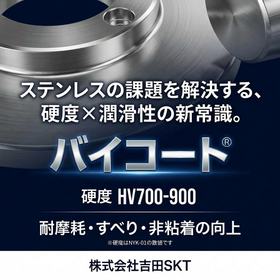
■お悩み 食品の包装時の搬送工程で、ステンレスガイドが製品搬送の抵抗になり、 ラインが詰まってしまう現象が発生していました。 それによって装置が停止し、製品がストップしまうことがお悩みでした。 ■背景 搬送ガイドには、通常はステンレスの磨き材を使用しますが、 搬送製品が高速で大量に搬送されるため、少しでも滑りにくい状態になると、 製品が詰まって装置が停止してしまいます。 包装機の製品の滑り性向上に実績のある「フッ素樹脂コーティング」を検討 しましたが、製品が高速で流れるためコーティングの摩耗紛による異物混入 の懸念があり採用にはいたりませんでした。 ■採用されたコーティング バイコート(R) ■実現できた効果 バイコート(R)は無機系材料と有機系材料を複合化した高耐久フッ素系有機コ ーティングです。HV700-900の硬い被膜と、フッ素樹脂が持つ潤滑性の特性 で、耐摩耗性と滑り性を両立。製品のスムーズな搬送とコーティングの摩耗 問題を解決できました。 ※『バイコート(R)』の製品情報をPDFでダウンロード頂けます。

  • Other surface treatment equipment
  • Coating

Added to bookmarks

Bookmarks list

Bookmark has been removed

Bookmarks list

You can't add any more bookmarks

By registering as a member, you can increase the number of bookmarks you can save and organize them with labels.

Free membership registration

Strong against wear and film peeling! Non-stick coating

Ah, strong! Remarkable durability. An organic coating system "Bicoat(R)" suitable for applications with mechanical loads.

When applying non-stick coatings to molds and jigs, there are applications that cannot be used due to wear or film peeling. For example, molds subjected to strong pressure and "heat sealers" in packaging machines that come into contact with metal are among them. 'Bicoat' is a coating system that achieves the ideal functions of non-stick and wear resistance by combining inorganic and organic surface treatment technologies. ◆ It offers reliable non-stick and release properties, as well as high hardness and excellent dimensional accuracy. ◆ It is also suitable for coating areas that require micron-level dimensional precision. 【Features】 ■ Incredible durability ■ High hardness and scratch resistance ■ Excellent wear resistance ■ Superior non-stick and release properties ■ Safe for use in molds requiring micron-level dimensional precision *For more details, please refer to the PDF document or feel free to contact us.

  • s-シーラー.jpg
  • NYF-11-S 1_edited.jpg
  • Other surface treatment equipment
  • Coating

Added to bookmarks

Bookmarks list

Bookmark has been removed

Bookmarks list

You can't add any more bookmarks

By registering as a member, you can increase the number of bookmarks you can save and organize them with labels.

Free membership registration

New proposal for release agent coating selection! "Measurement of release force of molten resin pellets"

To meet the need of wanting to confirm the effectiveness before adopting a coating, Yoshida SKT measures the coating surface using its unique know-how.

"I want to test the effectiveness of coatings using materials produced in-house in advance." "I am considering the introduction of coatings but am struggling with the selection method." For concerns and issues related to coating selection, Yoshida SKT offers unique expertise in measuring coating performance. Please feel free to consult us about preparing sample pieces. - Do you have any of these concerns? During resin molding, resin sticks to molds or extruders, causing problems. After researching various options, I found that surface treatment is an effective way to prevent sticking, but there are various types of resins and additives depending on the product, and I don't know which surface treatment to choose. - With our coating performance measurement service, you can use the materials you are currently using to check the adhesion with the coating, allowing for a smoother real-world test. ■ Measurement of Release Force of Melted Resin Pellets We measure the release force between melted resin pellets and the coated surface, allowing you to confirm the degree of peeling from the coating numerically. *For applications and to download materials, please visit the official Yoshida SKT website below.

  • Contract measurement
  • Coating

Added to bookmarks

Bookmarks list

Bookmark has been removed

Bookmarks list

You can't add any more bookmarks

By registering as a member, you can increase the number of bookmarks you can save and organize them with labels.

Free membership registration

[Packaging Machine Case Study] Wear-Resistant and Non-Stick Coating for Heat Sealers

A heat sealer that requires compatibility with packaging materials! Troubles are resolved with Bi-Coat, which combines non-stick properties and durability.

We will introduce examples of surface treatment in pillow packaging machines used for packaging food and pharmaceuticals. ■ Adhesion Issues with Heat Sealers The films used for pillow packaging vary in thickness and functionality depending on their application. In thicker packaging films that excel in preserving product quality, a resin that melts easily is used on the inner surface. When heat sealing, the resin on the sealing surface adheres to the heating part of the sealer, leading to issues such as product contamination. ■ Coating Used Bicoat "NYF-11-S" ■ Background and Effects of Adoption While plating treatment is often used to prevent adhesion on heat sealers, the soft, melted resin tends to stick to the heat sealer and does not come off. Fluororesin coatings were considered, but under high temperature and pressure conditions, there was a high risk of the coating peeling off, making it unsuitable for use. Yoshida SKT's Bicoat eliminates resin adhesion to the sealer due to its excellent release properties, and the high hardness coating with superior adhesion improves durability. This has led to a reduction in product defects and successful packaging using new materials. You can request a sample book of coatings suitable for sealers through the link provided.

  • 2021-06-10 (2).png
  • s-0186XT.jpg
  • Surface treatment contract service
  • Coating

Added to bookmarks

Bookmarks list

Bookmark has been removed

Bookmarks list

You can't add any more bookmarks

By registering as a member, you can increase the number of bookmarks you can save and organize them with labels.

Free membership registration

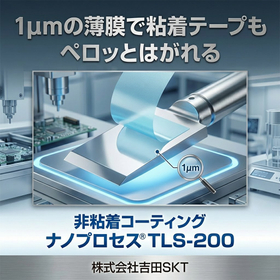
A non-stick coating that allows adhesive tape to be easily peeled off with a 1μm thin film.

Nano Process (R) TLS-200 allows for non-stick coating while maintaining high surface precision with a thin film coating of approximately 1μm.

The "Nano Process (R) TLS-200" has almost no thickness due to the coating, so there is little need to consider the thickness of the coating, allowing for effects such as non-stick, water-repellent, and oil-repellent properties. Even with sharp substrates like blades, processing can be done while maintaining their shape, enabling surface modification of components in a wide range of industries, including production equipment transport lines and packaging processes. *For more details, please refer to the PDF materials or feel free to contact us. ▼ Here is the official Yoshida SKT website for "Nano Process (R)" ▼

  • IMG_1889_edited.jpg
  • 製品バナーTLSシリーズ550x55.jpg
  • Coating Agent
  • Coating

Added to bookmarks

Bookmarks list

Bookmark has been removed

Bookmarks list

You can't add any more bookmarks

By registering as a member, you can increase the number of bookmarks you can save and organize them with labels.

Free membership registration

[Pharmaceutical Industry Surface Treatment Case] Achieving Automation of Transport Equipment in Sterile Rooms

Solve the "clogging" of the eye drop resin bottle production line! Achieve reduced maintenance of transport equipment and automation of the clean room with fluorine coating!

This is a case of surface treatment for equipment that transports eye drop bottles arranged in a line, which are dispensed from a prescription. ■Problems to Solve Eye drop bottles were being transported in a manner where they were pushed out one after another over the transport chute. However, on the flat metal surface of the chute, the bottles tended to stick and were difficult to slide, leading to blockages and tipping during transport. ■Goals to Achieve Due to the need for minimal human traffic in the sterile room, it was necessary to use the equipment for at least six months without maintenance, and a surface treatment that improves sliding was requested. ■Background for Coating Selection While fluororesin coatings, which have excellent sliding properties, initially performed well, the surface would become polished due to friction with the bottles. Once worn down to a flat and smooth state, the sliding ability decreased, leading to issues. Additionally, a method was considered where the substrate would be pre-treated to form a rough surface before coating, thereby reducing the contact area. However, since different metals such as aluminum and stainless steel were used for the chute substrate, variations in hardness led to significant changes in surface roughness, and difficulties in processing arose depending on the material. ■Adopted Coating 'TP Coating' ▼ Click here for details on the coating!

  • 調整00000014_edited.jpg
  • 調整00000013_edited.jpg
  • Other conveying machines
  • Coating

Added to bookmarks

Bookmarks list

Bookmark has been removed

Bookmarks list

You can't add any more bookmarks

By registering as a member, you can increase the number of bookmarks you can save and organize them with labels.

Free membership registration