We have compiled a list of manufacturers, distributors, product information, reference prices, and rankings for particle.
ipros is IPROS GMS IPROS One of the largest technical database sites in Japan that collects information on.

particle Product List and Ranking from 45 Manufacturers, Suppliers and Companies | IPROS GMS

Last Updated: Aggregation Period:Feb 18, 2026~Mar 17, 2026
This ranking is based on the number of page views on our site.

particle Manufacturer, Suppliers and Company Rankings

Last Updated: Aggregation Period:Feb 18, 2026~Mar 17, 2026
This ranking is based on the number of page views on our site.

  1. Polysphere Co., Ltd. Ibaraki//others
  2. フジミインコーポレーテッド Gifu//Electronic Components and Semiconductors
  3. OsakaSodaCO.,LTD. Development&Commercialization Div. Hyogo//Chemical
  4. 4 レンゴー 本社 Osaka//Paper and pulp
  5. 5 大東化成工業 Osaka//others

particle Product ranking

Last Updated: Aggregation Period:Feb 18, 2026~Mar 17, 2026
This ranking is based on the number of page views on our site.

  1. 200nm Particle Size Calibration Standard 'Uni-spheres' Polysphere Co., Ltd.
  2. Silver nanoparticles for low temperature and low pressure/no pressure sintering. OsakaSodaCO.,LTD. Development&Commercialization Div.
  3. White fused alumina particles WA フジミインコーポレーテッド
  4. Plant-derived biodegradable spherical particles 'CELLULOBEADS' 大東化成工業
  5. 4 Plate-shaped alumina particles PWA フジミインコーポレーテッド

particle Product List

31~60 item / All 100 items

Displayed results

Diamond particles "Nano Amando"

Carbon nanoparticles with an average diameter of 2.6±0.5 nm.

"Nanoamond" is a diamond particle that has a size in the single-digit nanometer range and is expected to become an excellent general-purpose material. Currently, we are actively exploring its applications, and promising uses backed by patents and papers include high-speed ultra-precision polishing, lubricants, composition reinforcement components, nano-carbon raw materials, drug carriers, and composite films (LBL method), among others, with expectations for applications in a wide range of fields. Considering the diversity of applications discovered so far, it is believed that many more uses will be discovered and developed in the future. [Product Forms] ■ Colloidal solution (medium: water, DMSO, EG, PG, PAO, etc.) ■ Soft hydrogel ■ Hard hydrogel ■ Aerosolized anhydrous low-agglomeration fine powder *For more details, please download the PDF or feel free to contact us.

  • Other polymer materials
  • others
  • particle

Added to bookmarks

Bookmarks list

Bookmark has been removed

Bookmarks list

You can't add any more bookmarks

By registering as a member, you can increase the number of bookmarks you can save and organize them with labels.

Free membership registration

Amorphous silica particles "Admafuse"

Amorphous silica particles that can improve resin adhesion!

"Admafuse" is an amorphous silica particle that has been spheroidized using a unique melting technology. The average particle size ranges widely from 5 to 30 μm. Customization, such as particle size adjustment, is also available. Additionally, the same surface treatment technology as "Admafine" can be applied. 【Basic Characteristics】 ■ High fluidity and low viscosity: Optimized formulation through blending technology ■ Particle size and particle size distribution: Adjustable according to your requirements ■ Shape: Achieves high sphericity through unique combustion technology ■ High purity: A lineup specialized for low alpha radiation ■ Classification: High-precision cutting possible with dry classification technology *For more details, please download the PDF or feel free to contact us.

  • Other polymer materials
  • particle

Added to bookmarks

Bookmarks list

Bookmark has been removed

Bookmarks list

You can't add any more bookmarks

By registering as a member, you can increase the number of bookmarks you can save and organize them with labels.

Free membership registration

True NANO Silver® Nanoparticles

Exhibiting excellent nano properties! Silver nanoparticles produced by organometallic methods and the Recanalization method.

"True NANO Silver(R)" is a silver nanoparticle that can bond aluminum with high conductivity, high thermal conductivity, and high heat resistance. It eliminates the need for equipment such as atmosphere adjustment furnaces and welding machines, achieving a reduction in material costs. This is expected to contribute to the lightweighting of electrical and electronic devices, including motors. Additionally, it is capable of bonding a wide variety of materials, not just aluminum. [Features] ■ Excellent physical properties ■ High productivity ■ Low introduction costs *For more details, please download the PDF or feel free to contact us.

  • Other polymer materials
  • particle

Added to bookmarks

Bookmarks list

Bookmark has been removed

Bookmarks list

You can't add any more bookmarks

By registering as a member, you can increase the number of bookmarks you can save and organize them with labels.

Free membership registration

Effects of non-colloidal nano-platinum particles

I will introduce nano-platinum particles that have a variety of effects after removing the colloidal membrane.

Non-colloid nano-platinum particles are refined using a patented method that utilizes advanced nanotechnology to create platinum nanoparticles without attaching a colloidal membrane for protection. This has made it possible to discover deodorizing effects and sterilizing/antibacterial effects that were previously hard to conceive based on conventional theories of platinum. Nano-platinum has high antioxidant power and is now added to products such as food freshness preservation, cosmetics, and more recently, health foods and mineral water. 【Effects】 ■ Beauty and health ■ Deodorization and antibacterial ■ Freshness preservation and antioxidant ■ Safety *For more details, please refer to the PDF document or feel free to contact us.

  • Organic Natural Materials
  • particle

Added to bookmarks

Bookmarks list

Bookmark has been removed

Bookmarks list

You can't add any more bookmarks

By registering as a member, you can increase the number of bookmarks you can save and organize them with labels.

Free membership registration

Fast CPC(MODEL 3650)

Achieving a response time of 100ms in nanoparticle measurement! Compact and robust, suitable for field measurements.

The "Fast CPC (MODEL 3650)" is an ideal device that can measure rapidly changing aerosol concentrations and electrical mobility particle size distributions with a fast response time. In addition to the conventional method of condensing particles in supersaturated alcohol vapor, it prevents the diffusion of vapor through laminar flow in the condenser section, allowing for the growth of micron-sized droplets nucleated by nanoparticles as small as 1.9 nm. These droplets are then detected and counted using light scattering. 【Features】 - Compact and robust, suitable for field measurements - Resistant to vibrations and pressure changes, enabling mobile measurements - Built-in flow meter and pump *For more details, please refer to the PDF document or feel free to contact us.

Added to bookmarks

Bookmarks list

Bookmark has been removed

Bookmarks list

You can't add any more bookmarks

By registering as a member, you can increase the number of bookmarks you can save and organize them with labels.

Free membership registration

Acrylic particles "Lumisys Marker"

No optical filter needed! Tracer particles suitable for flow visualization experiments and particle tracking methods.

The "Lumisis Marker" is a spherical acrylic particle (approximately 10μm) that contains the ultraviolet-excited phosphor "Lumisis." Complicated image processing such as masking is mostly unnecessary. Bubbles and debris on walls or in fluids are not visible, and optical filters are not needed. Due to the invisible light, the existing issue of halation caused by photography is almost nonexistent. 【Features】 ■ Particles that fluoresce in different colors when illuminated by a single light source ■ Almost no halation caused by photography due to invisible light ■ Bubbles and debris on walls or in fluids are not visible ■ Complicated image processing such as masking is mostly unnecessary ■ No optical filters needed *For more details, please refer to the PDF document or feel free to contact us.

Added to bookmarks

Bookmarks list

Bookmark has been removed

Bookmarks list

You can't add any more bookmarks

By registering as a member, you can increase the number of bookmarks you can save and organize them with labels.

Free membership registration

Fluorescence of resin particles "Lumisis Marker"

Introducing cases where ultraviolet light, which is invisible, is used as a light source, as well as cases where visible light at 405nm (purple) is used as a light source!

The Lumisis Marker fluoresces strongly at wavelengths of 290 to 405 nm, and it has been confirmed that it also fluoresces at the visible light wavelength of 405 nm. When using ultraviolet light, which is invisible, only the Lumisis Marker fluoresces, and other objects such as walls and debris do not reflect light, making them invisible. When using visible light at 405 nm (purple) as the light source, the Lumisis Marker emits a fluorescent color, while other objects like walls and debris appear purple. When using common visible light such as blue, green, red, or white, all objects including the Lumisis Marker reflect the same color as the light source or the color of the object itself. *For more details, please refer to the PDF document or feel free to contact us.*

  • Composite Materials
  • particle

Added to bookmarks

Bookmarks list

Bookmark has been removed

Bookmarks list

You can't add any more bookmarks

By registering as a member, you can increase the number of bookmarks you can save and organize them with labels.

Free membership registration

Features of the spherical resin particles "Lumisis Marker"

Various thermoplastic resins are available as base materials! They show strong tendencies depending on the type.

"LumisisMarker" is a spherical resin particle containing our ultraviolet-excited phosphor "Lumisis." The ultraviolet-excited phosphor Lumisis is excited by ultraviolet wavelengths and shows a strong tendency to emit various colors such as red, blue, and green, depending on the type. Various thermoplastic resins such as acrylic, nylon, polystyrene, and ABS can be used as the base material. 【Features】 ■ The excitation wavelength and fluorescence wavelength are the same as Lumisis's excitation wavelength. ■ Particle size can be controlled from the nanometer order to the 100μm order. ■ The proportion of Lumisis contained can be controlled. ■ The specific gravity is almost the same as that of the base resin. *For more details, please refer to the PDF document or feel free to contact us.

  • Composite Materials
  • particle

Added to bookmarks

Bookmarks list

Bookmark has been removed

Bookmarks list

You can't add any more bookmarks

By registering as a member, you can increase the number of bookmarks you can save and organize them with labels.

Free membership registration

Silver nanoparticles 'LS0305'

TG (N2) is 0.1 to 0.35%! Introducing low-temperature sintered silver that can accommodate multiple solvent dispersions!

We would like to introduce our silver nanoparticles 'LS0305'. The particle shape is polyhedral, the particle size ranges from 0.15 to 0.4 μm, and the specific surface area is between 1.2 and 2.2 m²/g. We can accommodate multiple solvent dispersions. The shipping form is solvent dispersion, and the dispersible solvents include water, EtOH, DPM, C, CA, BC, TPM, and BCA. 【Characteristics (partial)】 ■ Particle shape: Polyhedral ■ Particle size (μm): 0.15 to 0.4 ■ Specific surface area (m²/g): 1.2 to 2.2 ■ Tap density (g/cm³): 4.5 to 6.5 ■ TG<N2> (%): 0.1 to 0.35 * You can download the English version of the catalog. * For more details, please refer to the PDF document or feel free to contact us.

  • Other metal materials
  • particle

Added to bookmarks

Bookmarks list

Bookmark has been removed

Bookmarks list

You can't add any more bookmarks

By registering as a member, you can increase the number of bookmarks you can save and organize them with labels.

Free membership registration

Silver nanoparticles 'N300'

The electrical resistivity is 4.4 μΩ·cm (after sintering)! TG (N2) is 0.70 to 1.30%!

We would like to introduce our silver nanoparticles 'N300'. The tap density is 1.5–3.0 g/cm³, the specific surface area is 1.9–2.9 m²/g, and the thickness is ≤50 nm. The shipping form is powder. Additionally, the particle shape is flake-shaped, and the particle size is 0.3–0.5 μm. 【Properties (partial)】 ■ Particle shape: Flake shape ■ Particle size (μm): 0.3–0.5 ■ Thickness (nm): ≤50 ■ Specific surface area (m²/g): 1.9–2.9 ■ Tap density (g/cm³): 1.5–3.0 * You can download the English version of the catalog. * For more details, please refer to the PDF document or feel free to contact us.

  • Other metal materials
  • particle

Added to bookmarks

Bookmarks list

Bookmark has been removed

Bookmarks list

You can't add any more bookmarks

By registering as a member, you can increase the number of bookmarks you can save and organize them with labels.

Free membership registration

Characteristics of Cerabeads in the Living Type Process Application

High fire resistance and strong against high thermal loads, making it usable as skin sand! Contributes to improved dimensional accuracy and thinning.

"Serabiz" is a synthetic spherical sintered sand that demonstrates its strengths in frame-less molds due to its lack of thermal expansion. It has high particle strength and contributes to waste reduction. Its low thermal conductivity improves the flow of molten metal. With a high ratio of point contact due to spherical particles, it maintains stable voids between particles, allowing for good gas escape. 【Features】 ■ Improved dimensional accuracy and the ability to create thinner castings ■ Prevents mold cracking during pouring and reduces veining defects ■ Achieves higher strength than silica sand through repeated mixing ■ Can be reused repeatedly as line sand, more so than silica sand ■ Improves the working environment by reducing free silica *For more details, please refer to the PDF document or feel free to contact us.

  • Ceramics
  • particle

Added to bookmarks

Bookmarks list

Bookmark has been removed

Bookmarks list

You can't add any more bookmarks

By registering as a member, you can increase the number of bookmarks you can save and organize them with labels.

Free membership registration

Precursor reagent "Crea Series"

Precursor reagent developed through joint research with Tohoku University.

The "Clare Series" is a precursor reagent for synthesizing uniform and homogeneous organic-modified CeO2 particles that can be provided by our company. By using supercritical hydrothermal treatment, CeO2 nanoparticles with surfaces densely modified by organic molecules can be synthesized. Additionally, the synthesized CeO2 nanoparticles can be dispersed at high concentrations in organic solvents such as cyclohexane. 【Product Lineup】 ■ Clare CeO: Precursor reagent for synthesizing organic-modified CeO2 particles ■ Clare ZrO: Precursor reagent for synthesizing organic-modified ZrO2 particles ■ Clare TiO: Precursor reagent for synthesizing organic-modified TiO2 particles ■ Clare FeO: Precursor reagent for synthesizing organic-modified Fe2O3 particles *For more details, please download the PDF or feel free to contact us.

Added to bookmarks

Bookmarks list

Bookmark has been removed

Bookmarks list

You can't add any more bookmarks

By registering as a member, you can increase the number of bookmarks you can save and organize them with labels.

Free membership registration

Synthetic Talc "SN-Talc"

Synthetic talc with uniform particle size and zero impurities!

"SN-Talc" is a synthetic talc with uniform particle size and zero impurities, produced through supercritical hydrothermal synthesis and organic modification. Talc (soapstone) is typically extracted as a natural mineral and has a wide range of industrial applications, including in food, cosmetics, pharmaceuticals, ceramics, electronic components, and paints. While China, India, and Pakistan are the main sources, it is difficult to achieve 0% impurities due to its natural mineral origin, and even with advancements in grinding technology, it is said to be impossible to produce a uniform particle size. [Features] - Shape: Uniform - Contaminants: 0% - Particle Size: Adjustable on a nanometer scale *For more details, please download the PDF or feel free to contact us.

  • Organic Natural Materials
  • Other polymer materials
  • particle

Added to bookmarks

Bookmarks list

Bookmark has been removed

Bookmarks list

You can't add any more bookmarks

By registering as a member, you can increase the number of bookmarks you can save and organize them with labels.

Free membership registration

Cosmetic ingredient cellulose particles "CELLUFLOW"

As a cosmetic ingredient, with years of proven results! Introducing plant-derived porous cellulose particles!

"CELLUFLOW" is a porous, spherical cellulose microparticle. It has characteristics such as a smooth texture, low irritation to the skin, and water and oil absorption, making it suitable as a cosmetic ingredient. Due to its porous nature, it possesses water and oil absorption properties. By incorporating it into cosmetics such as foundation and sunscreen, products with excellent texture, spreadability, and functionality can be developed. [Features] - Proven track record as a cosmetic base material for many years - Solves the microbead problem due to its plant-based material - Spherical particles of 10μm that penetrate pores and provide various functionalities - High strength both physically and chemically - Prevents makeup from breaking down for extended periods when formulated into foundation - Provides uniform application properties to foundation *For more details, please refer to the PDF document or feel free to contact us.

  • Company:JNC
  • Price:Other
  • c-25-img02.png
  • Cosmetic materials and raw materials
  • particle

Added to bookmarks

Bookmarks list

Bookmark has been removed

Bookmarks list

You can't add any more bookmarks

By registering as a member, you can increase the number of bookmarks you can save and organize them with labels.

Free membership registration

Cellulose particles 'CELLUFLOW' usable in serums and lotions.

We have many years of experience as a supplier of cosmetic ingredients! We would like to introduce plant-derived porous cellulose particles.

"CELLUFLOW" is a porous, spherical cellulose microparticle. It has characteristics such as a smooth texture, low irritation to the skin, and water and oil absorption, making it suitable as a cosmetic ingredient. Due to its porous nature, it possesses water and oil absorption properties. By incorporating it into cosmetics such as lotions and serums, it can impart excellent texture, spreadability, and sustained release functions to the products. [Features] ■ Long-standing track record as a cosmetic ingredient ■ Solves the microplastic problem due to being plant-derived ■ Spherical particles of 10μm that penetrate pores and provide various functionalities ■ High strength both physically and chemically *For more details, please refer to the PDF document or feel free to contact us.

  • Company:JNC
  • Price:Other
  • c-25img.png
  • c-25-img02.png
  • Cosmetic materials and raw materials
  • particle

Added to bookmarks

Bookmarks list

Bookmark has been removed

Bookmarks list

You can't add any more bookmarks

By registering as a member, you can increase the number of bookmarks you can save and organize them with labels.

Free membership registration

Hollow silica nanoparticles "BalloonSil(R) Nano"

By dispersing in resins and coatings at the nanoscale, it is effective in enhancing various functionalities!

We would like to introduce our product, "BalloonSil® Nano." By dispersing it in resins and coatings at the nanoscale, it effectively enhances various functionalities, enabling a wide range of applications such as high-performance insulation materials, lightweight materials, and special coatings. In the application to insulating glass, using nanosized hollow particles overcomes all challenges such as "difficulty in achieving sufficient insulation" and "lack of hardness, transparency, and weather resistance." 【Specifications (excerpt)】 <40nm Hollow Particles> ■Outer diameter nm: 40 ■Inner diameter nm: 30 ■Shell thickness nm: 5 ■Porosity %: 40 *For more details, please refer to the PDF document or feel free to contact us.

  • Other polymer materials
  • particle

Added to bookmarks

Bookmarks list

Bookmark has been removed

Bookmarks list

You can't add any more bookmarks

By registering as a member, you can increase the number of bookmarks you can save and organize them with labels.

Free membership registration

Synthesis of metal oxide sol particles

Leave the synthesis of nanosized metal oxide sol particles to us! We have a proven track record in various coating materials.

Our company has developed and produced nanosized metal oxide sol particles for optical material applications using a unique sol synthesis technology based on metal alkoxides. To achieve optimal film-forming properties, film characteristics, and film durability, we track and precisely control the hydrolysis and condensation reactions of metal alkoxides using measurements such as kinematic viscosity, particle size distribution, and nuclear magnetic resonance spectroscopy (NMR). This control technology enables the synthesis of sol particles with single nanosized microparticles for certain metal species. Additionally, leveraging the know-how of reaction factors obtained from years of research, we can design optimal processes for stable production, which is a significant strength. The nanosized metal oxide sol particles synthesized using our sol synthesis technology are characterized by high transparency due to their highly dispersed nature with minimal aggregation or precipitation. It is possible to form transparent and uniform thin films on substrates where transparency is emphasized, with thicknesses on the order of several tens of nanometers.

  • Other polymer materials
  • particle

Added to bookmarks

Bookmarks list

Bookmark has been removed

Bookmarks list

You can't add any more bookmarks

By registering as a member, you can increase the number of bookmarks you can save and organize them with labels.

Free membership registration

Silver nanoparticles for low temperature and low pressure/no pressure sintering.

Achieve a dense silver sintered layer at low temperature and low pressure / without applied pressure! A lineup of silver nanoparticles ranging from nano to submicron diameter.

We would like to introduce the new development product "Silver Nanoparticles" from Osaka Soda Co., Ltd. By applying silver nanoparticle synthesis technology, we have created a lineup of silver nanoparticles with particle sizes not available in conventional commercial products, while maintaining high low-temperature sinterability. As an application example, by combining with commercially available silver particles to achieve a densely packed design, we can achieve high reliability, bonding strength, and conductivity with a dense and low-shrinkage sintered bonding layer even under low-temperature and no-pressure bonding conditions. 【Features of the added silver sintered layer】 ■ High thermal conductivity ■ Low electrical resistance ■ High bonding strength ■ Improved thermal reliability *For more details, please refer to the PDF document or feel free to contact us.

Added to bookmarks

Bookmarks list

Bookmark has been removed

Bookmarks list

You can't add any more bookmarks

By registering as a member, you can increase the number of bookmarks you can save and organize them with labels.

Free membership registration

Gold nanoparticles

Colloidal gold nanoparticles for applications in biopharmaceuticals and imaging / Particle sizes: 5nm, 10nm, 20nm

Gold nanoparticles are of particular interest in the biomedical field due to their potential to utilize biomolecules, and they can be easily observed using a wide range of imaging systems, including UV-visible cameras, TEM, and SEM. Gold nanoparticles are used in a wide range of applications, from plasmonics-related and biosensor development to immunostaining, as well as in chemicals that enhance X-ray contrast and standards for SEM, TEM, UV-VIS cameras, and AFM. These high-quality gold nanoparticles meet NN-LABS' excellent quality control standards, achieving superior particle size distribution, monodispersity, and uniform morphology.

  • others
  • particle

Added to bookmarks

Bookmarks list

Bookmark has been removed

Bookmarks list

You can't add any more bookmarks

By registering as a member, you can increase the number of bookmarks you can save and organize them with labels.

Free membership registration

[Document] Particle Plus High Concentration Measurement Procedure Manual

Introducing the pre-measurement setup adjustments clearly with photos, starting from zero count adjustment!

This document introduces the procedure for high-concentration measurements using Particle Plus. High-concentration measurements place a significant load on the measuring instrument. By adopting the high-concentration support technology of Particle Plus brand products and the procedures introduced in this document, you will be able to achieve appropriate and stable measurements, so please make use of it. 【Contents】 ■ Introduction ■ Pre-measurement preparation setting - Zero count adjustment - ■ Pre-measurement preparation setting - Count setting - ■ Pre-measurement preparation setting - Regarding actual measurements - ■ Pre-measurement preparation setting - Summary - *For more details, please refer to the PDF document or feel free to contact us.

  • Other measurement, recording and measuring instruments
  • particle

Added to bookmarks

Bookmarks list

Bookmark has been removed

Bookmarks list

You can't add any more bookmarks

By registering as a member, you can increase the number of bookmarks you can save and organize them with labels.

Free membership registration

[Business Introduction] Development of Various Nanoparticles

Supercritical hydrothermal synthesis using only water as a solvent! Introduction to the nanoparticle research and development project.

We would like to introduce our business of "development of various types of nanoparticles." Based on a supercritical hydrothermal synthesis method that does not require organic solvents, we are engaged in the design development and prototyping of nanoparticles. Since our prototype equipment operates continuously, we can positively respond to customer requests regarding the concrete expansion of nanoparticle mass production. We research, develop, and manufacture various new nanoparticles that can be used in a wide range of fields, including electrical and electronic component materials, magnetic materials, medical materials, phosphor materials, electrode materials, catalysts, and high-refractive materials, supporting companies in creating new functional products with new properties tailored to their needs. 【Features of Continuous Supercritical Hydrothermal Synthesis Method】 ■ All substances found on Earth can be continuously synthesized as nanosized particles. ■ The synthesis occurs at high temperatures, resulting in particles with good crystallinity. ■ By inducing uniform nucleation, particles with a narrow particle size distribution can be obtained. ■ The reaction time is very short, on the order of seconds, allowing for mass production through continuous synthesis. ■ Nanoparticles with multi-component compositions can be synthesized. *For more details, please refer to the related links or feel free to contact us.

  • Other physicochemical equipment
  • particle

Added to bookmarks

Bookmarks list

Bookmark has been removed

Bookmarks list

You can't add any more bookmarks

By registering as a member, you can increase the number of bookmarks you can save and organize them with labels.

Free membership registration

Composite particles using ultra-fine bubbles: T20-3142

Improving laser absorption rates makes it easier to create shapes with 3D printers, and also enhances corrosion resistance, heat resistance, and oxidation resistance.

Introduction of Tohoku University Technology (T20-3142) To reduce the amount of energy required to melt metal particles in 3D printing, it is effective to disperse nm-order ceramic particles on the surface of the metal particles, thereby increasing the surface area as metal-ceramic composite particles. Additionally, composite particles have the advantage of improved properties such as corrosion resistance, heat resistance, and oxidation resistance. However, there is a challenge in that both metal particles and ceramic particles are positively charged in water, making it difficult to produce uniform composite particles. The inventors have previously succeeded in creating composite particles using carbon nanotubes without the use of agents for surface charge adjustment or binders. This invention relates to a technology for producing uniform metal-ceramic composite particles that are completely free of impurities without even adding carbon nanotubes, by using ultra-fine bubbles. It is expected that by shaping the obtained composite particles with a 3D printer, composite materials with improved properties can be realized.

Added to bookmarks

Bookmarks list

Bookmark has been removed

Bookmarks list

You can't add any more bookmarks

By registering as a member, you can increase the number of bookmarks you can save and organize them with labels.

Free membership registration

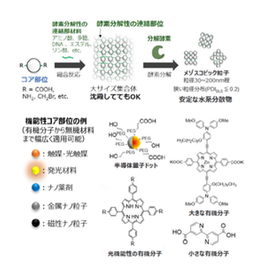
Hokkaido Univ. Technology : Bio-Catalytic Approach to Mesoscopic Particle Synthesis : HK24-007

Innovative method using hydrolytic action of enzymes

Mesoscopic particles, ranging from several tens to several hundred nm in size, have attracted attention in a wide range of fields as interesting materials where quantum size effects and bulk effects interact or synergize. Regarding manufacturing methods, top-down approaches such as physical grinding and bottom-up approaches such as chemical synthesis have been proposed. However, these methods face challenges related to yield, dispersibility, and cost, necessitating new solutions.  In this study, the inventor has developed a novel manufacturing method to address these issues: the "Biocatalytic Nanoparticle Shaping method" (BNS method), which utilizes enzymes. The BNS method can be applied to fabricate various mesoscopic particles by combining enzyme-degradable materials with organic/inorganic materials. For example, semiconducting quantum dots (QDs), porphyrin molecules, bipyridine molecules, and nanographene were used as core units, resulting in nearly monodispersed mesoscopic particles with uniform sizes, obtained as stable aqueous dispersions.

Added to bookmarks

Bookmarks list

Bookmark has been removed

Bookmarks list

You can't add any more bookmarks

By registering as a member, you can increase the number of bookmarks you can save and organize them with labels.

Free membership registration

Rare Metal Materials Research Institute engaged in the development and manufacturing of new materials.

Creation and manufacturing of functional particles such as oxides, fluorides, and metal nanoparticles through new processes!

Our company was established with the purpose of constructing various specialized liquid-phase reactions and using those processes to mass-produce materials that are considered difficult to supply in large quantities to the market, providing the materials needed by various domestic companies at a low cost. This document includes "the advantages of particle control in the context of liquid-phase environments," as well as "contract evaluation of batteries and magnetic materials," "materials that we have started selling," and "introduction of flake metal particles such as Fe, Ni, and Cu." Please feel free to download and take a look. [Contents] ■ Purpose and features of our establishment ■ Characteristics of our particle construction methods and introduction of specific developed particles ■ Introduction of metal powders and oxide powders produced by various synthesis methods *For more details, please refer to the PDF document or feel free to contact us.

  • Other metal materials
  • Contract manufacturing
  • particle

Added to bookmarks

Bookmarks list

Bookmark has been removed

Bookmarks list

You can't add any more bookmarks

By registering as a member, you can increase the number of bookmarks you can save and organize them with labels.

Free membership registration

[Information] Introduction of Infrared Absorbing ITO Nanoparticles

Photos of the "produced ITO nanoparticle dispersion" and materials featuring "the characteristics of our ITO nanoparticles," etc.

This document introduces "Infrared Absorbing ITO Nanoparticles." Our manufacturing method is a slight improvement on the conventional co-precipitation method, allowing for cost-effective production. In small quantities, the price is 200,000 yen per kg for 1 kg to 100 kg, but at the ton level, it is possible to reduce the price to below 150,000 yen per kg. Please take a moment to read. [Contents (excerpt)] ■ Establishment of a low-temperature synthesis method for ITO nanoparticles with a minimum size of 10 nm ■ Manufacturing process ■ Dispersion of the produced ITO nanoparticles ■ Features of our ITO nanoparticles ■ Example 1 of ITO nanoparticles *For more details, please refer to the PDF document or feel free to contact us.

  • others
  • Chemicals
  • Other consumables
  • particle

Added to bookmarks

Bookmarks list

Bookmark has been removed

Bookmarks list

You can't add any more bookmarks

By registering as a member, you can increase the number of bookmarks you can save and organize them with labels.

Free membership registration

[Data] MgF2 nanoparticles with size control between 10 and 100 nm.

Publication of SEM and TEM observation results of 10nm-sized MgF2 nanopowders!

This document introduces MgF2 nanoparticles with size control in the range of 10 to 100 nm. It includes SEM observation results of 10 nm-sized MgF2 nanopowders, SEM observation results of secondary spherical agglomerates of 10 nm-sized MgF2 nanopowders, and TEM observation results of 10 nm-sized MgF2 nanopowders. We encourage you to read it. 【Contents (excerpt)】 ■ 10 nm-sized MgF2 nanopowders - SEM observation results of 10 nm-sized MgF2 nanopowders - SEM observation results of secondary spherical agglomerates of 10 nm-sized MgF2 nanopowders - TEM observation results of 10 nm-sized MgF2 nanopowders - Crystallite size and lattice fringes of MgF2 nanopowders observed by high-resolution TEM *For more details, please refer to the PDF document or feel free to contact us.

  • Other polymer materials
  • particle

Added to bookmarks

Bookmarks list

Bookmark has been removed

Bookmarks list

You can't add any more bookmarks

By registering as a member, you can increase the number of bookmarks you can save and organize them with labels.

Free membership registration

[Data] Applications and Market Potential of Magnesium Fluoride Nanoparticles for Anti-Reflective Coatings

It introduces methods for dealing with anti-reflection, including examples of using MgF2 powder.

Anti-reflective films are applied to surfaces such as camera lenses and LCD monitors, primarily aimed at improving "light transmittance" and preventing "reflected images on LCD monitor screens." This document covers the applications and market potential of magnesium fluoride nanoparticles for anti-reflective films. It introduces methods for addressing reflections, the applications of anti-reflective films, the uses of magnesium fluoride as a low refractive index material, and examples of methods using MgF2 powder. [Contents (excerpt)] ■ What is an anti-reflective film ■ Methods for addressing reflections ■ Principles of anti-reflective films ■ Applications of anti-reflective films ■ Applications beyond building materials *For more details, please refer to the PDF document or feel free to contact us.

  • Other polymer materials
  • particle

Added to bookmarks

Bookmarks list

Bookmark has been removed

Bookmarks list

You can't add any more bookmarks

By registering as a member, you can increase the number of bookmarks you can save and organize them with labels.

Free membership registration

InGaZnO-based oxide nanoparticles

An example of a composite oxide consisting of oxides made from In, Ga, and Zn with the addition of Sn is presented.

This document introduces InGaZnO-based oxide nanoparticles. It includes features of our manufacturing method, conductive particles of InGaZnO-based oxides with an average particle size of 10nm, and an example of a composite oxide made by adding Sn to oxides composed of In, Ga, and Zn. We invite you to read it. 【Contents】 ■ Features of our manufacturing method ■ Conductive particles of InGaZnO-based oxides with an average particle size of 10nm ■ An example of a composite oxide made by adding Sn to oxides composed of In, Ga, and Zn ■ Colorless transparent dispersion of InGaZnO-based oxide nanoparticles (solvent: water) *For more details, please refer to the PDF document or feel free to contact us.

  • Other polymer materials
  • particle

Added to bookmarks

Bookmarks list

Bookmark has been removed

Bookmarks list

You can't add any more bookmarks

By registering as a member, you can increase the number of bookmarks you can save and organize them with labels.

Free membership registration

[Information] Introduction of fine Cu2O particles

Materials introducing photos of "Cu2O particles in aqueous dispersion," "SEM images of Cu2O particles," and "TEM images of Cu2O particles."

This document introduces fine Cu2O particles. It includes photos of "water-dispersed Cu2O particles," as well as "SEM images of Cu2O particles" and "TEM images of Cu2O particles." Please take a moment to read it. 【Contents】 ■ Water-dispersed Cu2O particles ■ SEM images of Cu2O particles ■ TEM images of Cu2O particles *For more details, please refer to the PDF document or feel free to contact us.

  • Other polymer materials
  • particle

Added to bookmarks

Bookmarks list

Bookmark has been removed

Bookmarks list

You can't add any more bookmarks

By registering as a member, you can increase the number of bookmarks you can save and organize them with labels.

Free membership registration

[Information] Introduction to GaN Nanoparticles

An easy-to-understand introduction using photos, such as 'Crystal stripe patterns of GaN nanoparticles observed by TEM'!

This document introduces "GaN nanoparticles" handled by the Rare Metal Materials Research Institute. When the nano-dispersed liquid was dispersed on a mesh for TEM observation, the nanoparticles strongly aggregated, making clear observation difficult. However, from the lattice stripes, the particle size is approximately 10 nm, and distinct diffraction spots are observed in the electron diffraction pattern, indicating that the particles are crystalline. Please take a moment to read it. [Contents] ■ GaN nanocrystalline particles ■ Crystal stripe patterns of GaN nanoparticles observed by TEM ■ Electron diffraction patterns of GaN nanoparticles using TEM *For more details, please refer to the PDF document or feel free to contact us.

  • Other polymer materials
  • particle

Added to bookmarks

Bookmarks list

Bookmark has been removed

Bookmarks list

You can't add any more bookmarks

By registering as a member, you can increase the number of bookmarks you can save and organize them with labels.

Free membership registration