We have compiled a list of manufacturers, distributors, product information, reference prices, and rankings for analysis.
ipros is IPROS GMS IPROS One of the largest technical database sites in Japan that collects information on.

analysis Product List and Ranking from 179 Manufacturers, Suppliers and Companies | IPROS GMS

Last Updated: Aggregation Period:Jan 14, 2026~Feb 10, 2026
This ranking is based on the number of page views on our site.

analysis Manufacturer, Suppliers and Company Rankings

Last Updated: Aggregation Period:Jan 14, 2026~Feb 10, 2026
This ranking is based on the number of page views on our site.

  1. 一般財団法人材料科学技術振興財団 MST Tokyo//Testing, Analysis and Measurement
  2. ビーエルテック Tokyo//Testing, Analysis and Measurement
  3. 西進商事 Hyogo//Industrial Machinery
  4. 4 同仁グローカル Kumamoto//others
  5. 5 クラスターテクノロジー 本社 Osaka//Resin/Plastic

analysis Product ranking

Last Updated: Aggregation Period:Jan 14, 2026~Feb 10, 2026
This ranking is based on the number of page views on our site.

  1. Certified single-element and mixed standard solutions for ICP-AES/ICP-MS wet analysis. 西進商事
  2. "J106S・J116S" (EP) low linear expansion, low shrinkage rate, composite material クラスターテクノロジー 本社
  3. Simple screening test for residual antibiotics in milk: "Charm DIP Test" フォス・ジャパン
  4. 4 Epoxy resin insulator クラスターテクノロジー 本社
  5. 5 Shaking culture device TVS062CA アドバンテック東洋

analysis Product List

241~270 item / All 641 items

Displayed results

Non-destructive observation of the inside of the tablet.

Visualizing the voids inside caplet tablets using a 3D X-ray microscope! Low X-ray absorption rate appears dark.

Tablets have important functions that adjust the melting points and times to ensure ease of ingestion, ease of handling, suppression of odors and bitterness, and that the appropriate amount acts at the correct site. The 3D X-ray microscope (X-ray CT) can confirm the internal structure, such as the coating layer and the distribution of powdered medicine, and since it is non-destructive, it can also be used to check for changes in condition due to drying or wetting. Please feel free to contact us when needed. 【Calculation of Porosity Inside Caplet Tablets Overview】 ■ Visualization of the internal voids of caplet tablets using a 3D X-ray microscope ■ Voids are displayed darkly due to low X-ray absorption rates *For more details, please refer to the PDF document or feel free to contact us.

  • Other microscopes and optical inspection equipment
  • analysis

Added to bookmarks

Bookmarks list

Bookmark has been removed

Bookmarks list

You can't add any more bookmarks

By registering as a member, you can increase the number of bookmarks you can save and organize them with labels.

Free membership registration

Open - Fault Location Identification

It is possible to visualize the internal condition that cannot be detected by visual inspection non-destructively!

There may be cases where electrical products fail due to wire disconnection. If the wiring is covered with opaque resin or similar materials, it is difficult to locate the disconnection just by visual inspection. In such cases, it is possible to find the disconnection point through X-ray transmission observation. Please feel free to contact us when needed. 【Overview】 ■Identification of disconnection points using X-ray transmission observation *For more details, please refer to the PDF document or feel free to contact us.

  • X-ray inspection equipment
  • analysis

Added to bookmarks

Bookmarks list

Bookmark has been removed

Bookmarks list

You can't add any more bookmarks

By registering as a member, you can increase the number of bookmarks you can save and organize them with labels.

Free membership registration

Thin Film Analysis and Evaluation

We will evaluate the types and quantities of constituent elements, membrane quality, etc.! We propose a comprehensive analysis.

We would like to introduce our "Thin Film Analysis and Evaluation" services. Thin films are one of the important factors for enhancing the functionality of electronic devices. We propose comprehensive analysis of thin films. Please feel free to contact us when you need our services. 【Details】 ■ Composition Evaluation ■ Impurity and Contamination Evaluation ■ Bonding State ■ Density Evaluation ■ Evolved Gases ■ Shape Observation *For more details, please download the PDF or feel free to contact us.

  • Other analysis and evaluation services
  • analysis

Added to bookmarks

Bookmarks list

Bookmark has been removed

Bookmarks list

You can't add any more bookmarks

By registering as a member, you can increase the number of bookmarks you can save and organize them with labels.

Free membership registration

Evaluation of buried interfaces using HAXPES with synchrotron radiation.

The detection depth increases, allowing for the evaluation of deeper areas!

We would like to introduce our evaluation of buried interfaces using "Hard X-ray Photoelectron Spectroscopy (HAXPES) with Synchrotron Radiation." X-ray Photoelectron Spectroscopy (XPS) allows for the analysis of surface composition and state, making it an essential technique for surface analysis. While laboratory-type XPS (Al Kα: 1.5 keV) is limited to evaluating extreme surfaces of about 3 nm, using external facilities for Hard X-ray Photoelectron Spectroscopy (HAXPES) at 8 keV enables the evaluation of deeper regions, such as buried interfaces in multilayer structures and stack structures close to actual devices. 【Features】 ■ Greater detection depth compared to conventional XPS ■ Measurement of photoelectrons from deeper energy levels ■ Easier state analysis due to the absence of overlaps with simultaneously generated Auger electrons ■ Utilization of third-generation synchrotron facilities (SPring-8) as a high-brightness X-ray source *For more details, please download the PDF or feel free to contact us.

  • Other analysis and evaluation services
  • analysis

Added to bookmarks

Bookmarks list

Bookmark has been removed

Bookmarks list

You can't add any more bookmarks

By registering as a member, you can increase the number of bookmarks you can save and organize them with labels.

Free membership registration

Solder heat resistance test for surface mount components

Moisture accumulated inside the component vaporizes due to thermal stress! Stress occurs due to volume expansion.

In the "Solder Heat Resistance Test for Surface Mount Components," we simulate the process from moisture-proof packaging of surface mount components to reflow, evaluating their thermal stress resistance. In cases of defects that occur during the test, moisture accumulated inside the components vaporizes due to thermal stress, causing volume expansion and resulting in stress. This stress can lead to delamination and cracks at the interface. Since these anomalies are difficult to detect visually, we use an ultrasonic microscope to inspect the internal adhesion state. [Test Flow] ■ Confirm initial state ■ Dehumidify in a constant temperature chamber ■ Humidify in a constant temperature and humidity chamber ■ Apply thermal stress using a reflow device ■ Confirm post-test state *For more details, please download the PDF or feel free to contact us.

  • Other analysis and evaluation services
  • analysis

Added to bookmarks

Bookmarks list

Bookmark has been removed

Bookmarks list

You can't add any more bookmarks

By registering as a member, you can increase the number of bookmarks you can save and organize them with labels.

Free membership registration

Analysis service

Analyze the filter after resin circulation as needed! Supporting optimal operation for our customers.

Our company offers a variety of analysis services, including expanded observation and elemental analysis. In cases where abnormalities are confirmed during the use of filters, we conduct "dismantling investigations." If special foreign substances are found on the filter during cleaning, we provide "elemental analysis services" for foreign substances upon request. Additionally, we can measure viscosity at a constant temperature using a viscometer available at our research facility. 【Service Details】 ■ Dismantling Investigation ■ Elemental Analysis ■ Viscosity Measurement *For more details, please refer to the related links or feel free to contact us.

  • Analytical Equipment and Devices
  • Contract measurement
  • filter
  • analysis

Added to bookmarks

Bookmarks list

Bookmark has been removed

Bookmarks list

You can't add any more bookmarks

By registering as a member, you can increase the number of bookmarks you can save and organize them with labels.

Free membership registration

Measurement methods for biofilms

Measure the absorbance of the extracted crystal violet solution at 590 nm! Compare the amount of biofilm.

We would like to introduce the "Measurement Method for Biofilms" conducted by our company. Typically, to detect biofilms, a dye called crystal violet is used. This cationic blue dye compound strongly binds electrostatically to the anions of the biofilm constituents in aqueous solution. In organic solvents, the binding weakens, allowing the crystal violet that was bound to the biofilm to be extracted by the organic solvent. 【Other Methods】 ■ Sensory Testing ■ Gravimetric Method *For more details, please refer to the PDF document or feel free to contact us.

  • バイオフィルム測定方法カタログimg.png
  • Other analysis and evaluation services
  • analysis

Added to bookmarks

Bookmarks list

Bookmark has been removed

Bookmarks list

You can't add any more bookmarks

By registering as a member, you can increase the number of bookmarks you can save and organize them with labels.

Free membership registration

What can be understood through biofilm analysis

Utilized for various evaluations, such as assessing the inhibitory effect of biofilm formation on reverse osmosis membranes!

We would like to introduce what can be understood through biofilm analysis. It is utilized for evaluating the biofilm formation inhibition effects of panels and components used in various household appliances such as refrigerators, washing machines, and air conditioners, as well as for evaluating the biofilm formation inhibition effects of indwelling catheters. Our company has numerous achievements in evaluating biofilm formation suppression and removal capabilities using various materials and agents, so we can propose analysis systems tailored to your objectives and requests. 【Evaluation Achievements (Partial)】 ■ Evaluation of biofilm formation inhibition effects on materials used in bathtubs and piping ■ Evaluation of biofilm removal effects of cleaning agents ■ Evaluation of the inhibition effects on bacterial growth within biofilms by disinfectants, as well as evaluation of their sterilization effects ■ Evaluation of biofilm formation inhibition effects by surface treatment agents *For more details, please refer to the PDF document or feel free to contact us.

  • Other analysis and evaluation services
  • analysis

Added to bookmarks

Bookmarks list

Bookmark has been removed

Bookmarks list

You can't add any more bookmarks

By registering as a member, you can increase the number of bookmarks you can save and organize them with labels.

Free membership registration

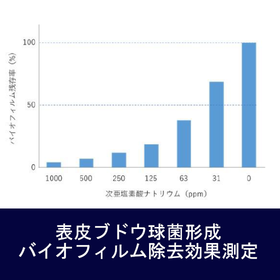
Removal of biofilm using sodium hypochlorite solution.

Used for the removal of biofilm formed in sinks, pipes, and washing machines!

We would like to introduce the removal of biofilms using sodium hypochlorite solution based on the biofilm-related analysis conducted by our company. The effectiveness is quicker at higher concentrations, and at a 5% concentration, biofilms can be removed in just a few minutes. The effectiveness of biofilm removal also varies depending on the type of bacteria and the amount of biofilm present. It is also important to properly control the amount of biofilm formation to evaluate the effectiveness of the cleaning agent. 【Features】 ■ The higher the concentration, the quicker the removal; at a 5% concentration, removal is possible in just a few minutes. ■ The amount of biofilm decreases in a concentration-dependent manner with sodium hypochlorite. *For more details, please refer to the PDF document or feel free to contact us.

  • バイオフィルム除去次亜塩素酸Naカタログ.png
  • Other analysis and evaluation services
  • analysis

Added to bookmarks

Bookmarks list

Bookmark has been removed

Bookmarks list

You can't add any more bookmarks

By registering as a member, you can increase the number of bookmarks you can save and organize them with labels.

Free membership registration

Analysis of Angiotensin-Converting Enzyme (ACE) Inhibitory Activity

We will determine the activity of inhibitors against ACE using 3HB-GGG (peptide) as the ACE substrate with the WST method!

We would like to introduce our "Angiotensin Converting Enzyme (ACE) Inhibition Activity Analysis." Angiotensin Converting Enzyme (ACE) converts angiotensin I into angiotensin II, which has blood pressure-raising effects, while simultaneously breaking down bradykinin, which has blood pressure-lowering effects. This enzyme is involved in the increase of blood pressure within the body. In recent years, ACE inhibition activity measurement has been conducted in processed foods such as agricultural products and fermented foods, as well as in beverages. Depending on the nature and purpose of the samples, we will propose suitable pretreatment methods. [Characteristics of Angiotensin Converting Enzyme] - It converts angiotensin I into angiotensin II, which has blood pressure-raising effects, while simultaneously breaking down bradykinin, which has blood pressure-lowering effects, thus playing a role in the increase of blood pressure within the body. *For more details, please refer to the PDF document or feel free to contact us.

  • Other analysis and evaluation services
  • analysis

Added to bookmarks

Bookmarks list

Bookmark has been removed

Bookmarks list

You can't add any more bookmarks

By registering as a member, you can increase the number of bookmarks you can save and organize them with labels.

Free membership registration

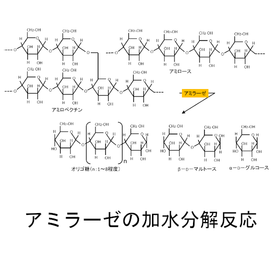
Enzyme activity analysis <Amylase activity>

Enzymes that hydrolyze glycosidic bonds of carbohydrates such as starch! Measurement of amylase activity.

We would like to introduce our "Enzyme Activity Analysis <Amylase Activity>". A common method for measuring amylase activity involves adding the extracted enzyme solution to a starch solution and conducting the enzyme reaction at a precise temperature and time. After that, the reaction mixture is mixed with iodine solution over time to measure the blue absorbance. The decrease in absorbance is used to determine the amylase activity. [Analysis Examples] ■ Grains ■ Processed Foods ■ Functional Foods *For more details, please refer to the PDF document or feel free to contact us.

  • アミラーゼ活性カタログ.png
  • Ingredient analysis
  • analysis

Added to bookmarks

Bookmarks list

Bookmark has been removed

Bookmarks list

You can't add any more bookmarks

By registering as a member, you can increase the number of bookmarks you can save and organize them with labels.

Free membership registration

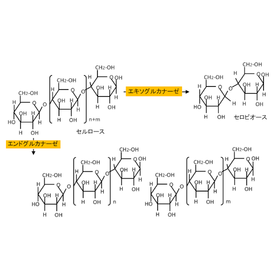
Enzyme Activity Analysis <Cellulase Activity>

Enzymes possessed by bacteria and plants! Cleaving glycosidic bonds such as cellulose.

We would like to introduce our "Enzyme Activity Analysis <Cellulase Activity>". Cellulose is not water-soluble. Therefore, water-soluble carboxymethyl cellulose is used for cellulase activity analysis. Enzyme activity is determined by measuring the amount of reducing sugars produced by the enzyme reaction as glucose. 【Analysis Examples】 ■ Extracts ■ Fermented products, fungal products ■ Functional foods *For more details, please refer to the PDF document or feel free to contact us.

  • セルラーゼ活性カタログ.png
  • Ingredient analysis
  • analysis

Added to bookmarks

Bookmarks list

Bookmark has been removed

Bookmarks list

You can't add any more bookmarks

By registering as a member, you can increase the number of bookmarks you can save and organize them with labels.

Free membership registration

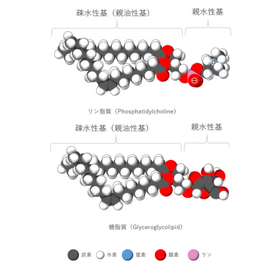
What can be understood through fatty acid analysis

The types of lipid molecules that make up lipids are vast! Analyzing lipids is typically done by analyzing them as fatty acids.

Our company offers "fatty acid analysis" for trace samples such as blood cells and other precious samples. Measuring the proportion of each fatty acid contained in lipids and the amount of each fatty acid can provide insights into the condition of each sample. Fatty acid analysis may yield new findings, so please feel free to contact us. [Analysis Objectives (Excerpt)] ■ Meat: Evaluation of fatty acid composition ratios based on tissue/species differences ■ Plants: Evaluation of fatty acid composition ratios based on species differences ■ Microorganisms: Evaluation of fatty acid composition based on differences in habitat ■ Algae: Measurement of fatty acid content and composition ratios ■ Tea: Evaluation of fatty acid composition ratios based on processing methods *For more details, please refer to the PDF document or feel free to contact us.

  • 脂肪酸分析でわかることカタログ.png
  • Other analysis and evaluation services
  • analysis

Added to bookmarks

Bookmarks list

Bookmark has been removed

Bookmarks list

You can't add any more bookmarks

By registering as a member, you can increase the number of bookmarks you can save and organize them with labels.

Free membership registration

What can be understood through enzyme activity analysis

We also conduct enzyme activity analysis tailored to your requests, as well as processing samples using enzymes on a small scale!

I will introduce what can be understood through "enzyme activity analysis." Enzyme activity measurement is conducted for various purposes such as functional analysis, cause investigation, and development research. Reactions involving enzymes include the expression of biological functions, fermentation by microorganisms, food processing by enzymes, and spoilage by microorganisms (anaerobic fermentation), as well as selective organic synthesis reactions, resulting in a vast variety of samples related to each analysis. 【Analysis Purposes (Excerpt)】 ■ Processed Foods: Monitoring of fermentation processes ■ Waste Processing: Resource recovery from waste ■ Raw Materials: Selection of raw materials ■ Processed Products: Confirmation of enzyme inactivation ■ Extracts: Measurement of enzyme activity values *For more details, please refer to the PDF document or feel free to contact us.

  • Other analysis and evaluation services
  • analysis

Added to bookmarks

Bookmarks list

Bookmark has been removed

Bookmarks list

You can't add any more bookmarks

By registering as a member, you can increase the number of bookmarks you can save and organize them with labels.

Free membership registration

【Trivia】About Cell Activity Evaluation Methods

Quantifying the extent of damage caused to cells by drugs and the environment using cellular function as an indicator!

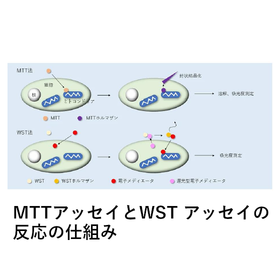
This article introduces methods for evaluating cell activity. The ability to use cells in experiments is largely due to advancements in cell culture techniques and the establishment of cell lines, which are the results of research conducted from the early to mid-20th century. The culture medium began with isotonic solutions (physiological saline, 0.9 w/v% sodium chloride solution), followed by the development of Ringer's solution, the use of serum-supplemented media, and the detachment of adherent cells using trypsin. Additionally, the immortalized animal cell line L929, derived from mouse fibroblasts, was reported around the mid-20th century, and shortly thereafter, the human cell line HeLa was established. *For more detailed information, please refer to the related links and catalog. Feel free to contact us for further inquiries.*

  • 細胞活性評価法カタログ.png
  • Other analysis and evaluation services
  • analysis

Added to bookmarks

Bookmarks list

Bookmark has been removed

Bookmarks list

You can't add any more bookmarks

By registering as a member, you can increase the number of bookmarks you can save and organize them with labels.

Free membership registration

【Trivia】Inactivation of enzymes

Introducing the mechanism by which enzymes lose their activity and strategies to prevent inactivation!

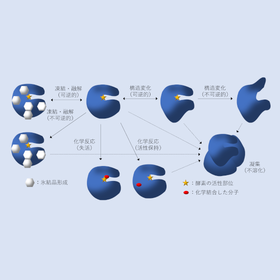
This article introduces the inactivation of enzymes. Proteins are made up of numerous amino acids that link together, folding into structures that perform various functions. Enzymes are also a type of protein that catalyzes the chemical reactions necessary for sustaining life. To function as enzymes, several hundred amino acid polymers must be correctly folded, and the enzymes need the folded amino acid polymers to join at the correct positions and orientations to form complexes. *For more detailed information, please refer to the related links and catalog. Feel free to contact us for further inquiries.*

  • 酵素の失活カタログimg.png
  • enzyme
  • analysis

Added to bookmarks

Bookmarks list

Bookmark has been removed

Bookmarks list

You can't add any more bookmarks

By registering as a member, you can increase the number of bookmarks you can save and organize them with labels.

Free membership registration

[Trivia] Introduction <Enzyme Work Series>

To understand the functions, analysis is necessary! An introduction focusing on the roles of enzymes and analysis methods.

What comes to mind when you hear the word "enzyme"? Perhaps digestive enzymes like diastase, or beauty and health supplements? The first enzyme to be discovered was diastase. Since then, thousands of different enzymes have been identified. Analyzing each enzyme is necessary to understand its function, and some general methods have been proposed for certain enzymes. In this article, we will focus on the roles of enzymes and methods of analysis. *For more detailed information, please refer to the related links and catalog. Feel free to contact us for more details.*

  • enzyme
  • analysis

Added to bookmarks

Bookmarks list

Bookmark has been removed

Bookmarks list

You can't add any more bookmarks

By registering as a member, you can increase the number of bookmarks you can save and organize them with labels.

Free membership registration

[Analysis Case] Fatty Acid Analysis of Animal Tissue (Cells)

We will propose analyses tailored to your objectives, including sample preprocessing methods!

Using Equipment: GC/MS We would like to introduce our "Fatty Acid Analysis of Animal Tissues (Cells)." We conduct analysis of fatty acid composition in tissues such as muscle, fat, and organs, as well as in blood cells and cultured cells, and analyze specific fatty acid components. Our company performs fatty acid analysis on various samples including fresh foods, grains, processed and fermented foods, animal tissues, plant tissues, blood, cells, bacteria, culture media, feed, and waste. [Analysis Example] ■ Cultured Cells: Human Immortalized Keratinocytes *For more details, please download the PDF or feel free to contact us.

  • 動物組織(培養細胞)の脂肪酸分析カタログ.png
  • Ingredient analysis
  • analysis

Added to bookmarks

Bookmarks list

Bookmark has been removed

Bookmarks list

You can't add any more bookmarks

By registering as a member, you can increase the number of bookmarks you can save and organize them with labels.

Free membership registration

[Analysis Case] Fatty Acid Analysis of Plant Tissues

Using the machine: GC/MS We are conducting analyses of the fatty acid composition of common edible oils!

We would like to introduce our "Fatty Acid Analysis of Plant Tissues." We conduct analysis of the fatty acids contained in plant tissues (cells). Measuring the proportion of each fatty acid in lipids and the quantity of each fatty acid can provide insights into the condition of each sample. Please feel free to contact us when you need our services. [Analysis Examples] ■ Edible Oil Fatty Acids ■ Olive Oil *For more details, please download the PDF or feel free to contact us.

  • 植物組織の脂肪酸分析カタログ.png
  • Ingredient analysis
  • analysis

Added to bookmarks

Bookmarks list

Bookmark has been removed

Bookmarks list

You can't add any more bookmarks

By registering as a member, you can increase the number of bookmarks you can save and organize them with labels.

Free membership registration

[Analysis Case] Fatty Acid Analysis of Microorganisms

Using the machine: GC/MS. It is also possible to analyze branched fatty acids and hydroxy fatty acids contained in microorganisms!

We would like to introduce our "Fatty Acid Analysis of Microorganisms." We conduct fatty acid analysis of lipids from microorganisms such as bacteria, plankton, and algae. Measuring the proportion of each fatty acid contained in the lipids and the amount of each fatty acid helps us understand the condition of each sample. We perform fatty acid analysis on various samples, including fresh foods, grains, processed and fermented foods, animal tissues, plant tissues, blood, cells, bacteria, culture media, feed, and excrement. [Analysis Example] ■Microorganism: Staphylococcus epidermidis *For more details, please download the PDF or feel free to contact us.

  • 微生物脂肪酸分析カタログ.png
  • Ingredient analysis
  • analysis

Added to bookmarks

Bookmarks list

Bookmark has been removed

Bookmarks list

You can't add any more bookmarks

By registering as a member, you can increase the number of bookmarks you can save and organize them with labels.

Free membership registration

[Analysis Case] Analysis of Fatty Acids on the Surface of Insects

Using the machine: GC/MS, we are analyzing the fatty acid components on the surface of insects and the fatty acid components contained in microorganisms!

Our company conducts "fatty acid analysis of the insect body surface." Insects are covered by an exoskeleton, and lipid components are secreted on their surface as wax to protect them from drying out. Additionally, it is believed that there are fatty acid compositions related to the unique individual recognition of insects. In the downloadable materials, you can find the results of the extraction and fatty acid analysis of the lipids from the body surface of stink bugs. Please take a look. [Analysis Examples] - Conducted analysis of fatty acid components on the insect body surface and fatty acid components in microorganisms. - Analysis Method: - Extraction: Chloroform-methanol mixed extraction - Derivatization: Methyl esterification - Analysis Equipment: GC/MS (Agilent Technologies) *For more details, please download the PDF or feel free to contact us.

  • 昆虫体表面の脂肪酸分析カタログimg.png
  • Ingredient analysis
  • analysis

Added to bookmarks

Bookmarks list

Bookmark has been removed

Bookmarks list

You can't add any more bookmarks

By registering as a member, you can increase the number of bookmarks you can save and organize them with labels.

Free membership registration

[Analysis Case] Differences in Fatty Acid Composition by Type of Tea Leaves

Using the machine: GC/MS, we will propose analyses tailored to your needs, including sample pretreatment methods!

We would like to introduce the measurement of "differences in fatty acid composition by type of tea leaves" that we conduct. Tea is basically made from the same tea leaves, but the manufacturing processes differ. Sencha is made without fermentation, while oolong tea and black tea undergo fermentation processes. As a result, the proportions of fatty acids in the lipids contained in each type of tea and the amounts of each fatty acid vary. Here, we present the results of measurements regarding the differences in fatty acid composition by type of tea leaves. [Analysis Example] - Analysis of fatty acid composition by type for sencha, matcha, oolong tea, and black tea. *For more details, please download the PDF or feel free to contact us.

  • 茶葉脂肪酸分析カタログ.png
  • Ingredient analysis
  • analysis

Added to bookmarks

Bookmarks list

Bookmark has been removed

Bookmarks list

You can't add any more bookmarks

By registering as a member, you can increase the number of bookmarks you can save and organize them with labels.

Free membership registration

Analysis of Inhibitory Activity of Disaccharide Decomposing Enzymes

We will confirm the inhibitory effect of the sugar-decomposing enzyme. We can determine the concentration of the inhibitor that suppresses it by 50% (IC50).

We would like to introduce our analysis of "inhibitory activity of disaccharide-degrading enzymes." Disaccharides such as maltose, sucrose, and lactose are broken down by the respective enzymes maltase, sucrase, and lactase into glucose + glucose, fructose + glucose, and galactose + glucose. This test is used to evaluate the inhibitory activity of various compounds, extracts, and processed products on each disaccharide-degrading enzyme. [Analysis Examples] ■ Comparison tests of inhibitors ■ Calculation of IC50 *For more details, please download the PDF or feel free to contact us.

  • Other analysis and evaluation services
  • analysis

Added to bookmarks

Bookmarks list

Bookmark has been removed

Bookmarks list

You can't add any more bookmarks

By registering as a member, you can increase the number of bookmarks you can save and organize them with labels.

Free membership registration

Development, analysis, and evaluation of substances with various new functions.

Keywords: metal, metal complex, crystal structure, molecular structure, functional materials, color change, instrumental analysis

Compounds formed by the combination of metal ions with various organic or inorganic compounds are generally referred to as "metal complexes" (or "complex ions" in high school textbooks). The properties of a complex are determined by the structure surrounding the metal ion (what is bonded and what shape it takes) and the state of its electrons. Even with the same metal ion, completely different colors and properties can be obtained depending on the environment. In particular, the differences in color are vivid and are a very intriguing phenomenon. Moreover, these compounds are not only visually appealing but also highly functional, existing in both industrial products and natural substances. While it is enjoyable to develop methods for designing compounds that exhibit desired properties and synthesizing them as intended, I am also interested in the unexpected new properties that can sometimes be discovered, which drives my research. Through these studies, I am also working on improving various analytical techniques that can accommodate a wide range of applications.

Added to bookmarks

Bookmarks list

Bookmark has been removed

Bookmarks list

You can't add any more bookmarks

By registering as a member, you can increase the number of bookmarks you can save and organize them with labels.

Free membership registration

[Evaluation Case] Total Solution for PET Bottles

Cap, main body, and film all measurable! Can be mounted on a microscope and used for foreign substance analysis.

We will introduce a case study of PET bottle evaluation using simple measurement with objective lenses or probes. Measurements can be taken from general-purpose plastics such as PET, PP, PS, and acrylic, as well as other engineering plastics, super engineering plastics, and thermosetting plastics. In field measurements, it is possible to determine the type of plastic. [Features] ■ Rapid measurement in 1 to 5 seconds ■ Simultaneous measurement of PET bottles, caps, and films ■ Measurement of thermal deformation and load is possible ■ Can be mounted on a microscope and used for foreign substance analysis ■ Usable in the field of plastic recycling ■ Ability to determine the type of plastic in field measurements *For more details, please download the PDF or feel free to contact us.

  • Other measurement, recording and measuring instruments
  • analysis

Added to bookmarks

Bookmarks list

Bookmark has been removed

Bookmarks list

You can't add any more bookmarks

By registering as a member, you can increase the number of bookmarks you can save and organize them with labels.

Free membership registration

Lock-in infrared heating analysis device

Achieving overwhelming low prices that are industry No. 1 while maintaining high performance.

Features ● Industry No.1 pricing ● Wide field of view, ideal for large samples ● Abundant lens options ● Operates like a digital camera

  • Defect Inspection Equipment
  • analysis

Added to bookmarks

Bookmarks list

Bookmark has been removed

Bookmarks list

You can't add any more bookmarks

By registering as a member, you can increase the number of bookmarks you can save and organize them with labels.

Free membership registration

Water Quality Monitoring Network System IQ Sensor Net

Customizable freely according to scale! Centralized water quality management.

The IQ Sensor Net system helps collect the necessary data for monitoring and controlling processes by freely combining 21 types of sensors. It supports small-scale operations with 2 sensors up to large-scale processing processes with a maximum of 20 sensors, providing optimal water quality management tailored to users. It also supports remote monitoring, allowing data to be viewed from anywhere using a smartphone, tablet, or computer as long as there is an internet connection. This enables operation from outside the facility when urgent on-site response is needed. Types of sensors: DO (marine water compatible model available), pH/ORP (marine water compatible model available), conductivity (marine water compatible model available), turbidity (marine water compatible model available), color, SS (marine water compatible model available), MLSS, ammonia, nitrate, nitrite, organic matter, sludge interface.

  • Water quality testing
  • Wastewater treatment equipment, technology and maintenance
  • Wastewater/wastewater treatment equipment
  • analysis

Added to bookmarks

Bookmarks list

Bookmark has been removed

Bookmarks list

You can't add any more bookmarks

By registering as a member, you can increase the number of bookmarks you can save and organize them with labels.

Free membership registration