We have compiled a list of manufacturers, distributors, product information, reference prices, and rankings for analysis.
ipros is IPROS GMS IPROS One of the largest technical database sites in Japan that collects information on.

analysis(si) - List of Manufacturers, Suppliers, Companies and Products | IPROS GMS

Last Updated: Aggregation Period:Mar 04, 2026~Mar 31, 2026
This ranking is based on the number of page views on our site.

analysis Product List

1~30 item / All 105 items

Displayed results

[Analysis Case] Analysis of H termination on Si surface

Qualitative and relative comparison of SiH and states on the Si surface due to differences in processing.

We compared the states of the Si surface after HF treatment and after ozone treatment. In the positive ion spectrum, the peak intensity of Si was different. The weaker Si intensity after HF treatment is due to Si being metallic, while the stronger Si intensity after UV-ozone cleaning and in the As Received state is due to Si being oxide-based. From the negative ion spectrum, fragment ions reflecting the surface state were detected: SiF, SiH, and Six series after HF treatment, and SiO2 series after UV-ozone cleaning and in the As Received state.

Added to bookmarks

Bookmarks list

Bookmark has been removed

Bookmarks list

You can't add any more bookmarks

By registering as a member, you can increase the number of bookmarks you can save and organize them with labels.

Free membership registration

[Analysis Case] Damage Assessment of Single Crystal Si Surface

Quantitative analysis of c-Si and a-Si by state is possible using high-resolution measurement and waveform analysis.

In the semiconductor manufacturing process, ion irradiation is sometimes performed for the purpose of surface modification. It is known that irradiating the surface of single-crystal Si with ions of inert elements can cause structural damage and lead to the formation of an amorphous layer. Utilizing the fact that high-resolution XPS spectra detect c (single-crystal) Si and a (amorphous) Si with different peak shapes, we will introduce a case where this damage-derived a-Si was separated from c-Si and quantitatively evaluated.

Added to bookmarks

Bookmarks list

Bookmark has been removed

Bookmarks list

You can't add any more bookmarks

By registering as a member, you can increase the number of bookmarks you can save and organize them with labels.

Free membership registration

Evaluation of metal contamination on the Si wafer surface

ICP-MS: Inductively Coupled Plasma Mass Spectrometry

The purpose of evaluating metal contamination on the surface of Si wafers using ICP-MS includes not only the contamination assessment of the Si wafers themselves but also the evaluation of contamination within semiconductor devices and the assessment of the working environment due to Si wafer exposure. Therefore, the analysis of the Si wafer surface is conducted for various purposes. ICP-MS analysis can sensitively obtain the amount of metal contamination on the surface of Si wafers, and it is also possible to specify the evaluation area according to the purpose.

Added to bookmarks

Bookmarks list

Bookmark has been removed

Bookmarks list

You can't add any more bookmarks

By registering as a member, you can increase the number of bookmarks you can save and organize them with labels.

Free membership registration

[Analysis Case] Diffusion Evaluation of Ga and Al in Si Substrate using SSDP-SIMS

Measurement avoiding the influence of high concentration layers using SSDP-SIMS.

From the perspective of cost reduction, the use of high-resistance Si substrates for power devices made of GaN is expected. However, it is said that if Al and Ga diffuse to the surface of the Si substrate during high-temperature film formation, a low-resistance layer is formed, leading to leakage. Therefore, we will introduce a case where SIMS analysis was conducted to evaluate the presence or absence of Al and Ga diffusion into the Si substrate. To accurately assess trace diffusion, measurements were conducted from the Si substrate side towards the GaN layer.

Added to bookmarks

Bookmarks list

Bookmark has been removed

Bookmarks list

You can't add any more bookmarks

By registering as a member, you can increase the number of bookmarks you can save and organize them with labels.

Free membership registration

[Analysis Case] Evaluation of Si Anode in Lithium-Ion Secondary Batteries

It is possible to evaluate the structure of the Si anode after charging through sample cooling.

Si is one of the candidates for high-capacity negative electrode active materials, but it is said to suffer from severe cycle degradation due to very large volume changes during charge and discharge. In this study, to confirm the state of the Si negative electrode after charging, we disassembled it under a controlled atmosphere environment and performed cooling FIB processing, followed by observing the cross-sectional shape using SEM. When observing the cross-section at room temperature, significant damage such as film contraction, roughness of the observation surface, and pore formation was observed. In contrast, by conducting the observation while cooling, we were able to suppress the alteration of the Si negative electrode and evaluate the original shape of the sample.

  • 冷却FIB加工_室温SEM観察.png
  • 充電曲線およびSi負極の形態観察.png
  • 充電後の形状観察結果_Si膜の変質_Cu箔の露出.png
  • 電池図.png
  • Contract Analysis
  • Contract measurement
  • analysis

Added to bookmarks

Bookmarks list

Bookmark has been removed

Bookmarks list

You can't add any more bookmarks

By registering as a member, you can increase the number of bookmarks you can save and organize them with labels.

Free membership registration

[Analysis Case] Evaluation of the Diffusion Layer in Crystalline Si Solar Cells

Quantitative evaluation of dopants and evaluation of carrier distribution.

This is an example of quantitatively evaluating the dopant concentration distribution directly beneath the electrode in back contact type crystalline silicon solar cells. Additionally, by evaluating the carrier distribution, it is possible to determine the polarity of p/n and visualize the depletion layer in the cross-sectional direction.

Added to bookmarks

Bookmarks list

Bookmark has been removed

Bookmarks list

You can't add any more bookmarks

By registering as a member, you can increase the number of bookmarks you can save and organize them with labels.

Free membership registration

[Analysis Case] Low-Temperature PL Spectrum of Si After Ion Implantation Annealing Treatment

It is possible to confirm the recovery of crystallinity due to irradiation defects and annealing.

In the fabrication of Si-based semiconductor devices, various processes such as ion implantation and annealing are performed. It is considered important to confirm the degree of irradiation defects and the extent of crystallinity recovery before and after these processes in order to control the manufacturing process. Photoluminescence (PL) measurements at low temperatures are one effective means of investigating these aspects. An example of PL measurements of samples that underwent ion implantation on a Si substrate followed by annealing treatment is presented.

Added to bookmarks

Bookmarks list

Bookmark has been removed

Bookmarks list

You can't add any more bookmarks

By registering as a member, you can increase the number of bookmarks you can save and organize them with labels.

Free membership registration

[Test] Fe, Ni, V, Na, K, Al, Si in heavy oil

After burning and ashing the sample, perform alkaline fusion treatment to obtain a solution! Measure the light intensity for quantitative analysis.

We would like to introduce our test for "Fe, Ni, V, Na, K, Al, Si in heavy oil." This test measures the levels of Fe, Ni, V, Na, K, Al, and Si contained in the fuel. After combusting and ashing the sample, it is treated with alkaline fusion to create an aqueous solution. The intensity of light emitted when the plasma in the ICP optical emission spectrometer returns from an excited state to the ground state is measured for quantitative analysis. 【Test Details】 ■Item Number: K548 ■Required Amount: 100g ■Standard Number: JPI-5S-62 ■Main Target Oil Types: Diesel (including mixed diesel), Heavy Oil *For more details, please refer to the related links or feel free to contact us.

  • Testing Equipment and Devices
  • analysis

Added to bookmarks

Bookmarks list

Bookmark has been removed

Bookmarks list

You can't add any more bookmarks

By registering as a member, you can increase the number of bookmarks you can save and organize them with labels.

Free membership registration

[Analysis Case] Evaluation of Carrier Distribution in Crystalline Si Solar Cells

Evaluation of carrier diffusion layer uniformity in samples with surface roughness.

This is an introduction to a case where the carrier diffusion layer distribution of the surface textured part and the back surface field (BSF) part of BSF-type crystalline silicon solar cells was evaluated using SCM. In the textured part, the pn junction is formed along the surface irregularities, while in the BSF part, it can be confirmed that the carrier distribution is interrupted and uneven.

Added to bookmarks

Bookmarks list

Bookmark has been removed

Bookmarks list

You can't add any more bookmarks

By registering as a member, you can increase the number of bookmarks you can save and organize them with labels.

Free membership registration

[Analysis Case] Evaluation of Carrier Concentration Distribution in Si-IGBT Chips

SRA evaluation of field stop layers and lifetime killers.

SRA can analyze the depth profile of carrier concentration distribution over a wide range from shallow regions (a few hundred nm) to deep regions (a few hundred μm). It is also possible to evaluate the in-plane distribution of resistance values at the sample surface or at specified depths. As an example, we will introduce a case where the depth profile of carrier concentration distribution for a commercially available Si-IGBT chip was evaluated, including the entire chip, the field stop layer, and the lifetime killer, as well as the in-plane distribution of resistance values at the irradiation depth of the lifetime killer using SRA.

Added to bookmarks

Bookmarks list

Bookmark has been removed

Bookmarks list

You can't add any more bookmarks

By registering as a member, you can increase the number of bookmarks you can save and organize them with labels.

Free membership registration

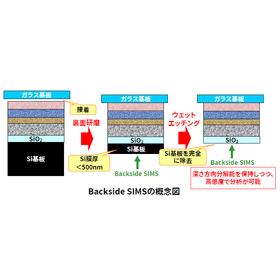
Evaluation of impurity diffusion from the high concentration layer to the lower layer membrane.

Introducing backside SIMS analysis conducted from the substrate side!

In SIMS analysis, when evaluating the diffusion of impurities from a high-concentration layer to a lower layer film, the effects of surface roughness and sputter etching may influence the crater edge effect and knock-on effects from the high-concentration layer. A method of evaluation that is not affected by these influences is Backside SIMS, which conducts SIMS analysis from the substrate side. In the attached PDF document, we introduce the evaluation of the diffusion distribution of F from a SiO2 film (FSG film) to a lower SiO2 film using Backside SIMS, so please take a look. 【Principle of Backside SIMS】 - By polishing the backside of the Si substrate to thin it, we can approach from the backside. - It is possible to control the remaining thickness of the Si substrate to create a thin film, to thin specific areas of patterned samples, or to selectively stop the etching of Si layers such as SiO2. In cases where there are layers that can stop etching, it is also possible to completely remove the Si substrate portion by wet etching. *For more details, please download the PDF or feel free to contact us.

  • Other analysis and evaluation services
  • analysis

Added to bookmarks

Bookmarks list

Bookmark has been removed

Bookmarks list

You can't add any more bookmarks

By registering as a member, you can increase the number of bookmarks you can save and organize them with labels.

Free membership registration

Analysis of trace metal elements in the environment

ICP-MS: Inductively Coupled Plasma Mass Spectrometry

Metal elements suspended in environments such as clean rooms and production lines can adhere to or contaminate products, potentially leading to a deterioration in product performance. With ICP-MS, exposure tests can be conducted on clean Si wafers, allowing for the measurement of the amount of metal elements adhered to the surface at ppt levels. Additionally, we also offer the loan of Si wafers that have been pre-cleaned.

Added to bookmarks

Bookmarks list

Bookmark has been removed

Bookmarks list

You can't add any more bookmarks

By registering as a member, you can increase the number of bookmarks you can save and organize them with labels.

Free membership registration

[Analysis Case] Stress Evaluation by Raman Mapping

It is possible to confirm the stress distribution in the sample cross-section.

The peaks in the Raman spectrum of single crystal Si shift to higher wavenumbers when compressive stress is applied to the sample and shift to lower wavenumbers when tensile stress is applied. This allows us to gain insights into the stress in Si. An example is shown where the distribution of stress in the cross-section of an IGBT (Insulated Gate Bipolar Transistor) was confirmed using Raman mapping.

Added to bookmarks

Bookmarks list

Bookmark has been removed

Bookmarks list

You can't add any more bookmarks

By registering as a member, you can increase the number of bookmarks you can save and organize them with labels.

Free membership registration

[Analysis Case] Evaluation of Contact Electrodes for SiC Power MOSFETs

Identification of the interface between contact electrodes and SiC layer, and evaluation of elemental distribution.

We will introduce an analysis case of commercially available SiC power MOSFET devices. In SiC materials, it is essential to control the materials in a system that includes not only Si but also C, which differs from the conventional manufacturing methods of Si semiconductors. In the process of forming ohmic junctions between the contact electrodes and the SiC layer, we evaluated the elemental distribution and crystal phases, including C, using EDX/EELS analysis with TEM and electron diffraction.

Added to bookmarks

Bookmarks list

Bookmark has been removed

Bookmarks list

You can't add any more bookmarks

By registering as a member, you can increase the number of bookmarks you can save and organize them with labels.

Free membership registration

[Analysis Case] Evaluation of Si-based IGBT Chip Cross-section by Low-Temperature Micro Photoluminescence Analysis

It is possible to confirm the influence of the lifetime killer from the cross-sectional direction.

IGBT (Insulated Gate Bipolar Transistor) is used in various products as a power semiconductor module, ranging from home appliances to industrial equipment. Lifetime control is implemented for performance improvement in IGBTs, but this control is achieved by creating defects (lifetime killers) in the drift layer. By conducting low-temperature micro-PL analysis from the cross-section, it is possible to gain insights into lifetime killers.

Added to bookmarks

Bookmarks list

Bookmark has been removed

Bookmarks list

You can't add any more bookmarks

By registering as a member, you can increase the number of bookmarks you can save and organize them with labels.

Free membership registration

[Analysis Case] Image Analysis of Micro Beer

It is possible to evaluate the distribution of micro-regions.

With the miniaturization of circuits, the design and development of micro vias for interlayer connections require an understanding of the quality of filling. TOF-SIMS is an effective method for evaluating the results, as it can simultaneously perform elemental analysis and analyze molecular information of organic and inorganic substances, as well as enable image analysis. This document presents a case study analyzing a sample with Cu filled in vias of approximately 0.5μm in diameter on a Si substrate. The analysis of positive ion results confirmed the distribution of Cu and Si. Measurement method: TOF-SIMS Product fields: LSI, memory, electronic components Analysis objectives: Composition distribution evaluation, failure analysis, defect analysis For more details, please download the document or contact us.

Added to bookmarks

Bookmarks list

Bookmark has been removed

Bookmarks list

You can't add any more bookmarks

By registering as a member, you can increase the number of bookmarks you can save and organize them with labels.

Free membership registration

[Analysis Case] Evaluation Case of Hydrogen Injection Sample using SRA/SIMS

Introduction to Case Studies on Carrier Concentration Analysis in Lifetime Control Samples

In power semiconductor devices, crystal defects may be formed within the Si substrate for lifetime control. This presents a case study evaluating the carrier concentration distribution due to differences in thermal treatment conditions of hydrogen ions, one of the elements used to create the lifetime control region.

Added to bookmarks

Bookmarks list

Bookmark has been removed

Bookmarks list

You can't add any more bookmarks

By registering as a member, you can increase the number of bookmarks you can save and organize them with labels.

Free membership registration

[Analysis Case] SCM Analysis of SiC Planer Power MOS

You can visualize the diffusion layer structure of SiC devices.

In SCM, it is possible to identify the p/n polarity of semiconductors and visualize the shape of the diffusion layer. This method has been utilized for Si devices, but it can also be applied to SiC devices in areas where the carrier concentration is sufficiently high. This document presents the results of SCM analysis conducted on a cross-section of a SiC Planar Power MOS.

Added to bookmarks

Bookmarks list

Bookmark has been removed

Bookmarks list

You can't add any more bookmarks

By registering as a member, you can increase the number of bookmarks you can save and organize them with labels.

Free membership registration

[Analysis Case] Observation of Crosshatch Pattern Shape

It is possible to visualize small irregularities with high vertical resolution.

A scanning white light interferometer (optical interferometer) can perform high-precision non-contact three-dimensional measurements of the surface shape of a sample with "high vertical (Z) resolution (0.1 nm) and a wide (X-Y) measurement field of view (50 μm to 4.2 mm)." An example of observing the surface shape of a Si/SiGe layered sample (crosshatch pattern) is presented. Shape evaluation with an average roughness (Ra) of approximately 1 nm is possible.

Added to bookmarks

Bookmarks list

Bookmark has been removed

Bookmarks list

You can't add any more bookmarks

By registering as a member, you can increase the number of bookmarks you can save and organize them with labels.

Free membership registration

[Analysis Case] Composition and Thickness Evaluation of Ultra-Thin SiON Films

Estimation of film thickness using the average free path of photoelectrons.

For extremely thin films with a thickness of a few nanometers or less, such as natural oxide films on silicon wafers and silicon nitride thin films, we will measure the Si2p spectrum of the sample's surface. By performing waveform analysis on the obtained spectrum, we will determine the proportion of each bonding state and estimate the film thickness from this result and the average free path of photoelectrons (Equation 1).

Added to bookmarks

Bookmarks list

Bookmark has been removed

Bookmarks list

You can't add any more bookmarks

By registering as a member, you can increase the number of bookmarks you can save and organize them with labels.

Free membership registration

[Analysis Case] Discrimination between Anatase and Rutile Types of Titanium Dioxide

TEM-EELS enables elemental identification and chemical state analysis in micro-regions.

Titanium dioxide (TiO2), used in electronic materials, catalytic materials, ultraviolet absorbers, and photocatalysts, exists in two forms with the same composition but different crystal structures: anatase and rutile. We conducted measurements on a polycrystalline TiO2 sample with a thickness of 20 nm, deposited on a Si substrate (Photo 1), using an electron beam probe focused down to approximately 1 nmΦ (FWHM). The EELS spectra obtained from the sample match the standard spectra of anatase TiO2 for both Ti and O (Figures 1 and 2).

Added to bookmarks

Bookmarks list

Bookmark has been removed

Bookmarks list

You can't add any more bookmarks

By registering as a member, you can increase the number of bookmarks you can save and organize them with labels.

Free membership registration

[Analysis Case] Lock-in Thermal Analysis of Package Products

Non-destructive analysis of leakage points in Si-based power diodes.

In lock-in thermal analysis, it is desirable to increase the frequency to narrow down the hotspots; however, there is a problem that the sensitivity decreases. Therefore, it is important to shift the measurement conditions from the high-frequency side to the low-frequency side and identify the frequency at which the heating signal begins to be obtained. In this case, we will introduce an example where the heating location associated with leakage current was identified non-destructively in a cylindrical package. Thus, it is possible to identify heating locations even in samples with complex three-dimensional structures, which are difficult to analyze using the liquid crystal method.

Added to bookmarks

Bookmarks list

Bookmark has been removed

Bookmarks list

You can't add any more bookmarks

By registering as a member, you can increase the number of bookmarks you can save and organize them with labels.

Free membership registration

[Analysis Case] Evaluation of Organic Contamination of Wafers in Wafer Cases

You can evaluate the causes and total amount of organic contamination in the manufacturing process.

It is known that the adsorption of organic substances on the wafer surface can lead to various issues, such as the degradation of gate oxide film breakdown voltage. Therefore, as the miniaturization and high integration of semiconductor devices progress, it has become increasingly important to monitor not only inorganic substances but also trace amounts of organic substances. Here, we present a case where silicon wafers were stored in two types of wafer cases, and the organic contamination components adhered to the entire wafer surface were concentrated using a wafer analyzer and evaluated using GC/MS.

Added to bookmarks

Bookmarks list

Bookmark has been removed

Bookmarks list

You can't add any more bookmarks

By registering as a member, you can increase the number of bookmarks you can save and organize them with labels.

Free membership registration

[Analysis Case] Evaluation of Impurity Concentration in Gallium Oxide Ga2O3 Films Using SIMS

It is possible to quantitatively evaluate impurity elements.

Gallium oxide (Ga2O3) has a higher band gap and superior physical properties compared to SiC and GaN, making it a material of interest for power devices that can be expected to be high-efficiency and low-cost. Controlling the impurity concentration, which affects the characteristics, is crucial in wafer development. This document presents a case study of impurity concentration analysis in Ga2O3 films. It is found that B and C are below the background level, while Si is present. MST offers a range of Ga2O3 standard samples and can quantify over 30 types of impurities.

Added to bookmarks

Bookmarks list

Bookmark has been removed

Bookmarks list

You can't add any more bookmarks

By registering as a member, you can increase the number of bookmarks you can save and organize them with labels.

Free membership registration

[Analysis Case] High-Sensitivity Analysis of Light Elements in Semiconductor Substrates Using SIMS

SIMS analysis allows for the evaluation of elements such as H, C, N, O, and F down to levels below 1 ppm.

It is possible to detect H, C, N, and O in semiconductor substrates at concentrations below 1 ppm (approximately 5E16 atoms/cm3) and F at concentrations below 1 ppb (approximately 5E13 atoms/cm3) using this method. Examples of measurements in actual FZ-Si (Figure 1) and the background levels of III-V semiconductors are presented (Table 2). In addition to III-V semiconductors, standard samples have been prepared for various materials such as metal films and insulating films, enabling highly sensitive quantitative analysis. This method is ideal for bulk analysis of various materials, including semiconductor substrates, and for evaluating the contamination of gas components during semiconductor processes.

Added to bookmarks

Bookmarks list

Bookmark has been removed

Bookmarks list

You can't add any more bookmarks

By registering as a member, you can increase the number of bookmarks you can save and organize them with labels.

Free membership registration

Evaluation of sintered magnetic cores using EBSD

By using EBSD, it becomes possible to analyze the causes of the deterioration of magnetic properties in soft magnetic metal powder compacts.

The magnetic cores made from soft magnetic powder through compression molding undergo an annealing treatment after compaction. Factors that change with annealing temperature were analyzed using EBSD, and the relationship with coercivity was investigated. As a result, a decrease in KAM value and an increase in average grain size were observed with rising annealing temperature, which showed a tendency for coercivity to decrease. By applying these results, it becomes possible to analyze the causes of magnetic property degradation in compressed magnetic cores made from soft magnetic metal powders using EBSD.

  • Contract Analysis
  • analysis

Added to bookmarks

Bookmarks list

Bookmark has been removed

Bookmarks list

You can't add any more bookmarks

By registering as a member, you can increase the number of bookmarks you can save and organize them with labels.

Free membership registration

Combinatorial characteristic analysis

Conducting evaluations of electrical characteristics, optical characteristics, crystallinity, and composition!

In our "Combinatorial Property Analysis," we conduct various multi-point physical analyses according to your requests, based on compositional changes. In the example shown in the image, we formed Pt electrodes on a triangular 3-component combinatorial composition gradient sample of HfO2, Y2O3, and Al2O3 on a Si substrate, and performed electrical characteristics such as C-V and I-V to evaluate the high dielectric constant layer. The composition mapping from the top shows the dielectric constant, flat band potential, and leakage current, allowing for simultaneous evaluation of 246 compositions within a single sample. Please feel free to contact us when you need our services. 【Service Details】 ■ Electrical property evaluation such as C-V, I-V, semiconductor characteristics (room temperature to 400°C) ■ Optical property evaluation including transmittance measurement and spectroscopic ellipsometry ■ Crystallinity evaluation using microbeam XRD ■ Compositional evaluation using microbeam XRF, XPS, Auger spectroscopy, etc. *For more details, please refer to the PDF document or feel free to contact us.

  • Other contract services
  • Analysis Services
  • analysis

Added to bookmarks

Bookmarks list

Bookmark has been removed

Bookmarks list

You can't add any more bookmarks

By registering as a member, you can increase the number of bookmarks you can save and organize them with labels.

Free membership registration

NMR analysis service

We provide a wide range of analysis of organic and inorganic substances, including composition and molecular structure, using NMR! We will carefully assist you from examination to result reporting.

【Analysis Examples】 - Batteries/Semiconductors: Solution NMR of electrolytes and multinuclear/solid NMR measurements under non-exposure to the atmosphere - Resins/Polymers: Analysis of the composition and degradation of resin components and polymers is possible - Food/Environment: Quantification of components in food and supplements and analysis of degradation status - Pharmaceuticals/Bio: Measurement of the presence and strength of interactions between drugs and receptors is possible

  • Contract Analysis
  • Contract measurement
  • Contract Inspection
  • analysis

Added to bookmarks

Bookmarks list

Bookmark has been removed

Bookmarks list

You can't add any more bookmarks

By registering as a member, you can increase the number of bookmarks you can save and organize them with labels.

Free membership registration

Data DL available: FIB - Nano-level high-precision processing by FIB

The FIB device allows for high-precision processing at the desired position on a Si substrate without a mask at the nano level.

The FIB (Focused Ion Beam) system allows for maskless etching processing to create arbitrary shapes. In this case, we introduce the fabrication of pillars at 50nm steps with the following sizes: - Circular: φ5μm - Pillar height: 700nm/650nm/600nm - Pillar diameter: φ500nm Please take a moment to read the PDF materials. Additionally, our company specializes in wiring modifications aimed at circuit corrections for ICs and LSIs using FIB. Specifically, we offer the following services: - Cutting of wiring - Connecting of wiring - Fabrication of test pads for characteristic evaluation We perform these services with a short turnaround time to assist in your IC and LSI development. We would be happy to discuss this further, so please feel free to reach out. *If you need more details, please do not hesitate to contact us. Seiko Future Creation Official Website https://www.seiko-sfc.co.jp/

  • Processing Contract
  • Contract Analysis
  • Other semiconductors
  • analysis

Added to bookmarks

Bookmarks list

Bookmark has been removed

Bookmarks list

You can't add any more bookmarks

By registering as a member, you can increase the number of bookmarks you can save and organize them with labels.

Free membership registration

Technical Information Magazine 201903-01 Cutting-edge SIMS Analysis Equipment

The technical information magazine The TRC News provides the latest information on analytical techniques that are useful for research and development, solving production troubles, and quality control.

**Abstract** The state-of-the-art secondary ion mass spectrometry (SIMS) device, NanoSIMS 50L, enables imaging measurements with spatial resolution approximately two orders of magnitude higher than conventional SIMS, thanks to its ion beam with a probe diameter of about 50 nm and a highly efficient mass analysis system. This paper introduces the features of the NanoSIMS 50L device and analysis examples. **Table of Contents** 1. Introduction 2. Overview of the Analytical Device 3. Analysis Example of Hair Cross-Section 4. Analysis Example of SiC Semiconductor Devices 5. Conclusion

  • Contract Analysis
  • Contract measurement
  • Technical and Reference Books
  • analysis

Added to bookmarks

Bookmarks list

Bookmark has been removed

Bookmarks list

You can't add any more bookmarks

By registering as a member, you can increase the number of bookmarks you can save and organize them with labels.

Free membership registration