1~45 item / All 89 items
Displayed results
Filter by category

Added to bookmarks
Bookmarks listBookmark has been removed
Bookmarks listYou can't add any more bookmarks
By registering as a member, you can increase the number of bookmarks you can save and organize them with labels.
Free membership registration
Contact this company
Inquiry FormBefore making an inquiry
Download Profile1~45 item / All 89 items
Filter by category

In the manufacturing industry, quality control is a crucial factor that influences the reliability of products. Accurate data recording is essential to suppress the occurrence of defective products and gain customer trust. Recording errors due to handwriting or double entry can lead to quality issues, requiring time and cost for correction. WorkingVoice enables accurate data recording on-site through voice input, achieving real-time prevention of human errors. This supports the efficiency of quality control and the provision of more reliable products. 【Usage Scenarios】 - Inspection records in manufacturing sites - Data entry in quality control departments - Progress records in process management 【Benefits of Implementation】 - Reduction of recording errors - Shortening of data entry time - Early detection of quality issues - Improvement of traceability
Added to bookmarks
Bookmarks listBookmark has been removed
Bookmarks listYou can't add any more bookmarks
By registering as a member, you can increase the number of bookmarks you can save and organize them with labels.
Free membership registration
WorkingVoice, which realizes on-site DX through voice input, eliminates handwritten notes and double entries, enabling accurate data recording on the spot. It can be implemented with just a PC and a headset, and familiar Excel can also be utilized. Users can input data hands-free and eyes-free without stopping their work, preventing human errors in real-time. Accurate data supports quality and contributes to building trust in companies.
Added to bookmarks
Bookmarks listBookmark has been removed
Bookmarks listYou can't add any more bookmarks
By registering as a member, you can increase the number of bookmarks you can save and organize them with labels.
Free membership registration
In the construction industry, site management often involves keeping daily records on paper, which makes transcription and aggregation time-consuming. In particular, records taken on-site are easily affected by weather and working conditions, and there is a risk of loss or deterioration of these records. To address these challenges, digitizing records is essential. The WorkingVoice paperless solution provides a voice system as an Excel add-in, allowing direct voice input into your existing Excel format, achieving paperlessness on the same day. By opening an Excel format file and clicking the voice input button, you won't need to touch the mouse until the data entry task is complete. Input errors and cell movements can also be executed using "voice commands" without clicking. 【Usage Scenarios】 - Creating daily reports for construction sites - Preparing progress reports - Maintaining safety management records 【Benefits of Implementation】 - Reduction in record-keeping time - Decrease in recording errors - Faster information sharing
Added to bookmarks
Bookmarks listBookmark has been removed
Bookmarks listYou can't add any more bookmarks
By registering as a member, you can increase the number of bookmarks you can save and organize them with labels.
Free membership registration
In the healthcare industry, accurate and rapid information sharing is essential. Many pieces of information, such as patient records, test results, and treatment plans, are managed on paper, which poses challenges due to the time required for searching and sharing information. Particularly in busy medical settings, transcription errors and delays in information transmission can potentially impact the quality of care. The WorkingVoice paperless solution, equipped with voice input functionality as an EXCEL add-in, digitizes daily records to enhance the efficiency of information sharing. 【Usage Scenarios】 - Vital data recording - Integration with electronic medical records - Recording of test results - Patient information management 【Benefits of Implementation】 - Reduction in recording time - Acceleration of information sharing - Decrease in transcription errors - Improvement in operational efficiency
Added to bookmarks
Bookmarks listBookmark has been removed
Bookmarks listYou can't add any more bookmarks
By registering as a member, you can increase the number of bookmarks you can save and organize them with labels.
Free membership registration
In educational institutions, accurate and efficient grade management is essential. Particularly when recording a large number of students' grades manually, input errors and time wastage become significant challenges. Handwritten records also complicate aggregation and analysis, increasing the burden on teachers. The WorkingVoice paperless solution provides a voice system as an EXCEL add-in, addressing these issues by digitizing handwritten records. By directly inputting voice data into your existing EXCEL format, it enables immediate paperlessness and contributes to the efficiency of grade management tasks. 【Usage Scenarios】 - Recording exam results and classroom comments - Tracking students' learning progress - Information sharing among teachers 【Benefits of Implementation】 - Reduced input time - Decreased errors - Improved data aggregation efficiency - Cost savings through paperlessness
Added to bookmarks
Bookmarks listBookmark has been removed
Bookmarks listYou can't add any more bookmarks
By registering as a member, you can increase the number of bookmarks you can save and organize them with labels.
Free membership registration
In the transportation industry, accurate information recording and prompt reporting are required in operational records. Handwritten records are time-consuming and labor-intensive, and transcription errors are likely to occur, which can lead to decreased operational efficiency. The WorkingVoice paperless solution features voice input capabilities as an EXCEL add-in, digitizing daily operational records. This enables the streamlining of recording tasks and reduction of errors, allowing for more accurate information management. 【Usage Scenarios】 * Creating daily driving reports * Inputting inspection records * Recording operational routes 【Effects of Implementation】 * Reduction in recording time * Improved accuracy due to reduced errors * Cost savings through paperless operations
Added to bookmarks
Bookmarks listBookmark has been removed
Bookmarks listYou can't add any more bookmarks
By registering as a member, you can increase the number of bookmarks you can save and organize them with labels.
Free membership registration
In the retail industry's inventory management, accurate quantity tracking and quick recording are essential. Particularly when there is a high volume of product inflow and outflow, handwritten records can be time-consuming and labor-intensive, increasing the risk of errors. In response to this challenge, the WorkingVoice paperless solution features a voice input function as an EXCEL add-in, streamlining inventory management tasks. By directly inputting voice data into your current EXCEL format, you can achieve paperless operations on the same day. 【Usage Scenarios】 - Quantity input during inventory counts - Recording during inbound and outbound processes - Quality inspection tasks 【Benefits of Implementation】 - Reduced input time - Decreased recording errors - Significant improvement in operational efficiency


Added to bookmarks
Bookmarks listBookmark has been removed
Bookmarks listYou can't add any more bookmarks
By registering as a member, you can increase the number of bookmarks you can save and organize them with labels.
Free membership registration
In the agricultural field, a lot of time and effort is spent on recording daily work reports. Handwritten records come with challenges such as transcription errors, complicated aggregation, and the risk of losing paper documents. The WorkingVoice paperless solution addresses these issues and improves work efficiency. By providing a voice system as an Excel add-in, it enables direct voice input into your existing Excel format, achieving paperlessness on the same day. 【Usage Scenarios】 - Recording agricultural work - Recording harvest quantities - Recording working hours 【Benefits of Implementation】 - Reduction in recording time - Streamlining of aggregation tasks - Cost reduction through paper reduction
Added to bookmarks
Bookmarks listBookmark has been removed
Bookmarks listYou can't add any more bookmarks
By registering as a member, you can increase the number of bookmarks you can save and organize them with labels.
Free membership registration
We will achieve the minimization of non-value-added tasks associated with data recording, input, transcription, and verification at the manufacturing site through a voice system. Work instructions will be provided via voice guidance to the worker's earphones, and actual results will be input via voice using a microphone, enabling hands-free and eyes-free operation.
Added to bookmarks
Bookmarks listBookmark has been removed
Bookmarks listYou can't add any more bookmarks
By registering as a member, you can increase the number of bookmarks you can save and organize them with labels.
Free membership registration
- The campaign is applicable to estimates until May 31, 2026, and projects to be implemented by July 31 of the same year. - The campaign price covers only the labor cost (one day of work); transportation costs are separate. - It is limited to the first 10 companies.
Added to bookmarks
Bookmarks listBookmark has been removed
Bookmarks listYou can't add any more bookmarks
By registering as a member, you can increase the number of bookmarks you can save and organize them with labels.
Free membership registration
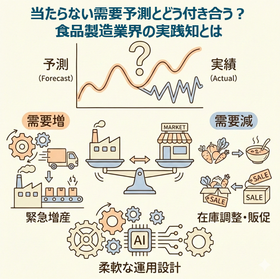
In the food manufacturing industry, demand forecasting is utilized with the premise that it "is not always accurate." Production plans are based on daily sales data, seasonal events, and weather forecasts, but because food has a short shelf life and trends can change rapidly, achieving 100% accuracy is not feasible. As a result, companies position forecasts not as "correct answers" but as "guidelines for decision-making." They are used as a foundation to support on-site judgments regarding raw material procurement, line operation, and personnel allocation, and are flexibly adjusted daily and weekly based on actual performance. So, how do companies recover when forecasts are off? If demand is higher than expected, they increase production through emergency procurement in collaboration with suppliers, switching to other lines, or utilizing external factories. Conversely, if there is leftover inventory, they mitigate stock risks through enhanced promotions, expanding shipping destinations, repurposing, and reducing the production volume for the next cycle. Additionally, there are increasing cases where short-term forecasts are recalculated using AI, and POS data is immediately reflected to quickly restore forecasting accuracy. Ultimately, the key point for the food manufacturing industry in dealing with uncertain demand is the "operational design that incorporates the possibility of being wrong."
Added to bookmarks
Bookmarks listBookmark has been removed
Bookmarks listYou can't add any more bookmarks
By registering as a member, you can increase the number of bookmarks you can save and organize them with labels.
Free membership registration
In today's world, where variant and variable production is mainstream, accurately "hitting" demand forecasts is almost impossible. There are limits to insisting on improving accuracy. Yet, why is forecasting still necessary? It is because forecasts serve as a "basis for decision-making" rather than "numbers to predict the future." For example, in response to a weather forecast of "30% chance of rain," someone who doesn't want to get wet will choose to carry an umbrella, while someone looking to reduce their load may decide not to. It is precisely because of the forecast that one can assess their risk tolerance. The same applies to production sites. Manufacturing always involves physical constraints (lead times), such as components that take months to procure or personnel arrangements that cannot be increased suddenly. It is the hypothesis of "demand is likely to increase next month" that enables "preparations in advance," such as placing advance orders or adjusting overtime shifts. Moreover, it is standard practice to capture forecasts not as points but as "ranges." Based on maximum, minimum, and intermediate forecast values, one can establish management decision-making axes, such as minimizing "waste loss" or avoiding "opportunity loss." In other words, the true value of modern demand forecasting lies not in hitting numerical targets but in providing a "basis for decision-making" in the face of an uncertain future.
Added to bookmarks
Bookmarks listBookmark has been removed
Bookmarks listYou can't add any more bookmarks
By registering as a member, you can increase the number of bookmarks you can save and organize them with labels.
Free membership registration
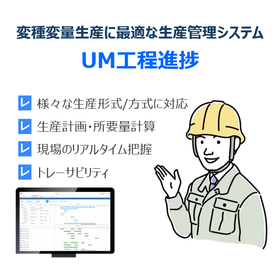
Due to market maturity and the proliferation of social media, consumer needs have become fragmented, and trends are changing rapidly. To respond to this unpredictable market, the manufacturing industry is required to shift towards "variant-variable production," which can immediately adapt to fluctuations in "what, when, and how much is needed." In today's world, where demand forecasting is extremely difficult, it is essential to have a system that can flexibly control items and production volumes according to the situation to prevent both excess inventory and opportunity loss. Recent advancements in IoT and AI have made such complex dynamic control possible, elevating variant-variable production to a realistic survival strategy. However, this approach places a high burden on the production site. Significant challenges arise from decreased efficiency due to irregular setup changes, frequent planning adjustments, the complexity of inventory management, and an increase in human errors associated with non-standardized work. Overcoming these challenges requires an advanced management system that can capture dynamic changes on-site in real-time and reallocate resources flexibly. Considering this background, we provide a clear explanation of the production management system "UM Process Progress," which addresses these challenges. For more details, please read the materials.
Added to bookmarks
Bookmarks listBookmark has been removed
Bookmarks listYou can't add any more bookmarks
By registering as a member, you can increase the number of bookmarks you can save and organize them with labels.
Free membership registration
In response to the global trend of decarbonization, it is expected that Japan will see over 150 trillion yen in GX (Green Transformation) investments from both the public and private sectors over the next decade. So, why should companies focus on GX? Firstly, it is about compliance with regulations. Laws promoting GX and carbon pricing systems are being strengthened, and companies that delay their response face risks of penalties and market exit. Secondly, there is an advantage in fundraising. Companies that actively pursue GX receive high evaluations from investors through ESG investments and green bonds, allowing them to secure funds at lower costs. Thirdly, it enhances market competitiveness and brand value. Environmental considerations are becoming criteria for consumers and business partners, and responding to GX works to the advantage of acquiring customers and expanding overseas. Fourthly, it leads to cost reductions. The introduction of renewable energy and energy-saving technologies lowers long-term operational costs and alleviates the burden of carbon taxes and emissions trading. Finally, it creates new business opportunities. GX-related markets such as renewable energy, hydrogen, and EVs are rapidly growing, providing new revenue sources for companies. GX is not just an environmental measure; it is a survival strategy for companies. The key to future competitiveness lies in how quickly they engage in GX.
Added to bookmarks
Bookmarks listBookmark has been removed
Bookmarks listYou can't add any more bookmarks
By registering as a member, you can increase the number of bookmarks you can save and organize them with labels.
Free membership registration
In the logistics industry, tracking systems are required to accurately manage customer package information and provide real-time tracking. In particular, data tampering and information leaks can lead to a loss of trust from customers and result in losses for the company. Web application diagnostic services can detect security vulnerabilities in tracking systems early and implement countermeasures to achieve secure information management. 【Usage Scenarios】 - Web applications for tracking systems - Customer information management systems - Delivery status confirmation systems 【Benefits of Implementation】 - Reduction of information leak risks - Increased reliability from customers - Avoidance of losses due to system downtime
Added to bookmarks
Bookmarks listBookmark has been removed
Bookmarks listYou can't add any more bookmarks
By registering as a member, you can increase the number of bookmarks you can save and organize them with labels.
Free membership registration
In the energy industry's remote monitoring systems, the stable operation of the system and information security are essential. In particular, systems that remotely monitor and control critical infrastructure such as plants and power transmission networks are often targets of cyberattacks, making the strengthening of security measures urgent. If measures are insufficient, unauthorized access, tampering, and information leaks can occur, potentially having serious impacts on business continuity. Web application diagnostic services can early detect security vulnerabilities in remote monitoring systems and implement measures to ensure the safety of the system. 【Usage Scenarios】 - Web applications for remote monitoring systems - Plant monitoring systems - Power transmission network monitoring systems - Strengthening security measures 【Benefits of Implementation】 - Early detection of security vulnerabilities - Prevention of unauthorized access to the system - Reduction of information leak risks - Assurance of stable system operation
Added to bookmarks
Bookmarks listBookmark has been removed
Bookmarks listYou can't add any more bookmarks
By registering as a member, you can increase the number of bookmarks you can save and organize them with labels.
Free membership registration
In the human resources industry, security measures for web applications that handle customer information and personal data are essential. Unauthorized access to job information sites and recruitment management systems can lead to information leaks and a loss of corporate trust. Web application diagnostic services mitigate these risks and enable safe information management. To prevent security-related damages in advance, early detection and countermeasures for issues (security vulnerabilities) are crucial!! 【Usage Scenarios】 - Strengthening the security of job information sites - Vulnerability assessment of recruitment management systems - Measures for personal information protection 【Benefits of Implementation】 - Reduction of information leak risks - Improvement of corporate reliability - Compliance with regulations
Added to bookmarks
Bookmarks listBookmark has been removed
Bookmarks listYou can't add any more bookmarks
By registering as a member, you can increase the number of bookmarks you can save and organize them with labels.
Free membership registration
In the travel industry’s reservation systems, a high level of security is required as they handle customers' personal information and credit card details. Information leaks due to unauthorized access can lead to a loss of trust from customers and potentially threaten the survival of the company. Web application diagnostic services help to identify vulnerabilities in reservation systems early and reduce risks. To prevent security-related damages in advance, early detection of issues (security vulnerabilities) and countermeasures are crucial!! 【Usage Scenarios】 - Online reservation systems - Member-exclusive my pages - Payment systems 【Benefits of Implementation】 - Reduction of information leak risks - Gaining trust from customers - Mitigation of legal risks
Added to bookmarks
Bookmarks listBookmark has been removed
Bookmarks listYou can't add any more bookmarks
By registering as a member, you can increase the number of bookmarks you can save and organize them with labels.
Free membership registration
In the real estate industry's contract management system, it is essential to securely manage confidential information such as customer data and contract details. Information leaks can undermine customer trust and potentially threaten the survival of the company. Web application diagnostic services can quickly identify vulnerabilities in the contract management system and reduce the risk of information leaks. 【Use Cases】 - Security measures for contract management systems - Protection of customer information - Vulnerability assessment of websites 【Benefits of Implementation】 - Reduced risk of information leaks - Gained trust from customers - Improved corporate brand image
Added to bookmarks
Bookmarks listBookmark has been removed
Bookmarks listYou can't add any more bookmarks
By registering as a member, you can increase the number of bookmarks you can save and organize them with labels.
Free membership registration
In the gaming industry, measures against cheating are essential to maintain player fairness and uphold the integrity of the game. Web applications are used for game management and player data handling, and if vulnerabilities are left unaddressed, they can lead to unauthorized access, data tampering, and facilitate cheating. Web application diagnostic services mitigate these risks and provide a safe gaming environment. 【Use Cases】 - Countermeasures against cheating in online games - Prevention of data tampering within the game - Protection from unauthorized access 【Benefits of Implementation】 - Maintenance of game fairness - Gaining trust from players - Stabilization of game operations
Added to bookmarks
Bookmarks listBookmark has been removed
Bookmarks listYou can't add any more bookmarks
By registering as a member, you can increase the number of bookmarks you can save and organize them with labels.
Free membership registration
In the information disclosure system of government agencies, a high level of security is required to ensure the reliability of information provided to the public. Information leaks and tampering can undermine the trust of the organization and have social repercussions. The web application diagnostic service helps to identify vulnerabilities in the information disclosure system early and implement measures to mitigate these risks. 【Usage Scenarios】 - Information disclosure websites - Government service portal sites - Internal information systems 【Benefits of Implementation】 - Reduction of information leak risks - Prevention of system tampering - Increased trust from the public
Added to bookmarks
Bookmarks listBookmark has been removed
Bookmarks listYou can't add any more bookmarks
By registering as a member, you can increase the number of bookmarks you can save and organize them with labels.
Free membership registration
In the manufacturing industry, it is common to handle highly confidential information such as product design blueprints and customer information through web applications, which always carry the risk of information leakage. Particularly, as information sharing across the entire supply chain progresses, security measures for web applications are essential. If these measures are inadequate, there is a possibility of information leakage or tampering due to unauthorized access, which can lead to a loss of corporate credibility and potential damages. Web application diagnostic services are necessary to mitigate information security risks in the manufacturing industry and protect the reliability of companies. 【Usage Scenarios】 - Management of product design data - Access to customer information databases - Information collaboration with the supply chain 【Benefits of Implementation】 - Reduction of information leakage risks - Improvement of corporate reliability - Compliance with regulations
Added to bookmarks
Bookmarks listBookmark has been removed
Bookmarks listYou can't add any more bookmarks
By registering as a member, you can increase the number of bookmarks you can save and organize them with labels.
Free membership registration
In educational institutions, it is essential to manage the personal information of students and staff securely. Web applications are used to access and manage personal information, making security measures crucial. Vulnerabilities can lead to information leaks and damage from unauthorized access, potentially undermining the trust in educational institutions. Our web application diagnostic service evaluates the security risks of educational institutions' web applications and contributes to the protection of personal information by implementing appropriate measures. 【Use Cases】 - Student information management systems - Portal sites for faculty and staff - Online learning platforms 【Benefits of Implementation】 - Reduction of personal information leakage risks - Protection from unauthorized access - Increased reliability of educational institutions
Added to bookmarks
Bookmarks listBookmark has been removed
Bookmarks listYou can't add any more bookmarks
By registering as a member, you can increase the number of bookmarks you can save and organize them with labels.
Free membership registration
In the healthcare industry, it is essential to securely manage highly confidential information such as patients' personal data and medical records. Information leaks can not only undermine trust from patients and lead to legal liabilities but can also jeopardize the survival of the company. Web applications are often used to access and manage patient information, and if security measures are inadequate, the risk of information leaks increases. Our web application diagnostic service helps mitigate information security risks for healthcare institutions, contributing to the protection of patient information and ensuring reliability. 【Use Cases】 - Electronic medical record systems - Appointment systems - Patient-facing websites - Medical information sharing platforms 【Benefits of Implementation】 - Reduction of information leak risks - Gaining trust from patients - Mitigation of legal risks - Improvement of the company's brand image
Added to bookmarks
Bookmarks listBookmark has been removed
Bookmarks listYou can't add any more bookmarks
By registering as a member, you can increase the number of bookmarks you can save and organize them with labels.
Free membership registration
In the financial industry, security measures for web applications that handle customer information and funds are essential. Information leaks and system outages due to unauthorized access can undermine customer trust and lead to significant damages. Our web application diagnostic service helps to identify vulnerabilities lurking in financial institutions' web applications early on and supports measures to prevent misuse and information leaks. Our service complies with the security policies of financial institutions and supports safe system operations. 【Use Cases】 - Online banking systems - Credit card payment systems - Customer management systems - Fraud detection systems 【Benefits of Implementation】 - Visualization of security risks - Prevention of unauthorized access - Prevention of information leaks - Reduction of system outage risks - Gaining customer trust
Added to bookmarks
Bookmarks listBookmark has been removed
Bookmarks listYou can't add any more bookmarks
By registering as a member, you can increase the number of bookmarks you can save and organize them with labels.
Free membership registration
The biggest cause of pressure on manufacturing profits is the lack of coordination among "sales," "purchasing," and "inventory." When each department operates on separate systems or Excel, information is not shared in real-time, leading to a disconnect between departments. This disconnect causes three significant inconveniences that hinder companies. 1. Generation of unnecessary costs: When sales results and forecasts are not communicated to purchasing, procurement occurs that diverges from actual demand. As a result, excess inventory (dead stock) increases, tying up capital. Conversely, emergency procurement during stockouts incurs high transportation costs and purchase prices. 2. Decline in customer satisfaction: Sales often struggle to provide realistic delivery dates because they cannot immediately confirm accurate inventory levels or the expected arrival of raw materials (inventory/purchasing) at the time of order. This frequently leads to delivery delays, resulting in a loss of trust from customers. 3. Decrease in productivity: Information about stockouts or delays in arrivals is not shared in real-time with the production floor, leading to frequent revisions of production plans. This causes confusion on the shop floor and significantly reduces work efficiency and productivity. To break free from the costs of excess inventory and emergency procurement, let's centralize company-wide information and immediately establish a system where "inventory is at the right level, and delivery dates are reliable."
Added to bookmarks
Bookmarks listBookmark has been removed
Bookmarks listYou can't add any more bookmarks
By registering as a member, you can increase the number of bookmarks you can save and organize them with labels.
Free membership registration
In the food industry, there is a growing awareness of consumer safety, and product traceability is being emphasized. By making information traceable from the procurement of raw materials to manufacturing and distribution, it enables quick identification of causes and responses in the event of an accident. Additionally, it helps in gaining consumer trust. UM SaaS Cloud addresses the challenges of traceability in food manufacturing and supports the provision of safe and secure products. 【Usage Scenarios】 - Tracking from the arrival of raw materials to the shipment of products - Recording information at each stage of the manufacturing process - Product tracking through lot number management - Expiration date management 【Benefits of Implementation】 - Faster identification of causes in the event of food accidents - Improved quality control of products - Gaining consumer trust - Compliance with regulations
Added to bookmarks
Bookmarks listBookmark has been removed
Bookmarks listYou can't add any more bookmarks
By registering as a member, you can increase the number of bookmarks you can save and organize them with labels.
Free membership registration
Sales management in the manufacturing industry is a crucial system that influences revenue and customer satisfaction. However, challenges such as "delivery delays," "excess inventory," and "information fragmentation" are common on the ground, and clear metrics and initiatives are necessary for improvement. ● The first step in improvement is the centralization of information. By integrating and sharing data on orders, inventory, shipments, and invoicing in real-time, interdepartmental collaboration is strengthened. ERP and sales management systems serve as the foundation for this. ● Next is the standardization and automation of processes. Manual data entry and verification can lead to errors and cause delivery delays. The digitalization of EDI, automatic ordering, and invoicing processes significantly enhances accuracy and speed. To measure the effects of improvements, KPIs are essential. The following are representative indicators: - Delivery compliance rate: An important indicator of customer satisfaction - Inventory turnover rate: An indicator of inventory liquidity - Order processing time: A measure of business speed improvement - Sales forecast accuracy: An indicator that enhances the reliability of management planning By regularly monitoring these metrics and cycling through improvements, sales management evolves into a "strategic capability that supports management." To maintain competitiveness, it is essential for manufacturing companies to optimize sales management in a data-driven manner.
Added to bookmarks
Bookmarks listBookmark has been removed
Bookmarks listYou can't add any more bookmarks
By registering as a member, you can increase the number of bookmarks you can save and organize them with labels.
Free membership registration
For the manufacturing industry, sales management is not just about managing orders and shipments; it is a crucial system that serves as the core of corporate management. This is because sales management is both a "system for confirming sales" and an "information infrastructure that connects production, inventory, purchasing, and finance." If the accuracy of this system is low, issues such as excess inventory, stockouts, delayed deliveries, and deteriorating cash flow can ripple throughout the entire company. First and foremost, sales management is directly linked to revenue assurance. Accurate order information supports billing and payment management, stabilizing cash flow. Additionally, since order data is reflected in production planning and inventory management, any errors can lead to increased costs and decreased customer satisfaction. Furthermore, sales management enhances customer responsiveness. Adherence to delivery dates and accurate shipments are achieved through the proper operation of sales management. Handling returns and complaints is also part of sales management and affects customer satisfaction. Moreover, sales data serves as the foundation for management decisions. Through sales analysis by product, region, and customer, it supports strategic decision-making. In other words, sales management is not merely administrative work; it is a management resource that enhances a company's competitiveness. For the manufacturing industry to achieve sustainable growth, it is essential to position sales management as an "information hub" and pursue accuracy and speed.
Added to bookmarks
Bookmarks listBookmark has been removed
Bookmarks listYou can't add any more bookmarks
By registering as a member, you can increase the number of bookmarks you can save and organize them with labels.
Free membership registration
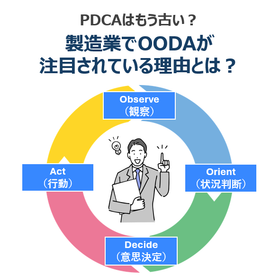
In the manufacturing industry, the PDCA (Plan-Do-Check-Act) cycle is often used as a framework for improvement and decision-making, but in recent years, the "OODA Loop" has gained attention. OODA consists of four steps: "Observe, Orient, Decide, and Act," emphasizing responsiveness to change. On the other hand, PDCA focuses on stable improvement through repeated planning and verification, consisting of "Plan, Do, Check, and Act." The difference lies in speed and purpose. PDCA is strong in long-term quality improvement and standardization, but tends to be weak in responding to sudden changes due to the time it takes for planning. In contrast, OODA is effective in situations that require speed, such as responding to anomalies on the shop floor, fluctuations in demand, and new product development. Particularly in smart factories that utilize IoT and real-time data, the responsiveness of OODA can lead to competitive advantage. In conclusion, a hybrid approach that establishes a foundation with PDCA while enhancing adaptability to change with OODA is ideal in the manufacturing industry. By incorporating both stability and speed in a balanced manner, it is possible to enhance both operational and managerial capabilities.
Added to bookmarks
Bookmarks listBookmark has been removed
Bookmarks listYou can't add any more bookmarks
By registering as a member, you can increase the number of bookmarks you can save and organize them with labels.
Free membership registration
In the era of globalization and uncertainty, supply chain risk management influences a company's competitiveness. Four categories are particularly important: 1. Environmental Risks Natural disasters, climate change, and pandemics can lead to production halts and transportation restrictions. It is essential to establish a Business Continuity Plan (BCP), diversify locations, and secure safety stock in advance. When incidents occur, alternative sourcing, switching transportation methods, and reconstructing demand forecasts are crucial. 2. Geopolitical Risks Wars, economic sanctions, and trade friction hinder logistics and transactions. It is important to conduct country-specific risk analyses and diversify suppliers, and during crises, quickly explore alternative markets and legal responses. 3. Economic Risks Exchange rate fluctuations, rising raw material costs, and economic recessions affect costs and demand. Prepare with currency hedging and long-term contracts, and respond to occurrences by passing on costs and adjusting procurement volumes. 4. Security Risks Cyberattacks and the circulation of counterfeit goods undermine trust. Implementing a zero-trust approach and ensuring traceability are necessary, and during incidents, thorough responses from Computer Security Incident Response Teams (CSIRT) and information sharing are vital. The keywords are "diversification, forecasting, monitoring" + "rapid alternatives, information sharing, legal responses." Now is the time to build a robust and flexible supply chain and strengthen BCP to enhance corporate sustainability and competitiveness.
Added to bookmarks
Bookmarks listBookmark has been removed
Bookmarks listYou can't add any more bookmarks
By registering as a member, you can increase the number of bookmarks you can save and organize them with labels.
Free membership registration
In recent years, cyber attacks have become more sophisticated and complex, with new attack methods emerging daily, and the threats to information systems continue to increase. In such a situation, information systems with inadequate countermeasures are suffering from damages such as intrusions, tampering, and information leaks. When the damage extends to customers, it is reported in various media, leading to a loss of social trust and significant financial losses. To prevent security-related damages before they occur, early detection of issues (security vulnerabilities) and appropriate countermeasures are crucial!
Added to bookmarks
Bookmarks listBookmark has been removed
Bookmarks listYou can't add any more bookmarks
By registering as a member, you can increase the number of bookmarks you can save and organize them with labels.
Free membership registration
In the manufacturing field, no matter how many measures are taken, there are times when things do not proceed as planned. This time, we will introduce five particularly impactful factors. 1. Fluctuations in demand and sudden changes in specifications Sudden additional orders or changes in specifications from customers can disrupt production plans. This is influenced by market changes and the trend towards shorter delivery times. 2. Re-manufacturing and rework due to quality defects When defects are found during the process or inspection, re-manufacturing or corrections become necessary. This is particularly likely to occur with complex products or initial lots, and even with strengthened quality control, it cannot be reduced to zero. 3. Delays from outsourcing and partner companies Delays in outsourced processing or parts supply can stall the entire process. Factors include capacity shortages, transportation troubles, and risks associated with overseas procurement. 4. Sudden equipment troubles Even with preventive maintenance, aging equipment or specialized machinery can experience unexpected failures. Complete prevention is difficult, and the ability to respond on-site is required. 5. Insufficient accuracy in production planning In low-volume, high-variety production, changing setups and transitions can take time, leading to deviations from the plan. Equipment downtime and underestimating on-site capacity can also impact planning. By anticipating these factors in advance, the impact can be minimized.
Added to bookmarks
Bookmarks listBookmark has been removed
Bookmarks listYou can't add any more bookmarks
By registering as a member, you can increase the number of bookmarks you can save and organize them with labels.
Free membership registration
- AI Transformation Incorporating AI into business processes and system structures to redefine operations and workflows. - Promoting Digital Transformation (DX) Supporting the transition from legacy environments and providing consistent support from planning to implementation and integration into the field. - Utilizing Generative AI Leveraging automatic generation technologies for text, images, and audio to enhance content creation and customer experience. - Building and Operating AI Infrastructure Providing a scalable infrastructure for model development and deployment in cloud/on-premises environments, along with continuous monitoring.
Added to bookmarks
Bookmarks listBookmark has been removed
Bookmarks listYou can't add any more bookmarks
By registering as a member, you can increase the number of bookmarks you can save and organize them with labels.
Free membership registration
Many companies struggle with "quality variation" on the manufacturing floor. Even with the same processes and materials, differences in products can occur—this is a challenge seen in many workplaces. The causes of variation can mainly be summarized into the following four plus additional factors: 1. Variation due to people Quality varies depending on the experience, attention, and understanding of procedures by the workers. Establishing standard operating procedures (SOP) and providing training are effective measures. 2. Variation due to equipment Wear and insufficient adjustments of machines can affect products. Regular maintenance and thorough preventive care lead to stable operations. 3. Variation due to materials The quality of raw materials and lot differences are also factors contributing to product quality variation. Strengthening incoming inspections and lot management is necessary. 4. Inadequacies in process management If processes and procedures are unclear or poorly managed, quality will not be stable. Utilizing process capability indices (Cp, Cpk) and statistical process control (SPC) is effective. In addition to these "4Ms," environmental factors such as temperature, humidity, and lighting also impact quality, so monitoring and managing the work environment is required. Significant quality variation can be controlled through "management." Visualizing the workplace and maintaining the PDCA cycle are the first steps toward stabilizing quality.
Added to bookmarks
Bookmarks listBookmark has been removed
Bookmarks listYou can't add any more bookmarks
By registering as a member, you can increase the number of bookmarks you can save and organize them with labels.
Free membership registration
Make on-site guidance smarter. At construction sites and during workplace tours, a lot of time and manpower are spent on visitor reception. The AI avatar on-site guidance service is a new solution that addresses this issue. The AI avatar will handle site explanations, provide necessary information, and answer questions on behalf of busy staff members. ✔ Reduction of response time ✔ Alleviation of labor shortages ✔ Polite and efficient guidance As the "new face" of construction sites, the AI avatar will play an active role. Isn't it time to start the DX (digital transformation) of your site?
Added to bookmarks
Bookmarks listBookmark has been removed
Bookmarks listYou can't add any more bookmarks
By registering as a member, you can increase the number of bookmarks you can save and organize them with labels.
Free membership registration
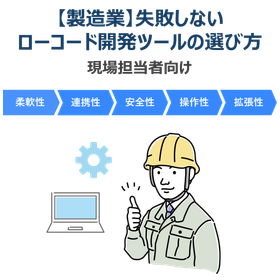
Low-code development tools are classified into "general-purpose," "specialized," and "hybrid" types. - General-purpose tools can accommodate a wide range of business needs and offer high flexibility; however, specific requirements unique to the manufacturing industry require additional development. - Specialized tools are designed for the manufacturing sector and come with pre-prepared templates and business components for inventory management, quality control, and more, making implementation smooth. However, there are limitations to flexible customization beyond standard features. - Hybrid tools combine the business suitability of specialized tools with the flexibility of general-purpose tools, making them suitable for building integrated systems across multiple operations and accommodating future expansions, thus recommended for the manufacturing industry as a whole. When selecting the appropriate tools for system development in the manufacturing sector, there are five key points to consider: ■ Flexibility to easily implement manufacturing-specific requirements such as inventory/lot management ■ Availability of API integration with ERP and production management or standard connectors ■ Security and compliance measures (permission management, audit logs) ■ Freedom in UI design and usability in the field ■ Scalability and ease of adding future functionalities By keeping these in mind, it becomes possible to select low-code tools that accelerate DX (digital transformation) in the manufacturing industry. For more details, please refer to the PDF document!
Added to bookmarks
Bookmarks listBookmark has been removed
Bookmarks listYou can't add any more bookmarks
By registering as a member, you can increase the number of bookmarks you can save and organize them with labels.
Free membership registration
■Issues and Causes An aging system that cannot keep up with changes in the business and is only utilizing a portion of its functions. Despite this, we have been paying high maintenance fees every month. There is pressure from upper management to "do something!" but due to a shortage of manpower and excessive customization, it is extremely difficult to make improvements in-house. We have no choice but to rely on vendors, but we are being presented with high estimates. ■Three Options <Revise the current system> While being familiar with the operation is an advantage, the revision costs are high and the duration tends to be long. <Replace with ERP (business application)> While it is easy to implement, it does not necessarily fit perfectly with our business operations, and training costs are also a challenge. <Completely develop from scratch> It can be optimized for business, but it tends to rely heavily on outsourcing, and costs are high with long durations. ■Recommended Response and Expected Effects We recommend "ERP (business application)" + "low-code development." By using the standard functions of the ERP (business application) to streamline operations and flexibly addressing unique requirements with low-code, we can achieve speedy construction while keeping costs down. *For more details on response strategies and points for selecting ERP (business applications), please refer to the PDF document!
Added to bookmarks
Bookmarks listBookmark has been removed
Bookmarks listYou can't add any more bookmarks
By registering as a member, you can increase the number of bookmarks you can save and organize them with labels.
Free membership registration
- Construction and operation of production management solutions: Providing production management and process management systems for the manufacturing industry. - Development of business applications utilizing low-code development tools. Strong in Java/Web technologies. - Also handling the voice input solution "WorkingVoice." - Supporting DX for the manufacturing industry, including scheduling assistance using AI.
Added to bookmarks
Bookmarks listBookmark has been removed
Bookmarks listYou can't add any more bookmarks
By registering as a member, you can increase the number of bookmarks you can save and organize them with labels.
Free membership registration
■Issues and Causes The issue of "safety checks being 'conducted' but 'not recorded'" is a significant challenge in on-site safety management in manufacturing, construction, and maintenance. The formalities of filling out paper forms or checklists have become mere rituals, making it difficult to grasp the timing of safety actions being implemented. ■Solution We propose the use of WorkingVoice for voice input of safety checks. The ability to record safety checks "on the spot" without stopping work, along with the impossibility of post-entry, serves as a decisive factor for preventing tampering and providing proof of implementation. ■Effects After Implementation Automatic recording of "who, when, and what was checked." The practice of pointing and calling has become established, contributing to the prevention of human errors. Additionally, it has significantly reduced unconscious work and has a strong educational effect. *For more details, please refer to the related links or feel free to contact us.*
Added to bookmarks
Bookmarks listBookmark has been removed
Bookmarks listYou can't add any more bookmarks
By registering as a member, you can increase the number of bookmarks you can save and organize them with labels.
Free membership registration
■Issues and Causes On-site maintenance and inspection operations face chronic issues such as "complexity of records, record omissions, and reporting delays." The time taken for reporting and data entry after inspections is lengthy, and the timing of abnormal findings to reporting is unclear, with photos and report data scattered. ■Solution We propose the use of WorkingVoice for voice input of work performance data and situation photography using a tablet camera. The ability to instantly record what is "seen and felt" on-site, even when both hands are occupied, was a key factor in the decision to implement this solution. ■Effects After Implementation Variability in judgment has been reduced, and reproducibility has improved. The response lead time has been shortened by half, and chronological management of equipment condition history has been achieved. Additionally, it can be utilized for training and technical transfer materials, and the voice logs remain as primary information, which are also noted as benefits. *For more details, please refer to the related links or feel free to contact us.*
Added to bookmarks
Bookmarks listBookmark has been removed
Bookmarks listYou can't add any more bookmarks
By registering as a member, you can increase the number of bookmarks you can save and organize them with labels.
Free membership registration
■Issues and Causes In the manufacturing field, "diversification of products with small quantities," "decrease in skilled workers," and "fluidity of workers" have made reading instructions itself a burden. Due to reasons such as gloves, protective gear, and confined spaces, operating paper or devices is also one of the current challenges. ■Solution We propose using WorkingVoice for voice-guided work instructions. The ability to receive work instructions hands-free and eyes-free, and the realization of a workplace where mistakes and confusion are minimized, were key factors for the implementation. ■Effects After Implementation Work efficiency improved by 10-20%, and the training period was shortened to less than half. We achieved a reduction in near-miss incidents, flexible responses to diverse production, and the elimination of misunderstandings and language barriers in instructions. *For more details, please refer to the related links or feel free to contact us.*
Added to bookmarks
Bookmarks listBookmark has been removed
Bookmarks listYou can't add any more bookmarks
By registering as a member, you can increase the number of bookmarks you can save and organize them with labels.
Free membership registration
■Issues and Causes There are situations in manufacturing work, such as when gloves are worn, that are not suitable for data entry, leading to inaccurate data input and resulting problems. Issues include discrepancies with actual working hours, ambiguity in cost by process, weak estimation basis, and difficulties in identifying bottlenecks and revising standard times. ■Solution We propose the voice input of inspection data using WorkingVoice. It allows for accurate time recording even in dust-proof, oil-proof, and gloved environments, and enables real-time automatic timestamping. The ability to improve data accuracy at low cost and in a short period was a decisive factor for implementation. ■Effects After Implementation The error in actual working hours was improved to within ±1 minute, and cost variances by process and production number were visualized. Managers were able to immediately grasp on-site progress, and measures against tampering and audit responses were strengthened. *For more details, please refer to the related links or feel free to contact us.*
Added to bookmarks
Bookmarks listBookmark has been removed
Bookmarks listYou can't add any more bookmarks
By registering as a member, you can increase the number of bookmarks you can save and organize them with labels.
Free membership registration
■Issues and Causes Due to the inspection being conducted by a pair consisting of a measurer and a recorder, challenges have arisen in terms of securing personnel and the accuracy of inspection data. It has been difficult to maintain a two-person system, leading to losses in the measurement → verbal communication → recording process, as well as misunderstandings and delays in recording. ■Solution We propose the voice input of inspection data using WorkingVoice. The ability to perform "measurement" and "recording" simultaneously, the prevention of tampering and creation of an audit trail through real-time recording, and its effectiveness in locations where devices cannot be brought in were key factors in the decision to implement it. ■Effects After Implementation By reducing the number of personnel from two to one, we achieved a 50% reduction in labor hours. Additionally, the inspection time per cycle was shortened by 20-30%, and accurate numerical recording with automatic timestamps was realized. We can also respond to external audits and customer requirements, enabling "voice proof" during audits. *For more details, please refer to the related links or feel free to contact us.*
Added to bookmarks
Bookmarks listBookmark has been removed
Bookmarks listYou can't add any more bookmarks
By registering as a member, you can increase the number of bookmarks you can save and organize them with labels.
Free membership registration
■Issues and Causes The reliability of the data (when, who, and what was measured) was ambiguous, leading to a situation where it could not be reproduced or evidence could not be presented during external audits. Errors due to manual input and transcription, as well as issues with double management of data and inconsistent formats, were observed. ■Solution We proposed the voice input of inspection data using WorkingVoice. The reliability of quality data and prevention of tampering, along with the reduction of on-site workload and support for data entry by skilled workers, made the realistic digital transformation (DX) with controlled implementation costs and duration a decisive factor for adoption. ■Results After Implementation Inspection time was reduced by approximately 15-30%, allowing us to respond to customer corrective requests (data accuracy and prevention of tampering). Additionally, we achieved "Quality DX" that can be operated by both skilled workers and the elderly, meeting customer demands. *For more details, please refer to the related links or feel free to contact us.*
Added to bookmarks
Bookmarks listBookmark has been removed
Bookmarks listYou can't add any more bookmarks
By registering as a member, you can increase the number of bookmarks you can save and organize them with labels.
Free membership registration