1~45 item / All 162 items
Displayed results
Filter by category

Added to bookmarks
Bookmarks listBookmark has been removed
Bookmarks listYou can't add any more bookmarks
By registering as a member, you can increase the number of bookmarks you can save and organize them with labels.
Free membership registration
Contact this company
Inquiry Form1~45 item / All 162 items
Filter by category

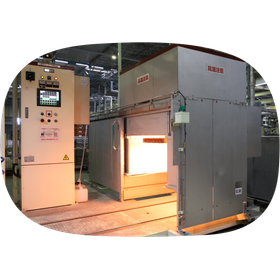
We would like to introduce a case where we provided Toyota Industries Corporation with a unique heating booth that functions as production equipment rather than just a standalone device. The company faced challenges due to increased energy consumption and workload associated with the multilayer coating process. In response, we proposed a heater that combines infrared heaters and hot air heaters, enabling high-output and high-efficiency heating while protecting the heaters. By designing the booth itself, including safety doors and furnace bodies, we were able to reflect the company's unique equipment standards in detail. This solution not only improved energy efficiency but also enhanced work efficiency and workplace environment. [Case Overview] - Increased energy consumption and workload due to multilayer coating became a bottleneck. - A challenging project that balances energy efficiency and work efficiency. - Practical application of research results from a hybrid heater using infrared and hot air. - In addition to the heater proposal, we also developed a heater booth compliant with customer equipment standards. - Trial and error within constraints of heating time and increased coating cycles. - Contributed to reducing energy consumption while ensuring labor savings and safety. *For more details, please download the PDF or feel free to contact us.*
Added to bookmarks
Bookmarks listBookmark has been removed
Bookmarks listYou can't add any more bookmarks
By registering as a member, you can increase the number of bookmarks you can save and organize them with labels.
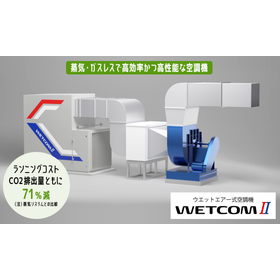
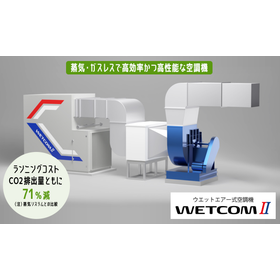
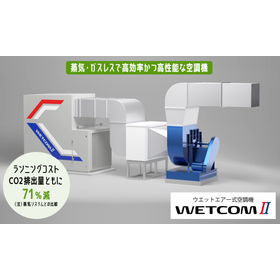
Free membership registrationIn the electronic components industry, measures against static electricity in the manufacturing process are essential for maintaining product quality. Static electricity can cause malfunctions or damage to fine components, requiring strict management. Particularly in the painting process, a clean environment and proper humidity control are crucial. Our 'WETCOMII' achieves high humidification performance without using steam or gas, providing a clean air conditioning environment that supports static electricity measures in electronic component manufacturing. 【Usage Scenarios】 - Painting booths for electronic components - Humidity and temperature management in clean rooms - Manufacturing lines where suppression of static electricity generation is desired 【Benefits of Implementation】 - Achieves high humidification performance without steam - Improved economic and environmental efficiency through heat pump systems - Air purification effect from contact with large amounts of water - Reduced maintenance burden on boilers and piping components
Added to bookmarks
Bookmarks listBookmark has been removed
Bookmarks listYou can't add any more bookmarks
By registering as a member, you can increase the number of bookmarks you can save and organize them with labels.
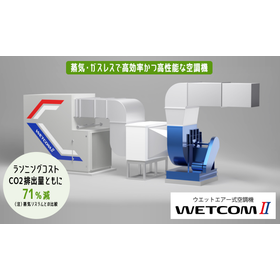
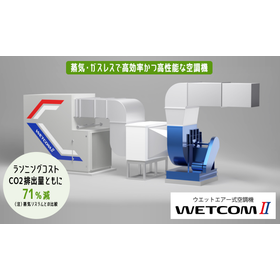
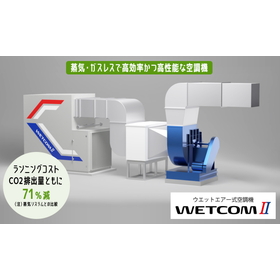
Free membership registrationIn the printing industry, uniform temperature and humidity control during the ink drying process significantly affects product quality. In particular, poor ink fixation and uneven drying not only compromise the finish of printed materials but also lead to increased costs due to rework. Additionally, traditional drying methods may involve the use of steam or gas, which can be cumbersome to manage and maintain. Our product, 'WETCOMII', addresses these challenges as a high-efficiency and high-performance air conditioning unit that operates without steam or gas. 【Usage Scenarios】 - Drying area of printing machines - Drying process of inkjet printers - Post-processing of various printed materials 【Benefits of Implementation】 - Achieves high humidification performance without steam, supporting ink drying - Improves economic and environmental efficiency through a heat pump system - Cleans the air by coming into contact with large amounts of water, providing a clean environment - Eliminates the need for extensive maintenance of boilers and piping components
Added to bookmarks
Bookmarks listBookmark has been removed
Bookmarks listYou can't add any more bookmarks
By registering as a member, you can increase the number of bookmarks you can save and organize them with labels.
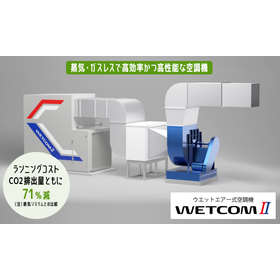
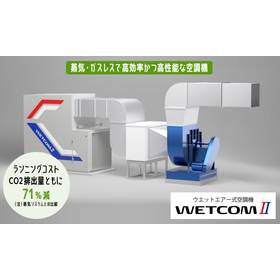
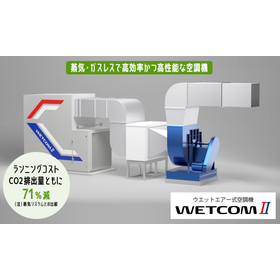
Free membership registrationIn the woodworking industry, proper temperature and humidity management is essential for maintaining wood quality and improving the finish in the painting process. In particular, stable air conditioning is crucial to prevent warping and cracking of wood and to ensure even drying of paint. Inadequate air conditioning can lead to wood deterioration and uneven paint application, resulting in a decline in product quality. Our 'WETCOMII' achieves high humidification performance without steam or gas, supporting wood protection and enhancing painting quality. 【Usage Scenarios】 - Wood painting booths - Wood drying processes - Wood storage areas 【Benefits of Implementation】 - Achieves high humidification performance without steam, reducing drying and cracking of wood - Improves economic and environmental efficiency through a heat pump system - Cleans the air and maintains a clean painting environment - Reduces maintenance burden for boilers and piping components
Added to bookmarks
Bookmarks listBookmark has been removed
Bookmarks listYou can't add any more bookmarks
By registering as a member, you can increase the number of bookmarks you can save and organize them with labels.
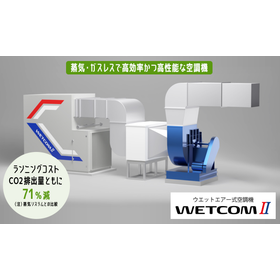
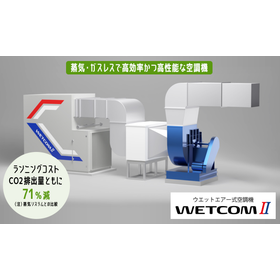
Free membership registrationIn the metal processing industry, especially in anti-corrosion painting, stabilizing paint quality and maintaining the working environment are emphasized. Uneven paint application and poor drying directly lead to a decline in product quality, while a deteriorating work environment can negatively impact employee health and productivity. In response to these challenges, our 'WETCOMII' provides stable temperature and humidity control and high humidification performance as a wet air conditioning unit that does not use steam or gas, optimally maintaining the environment within the painting booth. 【Usage Scenarios】 - Anti-corrosion painting booth for metal parts - Painting drying process - Humidity and temperature management of the working environment 【Benefits of Implementation】 - Achieves high humidification performance without steam - Improved economic and environmental efficiency through heat pump systems - Cleans dust from the air, enhancing paint quality - Reduces maintenance burden on boilers and piping systems
Added to bookmarks
Bookmarks listBookmark has been removed
Bookmarks listYou can't add any more bookmarks
By registering as a member, you can increase the number of bookmarks you can save and organize them with labels.
Free membership registrationIn the plastic molding industry, surface treatment requires the maintenance of uniform painting quality and improvement of the working environment. In particular, the management of temperature and humidity during painting significantly affects the finish and increases the risk of defective products. Additionally, conventional air conditioning systems may impose a burden due to the capital investment and maintenance required for equipment that uses steam or gas. Our 'WETCOMII' provides an optimal solution to these challenges as a high-efficiency and high-performance temperature and humidity control air conditioning unit that operates without steam or gas. 【Usage Scenarios】 - Painting booths for plastic products - Temperature and humidity management in surface treatment processes - Environmental maintenance in clean rooms 【Benefits of Implementation】 - Achieves high humidification performance without steam - Improves economic and environmental aspects through a heat pump system - Cleansing effect on air due to contact with large amounts of water - Reduces maintenance burden on boilers and piping components
Added to bookmarks
Bookmarks listBookmark has been removed
Bookmarks listYou can't add any more bookmarks
By registering as a member, you can increase the number of bookmarks you can save and organize them with labels.
Free membership registrationIn the medical device industry, strict hygiene management is required to ensure product quality and safety. In particular, the cleanliness of the air and the management of temperature and humidity in the manufacturing environment are extremely important, as they directly affect the performance and durability of the products. Inadequate air conditioning management can increase the risk of product contamination and deterioration. Our "WETCOMII," a wet air conditioning unit that does not use steam or gas, addresses these challenges and contributes to maintaining a stable and hygienic manufacturing environment. 【Usage Scenarios】 - Management of temperature, humidity, and air cleanliness in clean rooms - Maintenance of a hygienic environment on the production line - Manufacturing processes for delicate medical devices 【Benefits of Implementation】 - Achieves high humidification performance without steam, enabling stable humidity management - Balances economic efficiency and reduced environmental impact through a heat pump system - Cleans the air by coming into contact with large amounts of water, improving cleanliness - Eliminates the need for extensive maintenance of boilers and piping components
Added to bookmarks
Bookmarks listBookmark has been removed
Bookmarks listYou can't add any more bookmarks
By registering as a member, you can increase the number of bookmarks you can save and organize them with labels.
Free membership registrationIn the building materials industry, proper temperature and humidity management during the manufacturing process is essential for maintaining product quality and improving durability. Particularly in the painting process, uniform drying and curing of the paint film significantly affect the long-term performance of the product. Painting in inappropriate environmental conditions can lead to peeling and degradation of the paint film, potentially shortening the product's lifespan. Our 'WETCOMII' provides an optimal air conditioning environment that contributes to the durability of building materials, featuring high humidification performance and temperature and humidity control without steam or gas. 【Usage Scenarios】 - Temperature and humidity management in the painting process of building materials - Promotion of uniform drying and curing of the paint film - Maintenance of product quality and improvement of durability 【Benefits of Implementation】 - Achieves high humidification performance without steam, reducing issues like paint film cracking - Enhances economic and environmental efficiency through a heat pump system - Cleans the air by coming into contact with large amounts of water, providing a clean environment - Eliminates the need for extensive maintenance of boilers and piping components
Added to bookmarks
Bookmarks listBookmark has been removed
Bookmarks listYou can't add any more bookmarks
By registering as a member, you can increase the number of bookmarks you can save and organize them with labels.
Free membership registrationIn the manufacturing process of home appliances, maintaining the quality of appearance is a crucial factor that directly impacts product reliability and brand image. Particularly in the painting process, stable management of temperature and humidity is required to ensure uniform painting quality. Inadequate air conditioning management can lead to uneven paint application and poor drying, resulting in defects in the product's appearance. Our 'WETCOMII' addresses these challenges by providing a stable air conditioning environment. 【Usage Scenarios】 - Temperature and humidity management in the painting booth - Standardization of product appearance quality - Stable operation of the manufacturing line 【Benefits of Implementation】 - Achieves high humidification performance without steam - Improves economic and environmental efficiency with a heat pump system - Cleans the air by coming into contact with large amounts of water - Eliminates the need for extensive maintenance of boilers and piping components
Added to bookmarks
Bookmarks listBookmark has been removed
Bookmarks listYou can't add any more bookmarks
By registering as a member, you can increase the number of bookmarks you can save and organize them with labels.
Free membership registrationIn the furniture manufacturing industry, managing the air environment during the painting process is crucial for maintaining the aesthetic quality of products. In particular, controlling the drying of paint, suppressing the emission of volatile organic compounds (VOCs), and ensuring a comfortable working environment are essential for creating high-quality furniture. Inadequate air conditioning management can lead to issues such as uneven paint application, poor drying, impacts on worker health, and challenges in complying with environmental regulations. Our 'WETCOMII' provides high-efficiency and high-performance air conditioning without steam or gas, optimizing the environment of the painting booth. 【Usage Scenarios】 - Temperature and humidity management within the painting booth - Promotion of uniform paint drying - Reduction of environmental impact through VOC emission suppression - Improvement of working environment comfort 【Benefits of Implementation】 - Achieves high humidification performance without steam, stabilizing the drying condition of the paint. - Balances economic and environmental considerations through a heat pump system. - Cleans the air by coming into contact with large amounts of water, maintaining a clean environment. - Eliminates the need for extensive maintenance of boilers and piping components, reducing management burdens.
Added to bookmarks
Bookmarks listBookmark has been removed
Bookmarks listYou can't add any more bookmarks
By registering as a member, you can increase the number of bookmarks you can save and organize them with labels.
Free membership registrationIn the field of aerospace precision painting, maintaining uniform painting quality and a stable working environment is essential. In particular, precise control of temperature and humidity is indispensable for the formation of fine paint films and the use of special coatings. If these factors are not met, it can lead to quality issues such as paint unevenness and poor adhesion. Our 'WETCOMII' is a temperature and humidity control air conditioning unit that meets the needs of such precision painting. 【Usage Scenarios】 - Precision painting booths for aircraft parts - Painting lines for space equipment - Painting of precision instruments requiring high-quality paint films 【Benefits of Implementation】 - Achieves a stable humidity environment with high humidification performance without using steam - Contributes to economic efficiency and reduced environmental impact through a heat pump system - Air purification effect from contact with large amounts of water - Reduces maintenance burden on boilers and piping systems
Added to bookmarks
Bookmarks listBookmark has been removed
Bookmarks listYou can't add any more bookmarks
By registering as a member, you can increase the number of bookmarks you can save and organize them with labels.
Free membership registrationIn the automotive manufacturing industry, uniform coating formation during the painting process and maintaining the quality of the finish are extremely important. In particular, fluctuations in temperature and humidity can affect the drying state and adhesion of the coating, potentially leading to a decline in quality. Additionally, the maintenance and management of boiler equipment and steam piping can pose challenges in terms of cost and safety. Our "WETCOMII" addresses these challenges by providing a high-efficiency and high-performance temperature and humidity control function as a wet air conditioning system that does not use steam or gas, contributing to the improvement of painting quality. 【Usage Scenarios】 - Temperature and humidity management in the painting booth - Temperature and humidity adjustment during outside air intake - Stabilization of painting quality 【Benefits of Implementation】 - Achieves high humidification performance without steam - Improved economic and environmental aspects through heat pump systems - Air cleaning effect due to contact with large amounts of water - Reduced maintenance burden on boilers and piping components
Added to bookmarks
Bookmarks listBookmark has been removed
Bookmarks listYou can't add any more bookmarks
By registering as a member, you can increase the number of bookmarks you can save and organize them with labels.
Free membership registration
In the cosmetics industry, the separation and recovery of emulsions contained in oily wastewater generated during the manufacturing process is considered important from the perspective of reducing raw material loss and minimizing environmental impact. In particular, efficiently recovering emulsions that contain expensive raw materials or active ingredients directly contributes to cost reduction. However, conventional treatment methods have faced challenges such as difficulty in separating emulsions, leading to increased waste volume and higher treatment costs. Our "EBS (Emulsion Break System)" utilizes a swirling shear technology to efficiently separate emulsions dispersed in wastewater, enabling the recovery of oil and emulsions. This is expected to reduce waste volume and the associated treatment energy. [Application Scenarios] - Treatment of oily wastewater in cosmetics manufacturing plants - Recovery of emulsions containing expensive raw materials or active ingredients - Reduction of maintenance burden on wastewater treatment facilities [Effects of Implementation] - Reduction of waste derived from emulsions - Cost reduction due to increased recoverable raw materials - Decreased burden on wastewater facilities due to improved wastewater quality
Added to bookmarks
Bookmarks listBookmark has been removed
Bookmarks listYou can't add any more bookmarks
By registering as a member, you can increase the number of bookmarks you can save and organize them with labels.
Free membership registration
In the paint and ink industry, there is a demand to efficiently recover pigments from oily wastewater generated during the manufacturing process and to reduce waste. In particular, the separation of pigments dispersed in emulsion form is a significant challenge in wastewater treatment. Insufficient separation can lead to pigment loss and increased treatment costs. Our "EBS (Emulsion Break System)" efficiently separates emulsions dispersed in wastewater through a swirling shear technology, achieving pigment recovery and waste reduction. 【Application Scenarios】 - Paint and ink manufacturing plants - Wastewater treatment aimed at pigment recovery - Sites aiming for waste reduction and cost reduction 【Benefits of Implementation】 - Reduction of pigment loss from emulsions - Alleviation of wastewater treatment burden - Reduction of waste treatment costs
Added to bookmarks
Bookmarks listBookmark has been removed
Bookmarks listYou can't add any more bookmarks
By registering as a member, you can increase the number of bookmarks you can save and organize them with labels.
Free membership registration
In the automotive industry, the treatment of cleaning wastewater requires the separation of oils and emulsions. In particular, the wastewater generated during the cleaning process contains a mixture of oils and solids, making proper treatment essential. If these substances cannot be efficiently separated, it may lead to increased load on wastewater treatment facilities and higher waste disposal costs. Our emulsion-breaking separation device, 'EBS', addresses these challenges through its swirling shear technology. 【Application Scenarios】 - Treatment of wastewater from parts cleaning in automotive factories - Treatment of wastewater from floor cleaning in vehicle maintenance shops - Treatment of wastewater from automotive parts manufacturing lines 【Benefits of Implementation】 - Reduction of waste derived from emulsions - Decrease in the load on wastewater treatment facilities - Reduction in maintenance costs
Added to bookmarks
Bookmarks listBookmark has been removed
Bookmarks listYou can't add any more bookmarks
By registering as a member, you can increase the number of bookmarks you can save and organize them with labels.
Free membership registration
In the pulp and paper industry, the treatment of pulp wastewater requires the separation of emulsions in the effluent and the associated reduction of waste, in response to environmental regulations and cost reduction. In particular, the efficient separation of emulsions contained in pulp wastewater is crucial for reducing the burden on subsequent treatment processes and for maintaining equipment. Our emulsion destruction and separation device, 'EBS', efficiently separates emulsions in the wastewater through a swirling shear technology, contributing to waste reduction. 【Usage Scenarios】 - Wastewater treatment from the pulp manufacturing process - Treatment of oil-containing wastewater in paper mills 【Benefits of Implementation】 - Reduction of waste derived from emulsions - Decreased burden on wastewater treatment equipment - Lower maintenance costs
Added to bookmarks
Bookmarks listBookmark has been removed
Bookmarks listYou can't add any more bookmarks
By registering as a member, you can increase the number of bookmarks you can save and organize them with labels.
Free membership registration
In the dyeing process of the textile industry, the treatment of oils and emulsions contained in wastewater poses a challenge. These substances can increase the load on wastewater treatment facilities and potentially lead to an increase in waste volume. If not properly treated, there are also concerns about the impact on the environment. Our developed 'EBS (Emulsion Break System)' efficiently separates emulsions in wastewater using a swirling shear technology, allowing for the recovery of oils and emulsions. This is expected to reduce waste volume and decrease the energy required for wastewater treatment. 【Application Scenarios】 - Wastewater treatment in dyeing factories - Treatment of industrial wastewater containing high levels of oils and emulsions - Aiming to reduce the load on wastewater treatment facilities 【Benefits of Implementation】 - Reduction of waste derived from emulsions - Decreased load on wastewater facilities due to improved wastewater quality - Improved working environment through equipment cleanliness
Added to bookmarks
Bookmarks listBookmark has been removed
Bookmarks listYou can't add any more bookmarks
By registering as a member, you can increase the number of bookmarks you can save and organize them with labels.
Free membership registration
In the metal processing industry, the separation and removal of oil and emulsions in factory wastewater treatment, such as cutting oils, is an important challenge. If these substances are not properly treated, it can lead to increased load on wastewater facilities and a rise in waste volume. Our developed 'EBS (Emulsion Break System)' efficiently separates emulsions dispersed in wastewater using a swirling shear technology, allowing for the recovery of oil and emulsions. This is expected to reduce waste and lower wastewater treatment costs. 【Usage Scenarios】 - Regeneration and reuse of cutting oils - Treatment of oily wastewater from metal processing factories - Reduction of load on wastewater facilities 【Benefits of Implementation】 - Reduction of waste derived from emulsions - Improvement of work environment through equipment cleanliness - Reduction of load on wastewater facilities due to improved wastewater quality
Added to bookmarks
Bookmarks listBookmark has been removed
Bookmarks listYou can't add any more bookmarks
By registering as a member, you can increase the number of bookmarks you can save and organize them with labels.
Free membership registration
In the pharmaceutical industry, efficient separation of emulsions contained in wastewater and the reduction of associated waste are important challenges in the treatment of culture media. Additionally, there is a demand for reducing the load on wastewater treatment facilities and controlling maintenance costs. Our developed "EBS (Emulsion Break System)" is a device that uses rotational shear technology to separate emulsions dispersed in wastewater, efficiently removing oil and emulsions. This can lead to secondary benefits such as waste reduction, decreased energy concentration, and lower maintenance costs for wastewater treatment facilities. 【Usage Scenarios】 - Separation of oil and emulsions from culture media treatment wastewater in pharmaceutical factories - Reduction of load on wastewater treatment facilities - Reduction of waste treatment costs 【Effects of Implementation】 - Reduction of waste derived from emulsions - Improvement of the working environment through equipment cleaning - Reduction of load on wastewater facilities due to improved wastewater quality
Added to bookmarks
Bookmarks listBookmark has been removed
Bookmarks listYou can't add any more bookmarks
By registering as a member, you can increase the number of bookmarks you can save and organize them with labels.
Free membership registration
In the food processing industry, proper treatment of oily wastewater generated during the manufacturing process is required. In particular, the separation of emulsions contained in the wastewater is a significant challenge for reducing environmental impact and lowering treatment costs. Inadequate separation can lead to increased burden on subsequent wastewater treatment facilities and an increase in waste volume. Our emulsion destruction and separation device, 'EBS', efficiently separates emulsions in wastewater through a swirling shear technology, contributing to solving these challenges. 【Usage Scenarios】 - Treatment of oily wastewater from production lines - Pretreatment for oil recovery and reuse - Reducing the burden on wastewater treatment facilities 【Benefits of Implementation】 - Reduction of waste derived from emulsions - Decreased burden on wastewater facilities due to improved wastewater quality - Improved working environment through equipment cleanliness
Added to bookmarks
Bookmarks listBookmark has been removed
Bookmarks listYou can't add any more bookmarks
By registering as a member, you can increase the number of bookmarks you can save and organize them with labels.
Free membership registration
To all in the chemical industry: In the solvent recovery process, the efficient separation of emulsions contained in wastewater is key to waste reduction and cost efficiency. Improper separation can lead to decreased recovery rates and increased treatment burdens. Our emulsion destruction separation device, 'EBS', effectively separates emulsions in wastewater using rotational shear technology, supporting the recovery of oils and emulsions. 【Usage Scenarios】 - Treatment of oil-containing wastewater in the solvent recovery process - Oil separation from wastewater containing emulsions - Reduction of wastewater treatment burden 【Benefits of Implementation】 - Reduction of waste derived from emulsions - Improvement in solvent recovery rates - Reduction in wastewater treatment costs
Added to bookmarks
Bookmarks listBookmark has been removed
Bookmarks listYou can't add any more bookmarks
By registering as a member, you can increase the number of bookmarks you can save and organize them with labels.
Free membership registration
In the oil and gas industry, proper treatment of oil and emulsions contained in factory wastewater is required. In particular, reducing the burden of wastewater treatment and minimizing waste are important from both environmental impact reduction and cost management perspectives. Insufficient oil-water separation can lead to increased strain on wastewater treatment facilities and higher treatment costs. Our "EBS (Emulsion Break System)" efficiently separates emulsions in wastewater using a swirling shear technology, contributing to solving these challenges. 【Usage Scenarios】 - Treatment of oil-containing factory wastewater - Streamlining the oil-water separation process - Achieving waste reduction targets 【Benefits of Implementation】 - Reduction of waste derived from emulsions - Decreased burden on wastewater treatment facilities due to improved wastewater quality - Reduction of concentrated energy usage
Added to bookmarks
Bookmarks listBookmark has been removed
Bookmarks listYou can't add any more bookmarks
By registering as a member, you can increase the number of bookmarks you can save and organize them with labels.
Free membership registration
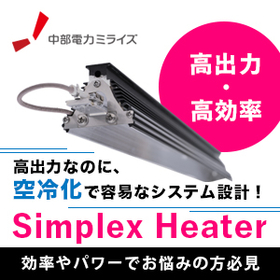
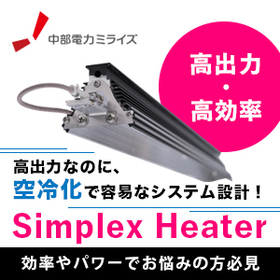
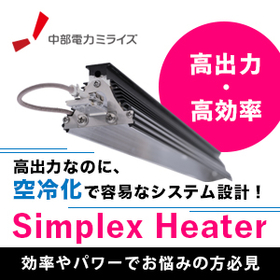
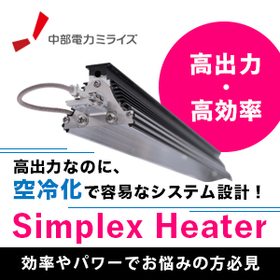
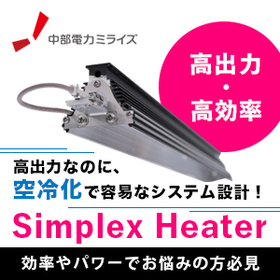
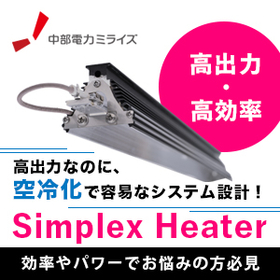
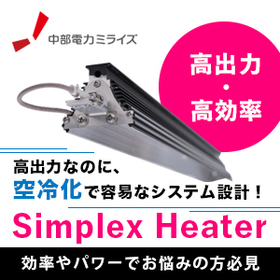
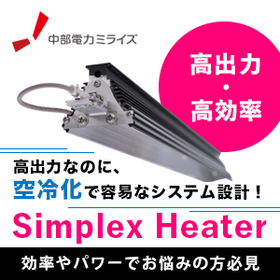
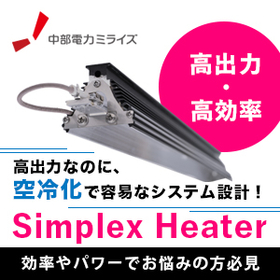
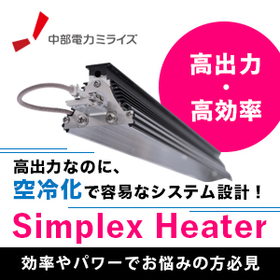
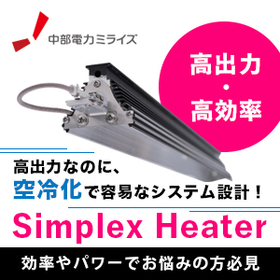
In the warehouse and logistics industry, temperature control in cargo storage can impact quality maintenance and storage efficiency. Particularly when dealing with delicate items or those requiring storage within a specific temperature range, ensuring a stable temperature environment becomes crucial. Traditional heating methods may lead to temperature inconsistencies and energy efficiency issues. In response to these challenges, our electric infrared heater, the 'Simplex Heater,' achieves high efficiency and high output through an optical design that maximizes the amount of radiant heat directed at the items being heated and a structure that enhances the heat dissipation performance of the housing, thereby supporting stable temperature management. 【Usage Scenarios】 - Maintaining the temperature of stored items - Heating temporary storage spaces - Preventing condensation 【Benefits of Implementation】 - Maintaining the quality of stored items - Reducing energy costs - Stabilizing the storage environment
Added to bookmarks
Bookmarks listBookmark has been removed
Bookmarks listYou can't add any more bookmarks
By registering as a member, you can increase the number of bookmarks you can save and organize them with labels.
Free membership registration
In the ceramics manufacturing industry, achieving a uniform and stable firing and drying process is essential for improving product quality. In particular, temperature control during the firing process, which is difficult to manage, and efficient drying significantly impact product yield and performance. Conventional heating methods may face challenges such as uneven heating and prolonged heating times. Our electric infrared heater, the 'Simplex Heater,' provides a high-efficiency and high-output heating solution to address these issues. 【Usage Scenarios】 ■ Firing of ceramic products ■ Drying of various ceramic materials 【Benefits of Implementation】 ■ Improved quality through uniform heating ■ Increased productivity through reduced heating time ■ Enhanced energy efficiency
Added to bookmarks
Bookmarks listBookmark has been removed
Bookmarks listYou can't add any more bookmarks
By registering as a member, you can increase the number of bookmarks you can save and organize them with labels.
Free membership registration
In the metal processing industry, particularly in surface treatment, uniform and efficient heating significantly affects product quality. In the surface treatment process, precision in temperature management and heating speed is required for substrate preparation and the drying and curing of coatings. Insufficient heating can lead to issues such as peeling of the coating, poor adhesion, and uneven finishes. Our electric infrared heater, the 'Simplex Heater,' addresses these challenges with high efficiency and high output heating capabilities. 【Application Scenarios】 ■ Preheating before work processing ■ Thermal processing ■ Paint drying 【Benefits of Implementation】 ■ Heating without thermal unevenness ■ Maximizing the amount of light radiation to the heated object for high efficiency ■ Consideration for conversion from gas heating is also possible
Added to bookmarks
Bookmarks listBookmark has been removed
Bookmarks listYou can't add any more bookmarks
By registering as a member, you can increase the number of bookmarks you can save and organize them with labels.
Free membership registration
In the plastic molding industry, uniform pre-drying of materials is required to stabilize product quality and enhance processing efficiency. Particularly when using highly hygroscopic resins, insufficient drying can lead to molding defects and a decrease in the physical properties of the products. Some may feel that traditional drying methods have challenges in terms of time and energy efficiency. Our electric infrared heater, the 'Simplex Heater,' provides a high-efficiency and high-output heating solution to address these issues. 【Usage Scenarios】 ■ Pre-drying of plastic raw materials ■ Drying process of molded products 【Benefits of Implementation】 ■ Improved heating efficiency ■ Reduced drying time ■ Stabilization of molding quality
Added to bookmarks
Bookmarks listBookmark has been removed
Bookmarks listYou can't add any more bookmarks
By registering as a member, you can increase the number of bookmarks you can save and organize them with labels.
Free membership registration
In the semiconductor manufacturing industry, uniform and efficient heating is required during the wafer drying process. In particular, maintaining the quality of wafers with fine circuits necessitates precise temperature control and even heating. Conventional heating methods may face challenges such as low heating efficiency and temperature variations. Our electric infrared heater, the 'Simplex Heater,' addresses these issues and contributes to the efficiency and quality improvement of the wafer drying process. 【Usage Scenarios】 ■ Wafer drying process ■ Heating processes that require precise temperature control 【Benefits of Implementation】 ■ Improved heating efficiency ■ Stabilization of quality through reduced temperature variations ■ Increased productivity
Added to bookmarks
Bookmarks listBookmark has been removed
Bookmarks listYou can't add any more bookmarks
By registering as a member, you can increase the number of bookmarks you can save and organize them with labels.
Free membership registration
In the printing and binding industry, the rapid and uniform drying of ink is a crucial process that affects product quality and productivity. Particularly, insufficient ink drying can lead to issues such as smudging, color bleeding, and delays in the production line. Additionally, traditional heating methods often have poor energy efficiency, which can lead to increased running costs. Our electric infrared heater, the 'Simplex Heater,' provides a high-efficiency and high-output heating solution to address these challenges. With an optical design that maximizes the amount of light radiation to the heated object and a structure that maximizes the heat dissipation performance of the casing, it shortens ink drying times and contributes to improved productivity. 【Usage Scenarios】 ■ Ink drying process in printing machines ■ Pre-drying before lamination on binding lines ■ Drying of special inks 【Benefits of Implementation】 ■ Increased productivity due to reduced ink drying times ■ Cost savings through improved energy efficiency ■ Maintenance and enhancement of print quality through uniform heating
Added to bookmarks
Bookmarks listBookmark has been removed
Bookmarks listYou can't add any more bookmarks
By registering as a member, you can increase the number of bookmarks you can save and organize them with labels.
Free membership registration
In the wood processing industry, a uniform and efficient drying and bonding process is required to maintain product quality and improve productivity. In particular, proper temperature management and uniform heat supply are essential for managing the moisture content of wood and curing adhesives. Inadequate drying or bonding can lead to issues such as warping, peeling, and insufficient strength in the products. Our "Simplex Heater" effectively supports the drying and bonding of wood through high-efficiency, high-output infrared heating to address these challenges. 【Usage Scenarios】 ■ Wood drying process ■ Accelerating adhesive curing ■ Manufacturing of laminated wood 【Benefits of Implementation】 ■ Reduced drying time ■ Improved adhesive quality ■ Increased productivity
Added to bookmarks
Bookmarks listBookmark has been removed
Bookmarks listYou can't add any more bookmarks
By registering as a member, you can increase the number of bookmarks you can save and organize them with labels.
Free membership registration
In the dyeing and drying process of the textile industry, uniform and efficient heating significantly impacts product quality. In particular, uneven drying can lead to variations in product finishing and may result in decreased production efficiency. Additionally, traditional heating methods often face challenges related to energy consumption and costs. In response to these issues, our electric infrared heater, the 'Simplex Heater,' combines an optical design that maximizes the amount of light radiation to the heated object with a structure that maximizes the heat dissipation performance of the housing, achieving high efficiency and high output. This contributes to improved heating efficiency in the dyeing and drying process and reduces energy costs. 【Usage Scenarios】 ■ Drying after dyeing textile products ■ Heat treatment in various fiber processing ■ As a heat source for drying ovens 【Effects of Implementation】 ■ Reduction in drying time due to improved heating efficiency ■ Decrease in energy consumption ■ Maintenance of uniform product quality
Added to bookmarks
Bookmarks listBookmark has been removed
Bookmarks listYou can't add any more bookmarks
By registering as a member, you can increase the number of bookmarks you can save and organize them with labels.
Free membership registration
In the sterilization and drying processes of the pharmaceutical industry, uniform and precise temperature control is required to maintain product quality and ensure safety. In particular, stable heating capacity and high efficiency are essential for the inactivation of microorganisms and the removal of moisture. Conventional heating methods may face challenges such as temperature unevenness and variations in heating time. Our electric infrared heater, the 'Simplex Heater,' addresses these issues by combining an optical design that maximizes the amount of light radiation to the heated object with a structure that maximizes the heat dissipation performance of the casing, achieving high efficiency and high output. 【Usage Scenarios】 ■ Uniform heating in sterilization processes ■ Moisture removal in drying processes ■ Thermal processing in pharmaceutical manufacturing lines 【Benefits of Implementation】 ■ Improved quality through stable temperature management ■ Energy savings through enhanced heating efficiency ■ Compatibility with equipment through customization
Added to bookmarks
Bookmarks listBookmark has been removed
Bookmarks listYou can't add any more bookmarks
By registering as a member, you can increase the number of bookmarks you can save and organize them with labels.
Free membership registration
In the food processing industry, a uniform and efficient drying and sterilization process is required to maintain product quality and ensure safety. In particular, effectively suppressing microorganisms without compromising the flavor and nutritional value of food is essential for improving product reliability. Conventional heating methods can face challenges such as temperature unevenness and variations in heating time. The Simplex Heater is an electric heater that achieves high efficiency and high output through an optical design that maximizes the amount of light radiation to the heated object and a structure that maximizes the heat dissipation performance of the housing. This enables efficient drying and sterilization processes for food. 【Usage Scenarios】 ■ Food drying processes ■ Sterilization treatment ■ Heat source for drying ovens 【Benefits of Implementation】 ■ Quality improvement through uniform heating ■ Increased productivity through efficient drying and sterilization ■ Potential for energy savings by switching from gas heating
Added to bookmarks
Bookmarks listBookmark has been removed
Bookmarks listYou can't add any more bookmarks
By registering as a member, you can increase the number of bookmarks you can save and organize them with labels.
Free membership registration
In the automotive manufacturing industry's painting and drying process, uniform and efficient drying directly impacts product quality. Particularly, appropriate temperature management and even heating are essential to maintain the adhesion and aesthetic appeal of the paint film. Traditional heating methods often face challenges such as long drying times, energy efficiency issues, and constraints on equipment space, making optimal drying difficult in some cases. In response to these challenges, our electric infrared heater, the 'Simplex Heater,' meets the needs of paint drying with high efficiency and high output. 【Application Scenarios】 ■ Drying of painted automotive parts ■ Drying of paint on body assembly lines 【Benefits of Implementation】 ■ Improved quality through uniform drying of the paint film ■ Potential reduction in drying time due to improved heating efficiency ■ Operational advantages from switching from gas heating
Added to bookmarks
Bookmarks listBookmark has been removed
Bookmarks listYou can't add any more bookmarks
By registering as a member, you can increase the number of bookmarks you can save and organize them with labels.
Free membership registration
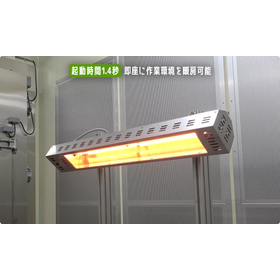
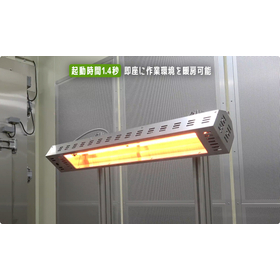
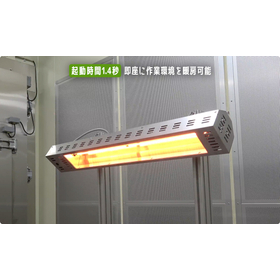
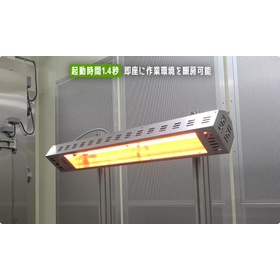
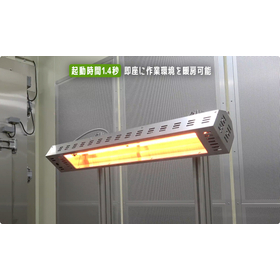
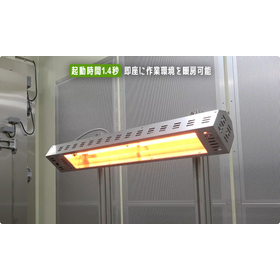
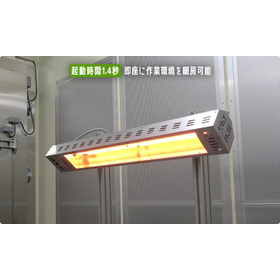
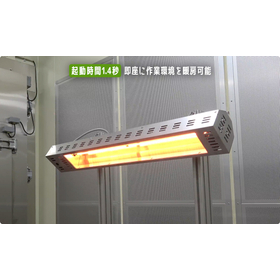
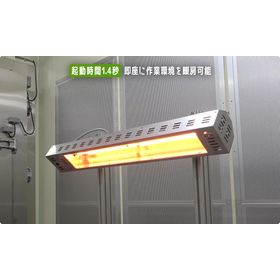
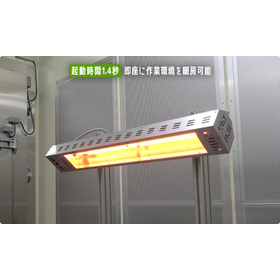
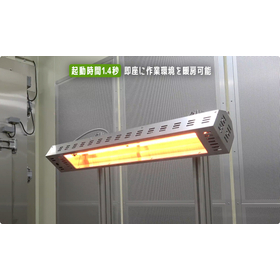
In a painting booth, it is essential to shorten the drying time of the paint and enhance work efficiency. In particular, uniform drying is crucial for maintaining product quality. Inadequate drying can lead to rework or a decline in quality. Our rapid heating factory heater starts heating instantly in 1.4 seconds, contributing to the drying process within the painting booth. Since it uses electricity, it operates in an energy-efficient manner by directly heating the workers instead of warming the entire factory, without using fossil fuels or steam. With a built-in human sensor, it automatically turns off when no one is present, reducing unnecessary power consumption. 【Usage Scenarios】 - Promoting drying in the painting booth - Improving worker comfort - Reducing energy costs 【Benefits of Implementation】 - Reduction in steam and gas usage by eliminating air curtains - Up to 94% cut in energy costs (depending on the implementation case) - Further energy savings with the human sensor - Immediate heating capability with a startup time of 1.4 seconds - Compact yet powerful, high-density heat source
Added to bookmarks
Bookmarks listBookmark has been removed
Bookmarks listYou can't add any more bookmarks
By registering as a member, you can increase the number of bookmarks you can save and organize them with labels.
Free membership registration
In the wood processing industry, temperature management of the work environment is crucial for drying and storage. Especially in areas where workers perform tasks for extended periods, inadequate temperature control can lead to decreased work efficiency and negatively impact the quality of the wood. Instead of heating the entire factory, it is essential to provide direct heating for workers to achieve efficient heating and create a comfortable working environment. Our rapid heating factory heater has a short startup time of 1.4 seconds, allowing for immediate heating of the work environment. [Usage Scenarios] - Work in the wood drying area - Work in the wood storage area - Waiting space for workers [Benefits of Implementation] - Maintaining work efficiency through improved comfort for workers - Reducing energy costs - Decreasing CO2 emissions
Added to bookmarks
Bookmarks listBookmark has been removed
Bookmarks listYou can't add any more bookmarks
By registering as a member, you can increase the number of bookmarks you can save and organize them with labels.
Free membership registration
In electronic component factories, it is essential to suppress the generation of static electricity and maintain product quality. Particularly in environments handling delicate electronic components, temperature management and static electricity countermeasures are crucial. Inadequate temperature management or the occurrence of static electricity can lead to component failure or performance degradation. Our "Energy-Saving Heater with Human Sensor" warms the workers directly, eliminating the need to heat the entire factory and allowing operation only when necessary, thus achieving efficient heating. This not only aids in static electricity countermeasures but also enables energy-efficient operations. 【Usage Scenarios】 - Electronic component manufacturing lines - Inspection and assembly areas - Workspaces requiring static electricity countermeasures 【Benefits of Implementation】 - Contribution to work efficiency through improved comfort for workers - Energy savings by operating only when needed - Reduction of CO2 emissions
Added to bookmarks
Bookmarks listBookmark has been removed
Bookmarks listYou can't add any more bookmarks
By registering as a member, you can increase the number of bookmarks you can save and organize them with labels.
Free membership registration
In a pharmaceutical factory, temperature management of the work environment is crucial to maintain consistent product quality. This is especially important when handling delicate pharmaceuticals or in manufacturing processes that require specific temperatures, where maintaining a stable thermal environment is essential. Inadequate temperature management can lead to product degradation and a decline in quality. Our "Energy-Saving Heater with Human Sensor" heats the work environment instantly in 1.4 seconds and automatically turns off when no one is present, achieving an energy-efficient operation without waste. This contributes to both CO2 reduction and improvement of the work environment, supporting the maintenance of quality in pharmaceutical factories. 【Usage Scenarios】 - Direct heating for workers on the production line - Temperature maintenance in quality control areas - Temperature management in pharmaceutical storage areas 【Benefits of Implementation】 - Quality maintenance through stabilization of the work environment - Reduction in energy costs - Decrease in CO2 emissions
Added to bookmarks
Bookmarks listBookmark has been removed
Bookmarks listYou can't add any more bookmarks
By registering as a member, you can increase the number of bookmarks you can save and organize them with labels.
Free membership registration
In printing factories, there is a demand to shorten ink drying times and increase productivity. Particularly, delays in ink drying can lead to impacts on subsequent processes and a decline in product quality. Additionally, the waste of energy due to heating large areas is also a challenge. Our "Energy-saving heater with human sensor" starts heating immediately with a startup time of 1.4 seconds, promoting ink drying. Since it uses electricity instead of fossil fuels or steam, and heats workers directly rather than the entire factory, it enables energy-efficient operation. Furthermore, the human sensor automatically turns off when no one is present, reducing unnecessary power consumption and balancing ink drying promotion with energy savings. 【Usage Scenarios】 - Promoting ink drying around the printing line - Local heating of workers' work areas - Processes where a reduction in ink drying time is necessary 【Benefits of Implementation】 - Increased productivity due to shortened ink drying times - Reduction in energy costs - Decrease in CO2 emissions and improvement of the workplace environment
Added to bookmarks
Bookmarks listBookmark has been removed
Bookmarks listYou can't add any more bookmarks
By registering as a member, you can increase the number of bookmarks you can save and organize them with labels.
Free membership registration
In chemical plants, temperature management in safe areas can affect the comfort and productivity of workers. In particular, there is a need to efficiently heat only specific areas while minimizing unnecessary energy consumption. Our "Energy-Saving Heater with Motion Sensor" has a fast startup time of 1.4 seconds and warms only the necessary places when needed, achieving both improved working conditions and energy savings. Since it uses electricity, it does not rely on fossil fuels or steam, contributing to CO2 reduction. 【Usage Scenarios】 - Safe areas within chemical plants - Waiting spaces for workers - Areas requiring localized heating 【Benefits of Implementation】 - Directly warms workers, operating only when necessary to reduce waste - Equipped with a motion sensor for automatic shut-off when unoccupied, further enhancing energy savings - With a startup time of 1.4 seconds, it can quickly heat the working environment - Achieves both CO2 emission reduction and workplace environment improvement simultaneously
Added to bookmarks
Bookmarks listBookmark has been removed
Bookmarks listYou can't add any more bookmarks
By registering as a member, you can increase the number of bookmarks you can save and organize them with labels.
Free membership registration
In the precision work environment of the metal processing industry, temperature management can affect product quality. Particularly during fine machining or assembly, the perceived temperature for workers can impact their concentration and work accuracy. If the temperature in the work environment is unstable, there is a risk of reduced machining precision and the occurrence of defective products. Our "Energy-Saving Heater with Human Sensor" has a quick startup time of 1.4 seconds and efficiently heats only the necessary areas at the necessary times by directly warming the workers, providing an environment suitable for precision work. Since it uses electricity, it does not rely on fossil fuels or steam, contributing to CO2 reduction. With the human sensor, it automatically turns off when no one is present, minimizing unnecessary power consumption and achieving energy-saving operations. 【Usage Scenarios】 - Assembly lines for precision parts - Inspection areas for metal components - Cutting and polishing workspaces - Welding and assembly work areas 【Benefits of Implementation】 - Maintaining work efficiency and accuracy through improved worker comfort - Reduction in energy costs (up to 94% cut depending on the implementation case) - Reduction in CO2 emissions - Maintaining a clean work environment by minimizing dust dispersion
Added to bookmarks
Bookmarks listBookmark has been removed
Bookmarks listYou can't add any more bookmarks
By registering as a member, you can increase the number of bookmarks you can save and organize them with labels.
Free membership registration
In food factories, maintaining product quality and ensuring worker comfort require a hygienic environment and appropriate temperature management. In particular, temperature and humidity control is crucial in hygiene management, as improper temperatures can increase the risk of bacterial growth. Additionally, managing workers' health also impacts productivity. Our "Energy-Saving Heater with Human Sensor" has a quick startup time of 1.4 seconds and provides targeted heating in the areas where workers need it, allowing for heating only when necessary without warming the entire factory. This enables the improvement of the working environment and the maintenance of hygiene management while reducing energy consumption. 【Usage Scenarios】 - Local heating in work areas - Surroundings of manufacturing lines where temperature control is needed - Break areas for workers - Areas requiring hygiene management 【Benefits of Implementation】 - Provides a comfortable working environment by directly warming workers - Reduces unnecessary power consumption during absence with the human sensor - Decreases steam and gas usage by eliminating air curtains (depending on implementation cases) - Reduces energy costs (depending on implementation cases) - Suitable for spaces where dust avoidance is desired due to minimal air flow generation
Added to bookmarks
Bookmarks listBookmark has been removed
Bookmarks listYou can't add any more bookmarks
By registering as a member, you can increase the number of bookmarks you can save and organize them with labels.
Free membership registration
In automobile factories, especially on assembly lines, maintaining the comfort and productivity of workers is crucial. In cold winter environments, there is a risk of decreased work efficiency and loss of concentration. Instead of heating the entire factory, there is a demand for creating an efficient thermal environment by delivering heat directly to the workers. Our "Energy-saving Heater with Human Sensor" starts heating instantly in 1.4 seconds and addresses these challenges by warming the workers directly. 【Usage Scenarios】 - Work areas on automobile assembly lines - Parts supply areas - Inspection and testing areas 【Benefits of Implementation】 - Maintaining productivity through improved worker comfort - Energy-saving operation that runs only when needed - Achieving both CO2 emission reduction and workplace environment improvement
Added to bookmarks
Bookmarks listBookmark has been removed
Bookmarks listYou can't add any more bookmarks
By registering as a member, you can increase the number of bookmarks you can save and organize them with labels.
Free membership registration
In the warehouse and logistics industry, maintaining a comfortable working environment during loading and unloading operations is essential. Particularly in large spaces or areas with frequent temperature changes due to opening and closing, proper temperature management is crucial for maintaining workers' concentration and ensuring efficient work performance. However, heating the entire factory tends to lead to high energy consumption. Our product efficiently heats only the necessary areas at the necessary times by directly warming the workers, achieving energy-saving operations without waste. 【Usage Scenarios】 - Loading and unloading areas - Workspaces within the warehouse - Areas for loading and unloading trucks 【Benefits of Implementation】 - Maintaining and improving work efficiency through enhanced worker comfort - Reducing energy costs - Decreasing CO2 emissions
Added to bookmarks
Bookmarks listBookmark has been removed
Bookmarks listYou can't add any more bookmarks
By registering as a member, you can increase the number of bookmarks you can save and organize them with labels.
Free membership registration
In the manufacturing industry, maintaining a comfortable working environment for workers leads to increased productivity. Particularly in vast factory spaces or areas where workers temporarily stay, issues such as energy waste from heating the entire factory and decreased work efficiency in areas where heating is difficult to reach can arise. Our "Energy-Saving Heater with Human Sensor" addresses these challenges by directly warming the workers, efficiently heating only the necessary places at the necessary times, thus achieving waste-free operation. 【Usage Scenarios】 - Work areas within factories - Warehouses - Break spaces for workers - Areas with many openings 【Benefits of Implementation】 - Startup time of 1.4 seconds, allowing for immediate heating of the work environment - Equipped with a human sensor that automatically turns off when no one is present, further enhancing energy savings - Reduction in steam and gas usage by eliminating air curtains (varies by implementation case) - Up to 94% reduction in energy costs (varies by implementation case) - Simultaneous reduction of CO2 emissions and improvement of workplace environment
Added to bookmarks
Bookmarks listBookmark has been removed
Bookmarks listYou can't add any more bookmarks
By registering as a member, you can increase the number of bookmarks you can save and organize them with labels.
Free membership registration
In the cosmetics industry, precise filling amounts are required to maintain product quality and achieve uniform finishes. In particular, visual checks of filling amounts tend to rely on the skill level of the operator, which can lead to human errors and variations. Additionally, as labor shortages become more severe, streamlining the inspection process is an urgent issue. Our company offers a "automation solution" through a unique image analysis program to support the resolution of these challenges. 【Usage Scenarios】 ■ Automation of visual inspection for filling amounts on cosmetic filling lines ■ Early detection of defective products and reduction of defect rates ■ Reduction of reliance on judgments made by skilled workers 【Benefits of Implementation】 ■ Labor savings through automation of filling amount verification tasks ■ Improved inspection accuracy and stabilization of quality ■ Increased production efficiency
Added to bookmarks
Bookmarks listBookmark has been removed
Bookmarks listYou can't add any more bookmarks
By registering as a member, you can increase the number of bookmarks you can save and organize them with labels.
Free membership registration