iPROS Manufacturing
  • Search for products by classification category

    • Electronic Components and Modules
      Electronic Components and Modules
      61718items
    • Machinery Parts
      Machinery Parts
      75960items
    • Manufacturing and processing machinery
      Manufacturing and processing machinery
      102082items
    • Scientific and Physics Equipment
      Scientific and Physics Equipment
      36354items
    • Materials
      Materials
      37796items
    • Measurement and Analysis
      Measurement and Analysis
      55203items
    • Image Processing
      Image Processing
      15383items
    • Control and Electrical Equipment
      Control and Electrical Equipment
      54639items
    • Tools, consumables, and supplies
      Tools, consumables, and supplies
      65620items
    • Design and production support
      Design and production support
      12682items
    • IT/Network
      IT/Network
      45674items
    • Office
      Office
      14202items
    • Business support services
      Business support services
      25405items
    • Seminars and Skill Development
      Seminars and Skill Development
      6564items
    • Pharmaceutical and food related
      Pharmaceutical and food related
      34238items
    • others
      75349items
  • Search for companies by industry

    • Manufacturing and processing contract
      7341
    • others
      4989
    • Industrial Machinery
      4447
    • Machine elements and parts
      3332
    • Other manufacturing
      2884
    • Trading company/Wholesale
      2651
    • IT/Telecommunications
      2573
    • Industrial Electrical Equipment
      2321
    • Building materials, supplies and fixtures
      1817
    • software
      1666
    • Electronic Components and Semiconductors
      1587
    • Resin/Plastic
      1501
    • Service Industry
      1478
    • Testing, Analysis and Measurement
      1130
    • Ferrous/Non-ferrous metals
      988
    • environment
      698
    • Chemical
      641
    • Automobiles and Transportation Equipment
      582
    • Printing Industry
      513
    • Information and Communications
      465
    • Consumer Electronics
      412
    • Energy
      333
    • Rubber products
      317
    • Food Machinery
      308
    • Optical Instruments
      279
    • robot
      274
    • fiber
      254
    • Paper and pulp
      230
    • Pharmaceuticals and Biotechnology
      173
    • Electricity, Gas and Water Industry
      167
    • Warehousing and transport related industries
      149
    • Glass and clay products
      139
    • Food and Beverage
      130
    • CAD/CAM
      124
    • Medical Devices
      109
    • retail
      108
    • Educational and Research Institutions
      108
    • Ceramics
      98
    • wood
      87
    • Transportation
      84
    • Petroleum and coal products
      63
    • Medical and Welfare
      62
    • Shipbuilding and heavy machinery
      51
    • Aviation & Aerospace
      48
    • Fisheries, Agriculture and Forestry
      41
    • equipment
      40
    • Materials
      33
    • Public interest/special/independent administrative agency
      31
    • Research and development equipment and devices
      29
    • Government
      24
    • self-employed
      24
    • Mining
      17
    • cosmetics
      15
    • Finance, securities and insurance
      14
    • Restaurants and accommodations
      10
    • Individual
      10
    • Police, Fire Department, Self-Defense Forces
      7
    • Laboratory Equipment and Consumables
      5
    • Raw materials for reagents and chemicals
      4
    • Contracted research
      3
  • Special Features
  • Ranking

    • Overall Products Ranking
    • Overall Company Ranking
Search for Products
  • Search for products by classification category

  • Electronic Components and Modules
  • Machinery Parts
  • Manufacturing and processing machinery
  • Scientific and Physics Equipment
  • Materials
  • Measurement and Analysis
  • Image Processing
  • Control and Electrical Equipment
  • Tools, consumables, and supplies
  • Design and production support
  • IT/Network
  • Office
  • Business support services
  • Seminars and Skill Development
  • Pharmaceutical and food related
  • others
Search for Companies
  • Search for companies by industry

  • Manufacturing and processing contract
  • others
  • Industrial Machinery
  • Machine elements and parts
  • Other manufacturing
  • Trading company/Wholesale
  • IT/Telecommunications
  • Industrial Electrical Equipment
  • Building materials, supplies and fixtures
  • software
  • Electronic Components and Semiconductors
  • Resin/Plastic
  • Service Industry
  • Testing, Analysis and Measurement
  • Ferrous/Non-ferrous metals
  • environment
  • Chemical
  • Automobiles and Transportation Equipment
  • Printing Industry
  • Information and Communications
  • Consumer Electronics
  • Energy
  • Rubber products
  • Food Machinery
  • Optical Instruments
  • robot
  • fiber
  • Paper and pulp
  • Pharmaceuticals and Biotechnology
  • Electricity, Gas and Water Industry
  • Warehousing and transport related industries
  • Glass and clay products
  • Food and Beverage
  • CAD/CAM
  • Medical Devices
  • retail
  • Educational and Research Institutions
  • Ceramics
  • wood
  • Transportation
  • Petroleum and coal products
  • Medical and Welfare
  • Shipbuilding and heavy machinery
  • Aviation & Aerospace
  • Fisheries, Agriculture and Forestry
  • equipment
  • Materials
  • Public interest/special/independent administrative agency
  • Research and development equipment and devices
  • Government
  • self-employed
  • Mining
  • cosmetics
  • Finance, securities and insurance
  • Restaurants and accommodations
  • Individual
  • Police, Fire Department, Self-Defense Forces
  • Laboratory Equipment and Consumables
  • Raw materials for reagents and chemicals
  • Contracted research
Special Features
Ranking
  • Overall Products Ranking
  • Overall Company Ranking
  • privacy policy
  • terms of service
  • About Us
  • Careers
  • Advertising
  1. Home
  2. Information and Communications
  3. コンテナ
  4. Product/Service List
Information and Communications
  • Added to bookmarks

    Bookmarks list

    Bookmark has been removed

    Bookmarks list

    You can't add any more bookmarks

    By registering as a member, you can increase the number of bookmarks you can save and organize them with labels.

    Free membership registration

コンテナ

capital3000Ten thousand
number of employees26
addressOsaka/Chuo-ku, Osaka-shi/2-6-7 Nankuhōji-machi, SO-TEN BLD
phone090-2906-5118
  • Special site
  • Official site
last updated:Jun 08, 2026
  • Contact this company

    Inquiry Form
  • Company information
  • Products/Services(75)
  • catalog(11)
  • news(9)

コンテナ Product Lineup

  • category

46~61 item / All 61 items

Displayed results

Filter by category

採用コミュニケーション設計サービス 採用コミュニケーション設計サービス
採用サイト制作 採用サイト制作
BtoB向けホームページ制作 BtoB向けホームページ制作
採用コミュニケーション設計サービス

採用コミュニケーション設計サービス

当社で提供している「採用コミュニケーション設計サービス」についてご紹介します。

A recruitment video to reduce the offer decline rate! How to choose a production company to increase applications.

Job postings alone do not convey the appeal... We draw out candidates' motivation through information design based on viewing data, preventing job offer declines and turnover.

Do you have any of these concerns? ■ While the number of applications is increasing, there are few applications from the target demographic your company is seeking. ■ Even after extending job offers, candidates lean towards other companies, and you struggle with last-minute withdrawal prevention strategies. ■ The videos you created are getting buried and are not being utilized to reach job seekers. The concerns and true feelings of job seekers change at each selection phase. Relying solely on job postings and photos for information dissemination often fails to convey the true appeal of the company and the fulfillment of the work, leading to cases where candidates withdraw due to insufficient motivation formation. To overcome this, it is essential to design scenarios that reflect job seeker psychology and to effectively utilize multiple touchpoints such as recruitment websites, social media, and scout emails. By optimizing the overall interaction with job seekers, not just the quality of individual videos, you can ensure successful hiring outcomes. Leveraging the expertise of specialized partners, rather than relying solely on internal resources, is key to success. We are currently offering a guide on information design to enhance the overall effectiveness of recruitment strategies. Please download the catalog and take a look.

Added to bookmarks

Bookmarks list

Bookmark has been removed

Bookmarks list

You can't add any more bookmarks

By registering as a member, you can increase the number of bookmarks you can save and organize them with labels.

Free membership registration

Onboarding in the manufacturing industry! Training methods for retaining young employees.

Increasing early turnover in the manufacturing industry. Introducing a method for onboarding that supports employees as a structured process for one year starting before their employment, moving away from relying solely on the workplace.

Even if young employees are hired, they do not stay. The background to this is the personalization of the acceptance system, which depends on the individual skills and compatibility of the on-site personnel. Onboarding is a system that systematically follows up on job acquisition and organizational adaptation from before joining the company to about a year after joining, involving the entire organization. By dividing it into three phases: preparation for acceptance, on-site assignment, and autonomous operation, and clarifying the goals and measures for each period, it becomes possible to provide a consistent level of retention support regardless of who is in charge. The key points for success are the clarification of role division between HR and on-site personnel, standardization of guidance quality through checklists, and ensuring psychological safety through mentors and one-on-ones. Transitioning from a system that relies on the enthusiasm of specific employees to a reproducible acceptance process as an organization leads to both the prevention of early turnover and the early development of capabilities. We are currently offering a document summarizing the approach to designing recruitment communication aimed at improving retention rates after joining. Please feel free to request the catalog by clicking the download button.

Added to bookmarks

Bookmarks list

Bookmark has been removed

Bookmarks list

You can't add any more bookmarks

By registering as a member, you can increase the number of bookmarks you can save and organize them with labels.

Free membership registration

Manufacturing industry recruitment site production

Convey the charm of the site in words that resonate. For recruitment support and web production specialized in the manufacturing industry, leave it to us.

Our company specializes in planning and producing recruitment websites tailored for the manufacturing industry. Not limited to mere design production, we enhance candidates' understanding of the company through content design that is based on SEO and AIO (AI search) compatibility, thereby improving the quality of applications and retention rates. We also reflect insights gained from our recruitment lab's operational search behavior and article design in our website production. **Features** - Content design based on recruitment plans and targets to strengthen application numbers and talent pool formation - Information design that bridges the gap after joining, leading to improved retention rates - Accurately articulating the unique appeal of the manufacturing industry to differentiate from competitors - Design that anticipates AIO compatibility, allowing for adaptation to future changes in search environments *For more details, please download the PDF or feel free to contact us.*

Added to bookmarks

Bookmarks list

Bookmark has been removed

Bookmarks list

You can't add any more bookmarks

By registering as a member, you can increase the number of bookmarks you can save and organize them with labels.

Free membership registration

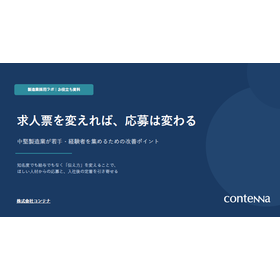
Changing the job listing will change the applications.

Introducing improvement points for mid-sized manufacturing companies to attract young talent and experienced professionals!

Even when job postings are made, there are no applications. When there are applications, they mostly come from outside the target demographic. The common issue behind this is that the job postings are not written in "the language of job seekers." ■ No Applications Even when job postings are made, the situation continues where no applications are gathered. ■ Mostly Outside the Target Even if there are applications, they do not match the young or experienced candidates we want to hire. ■ No Change Even After Review Even after multiple revisions, the changes are superficial, and time passes without any tangible results. This document explains the "improvement points for job postings" to change applications and retention, along with specific examples. *For more details, please download the PDF or feel free to contact us.

Added to bookmarks

Bookmarks list

Bookmark has been removed

Bookmarks list

You can't add any more bookmarks

By registering as a member, you can increase the number of bookmarks you can save and organize them with labels.

Free membership registration

If you change the job listing, the applications will change.

By changing the "way of communication" rather than focusing on popularity or salary, we attract applications from the desired talent and encourage retention after joining!

This catalog introduces improvement points for mid-sized manufacturing companies to attract young and experienced candidates. It addresses reasons why job seekers are not applying, such as the job content not being communicated effectively and the use of internal jargon raising psychological barriers for younger applicants. It also includes perspectives that need to be changed and a review checklist. Let's start by reviewing your company's job postings using the language of job seekers. [Contents] ■ Reasons why job postings do not lead to applications ■ Making the job content specific enough to visualize the "working scene" ■ Lowering psychological barriers caused by technical jargon ■ Changing job postings can change both applications and retention ■ Strengths that can be communicated specifically by mid-sized manufacturing companies ■ A review checklist that can be used starting tomorrow *For more details, please download the PDF or feel free to contact us.

Added to bookmarks

Bookmarks list

Bookmark has been removed

Bookmarks list

You can't add any more bookmarks

By registering as a member, you can increase the number of bookmarks you can save and organize them with labels.

Free membership registration

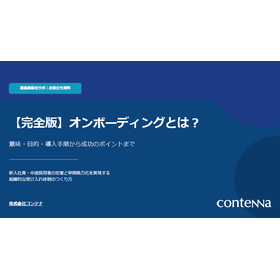
What is onboarding? From meaning and purpose to implementation steps and key points for success.

Introducing how to create an organizational acceptance system that ensures the retention and early empowerment of new employees and mid-career hires!

Before the hired personnel can demonstrate their abilities on-site, they may leave the company, or it may take time for them to get up to speed after being assigned. This is due to issues such as reliance on on-site guidance and the personalization of the onboarding process. An approach that provides gradual support from the entire organization, rather than relying on individual capabilities, is essential. ■ Early Departure Hired personnel leave before they can demonstrate their abilities on-site. ■ Slow Onboarding It takes time for new hires to get up to speed after being assigned, hindering their effectiveness. ■ Personalization of Training The onboarding process depends on the individual skills of the trainers, making it difficult to replicate the support system. This document systematically explains the definition of onboarding, implementation steps, case studies, and how to measure outcomes. *For more details, please download the PDF or feel free to contact us.

Added to bookmarks

Bookmarks list

Bookmark has been removed

Bookmarks list

You can't add any more bookmarks

By registering as a member, you can increase the number of bookmarks you can save and organize them with labels.

Free membership registration

[Catalog] [Complete Edition] What is onboarding?

A systematic explanation of the definition of onboarding, introduction procedures, case studies, and how to measure outcomes!

This catalog explains how to create an organizational acceptance system that achieves the retention and early empowerment of new employees and mid-career hires. It introduces the differences from traditional acceptance responses, the three phases of implementation, the details of each phase, achievement goals, and examples of evaluation indicators (both quantitative and qualitative). Let’s start by addressing the current issues within your company and aim to build a reproducible acceptance system. [Contents] ■ What is onboarding? ■ Differences from traditional OJT and training ■ Importance and benefits ■ Three phases of implementation (roadmap) ■ Case studies ■ Key points to prevent dependency ■ KPI design to measure results *For more details, please download the PDF or feel free to contact us.

Added to bookmarks

Bookmarks list

Bookmark has been removed

Bookmarks list

You can't add any more bookmarks

By registering as a member, you can increase the number of bookmarks you can save and organize them with labels.

Free membership registration

Improving onboarding in the manufacturing industry! Training methods to prevent early turnover.

For HR professionals struggling with ineffective onboarding in the manufacturing industry. Here are six improvement steps to identify the causes of stagnation and work with the field.

Are you feeling that the onboarding process you implemented is not sticking and is not functioning on-site? In most cases, the cause lies not in the system itself but in its daily operation. A mismatch in the vision of goals, manuals that are not suited to the field, a concentration of burden on the trainers, and the hollowing out of 1-on-1 meetings. When these four factors overlap, a situation arises where the system exists, but no one uses it. What you should first focus on is not redoing the system, but identifying where it is not functioning. This includes verbalizing the criteria for startup, refreshing checklists, reorganizing role assignments, and redesigning the format of 1-on-1 meetings. By reviewing in this order, the quality of acceptance will change while reducing the burden on the field. We are currently offering materials to support improvements in onboarding and increases in retention rates. Please feel free to request our catalog by clicking the download button.

Added to bookmarks

Bookmarks list

Bookmark has been removed

Bookmarks list

You can't add any more bookmarks

By registering as a member, you can increase the number of bookmarks you can save and organize them with labels.

Free membership registration

Prevent the formalization of onboarding! Operations to reduce on-site burden [Document presentation]

Identifying the hollowing out of systems and variations among leaders in the manufacturing industry. Introducing a redesign of operations that reduces the burden on the field while preventing early turnover and encouraging new employees to become independent.

Do you have any of these concerns? ■ The method of OJT guidance depends on the skills and experience of the person in charge, leading to inconsistencies in the quality of training. ■ Checklists have become mere formalities, causing new employees to feel "abandoned," which leads to early turnover. ■ The standards for "independence" pursued by HR and the field are not aligned, resulting in a lack of coordination in onboarding. When a system is in place but results are not being achieved, the cause often lies not in the system itself but in the daily "operations." The isolation of new employees is often due to the excessive burden on trainers and operational failures such as manuals that are disconnected from actual work. To solve these problems, it is effective to identify and redesign the bottlenecks in existing processes rather than completely overhauling the system. By articulating the desired outcomes, refreshing the manuals used on-site, and standardizing one-on-one meetings, we can improve the speed of onboarding and retention rates while reducing the burden on the field. For more details, please contact us or download the materials!

Added to bookmarks

Bookmarks list

Bookmark has been removed

Bookmarks list

You can't add any more bookmarks

By registering as a member, you can increase the number of bookmarks you can save and organize them with labels.

Free membership registration

Prevent job offer declines and early departures! Designing recruitment communication [Document available].

Eliminate the mismatch between job postings and actual work. How can we redesign the way we communicate recruitment information to align job seekers' expectations and improve retention rates?

Do you have any of these concerns? ■ Even if we explain the atmosphere during interviews, applicants cannot get a real image of working here. ■ There are ongoing cases of early turnover due to "the job is different from what I expected," wasting recruitment costs. ■ We want to create a video, but we cannot provide numerical evidence or cost-effectiveness to get internal approval. Candidates often only have job postings and interviews as opportunities to learn about our company. With such limited interactions, it is not uncommon for them to leave after joining because they feel "the job was different from what I expected." Recruitment videos are a means to convey the company culture and the reality of the work in a short time, which cannot be communicated through text or photos alone. However, simply creating a video is not enough, and choosing based solely on low cost may lead to content that does not address recruitment challenges. The criteria for selection should include clarity of the scope of services, presentation of cost-effectiveness, and a supportive attitude towards the internal approval phase. Choosing a support organization that not only produces videos but also assists with the overall information design of recruitment communication will lead to better retention. For more details, please contact us or download the materials!

Added to bookmarks

Bookmarks list

Bookmark has been removed

Bookmarks list

You can't add any more bookmarks

By registering as a member, you can increase the number of bookmarks you can save and organize them with labels.

Free membership registration

Mid-career onboarding in the manufacturing industry! Immediate productivity and prevention of early turnover.

Early turnover of mid-career employees is increasing in the manufacturing industry. Improving retention rates through mid-career specific onboarding that breaks through gaps from previous jobs and the barriers of tacit knowledge.

Mid-career hires who are brought on as immediate contributors often struggle to settle in. This is largely due to the focus on teaching them the job, which leaves out support for adapting to the organization. Mid-career employees face three distinct barriers that differ from new graduates: - Conflict with previous work methods - Stumbling due to unspoken internal knowledge - Isolation from not having peers Neglecting to address these barriers can lead to early turnover. The key to countermeasures lies in a design specifically for mid-career hires that centers on adapting to the organizational culture. By verbalizing tacit knowledge, visualizing expected roles, assigning mentors separate from evaluators, and providing unlearning support through one-on-one meetings, a system can be established that supports the onboarding of mid-career employees while minimizing the burden on the team. We are currently offering materials to support the improvement of mid-career employee retention rates. Please feel free to request the catalog by clicking the download button.

Added to bookmarks

Bookmarks list

Bookmark has been removed

Bookmarks list

You can't add any more bookmarks

By registering as a member, you can increase the number of bookmarks you can save and organize them with labels.

Free membership registration

Prevent mid-career immediate effectiveness and early turnover! Onboarding support for mid-career hires.

Is "being an experienced employee means being left alone" the cause of turnover? Achieving a quick ramp-up for mid-career employees through the visualization of tacit knowledge within the company and support for unlearning.

Do you have any of these concerns? ■ Mid-career hires, recruited for their immediate skills, are clinging to their previous job's methods and causing friction on-site. ■ Leaving them to figure things out on their own has led to stagnation in work due to a lack of understanding of local rules. ■ Without anyone to consult, they feel psychologically isolated and leave early before achieving the expected results. In mid-career hiring, there tends to be a focus on skill training, but what is truly necessary is "adaptation to organizational culture" and "unlearning past successful experiences." However, leaving the integration process to the field can lead to encountering unspoken knowledge and relational barriers, preventing them from demonstrating their true abilities. Our service supports the creation of a highly reproducible system to overcome the unique "three barriers (gaps, tacit knowledge, isolation)" faced by mid-career employees. We achieve a smooth onboarding process while minimizing the burden on the field by visualizing internal terminology and local rules (Wiki creation), clarifying expected roles, and designing mentoring relationships. We are currently offering a guide summarizing methods for retaining and empowering mid-career employees. *For more details, please feel free to request the catalog by clicking the download button.

Added to bookmarks

Bookmarks list

Bookmark has been removed

Bookmarks list

You can't add any more bookmarks

By registering as a member, you can increase the number of bookmarks you can save and organize them with labels.

Free membership registration

Recruitment information and video design support to prevent the "job is different from what I expected" after joining the company.

Job postings and interviews alone cannot fully convey the reality of the workplace, leading to early turnover. By designing information and using recruitment videos, we can adjust expectations and achieve hiring without mismatches.

Do you have any of these concerns? ■ Even after explaining the company culture and work environment during interviews, candidates struggle to envision what it's like to work there. ■ Early resignations due to "the job is different from what I expected" are ongoing, wasting recruitment and training costs. ■ I want to create a recruitment video, but I can't provide numerical evidence or cost-effectiveness to get internal approval. Candidates only have the job listing and the interview as opportunities to learn about your company. With such limited contact, it's difficult to convey the atmosphere of the factory and the reality of the work, leading to dissatisfaction after joining when they feel "it's different from what I imagined." Recruitment videos are an effective way to quickly deliver the realities of the workplace and the voices from the field that are hard to convey through text or photos. However, simply creating a visually appealing video won't prevent mismatches. Choosing based on low production costs can lead to videos that don't address your company's specific challenges. The key points are clarity of scope, presentation of cost-effectiveness through numbers, and a supportive system for internal approval. Properly designing information and supporting the entire recruitment communication process leads to successful outcomes. We are currently offering a document summarizing the know-how for designing recruitment communication. *For more details, please feel free to request the catalog by clicking the download button.

Added to bookmarks

Bookmarks list

Bookmark has been removed

Bookmarks list

You can't add any more bookmarks

By registering as a member, you can increase the number of bookmarks you can save and organize them with labels.

Free membership registration

Manufacturing Industry Recruitment Site Diagnosis! Transforming your site into one that leads to applications through AI and human analysis.

To manufacturing companies that have launched their recruitment sites but are not receiving applications. We are currently conducting an assessment to visualize the challenges of recruitment sites from both the job seekers' and AI's perspectives.

I created a recruitment website, but I'm not getting any applications. I feel the design is outdated, but I don't know what to fix or how. This is a common situation for hiring managers in the manufacturing industry. The challenges of a recruitment website are not just about the parts that people can notice. Today's job seekers research companies using AI. Even if the site looks polished, if the H1 headings, meta descriptions, and structured data are not set up correctly, the content won't be conveyed accurately to the AI, and the company's appeal won't reach potential candidates. In the assessment, we check both whether the appeal and information are conveyed to job seekers and whether the site is in a state that can be correctly interpreted by AI. Issues that may not be immediately noticeable become clear through the assessment. We are currently offering a document summarizing the current status of recruitment websites and how to proceed with improvements. Please feel free to request the catalog by clicking the download button.

Added to bookmarks

Bookmarks list

Bookmark has been removed

Bookmarks list

You can't add any more bookmarks

By registering as a member, you can increase the number of bookmarks you can save and organize them with labels.

Free membership registration

Onboarding challenges in the manufacturing industry! Solutions to bridge the gaps among the three parties.

To the manufacturing industry where onboarding is ineffective. Identify the discrepancies among HR, the field, and new employees, and introduce solutions by issue along with four steps.

Despite implementing onboarding, there are no results. The background to this is a discrepancy in understanding among three parties: the goals pursued by HR, the burden felt by on-site instructors, and the anxieties faced by new employees. The issues can be organized into three root causes: a lack of alignment on development goals between HR and the field, an uneven burden on instructors, and a focus on teaching job skills that delays adaptation to organizational culture. The solution is not to overhaul the system but to identify bottlenecks through hearings and gradually make adjustments while involving the field according to priority. This will create a structure that reduces the burden on instructors while preventing the psychological isolation of new employees. Improving onboarding also requires a review of information dissemination at the time of hiring and adjustments to expectations after joining. We are currently offering a document summarizing this approach. Please feel free to request it by downloading the catalog button.

Added to bookmarks

Bookmarks list

Bookmark has been removed

Bookmarks list

You can't add any more bookmarks

By registering as a member, you can increase the number of bookmarks you can save and organize them with labels.

Free membership registration

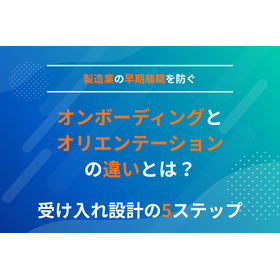
Guide to the Differences Between Onboarding and Orientation in Manufacturing Industry

What is the difference from orientation? Introducing the five steps of onboarding that prevent "tacit knowledge" and "isolation" on-site, and help prevent early turnover.

The main factor behind early turnover in the manufacturing industry is not merely a lack of knowledge. It stems from the gaps and feelings of isolation that arise from facing "tacit knowledge of the factory" and "barriers in human relationships" after being assigned to a position. The key to achieving early retention is to shift from merely explaining the rules (orientation) immediately after joining to a process (onboarding) that continues to support individuals until they can stand on their own after being assigned to the field. This article organizes the structural differences between these two concepts and provides a detailed explanation of the "5 Steps for Acceptance Design," which enhances retention rates while reducing the burden of acceptance through collaboration between HR and the field. If you are struggling with "having comprehensive safety and health education and procedures, yet still experiencing turnover after assignment," or if you are an HR representative aiming to systematize development involving the field, please take a look.

Added to bookmarks

Bookmarks list

Bookmark has been removed

Bookmarks list

You can't add any more bookmarks

By registering as a member, you can increase the number of bookmarks you can save and organize them with labels.

Free membership registration
Prev 12 Next
  • 竹中直人と対談しませんか? 出演企業募集中!
  • 技術・製品展示会 新技術創出交流会2026 入場無料 来場登録受付中 開催日時10月22日木・23日金 会場東京たま未来メッセ
    • Contact this company

      Inquiry Form

    Products

    • Search for Products

    Company

    • Search for Companies

    Special Features

    • Special Features

    Ranking

    • Overall Products Ranking
    • Overall Company Ranking

    support

    • site map
    IPROS
    • privacy policy Regarding external transmission of information
    • terms of service
    • About Us
    • Careers
    • Advertising
    IPROS Services
    • >IPROS GMS | Search site for the manufacturing industry
    • >IPROS | Search site for the B2B industry
    COPYRIGHT © 2001-2026 IPROS CORPORATION ALL RIGHTS RESERVED.
    Please note that the English text on this page is automatically translated and may contain inaccuracies.