1~45 item / All 99 items
Displayed results
Filter by category
Added to bookmarks
Bookmarks listBookmark has been removed
Bookmarks listYou can't add any more bookmarks
By registering as a member, you can increase the number of bookmarks you can save and organize them with labels.
Free membership registrationContact this company
Inquiry Form1~45 item / All 99 items
Filter by category

When it comes to urgent hiring needs, such as filling vacancies in design positions or addressing labor shortages on manufacturing lines, it can be challenging to decide which media to choose. In manufacturing recruitment, there are various options, including job search engines, general sites, and specialized sites, which can lead to ambiguous selection criteria. If you choose based solely on general recognition, it may result in a lack of applications and increased hiring costs. The key to addressing this issue is to select based on the profile of the person you want to hire, rather than the name of the media. By differentiating job postings by occupation and combining it with an applicant tracking system (ATS) for efficient applicant management, you can establish a system that effectively reaches the desired talent while minimizing unnecessary advertising costs. We are currently offering materials for our recruitment communication design service, which supports everything from information dissemination during the hiring process to employee retention after joining. Please feel free to request the catalog by clicking the download button.
Added to bookmarks
Bookmarks listBookmark has been removed
Bookmarks listYou can't add any more bookmarks
By registering as a member, you can increase the number of bookmarks you can save and organize them with labels.
Free membership registration
"Manufacturing Industry Recruitment Branding" is a service that achieves recruitment branding that resonates with job seekers through two axes: "Content Design" and "Communication." It is an initiative to continuously convey the company's philosophy, the people working there, and the reality of the job to job seekers. We operate the media "Manufacturing Recruitment Lab" for HR in the manufacturing industry, continuously tracking recruitment challenges in the industry and the interests of job seekers. We articulate the ingenuity of factories and the appeal of the people working there through interviews, providing consistent support from design to production, communication, and effectiveness measurement. [Features] ■ Achieves recruitment branding through the two axes of "Content Design" and "Communication" ■ Articulates the ingenuity of factories and the appeal of workers through interviews ■ Provides consistent support from design to production, communication, and effectiveness measurement *For more details, please feel free to contact us.
Added to bookmarks
Bookmarks listBookmark has been removed
Bookmarks listYou can't add any more bookmarks
By registering as a member, you can increase the number of bookmarks you can save and organize them with labels.
Free membership registration
"Recruitment Branding for the Manufacturing Industry" is a service that realizes recruitment branding that resonates with job seekers through two axes: "Content Design" and "Communication." We continuously share the company's philosophy, the people who work there, and the realities of the job, delivering content not just once but by combining various media that fit the purpose and budget, such as our own website, note, Wantedly, LinkedIn, and social media. By providing consistent support from hearing to content design, production, communication, and effectiveness measurement and improvement, we ensure that communication does not stop at just a few posts but leads to results. Utilizing the operational know-how of the media "Manufacturing Recruitment Lab" aimed at HR in the manufacturing industry, we draw out the ingenuity of factories and the appeal of the people working there from an external perspective. [Service Features] ■ Realizing branding through the two axes of "Content Design" and "Communication" ■ Continuous communication by combining media that fit the purpose and budget ■ Consistent support from hearing to effectiveness measurement and improvement ■ Utilizing the operational know-how of "Manufacturing Recruitment Lab" *For more details, please feel free to contact us.
Added to bookmarks
Bookmarks listBookmark has been removed
Bookmarks listYou can't add any more bookmarks
By registering as a member, you can increase the number of bookmarks you can save and organize them with labels.
Free membership registration
The early turnover of young and mid-career employees in the manufacturing field is caused not by the individual's qualities, but by the neglect of the "five walls" associated with on-the-job training (OJT) that is left to the site. If the deficiencies in the acceptance environment are left unaddressed, it will not be possible to prevent accidents due to lack of confirmation or employee turnover. The solution to this problem at its root is a 90-day onboarding design that balances safety education and skill transfer. Specifically, we will gradually build the following systems in collaboration with the site: - Standardization of work procedures (SOP) to prevent inconsistencies in teaching methods - Placement of mentor advisors and regular meetings to alleviate the isolation of newcomers - Designing small success experiences (small wins) to enhance early effectiveness We are currently offering materials for a recruitment communication design service that seamlessly connects information dissemination at the time of hiring to the onboarding system after joining, alleviating the anxieties of new employees and promoting retention. Please feel free to request the catalog by clicking the download button.
Added to bookmarks
Bookmarks listBookmark has been removed
Bookmarks listYou can't add any more bookmarks
By registering as a member, you can increase the number of bookmarks you can save and organize them with labels.
Free membership registration
The key to enabling new employees in the manufacturing industry to become independent in a short period lies in the division of roles between "onboarding," which helps them acclimate to the entire company, and "on-the-job training (OJT)," which takes place on-site. When the development of new employees is left solely to the workplace, it can lead to an overload of duties for trainers and inconsistencies in teaching methods, resulting in early turnover. Traditional OJT that focuses only on practical skills education relies on the individual skills of trainers for adapting to the workplace environment and mental support, making it easy for new employees to feel isolated. To balance retention rates and training speed, it is essential for HR to support workplace adaptation through interviews and a mentoring system, while on-site trainers can focus on technical instruction based on a checklist. We are currently offering materials that summarize the methods for designing a division of roles and a training roadmap that reduces the burden on the workplace and accelerates the onboarding of new employees. Please feel free to request the catalog by clicking the download button.
Added to bookmarks
Bookmarks listBookmark has been removed
Bookmarks listYou can't add any more bookmarks
By registering as a member, you can increase the number of bookmarks you can save and organize them with labels.
Free membership registration
This case study introduces how a mid-sized manufacturing company attracted applications from desired talent and improved retention after hiring by changing the way they communicated their job postings. Previously, they faced issues where job postings did not generate applications, and when they did, the applicants were not from the target demographic. A common challenge behind this was that the job postings were not written in "the language of job seekers." In this case, by changing the "communication method" rather than focusing on brand recognition or salary, they were able to attract applications from the desired talent and improve retention after hiring. [Challenges] ■ No applications received despite posting jobs ■ Mismatch with the desired young and experienced candidates ■ No positive response even after revising job postings *For more details, please download the PDF or feel free to contact us.
Added to bookmarks
Bookmarks listBookmark has been removed
Bookmarks listYou can't add any more bookmarks
By registering as a member, you can increase the number of bookmarks you can save and organize them with labels.
Free membership registration
This document is an explanatory material that outlines how to create an organizational acceptance system that enables the retention and early empowerment of new employees and mid-career hires. In the context of the unique recruitment and development challenges faced by medium-sized enterprises, there is a need to establish recruitment communication and organizational support (onboarding) to prevent offer declines and early turnover. This document introduces recruitment communication strategies to prevent offer declines and early turnover, as well as "information design" tailored to the specific recruitment and development challenges of medium-sized enterprises, along with support for internal proposals. [Contents] ■ Recruitment communication to prevent offer declines and early turnover ■ "Information design" tailored to the unique recruitment and development challenges of medium-sized enterprises ■ Support during the internal proposal and approval phases *For more details, please download the PDF or feel free to contact us.

Added to bookmarks
Bookmarks listBookmark has been removed
Bookmarks listYou can't add any more bookmarks
By registering as a member, you can increase the number of bookmarks you can save and organize them with labels.
Free membership registration
"Creating Recruitment Websites for the Manufacturing Industry" is a service that plans and produces recruitment websites specifically tailored for the manufacturing sector. It goes beyond mere design production, utilizing content design based on SEO and AIO (AI search) compatibility to deepen job seekers' understanding of the company, thereby improving the quality of applications and retention rates. Insights gained from the operation of the Recruitment Lab regarding search behavior and article design are also reflected in the website production. 【Benefits】 ■ Content design based on recruitment plans and target audiences leads to an increase in the number of applications and strengthens the candidate pool. ■ Information design that fills the gap between expectations and reality after joining, such as the voices of current employees and actual working conditions, contributes to improved retention rates. ■ Accurately articulating the unique attractions of the manufacturing industry allows for differentiated appeals compared to competitors. ■ Design that anticipates AIO compatibility enables adaptation to future changes in the search environment. *For more details, please download the PDF or feel free to contact us.


Added to bookmarks
Bookmarks listBookmark has been removed
Bookmarks listYou can't add any more bookmarks
By registering as a member, you can increase the number of bookmarks you can save and organize them with labels.
Free membership registration
The "BtoB Manufacturing Content Marketing Success Roadmap" is a roadmap specifically designed for BtoB manufacturing industries to establish a system that generates leads in the medium to long term as a sales foundation. This product proposes a systematic process design that takes into account the unique requirements of the manufacturing industry, such as the "lengthening of the purchasing process," "involvement of multiple departments," and "specialized technical information," rather than relying on one-off measures. It incorporates practical perspectives, such as collaboration with on-site departments (sales and technical), handling of technical information, and designing pathways in line with the purchasing process to build the system. Additionally, it organizes supporting information related to quality assurance, safety, and supply stability. 【Features】 ■ Systematic process design considering the overall picture ■ Incorporation of practical perspectives and collaboration with on-site departments (sales and technical) ■ Organization of supporting information regarding quality assurance, safety, and supply stability *For more details, please download the PDF or feel free to contact us.
Added to bookmarks
Bookmarks listBookmark has been removed
Bookmarks listYou can't add any more bookmarks
By registering as a member, you can increase the number of bookmarks you can save and organize them with labels.
Free membership registration
"The Recruitment Investment Guide for the Manufacturing Industry" is a guide aimed at preventing the erosion of the on-site "earning power" in the manufacturing sector. It presents a management rationale for reinterpreting vacancies caused by resignations not as temporary on-site issues, but as an annual "invisible profit loss (value-added outflow)" of approximately 17.28 million yen per person. It explains the "structural deterioration of operating profit margins" caused by excessive overtime and rising product costs due to filling vacancies with overtime, as well as the risks of reduced yield, mistakes, and accidents due to employee fatigue. To prevent the outflow of intangible assets such as "know-how and skills" and the risk of chain resignations, it redefines recruitment as "infrastructure investment to secure profits" and recommends building in-house recruitment channels. **Features** - Provides rationale for preventing an annual value-added outflow of approximately 17.28 million yen per vacancy - Explains the "structural deterioration of operating profit margins" due to excessive overtime and rising product costs - Avoids the outflow of "know-how and skills" and the risk of chain resignations - Explains three competitive advantages through recruitment and retention infrastructure *For more details, please download the PDF or feel free to contact us.*
Added to bookmarks
Bookmarks listBookmark has been removed
Bookmarks listYou can't add any more bookmarks
By registering as a member, you can increase the number of bookmarks you can save and organize them with labels.
Free membership registration
This document is a white paper that integrates actual data from over 6,000 corporate HR departments and behavioral data from job-seeking students, presenting a concrete prescription for becoming a "chosen company" in the 2028 graduation recruitment. In the face of the end of "selective hiring," it has become urgent to redesign the "selection experience (CX)" to dramatically prevent job offer declines. This paper includes a multifaceted approach, such as gap analysis, factors related to interviewers, and methods for alleviating resource shortages using generative AI. [Contents (partial)] ■ Data analysis showing risks of not meeting recruitment plans and the normalization of offer declines ■ Gap analysis between the "abilities" companies seek and the "reassurance" students desire ■ The importance of shifting internships to a "networking type" ■ Four elements of interviewers that drive the desire to join the company ■ Methods for creating "dialogue time" using generative AI *For more details, please download the PDF or feel free to contact us.
Added to bookmarks
Bookmarks listBookmark has been removed
Bookmarks listYou can't add any more bookmarks
By registering as a member, you can increase the number of bookmarks you can save and organize them with labels.
Free membership registration
Even when job openings are posted, there are no applications. Even if there are applications, they are often declined. Many of the reasons for this stem from a lack of information that allows job seekers to assess "what kind of work it is and who they will be working with." "Recruitment Branding for the Manufacturing Industry" is a service that consistently handles everything from design to operation, using platforms like note, Wantedly, LinkedIn, and Hatena Blog to deliver the true image of the company to job seekers. ■ Designing roles for each medium We decide who to deliver what to and separate the roles for each medium. ■ From planning to operation We continuously carry out the identification of communication themes, annual planning, article production, posting, and analysis and improvement of effectiveness. ■ Support for sustainable internal operations For companies that want to write articles internally, we also offer a supportive operational model focused on planning, editing, and analysis. ■ Operating a recruitment media specialized in the manufacturing industry We run our own "Manufacturing Recruitment Lab," designing based on the recruitment challenges in the manufacturing industry and how to effectively communicate with job seekers. Please feel free to contact us if you have any requests.
Added to bookmarks
Bookmarks listBookmark has been removed
Bookmarks listYou can't add any more bookmarks
By registering as a member, you can increase the number of bookmarks you can save and organize them with labels.
Free membership registration
Even when comparing onboarding tools, it becomes difficult to determine the necessary features for your company, making it hard to decide on implementation. This is especially true for mid-sized manufacturing companies with multiple locations, such as headquarters and factories, where the training processes differ depending on job roles and assignments. If you decide on implementation based solely on general specifications, it can lead to a mismatch with on-site operations and result in a hollowed-out process. Continuing to select tools without considering the burden on the field can lead to delays in new employees' ramp-up and feelings of isolation. The key to addressing these issues lies in inventorying the necessary features for your company and conducting prior verification of on-site usability. By narrowing down essential features tailored to the challenges, confirming on-site burdens through demos and partial operations, and designing follow-up support after implementation, you can establish a system that aids early adaptation of new employees while minimizing the burden on the field. We are currently offering a document summarizing the details of our recruitment communication design service. Please feel free to request the catalog by clicking the download button.
Added to bookmarks
Bookmarks listBookmark has been removed
Bookmarks listYou can't add any more bookmarks
By registering as a member, you can increase the number of bookmarks you can save and organize them with labels.
Free membership registration
If the items are left vague, such as "familiar with the job," even if you are using an onboarding checklist, you will not be able to accurately grasp the new employee's learning status. The lack of clear completion criteria and the division of roles for the verifiers leads to a reliance on the person in charge, resulting in educational disparities and delays or isolation for new employees. The key to addressing this issue is to clarify the completion criteria and organize the roles of the verifiers. [Points for Standardizing Operations] - Organizing items by time periods from before joining to 90 days after - Setting completion criteria that do not waver in judgment - Adding verification items tailored to the characteristics of new graduates and mid-career hires - Follow-up interviews when issues are detected By combining these elements, a system can be established that supports development with common standards while minimizing the burden on the field. We are currently offering a document summarizing the details of our recruitment communication design service. Please feel free to request the catalog by clicking the download button.
Added to bookmarks
Bookmarks listBookmark has been removed
Bookmarks listYou can't add any more bookmarks
By registering as a member, you can increase the number of bookmarks you can save and organize them with labels.
Free membership registration
Although onboarding interviews are being conducted, the true feelings and struggles of new employees are not being sufficiently understood. If the interviews proceed with only vague questions like "Are you having any problems?", it becomes difficult to detect the specific challenges that new employees face. The reason for this is not the frequency of the interviews, but rather the lack of organization regarding the purpose of the interviews and the questions being asked. Delaying responses to these challenges can lead to the isolation of new employees and early turnover. The key to addressing this issue lies in organizing the purpose of the interviews and the questions according to the timing after joining and the characteristics of the individuals involved. By setting objectives based on the timing of joining, preparing specific questions that draw out true feelings, and establishing a response flow that feeds back the interview results into on-site guidance, a system that supports the onboarding of new employees can be established. We are currently offering materials to support the improvement of new employee retention rates and interview design. Please feel free to request our catalog by clicking the download button.
Added to bookmarks
Bookmarks listBookmark has been removed
Bookmarks listYou can't add any more bookmarks
By registering as a member, you can increase the number of bookmarks you can save and organize them with labels.
Free membership registration
We have developed software that works in conjunction with an automatic irrigation IoT device for landscaping contractors of corporate buildings. At the request of NGK Insulators, Ltd., we are responsible for everything from the integration design with the device program to application development, network construction, and UI development. Please feel free to contact us for inquiries regarding the development of IoT device and software integration, as well as UI design and construction for business systems.
Added to bookmarks
Bookmarks listBookmark has been removed
Bookmarks listYou can't add any more bookmarks
By registering as a member, you can increase the number of bookmarks you can save and organize them with labels.
Free membership registration
We did not have our own media to disseminate information to HR personnel in the manufacturing industry, and relying solely on one-off contracts for recruitment site production did not allow us to build ongoing relationships or create touchpoints with potential customers. We launched an owned media platform specifically for HR personnel in the manufacturing industry called "Manufacturing Recruitment Lab," and we are continuously producing and publishing SEO articles at a pace of eight per month. We have established a system for creating and managing white papers, managing forms and leads in HubSpot, and conducting access analysis through integration with GA4 and Search Console. We operate seamlessly from article production to lead acquisition through white papers, lead management in HubSpot, and access analysis, enabling a system for continuous improvement based on data. If your company is struggling to create ongoing touchpoints with potential customers, please feel free to contact us.
Added to bookmarks
Bookmarks listBookmark has been removed
Bookmarks listYou can't add any more bookmarks
By registering as a member, you can increase the number of bookmarks you can save and organize them with labels.
Free membership registration
The corporate website, which had been online for several years, was falling behind compared to competitors. Additionally, the custom-built inquiry form made it difficult to utilize accumulated lead information for sales activities. We completely redesigned the corporate website and migrated the inquiry form to a marketing automation/customer relationship management system. This established a system for centralized management of lead information, allowing for better visibility of response statuses and smoother handovers to the sales team. From the redesign to the structuring of inquiry management using marketing automation/CRM, please feel free to contact us for any inquiries regarding your corporate website.
Added to bookmarks
Bookmarks listBookmark has been removed
Bookmarks listYou can't add any more bookmarks
By registering as a member, you can increase the number of bookmarks you can save and organize them with labels.
Free membership registration
I was responsible for building the ASICS TRAINING LOOKBOOK 2025AW MEN website for ASICS Japan Co., Ltd. Utilizing ASICS's proprietary CMS "QOR3," I was in charge of designing and implementing content that conveys the appeal and worldview of the apparel products. By effectively showcasing seasonal visuals and styling, we have created a site that balances brand image enhancement with product promotion. Please feel free to contact us for inquiries regarding similar landing pages, campaign sites, or brand site production.
Added to bookmarks
Bookmarks listBookmark has been removed
Bookmarks listYou can't add any more bookmarks
By registering as a member, you can increase the number of bookmarks you can save and organize them with labels.
Free membership registration
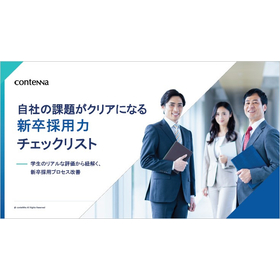
This document summarizes the "New Graduate Recruitment Capability Checklist." It provides a detailed explanation of the background and focus points of the decrease in applications, as well as the impact of the "recruitment process" on early turnover. Additionally, it includes the relationship between offer declines and interview design, as well as a checklist for designing points of contact with students, so please make use of it. 【Contents (partial)】 ■ Data Analysis (1) Background and Focus Points of Application Decrease ■ Data Analysis (2) Impact of the "Recruitment Process" on Early Turnover ■ Data Analysis (3) Relationship between Offer Declines and Interview Design ■ Checklist (1) Checklist for Designing Points of Contact with Students ■ Checklist (2) Pre- and Post-Joining Issues Checklist ■ Checklist (3) Selection and Assessment Phase Checklist *For more details, please download the PDF or feel free to contact us.
Added to bookmarks
Bookmarks listBookmark has been removed
Bookmarks listYou can't add any more bookmarks
By registering as a member, you can increase the number of bookmarks you can save and organize them with labels.
Free membership registration
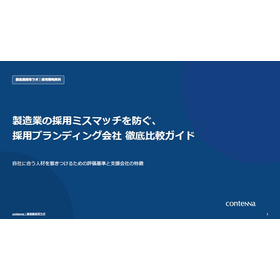
This document is a comprehensive comparison guide for recruitment branding companies aimed at preventing hiring mismatches in the manufacturing industry. It provides detailed information on the background and role of recruitment branding companies, as well as evaluation criteria for selecting a partner that fits your company. Additionally, we introduce the characteristics of major recruitment branding companies and key points for choosing a partner that aligns with your company's challenges, so please take a moment to read it. [Contents] ■ Background and role of recruitment branding companies ■ Evaluation criteria for selecting a partner that fits your company ■ Characteristics of major recruitment branding companies ■ Key points for choosing a partner that aligns with your company's challenges *For more details, please download the PDF or feel free to contact us.
Added to bookmarks
Bookmarks listBookmark has been removed
Bookmarks listYou can't add any more bookmarks
By registering as a member, you can increase the number of bookmarks you can save and organize them with labels.
Free membership registration
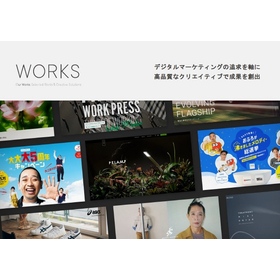
This document summarizes the production achievements of "WEB sites." It includes numerous examples of corporate sites for major companies and university promotion sites. Additionally, we also introduce case studies of owned media development and achievements in app and IoT development, so please take a moment to read through it. 【Contents (partial)】 ■ NTT Marketing Act Inc. ProCX ■ Evolv Inc. ■ Care21 Medical Inc. ■ Human Trust Inc. ■ Nishikawa Rubber Co., Ltd. ■ Uokuni Sohonzan Inc. *For more details, please download the PDF or feel free to contact us.
Added to bookmarks
Bookmarks listBookmark has been removed
Bookmarks listYou can't add any more bookmarks
By registering as a member, you can increase the number of bookmarks you can save and organize them with labels.
Free membership registration
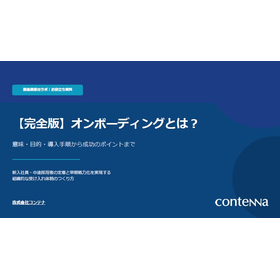
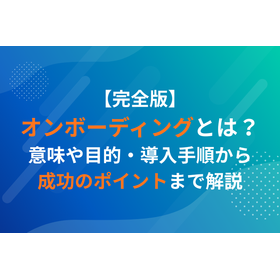
This document systematically explains everything from the definition of onboarding to implementation procedures, case studies, and how to measure outcomes. It provides detailed information on the definition of onboarding and the differences from traditional OJT and training. Additionally, it introduces the three phases of implementation (roadmap) and key points to prevent dependency on individuals, so please take a moment to read it. [Contents (partial)] ■ What is onboarding ■ Differences from traditional OJT and training ■ Importance and benefits ■ Three phases of implementation (roadmap) ■ Implementation case studies *For more details, please download the PDF or feel free to contact us.
Added to bookmarks
Bookmarks listBookmark has been removed
Bookmarks listYou can't add any more bookmarks
By registering as a member, you can increase the number of bookmarks you can save and organize them with labels.
Free membership registration
This document summarizes the "Recruitment Communication Design Service." It includes strategic proposals for sustainable recruitment success and addresses issues related to early turnover. Additionally, it explains the process that supports everything from information dissemination to talent retention, so please take a moment to read it. [Contents] ■ Solution approach through this service ■ Market trends and issues of early turnover ■ Impact on management and visualization of losses ■ Reasons for early turnover ■ Concept for resolution ■ Support process *For more details, please download the PDF or feel free to contact us.
Added to bookmarks
Bookmarks listBookmark has been removed
Bookmarks listYou can't add any more bookmarks
By registering as a member, you can increase the number of bookmarks you can save and organize them with labels.
Free membership registration
The main factor behind early turnover in the manufacturing industry is not merely a lack of knowledge. It stems from the gaps and feelings of isolation that arise from facing "tacit knowledge of the factory" and "barriers in human relationships" after being assigned to a position. The key to achieving early retention is to shift from merely explaining the rules (orientation) immediately after joining to a process (onboarding) that continues to support individuals until they can stand on their own after being assigned to the field. This article organizes the structural differences between these two concepts and provides a detailed explanation of the "5 Steps for Acceptance Design," which enhances retention rates while reducing the burden of acceptance through collaboration between HR and the field. If you are struggling with "having comprehensive safety and health education and procedures, yet still experiencing turnover after assignment," or if you are an HR representative aiming to systematize development involving the field, please take a look.
Added to bookmarks
Bookmarks listBookmark has been removed
Bookmarks listYou can't add any more bookmarks
By registering as a member, you can increase the number of bookmarks you can save and organize them with labels.
Free membership registration
Despite implementing onboarding, there are no results. The background to this is a discrepancy in understanding among three parties: the goals pursued by HR, the burden felt by on-site instructors, and the anxieties faced by new employees. The issues can be organized into three root causes: a lack of alignment on development goals between HR and the field, an uneven burden on instructors, and a focus on teaching job skills that delays adaptation to organizational culture. The solution is not to overhaul the system but to identify bottlenecks through hearings and gradually make adjustments while involving the field according to priority. This will create a structure that reduces the burden on instructors while preventing the psychological isolation of new employees. Improving onboarding also requires a review of information dissemination at the time of hiring and adjustments to expectations after joining. We are currently offering a document summarizing this approach. Please feel free to request it by downloading the catalog button.
Added to bookmarks
Bookmarks listBookmark has been removed
Bookmarks listYou can't add any more bookmarks
By registering as a member, you can increase the number of bookmarks you can save and organize them with labels.
Free membership registration
"Although we are disseminating content, we do not see results" and "It does not lead to lead acquisition." These are common challenges faced by companies engaged in BtoB marketing. Dentsu Inc.'s BtoB marketing support media, "Dentsu B2B Initiative," is responsible for everything from website construction and operation using HubSpot to interviews and content production. As a result of two years of continuous operation, we achieved a 72.23% increase in session numbers compared to the previous year, a 254% increase in newsletter subscribers, and a 157% increase in white paper downloads. The background of these results lies not in one-off measures but in continuous PDCA (Plan-Do-Check-Act) and improvement design based on data utilizing HubSpot. Companies facing similar challenges are welcome to view our company brochure or feel free to contact us.
Added to bookmarks
Bookmarks listBookmark has been removed
Bookmarks listYou can't add any more bookmarks
By registering as a member, you can increase the number of bookmarks you can save and organize them with labels.
Free membership registration
I created a recruitment website, but I'm not getting any applications. I feel the design is outdated, but I don't know what to fix or how. This is a common situation for hiring managers in the manufacturing industry. The challenges of a recruitment website are not just about the parts that people can notice. Today's job seekers research companies using AI. Even if the site looks polished, if the H1 headings, meta descriptions, and structured data are not set up correctly, the content won't be conveyed accurately to the AI, and the company's appeal won't reach potential candidates. In the assessment, we check both whether the appeal and information are conveyed to job seekers and whether the site is in a state that can be correctly interpreted by AI. Issues that may not be immediately noticeable become clear through the assessment. We are currently offering a document summarizing the current status of recruitment websites and how to proceed with improvements. Please feel free to request the catalog by clicking the download button.
Added to bookmarks
Bookmarks listBookmark has been removed
Bookmarks listYou can't add any more bookmarks
By registering as a member, you can increase the number of bookmarks you can save and organize them with labels.
Free membership registration
Do you have any of these concerns? ■ Even after explaining the company culture and work environment during interviews, candidates struggle to envision what it's like to work there. ■ Early resignations due to "the job is different from what I expected" are ongoing, wasting recruitment and training costs. ■ I want to create a recruitment video, but I can't provide numerical evidence or cost-effectiveness to get internal approval. Candidates only have the job listing and the interview as opportunities to learn about your company. With such limited contact, it's difficult to convey the atmosphere of the factory and the reality of the work, leading to dissatisfaction after joining when they feel "it's different from what I imagined." Recruitment videos are an effective way to quickly deliver the realities of the workplace and the voices from the field that are hard to convey through text or photos. However, simply creating a visually appealing video won't prevent mismatches. Choosing based on low production costs can lead to videos that don't address your company's specific challenges. The key points are clarity of scope, presentation of cost-effectiveness through numbers, and a supportive system for internal approval. Properly designing information and supporting the entire recruitment communication process leads to successful outcomes. We are currently offering a document summarizing the know-how for designing recruitment communication. *For more details, please feel free to request the catalog by clicking the download button.
Added to bookmarks
Bookmarks listBookmark has been removed
Bookmarks listYou can't add any more bookmarks
By registering as a member, you can increase the number of bookmarks you can save and organize them with labels.
Free membership registration
Do you have any of these concerns? ■ Mid-career hires, recruited for their immediate skills, are clinging to their previous job's methods and causing friction on-site. ■ Leaving them to figure things out on their own has led to stagnation in work due to a lack of understanding of local rules. ■ Without anyone to consult, they feel psychologically isolated and leave early before achieving the expected results. In mid-career hiring, there tends to be a focus on skill training, but what is truly necessary is "adaptation to organizational culture" and "unlearning past successful experiences." However, leaving the integration process to the field can lead to encountering unspoken knowledge and relational barriers, preventing them from demonstrating their true abilities. Our service supports the creation of a highly reproducible system to overcome the unique "three barriers (gaps, tacit knowledge, isolation)" faced by mid-career employees. We achieve a smooth onboarding process while minimizing the burden on the field by visualizing internal terminology and local rules (Wiki creation), clarifying expected roles, and designing mentoring relationships. We are currently offering a guide summarizing methods for retaining and empowering mid-career employees. *For more details, please feel free to request the catalog by clicking the download button.
Added to bookmarks
Bookmarks listBookmark has been removed
Bookmarks listYou can't add any more bookmarks
By registering as a member, you can increase the number of bookmarks you can save and organize them with labels.
Free membership registration
Mid-career hires who are brought on as immediate contributors often struggle to settle in. This is largely due to the focus on teaching them the job, which leaves out support for adapting to the organization. Mid-career employees face three distinct barriers that differ from new graduates: - Conflict with previous work methods - Stumbling due to unspoken internal knowledge - Isolation from not having peers Neglecting to address these barriers can lead to early turnover. The key to countermeasures lies in a design specifically for mid-career hires that centers on adapting to the organizational culture. By verbalizing tacit knowledge, visualizing expected roles, assigning mentors separate from evaluators, and providing unlearning support through one-on-one meetings, a system can be established that supports the onboarding of mid-career employees while minimizing the burden on the team. We are currently offering materials to support the improvement of mid-career employee retention rates. Please feel free to request the catalog by clicking the download button.
Added to bookmarks
Bookmarks listBookmark has been removed
Bookmarks listYou can't add any more bookmarks
By registering as a member, you can increase the number of bookmarks you can save and organize them with labels.
Free membership registration
Do you have any of these concerns? ■ Even if we explain the atmosphere during interviews, applicants cannot get a real image of working here. ■ There are ongoing cases of early turnover due to "the job is different from what I expected," wasting recruitment costs. ■ We want to create a video, but we cannot provide numerical evidence or cost-effectiveness to get internal approval. Candidates often only have job postings and interviews as opportunities to learn about our company. With such limited interactions, it is not uncommon for them to leave after joining because they feel "the job was different from what I expected." Recruitment videos are a means to convey the company culture and the reality of the work in a short time, which cannot be communicated through text or photos alone. However, simply creating a video is not enough, and choosing based solely on low cost may lead to content that does not address recruitment challenges. The criteria for selection should include clarity of the scope of services, presentation of cost-effectiveness, and a supportive attitude towards the internal approval phase. Choosing a support organization that not only produces videos but also assists with the overall information design of recruitment communication will lead to better retention. For more details, please contact us or download the materials!
Added to bookmarks
Bookmarks listBookmark has been removed
Bookmarks listYou can't add any more bookmarks
By registering as a member, you can increase the number of bookmarks you can save and organize them with labels.
Free membership registration
Do you have any of these concerns? ■ The method of OJT guidance depends on the skills and experience of the person in charge, leading to inconsistencies in the quality of training. ■ Checklists have become mere formalities, causing new employees to feel "abandoned," which leads to early turnover. ■ The standards for "independence" pursued by HR and the field are not aligned, resulting in a lack of coordination in onboarding. When a system is in place but results are not being achieved, the cause often lies not in the system itself but in the daily "operations." The isolation of new employees is often due to the excessive burden on trainers and operational failures such as manuals that are disconnected from actual work. To solve these problems, it is effective to identify and redesign the bottlenecks in existing processes rather than completely overhauling the system. By articulating the desired outcomes, refreshing the manuals used on-site, and standardizing one-on-one meetings, we can improve the speed of onboarding and retention rates while reducing the burden on the field. For more details, please contact us or download the materials!
Added to bookmarks
Bookmarks listBookmark has been removed
Bookmarks listYou can't add any more bookmarks
By registering as a member, you can increase the number of bookmarks you can save and organize them with labels.
Free membership registration
Are you feeling that the onboarding process you implemented is not sticking and is not functioning on-site? In most cases, the cause lies not in the system itself but in its daily operation. A mismatch in the vision of goals, manuals that are not suited to the field, a concentration of burden on the trainers, and the hollowing out of 1-on-1 meetings. When these four factors overlap, a situation arises where the system exists, but no one uses it. What you should first focus on is not redoing the system, but identifying where it is not functioning. This includes verbalizing the criteria for startup, refreshing checklists, reorganizing role assignments, and redesigning the format of 1-on-1 meetings. By reviewing in this order, the quality of acceptance will change while reducing the burden on the field. We are currently offering materials to support improvements in onboarding and increases in retention rates. Please feel free to request our catalog by clicking the download button.
Added to bookmarks
Bookmarks listBookmark has been removed
Bookmarks listYou can't add any more bookmarks
By registering as a member, you can increase the number of bookmarks you can save and organize them with labels.
Free membership registration
This catalog explains how to create an organizational acceptance system that achieves the retention and early empowerment of new employees and mid-career hires. It introduces the differences from traditional acceptance responses, the three phases of implementation, the details of each phase, achievement goals, and examples of evaluation indicators (both quantitative and qualitative). Let’s start by addressing the current issues within your company and aim to build a reproducible acceptance system. [Contents] ■ What is onboarding? ■ Differences from traditional OJT and training ■ Importance and benefits ■ Three phases of implementation (roadmap) ■ Case studies ■ Key points to prevent dependency ■ KPI design to measure results *For more details, please download the PDF or feel free to contact us.
Added to bookmarks
Bookmarks listBookmark has been removed
Bookmarks listYou can't add any more bookmarks
By registering as a member, you can increase the number of bookmarks you can save and organize them with labels.
Free membership registration
Before the hired personnel can demonstrate their abilities on-site, they may leave the company, or it may take time for them to get up to speed after being assigned. This is due to issues such as reliance on on-site guidance and the personalization of the onboarding process. An approach that provides gradual support from the entire organization, rather than relying on individual capabilities, is essential. ■ Early Departure Hired personnel leave before they can demonstrate their abilities on-site. ■ Slow Onboarding It takes time for new hires to get up to speed after being assigned, hindering their effectiveness. ■ Personalization of Training The onboarding process depends on the individual skills of the trainers, making it difficult to replicate the support system. This document systematically explains the definition of onboarding, implementation steps, case studies, and how to measure outcomes. *For more details, please download the PDF or feel free to contact us.
Added to bookmarks
Bookmarks listBookmark has been removed
Bookmarks listYou can't add any more bookmarks
By registering as a member, you can increase the number of bookmarks you can save and organize them with labels.
Free membership registration
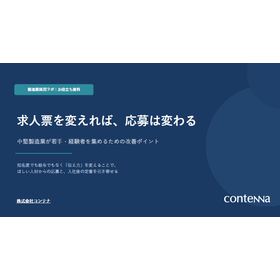
This catalog introduces improvement points for mid-sized manufacturing companies to attract young and experienced candidates. It addresses reasons why job seekers are not applying, such as the job content not being communicated effectively and the use of internal jargon raising psychological barriers for younger applicants. It also includes perspectives that need to be changed and a review checklist. Let's start by reviewing your company's job postings using the language of job seekers. [Contents] ■ Reasons why job postings do not lead to applications ■ Making the job content specific enough to visualize the "working scene" ■ Lowering psychological barriers caused by technical jargon ■ Changing job postings can change both applications and retention ■ Strengths that can be communicated specifically by mid-sized manufacturing companies ■ A review checklist that can be used starting tomorrow *For more details, please download the PDF or feel free to contact us.
Added to bookmarks
Bookmarks listBookmark has been removed
Bookmarks listYou can't add any more bookmarks
By registering as a member, you can increase the number of bookmarks you can save and organize them with labels.
Free membership registration
Even when job postings are made, there are no applications. When there are applications, they mostly come from outside the target demographic. The common issue behind this is that the job postings are not written in "the language of job seekers." ■ No Applications Even when job postings are made, the situation continues where no applications are gathered. ■ Mostly Outside the Target Even if there are applications, they do not match the young or experienced candidates we want to hire. ■ No Change Even After Review Even after multiple revisions, the changes are superficial, and time passes without any tangible results. This document explains the "improvement points for job postings" to change applications and retention, along with specific examples. *For more details, please download the PDF or feel free to contact us.
Added to bookmarks
Bookmarks listBookmark has been removed
Bookmarks listYou can't add any more bookmarks
By registering as a member, you can increase the number of bookmarks you can save and organize them with labels.
Free membership registration
Our company specializes in planning and producing recruitment websites tailored for the manufacturing industry. Not limited to mere design production, we enhance candidates' understanding of the company through content design that is based on SEO and AIO (AI search) compatibility, thereby improving the quality of applications and retention rates. We also reflect insights gained from our recruitment lab's operational search behavior and article design in our website production. **Features** - Content design based on recruitment plans and targets to strengthen application numbers and talent pool formation - Information design that bridges the gap after joining, leading to improved retention rates - Accurately articulating the unique appeal of the manufacturing industry to differentiate from competitors - Design that anticipates AIO compatibility, allowing for adaptation to future changes in search environments *For more details, please download the PDF or feel free to contact us.*
Added to bookmarks
Bookmarks listBookmark has been removed
Bookmarks listYou can't add any more bookmarks
By registering as a member, you can increase the number of bookmarks you can save and organize them with labels.
Free membership registration
Even if young employees are hired, they do not stay. The background to this is the personalization of the acceptance system, which depends on the individual skills and compatibility of the on-site personnel. Onboarding is a system that systematically follows up on job acquisition and organizational adaptation from before joining the company to about a year after joining, involving the entire organization. By dividing it into three phases: preparation for acceptance, on-site assignment, and autonomous operation, and clarifying the goals and measures for each period, it becomes possible to provide a consistent level of retention support regardless of who is in charge. The key points for success are the clarification of role division between HR and on-site personnel, standardization of guidance quality through checklists, and ensuring psychological safety through mentors and one-on-ones. Transitioning from a system that relies on the enthusiasm of specific employees to a reproducible acceptance process as an organization leads to both the prevention of early turnover and the early development of capabilities. We are currently offering a document summarizing the approach to designing recruitment communication aimed at improving retention rates after joining. Please feel free to request the catalog by clicking the download button.
Added to bookmarks
Bookmarks listBookmark has been removed
Bookmarks listYou can't add any more bookmarks
By registering as a member, you can increase the number of bookmarks you can save and organize them with labels.
Free membership registration
Do you have any of these concerns? ■ While the number of applications is increasing, there are few applications from the target demographic your company is seeking. ■ Even after extending job offers, candidates lean towards other companies, and you struggle with last-minute withdrawal prevention strategies. ■ The videos you created are getting buried and are not being utilized to reach job seekers. The concerns and true feelings of job seekers change at each selection phase. Relying solely on job postings and photos for information dissemination often fails to convey the true appeal of the company and the fulfillment of the work, leading to cases where candidates withdraw due to insufficient motivation formation. To overcome this, it is essential to design scenarios that reflect job seeker psychology and to effectively utilize multiple touchpoints such as recruitment websites, social media, and scout emails. By optimizing the overall interaction with job seekers, not just the quality of individual videos, you can ensure successful hiring outcomes. Leveraging the expertise of specialized partners, rather than relying solely on internal resources, is key to success. We are currently offering a guide on information design to enhance the overall effectiveness of recruitment strategies. Please download the catalog and take a look.
Added to bookmarks
Bookmarks listBookmark has been removed
Bookmarks listYou can't add any more bookmarks
By registering as a member, you can increase the number of bookmarks you can save and organize them with labels.
Free membership registration
Do you have any of these concerns? ■ Even if you explain the atmosphere during interviews, candidates cannot get a real image of working there. ■ Early resignations continue due to candidates saying, "It's different from what I expected," wasting recruitment costs. ■ You want to create a video but cannot provide numerical evidence or cost-effectiveness to get internal approval. Candidates only have job postings and interviews to learn about your company. With such limited interactions, it is not uncommon for mismatches to be discovered after joining. Recruitment videos are a means to convey the company culture and the realities of the job in a short time, which cannot be communicated through text or photos. However, the areas of expertise and cost structures vary greatly among production companies, and choosing based solely on low prices may result in videos that do not address your recruitment challenges. The evaluation criteria for selection are clarity of the scope of services, presentation of cost-effectiveness, and support attitude towards the internal approval phase. Choosing a partner who not only creates beautiful videos but also accompanies you in the overall information design of recruitment communication will lead to better outcomes. We are currently offering a document summarizing the approach to designing recruitment communication, including recruitment videos. Please feel free to request it by downloading the catalog using the button below.
Added to bookmarks
Bookmarks listBookmark has been removed
Bookmarks listYou can't add any more bookmarks
By registering as a member, you can increase the number of bookmarks you can save and organize them with labels.
Free membership registration
Candidates only have the opportunity to learn about the company through job postings and interviews. With such limited points of contact, it is not uncommon for new hires to say, "This job is different from what I expected" after joining. Recruitment videos are a means to convey the company culture and the realities of the job in a short amount of time, which cannot be fully communicated through text or photos. However, the strengths and costs can vary greatly among production companies, and choosing solely based on low prices may result in videos that do not address the company's recruitment challenges. The evaluation criteria for selection are clarity of the scope of services, presentation of cost-effectiveness, and support for the internal approval process. Choosing a partner who not only creates visually appealing videos but also collaborates on the overall information design of recruitment communication will lead to better hiring outcomes. We are currently offering a document summarizing the approach to designing recruitment communication, including recruitment videos. Please feel free to request the catalog by clicking the download button.
Added to bookmarks
Bookmarks listBookmark has been removed
Bookmarks listYou can't add any more bookmarks
By registering as a member, you can increase the number of bookmarks you can save and organize them with labels.
Free membership registration
This service is a comprehensive recruitment support service designed to prevent early turnover, from the dissemination of job information at the entry point of recruitment to onboarding after joining the company. While large companies tend to have fragmented operations, mid-sized manufacturing companies have the significant appeal of allowing employees to engage in a wide range of processes from an early stage. We will design communication that accurately conveys this strength. 【Value Provided by This Service】 ■ Empathy design for "why we create": Not just a list of tasks, but appealing the social value of technology. ■ Thorough elimination of mismatches: Accurately disclosing the working environment and actual tasks to prevent gaps after joining. ■ Unique appeal of mid-sized companies: Clearly articulating the environment where young employees can grow with discretion from an early stage. We aim to acquire individuals who are not just motivated by conditions but are attracted to our technology and will work with us for a long time, becoming the bearers of technological succession. We will build a system that realizes a happy matching between job seekers and companies. *For more details, please download the catalog or feel free to contact us.
Added to bookmarks
Bookmarks listBookmark has been removed
Bookmarks listYou can't add any more bookmarks
By registering as a member, you can increase the number of bookmarks you can save and organize them with labels.
Free membership registration
This service is a free diagnostic service aimed at mid-sized manufacturing companies struggling to attract applicants. It identifies issues in job postings from a professional and objective perspective and offers improvement suggestions. By translating the "greatness of our technology" and "interest in the job," which may seem obvious when you are on-site every day, into terms that resonate with job seekers, we support the transformation into highly responsive job advertisements. **Three Points You Can Understand from the Free Diagnosis** ■ Examination of Technical Terms: Whether there are internal terms that make young candidates feel "it's impossible for me" and disengage. ■ Visualization of Work: Whether candidates can imagine "what is produced and through which processes." ■ Redefinition of Strengths: Whether the "degree of discretion and growth environment" that is not found in large companies is being communicated. The diagnosis is conducted online (via Zoom, etc.) for 30 minutes to 1 hour, providing specific modification advice that can be used starting tomorrow. We create opportunities to meet "future technology successors" who resonate with the essential appeal of your company, rather than relying solely on brand recognition or salary conditions. *For more details, please download the catalog or feel free to contact us.*
Added to bookmarks
Bookmarks listBookmark has been removed
Bookmarks listYou can't add any more bookmarks
By registering as a member, you can increase the number of bookmarks you can save and organize them with labels.
Free membership registration