1~45 item / All 86 items
Displayed results
Filter by category

Added to bookmarks
Bookmarks listBookmark has been removed
Bookmarks listYou can't add any more bookmarks
By registering as a member, you can increase the number of bookmarks you can save and organize them with labels.
Free membership registration
Contact this company
Inquiry Form1~45 item / All 86 items
Filter by category
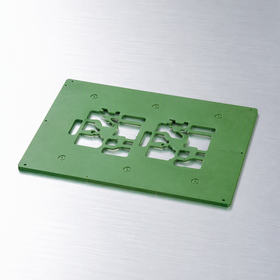
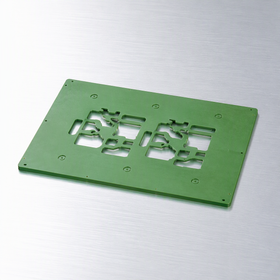
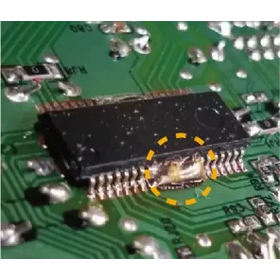
Invisible dirt creates unavoidable defects. Flux residues accumulated on the pallet openings and jig surfaces can cause quality issues such as misalignment of the circuit board and solder adhesion defects. Continuing operations with accumulated dirt may lead to reduced yield and equipment downtime. The Paleclean series efficiently removes flux and resin dirt adhered to the pallets, maintaining the jigs in good condition. Regular cleaning contributes to reducing the risk of quality problems and supports stable mounting quality and improved reliability of the manufacturing line.
Added to bookmarks
Bookmarks listBookmark has been removed
Bookmarks listYou can't add any more bookmarks
By registering as a member, you can increase the number of bookmarks you can save and organize them with labels.
Free membership registration
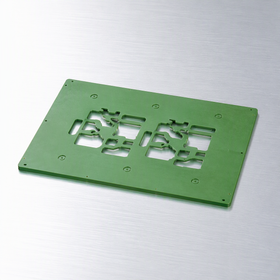
Is it really necessary for people to perform that cleaning task? While pallet cleaning is not part of the production activities themselves, it consumes a significant amount of time and personnel in many factories. In particular, the removal of accumulated flux dirt takes time and poses a considerable burden on both the manufacturing and maintenance departments. The Paleclean series shortens the time required for removing flux dirt with its excellent dissolving power, supporting the efficiency of cleaning tasks. When combined with pallet cleaners, it demonstrates even greater effectiveness, reducing the labor hours and personnel costs associated with cleaning tasks. This contributes to the effective utilization of limited personnel and improved productivity.
Added to bookmarks
Bookmarks listBookmark has been removed
Bookmarks listYou can't add any more bookmarks
By registering as a member, you can increase the number of bookmarks you can save and organize them with labels.
Free membership registration
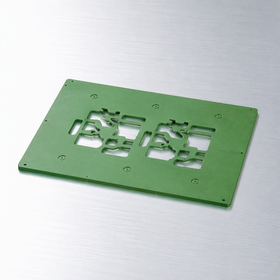
The era of compromising cleaning power for environmental considerations is over. In recent years, the manufacturing industry has been required to address VOC reduction, improvement of working environments, and ESG and environmental impact reduction. However, many workplaces still face the challenge that prioritizing environmental considerations leads to insufficient cleaning performance. The Palekrin series demonstrates excellent cleaning power through its high flux dissolution performance while also contributing to environmental improvement and labor-saving at the workplace. By efficiently removing flux residues, it supports the reduction of cleaning frequency and labor hours, making it an ideal cleaning agent for assembly sites where a balance of quality, environment, and productivity is required.
Added to bookmarks
Bookmarks listBookmark has been removed
Bookmarks listYou can't add any more bookmarks
By registering as a member, you can increase the number of bookmarks you can save and organize them with labels.
Free membership registration
If IPA doesn't work, you may need to change the cleaning agent. Flux residues adhered to flow pallets and reflow oven parts can harden over time, making them difficult to remove with IPA alone. As a result, prolonged scrubbing or multiple cleaning cycles may be necessary, increasing the burden on the site. The DIP pallet cleaning agent, the Paleclean series, is a specialized cleaning agent that demonstrates high solubility against stubborn flux and resin stains. By efficiently softening and removing adhered dirt, it shortens cleaning time while ensuring stable cleaning quality. It contributes to the efficiency of routine maintenance and reduces the workload.
Added to bookmarks
Bookmarks listBookmark has been removed
Bookmarks listYou can't add any more bookmarks
By registering as a member, you can increase the number of bookmarks you can save and organize them with labels.
Free membership registration
Are you choosing cleaning agents based solely on their cleaning power? When using alcohol-based or strong solvent cleaning agents, measures against fire risks and safety management are necessary. This is especially a significant challenge when used in conjunction with ultrasonic cleaning machines, where explosion prevention and ensuring safety during operation are major concerns. Locklin YD-99 is classified as a non-hazardous material under fire safety laws and does not fall under organic regulations or toxic substances. It maintains high cleaning power while ensuring safety, contributing to risk reduction and management burden alleviation in equipment maintenance operations. It is the ideal cleaning agent for sites that want to balance safety and work efficiency.
Added to bookmarks
Bookmarks listBookmark has been removed
Bookmarks listYou can't add any more bookmarks
By registering as a member, you can increase the number of bookmarks you can save and organize them with labels.
Free membership registration
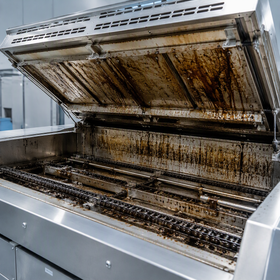
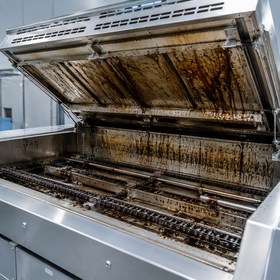
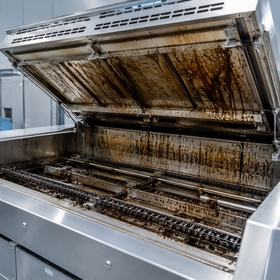
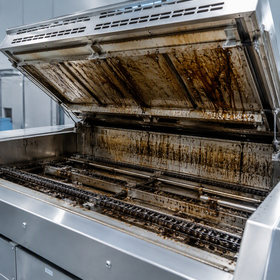
Stopped time does not generate profit. If cleaning the reflow oven takes too long, the downtime of production equipment increases, leading to a decrease in the operating rate of the manufacturing line. On the other hand, if the cleaning frequency is reduced, dirt can accumulate, resulting in a vicious cycle where cleaning time is further extended. Locklin YD-99 enhances the efficiency of traditional cleaning tasks due to its high flux dissolution performance. When used in conjunction with ultrasonic cleaning, it can clean complex-shaped internal components of the oven in a short time. It is a cleaning agent specifically designed for reflow ovens that supports the reduction of production losses due to shortened maintenance time and improves equipment operating rates.
Added to bookmarks
Bookmarks listBookmark has been removed
Bookmarks listYou can't add any more bookmarks
By registering as a member, you can increase the number of bookmarks you can save and organize them with labels.
Free membership registration
IPA does not remove it. It was developed for that purpose. Flux that has been heated for a long time can harden and carbonize, making it difficult to remove with IPA or general cleaning agents. As a result, wiping and re-cleaning tasks are repeated, leading to an increase in maintenance labor hours. Locklin YD-99 has more than three times the flux dissolving power of IPA and acts efficiently on hardened flux stains. It can be used not only for immersion cleaning but also in combination with ultrasonic cleaning, significantly reducing cleaning time. This ensures reliable cleaning in a short time and contributes to improving the productivity of equipment maintenance operations.
Added to bookmarks
Bookmarks listBookmark has been removed
Bookmarks listYou can't add any more bookmarks
By registering as a member, you can increase the number of bookmarks you can save and organize them with labels.
Free membership registration
Is there really no way to remove that dirt other than scraping it off? In the reflow oven, the inner walls of the chamber, the rectifying plates, and the conveyor components accumulate thick deposits of flux that have baked on due to repeated heating. Cleaning such dirt requires manual labor with scrapers and brushes, which places a significant burden on maintenance personnel. Locklin YD-99 is a specialized cleaning agent that penetrates baked-on flux, promoting softening and dissolution. By efficiently removing stubborn accumulated dirt, it shortens the cleaning time within the oven, achieving both improved efficiency in regular maintenance and a reduction in labor burden.
Added to bookmarks
Bookmarks listBookmark has been removed
Bookmarks listYou can't add any more bookmarks
By registering as a member, you can increase the number of bookmarks you can save and organize them with labels.
Free membership registration
Are you pushing the hassle of the cleaning equipment onto the person in charge? In the operation of cleaning equipment, tasks such as liquid replacement, waste liquid handling, and regular maintenance can become burdensome for on-site personnel. There are not infrequent cases where liquid gets on hands or clothing, or where the surrounding area becomes dirty, leading to dissatisfaction with the work environment and an increase in maintenance workload. The pallet cleaner adopts a user-friendly design that considers liquid supply, cleaning, drying, and waste liquid handling. It reduces the burden of daily maintenance while maintaining stable cleaning quality. It balances the reduction of worker burden with the efficiency of equipment operation, contributing to productivity improvements in both the maintenance and manufacturing departments.
Added to bookmarks
Bookmarks listBookmark has been removed
Bookmarks listYou can't add any more bookmarks
By registering as a member, you can increase the number of bookmarks you can save and organize them with labels.
Free membership registration
Is rinsing becoming more challenging than cleaning? In water-based cleaning, the rinsing and drying processes after cleaning are essential, leading to longer setup times and quality risks due to moisture residue. This is particularly problematic in environments with frequent process changes, where waiting for drying can become a bottleneck, even more so than the cleaning itself. The dedicated cleaner for pallets, "Pale Clean," is free of volatile components, eliminating the need for a water rinsing process. It simplifies the drying process after cleaning while also reducing the risk of residue transfer to the circuit boards. This achieves both a reduction in setup time and stabilization of quality simultaneously.
Added to bookmarks
Bookmarks listBookmark has been removed
Bookmarks listYou can't add any more bookmarks
By registering as a member, you can increase the number of bookmarks you can save and organize them with labels.
Free membership registration
Are you damaging your fixtures every time you clean them? While ultrasonic cleaning and brush cleaning have high cleaning power, they can sometimes cause physical damage to the pallet openings. Minor wear and deformation can affect mounting accuracy, leading to increased pallet replacement frequency and quality issues. The pallet cleaner is a system that combines the chemical dissolving power of a specialized cleaning agent with a unique shower cleaning method. By removing flux contamination without the impact of brushes or ultrasonic waves, it reduces the risk of wear and deformation of the openings. This contributes to the longevity of the pallets and helps reduce fixture management costs.
Added to bookmarks
Bookmarks listBookmark has been removed
Bookmarks listYou can't add any more bookmarks
By registering as a member, you can increase the number of bookmarks you can save and organize them with labels.
Free membership registration
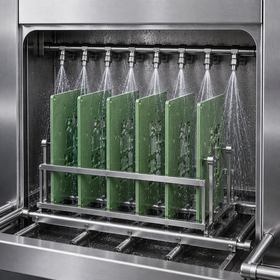
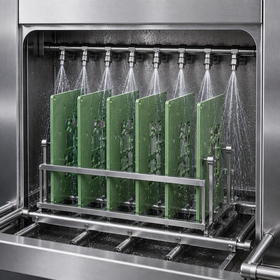
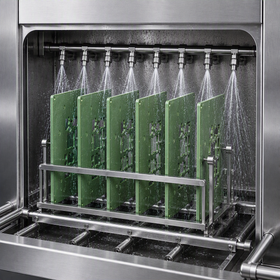
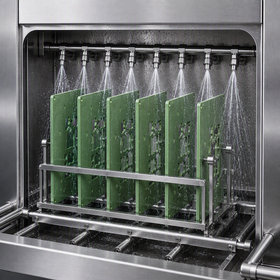
Isn't it time to end the era of manual washing? The task of scrubbing off flux and resin stains from flow pallets by hand requires a lot of time and labor costs. Especially in environments where multiple pallets are in operation, personnel involved in production are tied up with cleaning tasks, leading to decreased work efficiency. The pallet cleaner is a shower-type cleaning system that can wash up to 15 pallets at once. Once cleaning starts, you can leave it to the machine, significantly reducing the traditional scrubbing process. This allows for a reduction in work time and labor costs while enabling limited personnel to focus on more value-added tasks.
Added to bookmarks
Bookmarks listBookmark has been removed
Bookmarks listYou can't add any more bookmarks
By registering as a member, you can increase the number of bookmarks you can save and organize them with labels.
Free membership registration
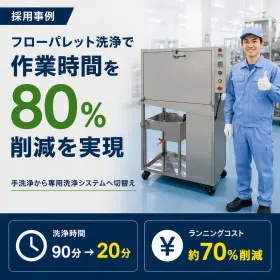
The flow palette accumulates flux and solder, so regular cleaning is necessary. However, hand cleaning not only takes time and labor but can also result in variations in cleaning quality. In this case, we will introduce an example where the introduction of a dedicated cleaning system achieved a reduction in cleaning time and labor savings.
Added to bookmarks
Bookmarks listBookmark has been removed
Bookmarks listYou can't add any more bookmarks
By registering as a member, you can increase the number of bookmarks you can save and organize them with labels.
Free membership registration
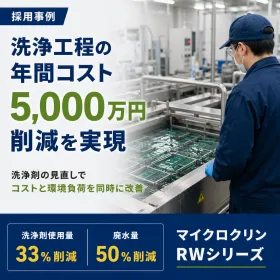
In the cleaning process of electronic components, various running costs arise, including not only cleaning agents but also the water used for rinsing and waste liquid treatment. This time, we will introduce a case where significant cost reduction was achieved while maintaining cleaning performance by switching the cleaning agent to the Microclean RW series.
Added to bookmarks
Bookmarks listBookmark has been removed
Bookmarks listYou can't add any more bookmarks
By registering as a member, you can increase the number of bookmarks you can save and organize them with labels.
Free membership registration
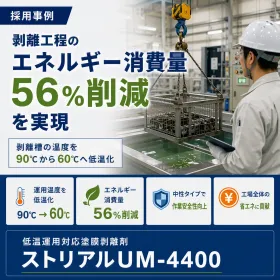
In the painting process of automobiles and automotive parts, a stripping process is necessary to regularly remove the paint film that adheres to the jigs. This time, we will introduce a case where we achieved a significant reduction in energy consumption while maintaining stripping performance by changing the stripping agent to Strial UM-4400.
Added to bookmarks
Bookmarks listBookmark has been removed
Bookmarks listYou can't add any more bookmarks
By registering as a member, you can increase the number of bookmarks you can save and organize them with labels.
Free membership registration
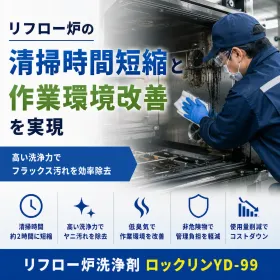
Inside the reflow oven, flux residue that has baked on due to heating accumulates, necessitating regular cleaning. This time, we will introduce a case where we reviewed cleaning with IPA and adopted Locklin YD-99, achieving a reduction in cleaning time and an improvement in the working environment.
Added to bookmarks
Bookmarks listBookmark has been removed
Bookmarks listYou can't add any more bookmarks
By registering as a member, you can increase the number of bookmarks you can save and organize them with labels.
Free membership registration
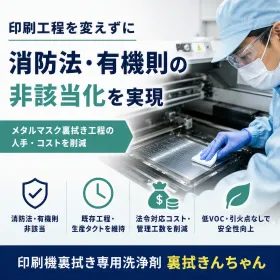
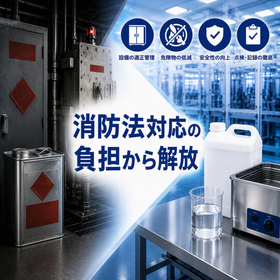
In the solder paste printing process, the back wiping process to remove the paste adhered to the back of the metal mask is essential. We will introduce a case where switching from the traditionally used IPA and ethanol to a dedicated cleaning agent has achieved a reduction in the burden of compliance with fire laws and organic regulations.
Added to bookmarks
Bookmarks listBookmark has been removed
Bookmarks listYou can't add any more bookmarks
By registering as a member, you can increase the number of bookmarks you can save and organize them with labels.
Free membership registration
The photopolymer resin used in 3D printers requires cleaning because resin adheres to the exterior and nozzle after printing. IPA is widely used for cleaning, but there are cases where compliance with organic regulations and fire safety laws is necessary. In this instance, we will introduce a case where the burden of compliance with organic regulations and fire safety laws was reduced by switching from IPA to a cleaning agent that is not subject to fire safety laws.
Added to bookmarks
Bookmarks listBookmark has been removed
Bookmarks listYou can't add any more bookmarks
By registering as a member, you can increase the number of bookmarks you can save and organize them with labels.
Free membership registration
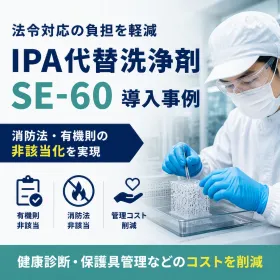
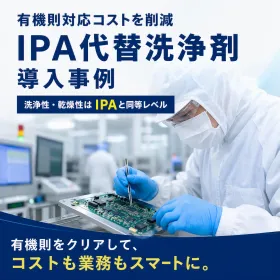
In the manufacturing site of electronic components, fine contaminants such as machining oils, grease, and dust can affect product quality, making the cleaning process essential. On the other hand, IPA falls under the organic regulations, requiring ongoing measures for health checks, protective equipment, and local exhaust systems. This document presents a case study of switching from IPA to a cleaning agent that is not subject to organic regulations, resulting in reduced compliance costs and management man-hours.
Added to bookmarks
Bookmarks listBookmark has been removed
Bookmarks listYou can't add any more bookmarks
By registering as a member, you can increase the number of bookmarks you can save and organize them with labels.
Free membership registration
Cleaning agents such as thinner, acetone, and IPA (isopropyl alcohol) have high cleaning performance, but many fall under hazardous materials according to fire safety laws. Therefore, various management burdens arise, such as managing storage quantities, storing in hazardous material storage facilities, and addressing explosion-proof equipment. In recent years, more companies have been switching to cleaning agents that are not classified as hazardous materials under fire safety laws to improve safety and reduce the burden of compliance. Main benefits of cleaning agents not classified as hazardous materials: - Easier to operate without worrying about designated quantities or storage methods for hazardous materials - Reduced reliance on explosion-proof equipment and hazardous material storage facilities - Improved safety due to reduced fire risk - Expected improvement in odor and working environment - Some products can be used in combination with ultrasonic cleaning machines
Added to bookmarks
Bookmarks listBookmark has been removed
Bookmarks listYou can't add any more bookmarks
By registering as a member, you can increase the number of bookmarks you can save and organize them with labels.
Free membership registration
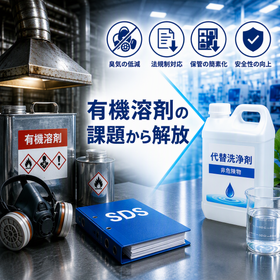
Typical organic solvents used in production processes include thinner, solvent, acetone, toluene, xylene, MEK (methyl ethyl ketone), and IPA (isopropyl alcohol). These solvents are widely used not only as diluents (thinner) for inks, paints, and pastes but also as cleaning solvents in various processes. This page refers to organic solvents and organic solvent-containing substances (Type 1 organic solvents, Type 2 organic solvents, Type 3 organic solvents) as "organic solvents" and introduces products that can replace organic solvents, such as acetone and cleaning thinners, according to their applications and cleaning targets. When handling organic solvents and organic solvent-containing substances subject to the Organic Solvent Regulation, obligations arise, such as appointing a work supervisor, implementing measures against the sources of organic solvent vapor emissions, managing the work environment, and conducting health management. The costs and efforts required to address these obligations, along with concerns about health hazards to workers, have led to an increase in customers considering alternatives to organic solvents. Recently, there has also been a growing number of customers exploring alternatives to organic solvents as part of chemical substance risk assessment measures.
Added to bookmarks
Bookmarks listBookmark has been removed
Bookmarks listYou can't add any more bookmarks
By registering as a member, you can increase the number of bookmarks you can save and organize them with labels.
Free membership registration
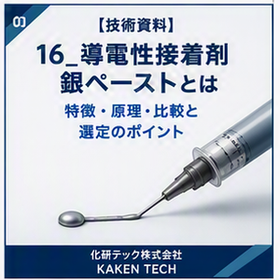
This document organizes the basic principles of conductive adhesive (silver paste), differences from solder, advantages and disadvantages, conductive mechanisms, typical material compositions, and points to check during selection.
Added to bookmarks
Bookmarks listBookmark has been removed
Bookmarks listYou can't add any more bookmarks
By registering as a member, you can increase the number of bookmarks you can save and organize them with labels.
Free membership registration
This document organizes the main regulations related to chemical substances used in industrial cleaning and representative target substances, and indicates the environmental and safety points that should be confirmed in the selection, use, storage, and disposal of cleaning agents.
Added to bookmarks
Bookmarks listBookmark has been removed
Bookmarks listYou can't add any more bookmarks
By registering as a member, you can increase the number of bookmarks you can save and organize them with labels.
Free membership registration
Regarding the regulatory standards for the storage and handling of hazardous materials as stipulated by the Fire Service Act, we will organize the list of designated quantities, calculation methods for multiples, and regulatory classifications, focusing on Class 4 flammable liquids.
Added to bookmarks
Bookmarks listBookmark has been removed
Bookmarks listYou can't add any more bookmarks
By registering as a member, you can increase the number of bookmarks you can save and organize them with labels.
Free membership registration
The purpose is to organize the definition of designated combustible materials, the target items and quantities, and the concept of reporting, so that the differences between combustible liquids and hazardous materials of Category 4 under the Fire Service Act can be confirmed. In practical management, always check the local municipal regulations and the latest information.
Added to bookmarks
Bookmarks listBookmark has been removed
Bookmarks listYou can't add any more bookmarks
By registering as a member, you can increase the number of bookmarks you can save and organize them with labels.
Free membership registration
This document organizes the flow from the introduction of risk assessment to the identification of hazards and harmful effects, estimation of risks, setting of priorities, reduction measures, and record-keeping, highlighting the key points for utilizing CREATE-SIMPLE in the evaluation of chemical substances.
Added to bookmarks
Bookmarks listBookmark has been removed
Bookmarks listYou can't add any more bookmarks
By registering as a member, you can increase the number of bookmarks you can save and organize them with labels.
Free membership registration
This document organizes the importance of metal mask cleaning and the differences in cleaning effectiveness when using IPA wipes, dedicated cleaning sprays, handheld ultrasonic cleaners, and automatic cleaning machines, highlighting key points that aid in maintaining print quality and reviewing the cleaning process.
Added to bookmarks
Bookmarks listBookmark has been removed
Bookmarks listYou can't add any more bookmarks
By registering as a member, you can increase the number of bookmarks you can save and organize them with labels.
Free membership registration
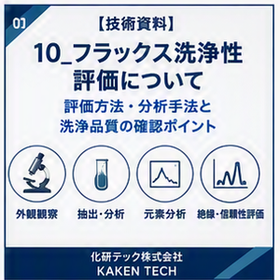
To confirm that residues have been sufficiently removed after flux cleaning, we will organize the evaluation methods for visual inspection, extraction method, elemental analysis, surface insulation characteristics, and dielectric characteristics, including evaluation targets, features, and points of caution.
Added to bookmarks
Bookmarks listBookmark has been removed
Bookmarks listYou can't add any more bookmarks
By registering as a member, you can increase the number of bookmarks you can save and organize them with labels.
Free membership registration
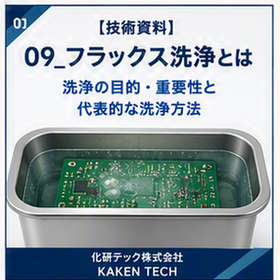
This document organizes the purpose and necessity of printed circuit board cleaning (flux cleaning), representative cleaning systems, targets for removal, post-cleaning evaluation, and physical cleaning methods, and presents the basics of process selection, including cleaning agents and cleaning equipment.
Added to bookmarks
Bookmarks listBookmark has been removed
Bookmarks listYou can't add any more bookmarks
By registering as a member, you can increase the number of bookmarks you can save and organize them with labels.
Free membership registration
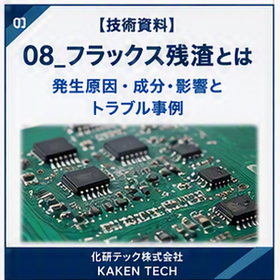
We will organize the mechanism of flux residue generation, the risks of issues if the residue is left unaddressed, the impact on product reliability, and the considerations for removal through cleaning.
Added to bookmarks
Bookmarks listBookmark has been removed
Bookmarks listYou can't add any more bookmarks
By registering as a member, you can increase the number of bookmarks you can save and organize them with labels.
Free membership registration
We will organize the characteristics and uses of ethanol, types based on synthesis methods, classifications according to regulations, and the differences between general alcohols, specific alcohols, and denatured alcohols included in industrial alcohol.
Added to bookmarks
Bookmarks listBookmark has been removed
Bookmarks listYou can't add any more bookmarks
By registering as a member, you can increase the number of bookmarks you can save and organize them with labels.
Free membership registration
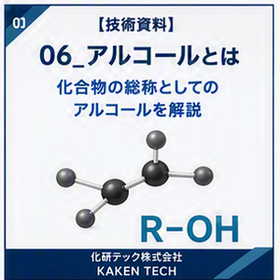
This text organizes the definition of the term "alcohol," which is widely used in everyday life, as a general term for a group of compounds, along with representative types, common properties, and classification based on valence and degree.
Added to bookmarks
Bookmarks listBookmark has been removed
Bookmarks listYou can't add any more bookmarks
By registering as a member, you can increase the number of bookmarks you can save and organize them with labels.
Free membership registration
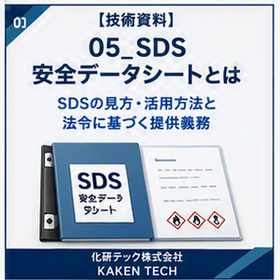
This document organizes the purpose of the SDS system, the differences from MSDS, the target chemicals and businesses under the Chemical Substances Control Law, and the 16 items listed in the SDS, clearly presenting the information that should be confirmed when handling chemicals.
Added to bookmarks
Bookmarks listBookmark has been removed
Bookmarks listYou can't add any more bookmarks
By registering as a member, you can increase the number of bookmarks you can save and organize them with labels.
Free membership registration
This document organizes the purpose and overview of the PRTR system, the criteria for determining target substances and businesses, the methods for calculating emissions and transfers, and the timing and methods for reporting, while highlighting key points to be confirmed in the practical management of chemical substances.
Added to bookmarks
Bookmarks listBookmark has been removed
Bookmarks listYou can't add any more bookmarks
By registering as a member, you can increase the number of bookmarks you can save and organize them with labels.
Free membership registration
We will organize the confirmation items for storage and handling of IPA used in cleaning processes and daily cleaning, from the perspectives of the Fire Service Act, Organic Solvent Poisoning Prevention Regulations, toxicity and harmfulness, flammability, VOCs, and cleaning efficacy.
Added to bookmarks
Bookmarks listBookmark has been removed
Bookmarks listYou can't add any more bookmarks
By registering as a member, you can increase the number of bookmarks you can save and organize them with labels.
Free membership registration
We will organize the substances, operations, and work locations subject to the Organic Law, and ensure that the necessary measures such as the appointment of a work supervisor, ventilation equipment, work environment measurement, posting, and health check-ups required for businesses can be confirmed.
Added to bookmarks
Bookmarks listBookmark has been removed
Bookmarks listYou can't add any more bookmarks
By registering as a member, you can increase the number of bookmarks you can save and organize them with labels.
Free membership registration
This document provides foundational information for selecting cleaning agents, including the definition of organic solvents, their main types, applications in manufacturing and implementation processes, health and fire risks, and their relationship with organic regulations, while also addressing safety and legal compliance.
Added to bookmarks
Bookmarks listBookmark has been removed
Bookmarks listYou can't add any more bookmarks
By registering as a member, you can increase the number of bookmarks you can save and organize them with labels.
Free membership registration
In the field of industrial robots, stable operation in harsh environments and long-term use are required. Particularly in robots equipped with precision electronic components, the removal of flux residues is essential for preventing electrical and physical troubles. The ionic components of flux residues can cause ion migration under high humidity, potentially leading to short circuits between electrodes and a decrease in insulation reliability. Additionally, in high-temperature and high-humidity environments, halogen ions can cause corrosion, which may accelerate the degradation of components. If flux residues adhere to contact points such as connectors, it can lead to connection failures, resulting in erroneous operation or functional shutdown of the robot. To prevent these issues and enhance the durability of industrial robots, appropriate flux cleaning is crucial. 【Application Scenes】 - Precision circuit boards of robotic arms - Electronic circuits inside control panels - Peripheral components of sensors - Connector areas 【Effects of Implementation】 - Maintenance of insulation reliability - Prevention of corrosion - Reduction of connection failures - Mitigation of short circuit risks - Maintenance of bonding strength in wire bonding
Added to bookmarks
Bookmarks listBookmark has been removed
Bookmarks listYou can't add any more bookmarks
By registering as a member, you can increase the number of bookmarks you can save and organize them with labels.
Free membership registration
The purpose and reason for cleaning flux is to prevent the occurrence of electrical and physical troubles. The ionic components of flux residues can cause ion migration under high humidity, leading to metal deposition between electrodes and resulting in short circuits. Additionally, the presence of halogen ions under high temperature and high humidity can generate halogen compounds, causing degradation and collapse. Furthermore, if flux residues adhere to contact points such as connectors, it can lead to poor connections. 【Troubles to Prevent (Partial List)】 ■ Decreased insulation reliability ■ Corrosion ■ Poor connections ■ Leaks or shorts due to residual solder balls ■ Decreased bonding strength in wire bonding *For more details, please refer to the related links or feel free to contact us.
Added to bookmarks
Bookmarks listBookmark has been removed
Bookmarks listYou can't add any more bookmarks
By registering as a member, you can increase the number of bookmarks you can save and organize them with labels.
Free membership registration
When selecting a cleaning method for flux, it is necessary to consider not only the cleaning performance but also the environmental impact, safety, the burden on operators (such as frequent liquid changes and waste liquid disposal), running costs, and to understand the advantages and disadvantages. Bromine-based and alternative fluorocarbon cleaning systems use cleaning agents that have no flash point and are very safe, and can be used with the same equipment as previous fluorocarbons. Hydrocarbon-based cleaning systems often require explosion-proof measures for the equipment and typically use cleaning agents that have a flash point. Additionally, there are types such as semi-aqueous systems and water-containing alcohol-based cleaning systems. [Bromine-based and Alternative Fluorocarbon Cleaning System Overview] ■ Cleaning Process: Alternative fluorocarbons or bromine-based cleaning agents ■ Rinsing Process: Clean cleaning agent vapor ■ Drying Process: Natural drying *For more details, please refer to the related links or feel free to contact us.
Added to bookmarks
Bookmarks listBookmark has been removed
Bookmarks listYou can't add any more bookmarks
By registering as a member, you can increase the number of bookmarks you can save and organize them with labels.
Free membership registration
Flux, which is often heard in the soldering process, is an auxiliary agent for soldering and plays a role in making soldering possible. This time, I will explain what flux residue is, which remains after soldering, as well as the troubles caused by flux residue and their countermeasures. The components that make up flux, such as rosin and activators, react with the oxide film on the metal surface during the soldering process, dissolving and removing the oxides, thus enabling soldering. However, at the same time as soldering, "flux residue" (the burnt remnants after the reaction) is generated. *For more detailed information, you can view the related links. Please feel free to contact us for more details.
Added to bookmarks
Bookmarks listBookmark has been removed
Bookmarks listYou can't add any more bookmarks
By registering as a member, you can increase the number of bookmarks you can save and organize them with labels.
Free membership registration
The "Micro Cleaner EC-8100 / Markless ECO-R81" is a cleaning agent and rinse agent for the flux cleaning system "Micro Cleaner," which is essential for high-density mounting. Thanks to its innovative cleaning mechanism, it can clean flux in narrow gaps of 50μm or less. It also excels in removing difficult-to-remove particles such as tiny solder balls, grease, and fine particles. About 70% of its ingredients are composed of water, which helps reduce VOC emissions during drying processes and evaporation. Additionally, it has no flash point and is not classified as a hazardous material under fire safety laws, making it suitable for international transport as a regular product. 【Features】 ■ Excellent cleaning ability for narrow gaps and particle removal ■ Environmentally friendly with low VOC and non-hazardous ■ Continuously distilled and regenerated within the device, requiring almost no liquid replacement (Markless ECO-R81) *For more details, please refer to the PDF document or feel free to contact us.
Added to bookmarks
Bookmarks listBookmark has been removed
Bookmarks listYou can't add any more bookmarks
By registering as a member, you can increase the number of bookmarks you can save and organize them with labels.
Free membership registration
The Palekrin series is a cleaning agent used for flow pallets and parts of reflow ovens (such as radiators) in the flow process, effectively removing adhered flux stains. The Palekrin series does not require liquid management, such as moisture adjustment. Additionally, since it does not contain non-volatile components like surfactants, there is no concern about surface wetting of the cleaned items due to residues, and a dedicated rinsing process after use is also unnecessary.
Added to bookmarks
Bookmarks listBookmark has been removed
Bookmarks listYou can't add any more bookmarks
By registering as a member, you can increase the number of bookmarks you can save and organize them with labels.
Free membership registration
TK PASTE is a silver paste/conductive adhesive with the following features: 1. Uses TK silver powder with controllable silver shape and particle size. 2. Achieves various functions such as low resistance, low silver content, and high reliability. 3. Exhibits good continuous dispensing performance with dispensers.
Added to bookmarks
Bookmarks listBookmark has been removed
Bookmarks listYou can't add any more bookmarks
By registering as a member, you can increase the number of bookmarks you can save and organize them with labels.
Free membership registration
Flow Palette Reflow Furnace Parts Cleaning System - Palette Cleaner! Fast... It enables shorter cleaning times than soaking with a shower-type cleaning machine. Easy... Just set the dirty palettes or workpieces in the palette cleaner. No need to scrub with brushes or cloths. Affordable... By using a dedicated cleaning agent (Pale Clean series) with a long liquid lifespan, it allows for operation at low running costs.
Added to bookmarks
Bookmarks listBookmark has been removed
Bookmarks listYou can't add any more bookmarks
By registering as a member, you can increase the number of bookmarks you can save and organize them with labels.
Free membership registration