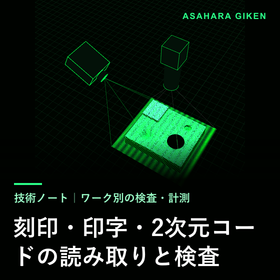
Concept of inspection for engraving, printing, and 2D code reading.
The reasons why engravings, prints, and 2D codes may not be readable are often due to insufficient contrast between the characters and the background or reflections from glossiness. Printed text is read based on the difference in brightness, while engravings are read through the shadows of the unevenness, which means the lighting needs to be adjusted accordingly. Engravings on metals or curved surfaces that do not show contrast may sometimes be readable in 3D by interpreting the unevenness. [Key Points] ■ Many unreadable cases are due to lack of contrast and reflections. ■ Printed text is read by brightness, while engravings are read by shadows of unevenness. ■ For engravings that do not show contrast, there is a method to read the unevenness in 3D. *For detailed explanations, please refer to the technical notes and downloadable materials in the related links.
Inquire About This Product
basic information
**Contents of this Technical Note** - Reading and inspecting engravings and prints are separate tasks: Can it be read, and is the quality sufficient? - The difficulty in reading engravings arises from the lack of contrast. - The appearance of ink, laser printing, dot stamping, and the lighting that suits them. - Characters with uneven surfaces, like stamps, are read by shadows or in 3D. - Shallow engravings, worn characters, and 2D codes on shiny surfaces are hard to read. - For 2D codes, it's important not only to see if they can be read but also to assess the margin for reading. - Verify the readable range with actual examples of faded or shallow engravings. **Consultation** We will confirm whether it can be measured or captured with your workpiece by checking the actual item. Please consult us with a photo.
Price information
The technical notes can be read by anyone from the related links. We will discuss the costs of development and testing based on the details you provide.
Delivery Time
※It varies depending on the content. Please contact us.
Applications/Examples of results
【Frequently Asked Questions】 Q. I just can't read the stamped metal characters. A. Sometimes you can read them by shining low-angle light from several directions. If that doesn't work, try measuring the indentation in 3D. Stamps that are too shallow may be unreadable. Q. How can I improve the reading rate of 2D codes? A. The basics are to choose lighting that provides contrast and to avoid reflections. Reviewing the placement, size, and print quality of the code can also be effective. Q. Can print quality be managed numerically? A. It is possible to quantify issues like smudging, chipping, and misalignment to track trends. The standards will be determined based on the requirements of the client and the operations on-site.
catalog(2)
Download All Catalogs![[Technical Document] Automation of Visual Inspection: Approach and Common Pitfalls, How to Capture Images and Choose Lighting Before AI](https://image.mono.ipros.com/public/catalog/image/2115800/IPROS9310882243773939791.png?w=120&h=170)
![[Sample Test Information] Before the estimate, we will let you know whether it can be measured (visual inspection and 3D measurement).](https://image.mono.ipros.com/public/catalog/image/2115800/IPROS16473448823474693670.png?w=120&h=170)
Company information

We specialize in 2D and 3D inspection and measurement technologies using cameras. We possess a wide range of knowledge in optics, mechanics, electronics, and software, enabling us to provide technical support for both hardware and software. Not only do we have personnel with experience working as researchers at image inspection device manufacturers, major electronic component manufacturers, and universities, but we also have numerous successful implementations of developed products in actual production environments, making our ability to adapt advanced technology to on-site needs a strong point. Additionally, we are skilled not only in developing proprietary algorithms but also in using off-the-shelf products such as image processing controllers from Keyence and Omron, allowing us to excel in selecting and utilizing the most suitable equipment for specific needs. In recent years, while AI technology has garnered attention, there are cases where utilizing 2D and 3D technologies can be implemented more easily than AI, and cases where optical devices and mechanical jigs can improve performance and reduce software load. We offer services related to image systems, including "equipment selection," "implementation support," "performance improvement of existing equipment," "technology development," and "joint development," so please feel free to consult with us first.