
List of Scientific and Physics Equipment products
- classification:Scientific and Physics Equipment
2221~2235 item / All 36048 items


Reduce the workload from handling heavy objects! Here are five case studies that solved customer challenges! We are also accepting free consultations and tests tailored to your work!

- Other conveying machines


Ideal for micro-machining! Achieves deburring of holes and double-sided machining in one pass, which was difficult with conventional tools!

- Other machine tools

We will be exhibiting at Mecatronics Tech Japan 2021 from October 20 (Wednesday) to October 23 (Saturday)!
Our company will exhibit at "Mechatrotech Japan 2021," which will be held at Portmesse Nagoya from Wednesday, October 20 to Saturday, October 23, 2021. We will introduce our tools, including the 'Bar Off Tool' capable of chamfering and deburring from a diameter of 0.8 mm, and the 'FEM' tool breakage detection device that reliably detects breakage. We look forward to your visit. (Booth number: 2B12)


【Primer and Binder Applications】By using it as a base material on substrates that repel paint, it facilitates painting and printing.


- paint
- Surface treatment contract service
- Chemicals


Improving the performance of EVs in cold climates. Contributing to extended driving range and maintaining charging capacity [Exhibiting at the 2025 Automotive Technology Exhibition].
- Other heaters
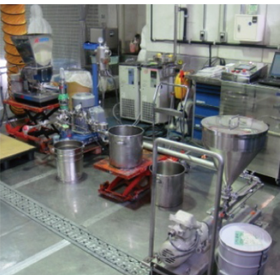

Quality changes with dispersion. Pre-validation of the reproducibility of resin materials through testing.

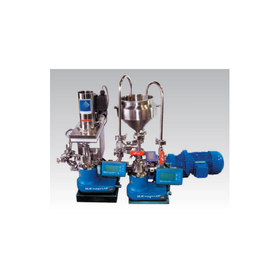
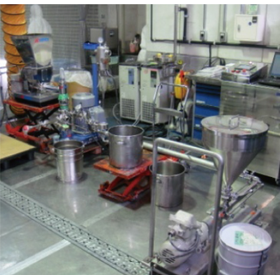
- Emulsifier/Disperser
- Vacuum degassing machine
- Dispersion/emulsification equipment/homogenizer
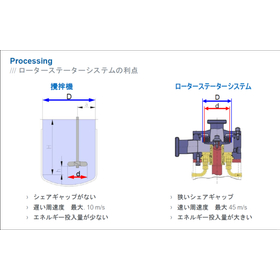
What are the reasons for changes in results from the lab to mass production? Causes and countermeasures for the deterioration of distributed quality during scale-up.
Despite obtaining good dispersion results in the lab, the challenge of unstable quality upon mass production occurs in many settings. The main cause of this is that the dispersion conditions are not replicated due to differences in scale. In lab equipment, the smaller size leads to higher energy density, making shear and flow more uniform, while in mass production equipment, the larger scale often results in insufficient dispersion energy at the same rotational speed and processing time. Additionally, differences in equipment structure and flow patterns can cause variations in the shear history and residence time experienced by particles, leading to differences in the dispersion state. Furthermore, simple scale-up does not ensure that critical parameters such as flow rate, residence time, and shear intensity match, making it difficult to reproduce the same results as in the lab. To address these challenges, it is essential to focus on process design based on dispersion energy density and flow conditions rather than merely increasing equipment size. By designing the system so that particles pass through the processing area under consistent conditions, it is possible to achieve reproducible dispersion quality even when the scale changes, as seen in inline continuous processing.
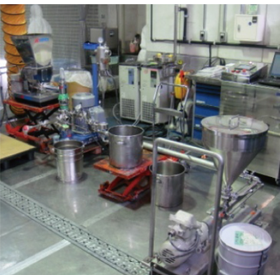
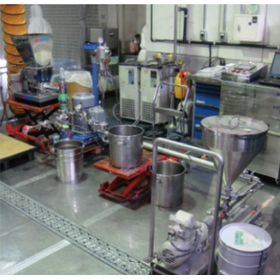
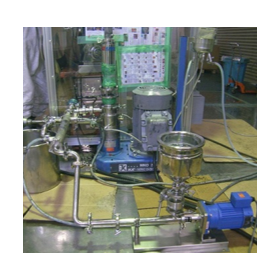
The strength is determined by the variance. Visualize quality variations through testing before mass production.

- Emulsifier/Disperser
- Vacuum degassing machine
- Dispersion/emulsification equipment/homogenizer
What are the reasons for changes in results from the lab to mass production? Causes and countermeasures for the deterioration of distributed quality during scale-up.
Despite obtaining good dispersion results in the lab, the challenge of unstable quality upon mass production occurs in many settings. The main cause of this is that the dispersion conditions are not replicated due to differences in scale. In lab equipment, the smaller size leads to higher energy density, making shear and flow more uniform, while in mass production equipment, the larger scale often results in insufficient dispersion energy at the same rotational speed and processing time. Additionally, differences in equipment structure and flow patterns can cause variations in the shear history and residence time experienced by particles, leading to differences in the dispersion state. Furthermore, simple scale-up does not ensure that critical parameters such as flow rate, residence time, and shear intensity match, making it difficult to reproduce the same results as in the lab. To address these challenges, it is essential to focus on process design based on dispersion energy density and flow conditions rather than merely increasing equipment size. By designing the system so that particles pass through the processing area under consistent conditions, it is possible to achieve reproducible dispersion quality even when the scale changes, as seen in inline continuous processing.
Resolve issues of not dissolving and clumping in advance. Test the dispersibility of the protein.

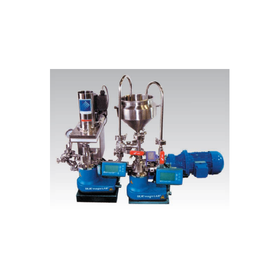
- Emulsifier/Disperser
- Vacuum degassing machine
- Dispersion/emulsification equipment/homogenizer
What are the reasons for changes in results from the lab to mass production? Causes and countermeasures for the deterioration of distributed quality during scale-up.
Despite obtaining good dispersion results in the lab, the challenge of unstable quality upon mass production occurs in many settings. The main cause of this is that the dispersion conditions are not replicated due to differences in scale. In lab equipment, the smaller size leads to higher energy density, making shear and flow more uniform, while in mass production equipment, the larger scale often results in insufficient dispersion energy at the same rotational speed and processing time. Additionally, differences in equipment structure and flow patterns can cause variations in the shear history and residence time experienced by particles, leading to differences in the dispersion state. Furthermore, simple scale-up does not ensure that critical parameters such as flow rate, residence time, and shear intensity match, making it difficult to reproduce the same results as in the lab. To address these challenges, it is essential to focus on process design based on dispersion energy density and flow conditions rather than merely increasing equipment size. By designing the system so that particles pass through the processing area under consistent conditions, it is possible to achieve reproducible dispersion quality even when the scale changes, as seen in inline continuous processing.

From October 29 (Tuesday) to 31 (Thursday), 2024! We will be exhibiting small ultrasonic dispersion devices and ultrasonic generators!



- Emulsifier/Disperser
- Powder Supply Device
- Dispersion/emulsification equipment/homogenizer
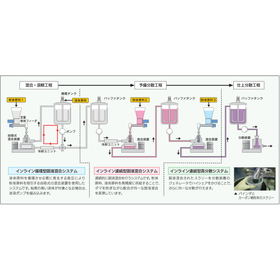
What is decentralized process design? Key points for stabilizing quality.
In dispersion engineering, stable quality cannot be achieved solely based on the performance of the equipment. What is important is the overall design of the process, taking into account material properties and process conditions. This is referred to as dispersion process design. Dispersion quality is determined not only by the strength of shear but also by multiple factors such as flow state, residence time, and method of input. If these conditions are not properly designed, localized agglomeration or variation can occur, making it difficult to maintain stable quality. For example, poor wetting during powder input or the occurrence of stagnant areas due to flow bias can lead to clumping or dispersion issues. Additionally, even if the shear energy is sufficient, if it does not act uniformly on all particles, differences in dispersion state will arise. Therefore, in dispersion processes, it is crucial to design "flow," "shear," and "processing time" as an integrated system. This allows for all particles to receive the same dispersion history, achieving uniform and highly reproducible dispersion quality. In particular, inline continuous processing has the advantage of maintaining consistent conditions within the flow, making it easier to ensure reproducibility in process design. Dispersion process design is a key concept for stabilizing quality and successfully scaling up.
![[PH Case Study] Optimizing Surface ...](https://image.mono.ipros.com/public/product/image/347234/IPROS14864001458542702032.png?w=280&h=280)

The adhesion strength is further improved compared to the composite treatment of nitriding and coating! It also suppresses the decrease in lifespan during re-surfacing.
- Surface treatment contract service