We have compiled a list of manufacturers, distributors, product information, reference prices, and rankings for Coating.
ipros is IPROS GMS ・ IPROS One of the largest technical database sites in Japan that collects information on.

Coating Product List and Ranking from 566 Manufacturers, Suppliers and Companies | IPROS GMS

Last Updated: Aggregation Period:Oct 28, 2026~Nov 24, 2026
This ranking is based on the number of page views on our site.

Coating Manufacturer, Suppliers and Company Rankings

Last Updated: Aggregation Period:Oct 28, 2026~Nov 24, 2026
This ranking is based on the number of page views on our site.

  1. 吉田SKT Aichi//Manufacturing and processing contract
  2. フロロテクノロジー Aichi//Chemical
  3. 日建塗装工業 Tokyo//Manufacturing and processing contract
  4. 4 フロロコート Saitama//others
  5. 5 中央自動車工業 営業開発部 営業推進グループ Osaka//Machine elements and parts

Coating Product ranking

Last Updated: Aggregation Period:Oct 28, 2026~Nov 24, 2026
This ranking is based on the number of page views on our site.

  1. Understand the differences between PTFE, PFA, FEP, and ETFE! Technical materials available. 吉田SKT
  2. Advantages and disadvantages of re-coating a non-stick frying pan. 吉田SKT
  3. Outstanding non-stick properties! Introducing "Plasma Coat." 大阪ガスケミカル株式会社 奈良表面加工センター
  4. 4 Causes of Teflon coating peeling and how to address them. 吉田SKT
  5. 5 High-performance coating "Glass Water Repellent Agent SKATO 360" 中央自動車工業 営業開発部 営業推進グループ

Coating Product List

2611~2640 item / All 3010 items

Displayed results

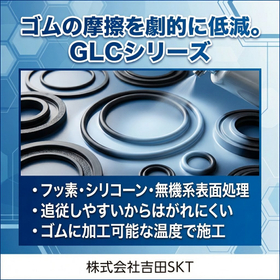
Why is the surface of rubber non-slip? = High friction characteristics and methods for reducing friction =

The "slip resistance" of rubber products is an inherent characteristic, but in some applications, slip properties are necessary.

Rubber generally has a high coefficient of friction and is a material that is not easy to slip on. ■ Why is rubber not slippery? Rubber is a material that easily undergoes elastic deformation. When pressed against a surface, it deforms along the contours, increasing the contact area. The larger the contact area, the greater the frictional force. Additionally, the surface of rubber may have tackiness, which increases friction and adhesion. ■ Cases where slip resistance is required In rubber O-rings, gaskets, and sealing components, smooth insertion during assembly and low friction during sliding are required. ■ Please consult us first The optimal measures vary depending on the type of rubber and the usage environment. Yoshida SKT's GLC series is a specialized coating that imparts low friction properties to the rubber surface. For more details, please download the materials and check.

  • Surface treatment contract service
  • Coating

Added to bookmarks

Bookmarks list

Bookmark has been removed

Bookmarks list

You can't add any more bookmarks

By registering as a member, you can increase the number of bookmarks you can save and organize them with labels.

Free membership registration

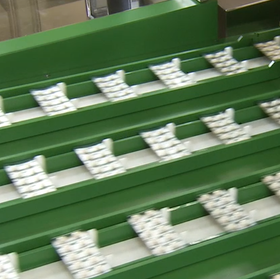
Transport blockage and adhesion countermeasures! Improved sliding property coating.

Products get stuck in the chute, adhere to the transport guide, and powders do not flow | A coating that improves sliding to prevent product jams and keeps the line running.

Product jams and sticking in transport shoots and guides are typical challenges that reduce productivity, leading to line stoppages and recovery efforts by operators. Functional surface treatments have become essential technologies in production sites to improve sliding during transport and prevent product jams. We offer a range of options tailored to the transported items and usage conditions, from coatings that utilize the low friction properties of fluororesins to organic-inorganic composite types that enhance durability, and types that reduce contact area with convex structures. [Examples of coatings that improve sliding properties] - Fluororesin coating: Low friction coefficient and excellent lubricity. Water and oil repellent, making it difficult for dirt to adhere. - Bi-Coat: Enhances sliding properties for automatic packaging machine transport guides, transport line shoots, and powder transport sections. Suitable when durability is also a priority. - TP/Super TP series: Excellent sliding properties due to reduced contact area, compatible with sticky transported items. - Safe-Fron: Addresses transport troubles related to adhesion caused by static electricity. [Expected effects] - Suppression of line stoppages due to product jams and sticking. - Reduction of labor hours for cleaning and recovery in transport sections. - Decreased replacement costs due to extended component lifespan. *For more details, please download the materials and check.

  • Processing Contract
  • Coating

Added to bookmarks

Bookmarks list

Bookmark has been removed

Bookmarks list

You can't add any more bookmarks

By registering as a member, you can increase the number of bookmarks you can save and organize them with labels.

Free membership registration

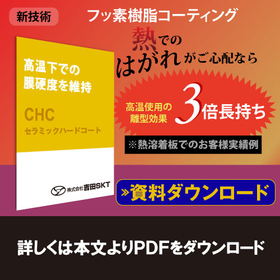
Heat-resistant coating that maintains release properties even at high temperatures *Materials available upon request.

At high temperatures, the coating becomes soft, reducing release properties and causing resin to adhere to the heat seal. A coating that maintains hardness and release properties even in high-temperature environments above 200°C.

In high-temperature processes such as resin molding, heat sealing, and high-temperature pressing, common coatings face challenges such as reduced film hardness and decreased release properties. Our company offers a lineup of coatings developed for high-temperature environments. "CHC (Ceramic Hard Coat)" minimizes the decrease in film hardness at temperatures above 200°C through the combination of ceramics and fluororesin, maintaining release properties for an extended period. 【Examples of coatings suitable for high-temperature environments】 ■ CHC: For resin molding molds (high-temperature release), heat sealing devices, components in contact with molten resin, and high-temperature pressing molds. ■ Fluororesin coating (PTFE): Heat resistance with a continuous use temperature of 260°C. 【Expected effects】 ■ Reduction of release failures and adhesion troubles in high-temperature processes. ■ Extension of reprocessing and replacement cycles due to the long lifespan of the coating. *For more details, please download the materials and check.

  • Surface treatment contract service
  • Coating

Added to bookmarks

Bookmarks list

Bookmark has been removed

Bookmarks list

You can't add any more bookmarks

By registering as a member, you can increase the number of bookmarks you can save and organize them with labels.

Free membership registration

Explanation: The difference between Biocote® and fluoropolymer coatings.

High hardness, resistant to scratches and wear. Non-stick coating that withstands long-term use.

"Bi-Coat®" is a coating that achieves excellent non-stick and release properties through a treatment that combines inorganic and organic materials. Compared to conventional fluoropolymer coatings, it has high hardness, is resistant to scratches, and experiences less wear, making it durable for long-term use. It also has high dimensional accuracy and is suitable for applications requiring micron-level precision. *For detailed explanations, please check the link.*

  • Surface treatment contract service
  • Coating

Added to bookmarks

Bookmarks list

Bookmark has been removed

Bookmarks list

You can't add any more bookmarks

By registering as a member, you can increase the number of bookmarks you can save and organize them with labels.

Free membership registration

Selection Guide: How to Choose BiCote® Grades

Iron, stainless steel, aluminum, copper alloys... We propose the optimal grade tailored to the base material and usage environment.

The grades of "Bicoat(R)" are selected based on the usage environment and required performance. There are three main criteria for selection: (1) Type of substrate: Since compatibility varies depending on the substrate, such as iron, stainless steel, aluminum, or copper alloys, selection must be tailored to the substrate. (2) Operating temperature (3) The type of substances in contact will also affect the optimal grade. After understanding the specific usage environment and performance requirements, our technical sales representatives will propose the most suitable grade. Please feel free to consult with us.

  • Surface treatment contract service
  • Coating

Added to bookmarks

Bookmarks list

Bookmark has been removed

Bookmarks list

You can't add any more bookmarks

By registering as a member, you can increase the number of bookmarks you can save and organize them with labels.

Free membership registration

Main applications of "Bycoat(R)" - from mold release to sliding parts.

Prevention of resin adhesion, wear resistance, and improved slip properties. Safe to use in areas subject to mechanical loads.

"Bycoat(R)" is suitable for preventing resin adhesion and improving release properties in injection molding molds, and can also be used in precision molds where micron-level dimensional accuracy is required. It provides excellent lubrication for guides and chutes in various packaging machines, achieving wear resistance and improved sliding in areas where friction occurs. It is also useful for releasing components that come into contact with particularly adhesive substances, such as adhesives. Due to its excellent durability, it can be confidently used in applications subject to mechanical loads, such as IC encapsulation cavities, piezoelectric ceramic manufacturing equipment, molds for rubber and resin, and sliding parts.

  • Surface treatment contract service
  • Coating

Added to bookmarks

Bookmarks list

Bookmark has been removed

Bookmarks list

You can't add any more bookmarks

By registering as a member, you can increase the number of bookmarks you can save and organize them with labels.

Free membership registration

Case Studies: 8 Examples of Bicoat® Applications

From PET bottle molds to heat sealers. We will introduce examples of solving on-site challenges.

Here are some representative application examples of "Bicoat(R)." In blow molding molds for PET bottles, a release coating on the inner surface prevents the adhesion of softened PET resin due to heat, reducing maintenance burdens while maintaining the transparency of the PET bottles. In heat sealers for pillow packaging machines, non-stick and wear-resistant properties prevent resin adhesion and improve productivity. Additionally, it demonstrates effectiveness in a wide range of applications, including decorative sheet transfer molds, transport jigs, vacuum transfer molds, suction pads, ejector pins, and biodegradable plastic molding molds.

  • Surface treatment contract service
  • Coating

Added to bookmarks

Bookmarks list

Bookmark has been removed

Bookmarks list

You can't add any more bookmarks

By registering as a member, you can increase the number of bookmarks you can save and organize them with labels.

Free membership registration

PFAS-free compatible 'Bicoat(R)' product line expansion

There are product numbers that do not contain PFAS (fluororesin). Development of next-generation PFAS-free products is also underway.

Bikote(R) also offers PFAS-free product numbers that do not contain PFAS (fluororesin). For information on the presence or absence of PFAS for each product number, please contact us. Additionally, we are advancing the development of environmentally friendly PFAS-free coatings as part of our next-generation product development. If you are considering compliance with PFAS regulations, please feel free to consult with us.

  • Surface treatment contract service
  • Coating

Added to bookmarks

Bookmarks list

Bookmark has been removed

Bookmarks list

You can't add any more bookmarks

By registering as a member, you can increase the number of bookmarks you can save and organize them with labels.

Free membership registration

【Selection Guide】How to Choose SafeLon(R) Grades

The corrosion resistance is AP+, the anti-fouling and release properties are AS+, the low friction and resin substrate are LF+, and the transparency is CC+.

The various grades of "Saflon(R)" are selected based on the usage environment and required performance. For applications where corrosion resistance is particularly important, "Saflon(R) AP+" is suitable, while "Saflon(R) AS+" is appropriate for environments requiring stain resistance and release properties. If lubrication is needed or for applications on heat-sensitive substrates like resins, please choose "Saflon(R) LF+," and for applications requiring transparency, "Saflon(R) CC+" is recommended. After understanding your specific usage environment and performance requirements, our technical sales representatives will propose the optimal grade. Please feel free to consult with us.

  • Surface treatment contract service
  • Coating

Added to bookmarks

Bookmarks list

Bookmark has been removed

Bookmarks list

You can't add any more bookmarks

By registering as a member, you can increase the number of bookmarks you can save and organize them with labels.

Free membership registration

Seafron(R) LF+ - Low friction and low temperature processing product number as well.

Compatible with resin substrates at low-temperature processing numbers below 100℃. Excellent coating hardness and abrasion resistance.

"SafeLon(R) LF+" is a grade developed as a new option for applications that require not only static electricity prevention but also mechanical strength, which the conventional SafeLon(R) series could not adequately address. LF stands for "Low Friction," meaning it has a low coefficient of friction and excellent lubricity. It also excels in coating hardness and wear resistance, making it suitable for applications that require mechanical strength. Furthermore, while conventional fluoropolymer coatings typically require firing at around 400°C, there are product numbers that allow for low-temperature processing below 100°C, making it applicable not only to metals but also to resin substrates.

  • Surface treatment contract service
  • Coating

Added to bookmarks

Bookmarks list

Bookmark has been removed

Bookmarks list

You can't add any more bookmarks

By registering as a member, you can increase the number of bookmarks you can save and organize them with labels.

Free membership registration

【Technical Q&A】Compatible substrates for Saflon® - including resins -

Compatible with iron, stainless steel, aluminum, and copper alloys. With LF+, low-temperature processing is also possible for resin substrates.

The substrates compatible with "Safron(R)" include iron (ferrous materials), stainless steel (SUS), and aluminum. Additionally, some grades such as "Safron(R) LF+" are available in types that can be processed at low temperatures below 100°C, making them applicable to substrates with low heat resistance, such as resins. The applicability and pretreatment methods vary depending on the type and condition of the substrate, so please consult our technical sales representative for specific applicability.

  • Surface treatment contract service
  • Coating

Added to bookmarks

Bookmarks list

Bookmark has been removed

Bookmarks list

You can't add any more bookmarks

By registering as a member, you can increase the number of bookmarks you can save and organize them with labels.

Free membership registration

Reasons why silicone excels in release properties - Low surface tension.

The property of good repellency creates water resistance and release properties. MRS further imparts solvent resistance and hardness, among others.

The main reason why silicone coatings excel in release properties is their "excellent repellency (low surface tension)." This property exhibits "water repellency" against water and "release properties" against sticky substances. Because silicone has low surface tension, it does not easily adhere to other materials, resulting in superior release and water-repellent properties. MRS coatings are an innovative coating that leverages these silicone properties while incorporating characteristics such as solvent resistance, high hardness, and high heat resistance, which were difficult to achieve with conventional silicone coatings.

  • Surface treatment contract service
  • Coating

Added to bookmarks

Bookmarks list

Bookmark has been removed

Bookmarks list

You can't add any more bookmarks

By registering as a member, you can increase the number of bookmarks you can save and organize them with labels.

Free membership registration

『MRSコーティング』のPFASフリー対応について

シリコーン主成分。新ラインナップはPFAS(フッ素樹脂)を含まず提供

MRSコーティングはシリコーンを主成分としており、新ラインナップではPFAS(フッ素樹脂)を含まないPFASフリー製品として提供しています。 シリーズごとのPFAS使用有無については、当社までお問い合わせください。 また当社では次世代製品の開発として、環境に配慮したPFASフリーコーティングの開発も進めています。

  • Surface treatment contract service
  • Coating

Added to bookmarks

Bookmarks list

Bookmark has been removed

Bookmarks list

You can't add any more bookmarks

By registering as a member, you can increase the number of bookmarks you can save and organize them with labels.

Free membership registration

For those struggling with paint removal from painting jigs.

Reduce stripping and cleaning, and create a jig surface that is less prone to paint buildup.

■Do you have any of these concerns? - It takes time to remove or clean contaminants. - I want to reduce the use of release agents, oils, and solvents. ■General countermeasures and criteria for selecting surface treatments When paint accumulates on painting jigs, chemical stripping, incineration stripping, removal with tools, or jig replacement becomes necessary. For shapes that cannot be addressed with masking or disposable covers, and in processes where we want to reduce cleaning downtime, non-stick coatings that make it difficult for paint to adhere are candidates. We will check the type of paint, curing temperature, and impact on the jigs, and suggest candidates such as fluoropolymer-based coatings. ■You can consult us from the stage of your concerns - Even if the target object or usage conditions are not determined, please let us know your concerns. - Based on the information you provide, we will suggest candidates for surface treatments and points to confirm. - We will propose the provision of test pieces or prototypes depending on the situation. Please contact us first. - If you want to know the functions and features of surface treatments, please download and view the catalog.

  • Surface treatment contract service
  • Coating

Added to bookmarks

Bookmarks list

Bookmark has been removed

Bookmarks list

You can't add any more bookmarks

By registering as a member, you can increase the number of bookmarks you can save and organize them with labels.

Free membership registration

For those troubled by resin adhesion on extrusion dies.

Reduce the adhesion of high-temperature molten resin and eye mucus, and decrease cleaning stoppages.

■Do you have any of these concerns? - It takes time to remove contaminants and clean - I want to reduce the use of release agents, oils, and solvents ■General measures and criteria for selecting surface treatments For resin adhesion and eye contamination around the extrusion die, first consider adjusting temperature and residence time, die polishing, and regular cleaning. If high-temperature molten resin still adheres and contaminates the product, surface treatments with heat resistance and release properties become candidates. We will check the type of resin, temperature, cleaning methods, and dimensional accuracy, and suggest candidates such as FSR or heat-resistant, high-hardness types. ■You can consult us at any stage of your concerns - Even if you haven't decided on the target object or usage conditions, please let us know your concerns - Based on the information you provide, we will suggest candidates for surface treatments and points to confirm - We will propose the provision of test pieces or prototypes depending on the situation. Please contact us first - If you want to know about the functions and features of surface treatments, please download and view the catalog.

  • Surface treatment contract service
  • Coating

Added to bookmarks

Bookmarks list

Bookmark has been removed

Bookmarks list

You can't add any more bookmarks

By registering as a member, you can increase the number of bookmarks you can save and organize them with labels.

Free membership registration

For those having trouble with non-lubricatable sliding parts.

Solid lubrication of internal components that are difficult to maintain, reducing lubrication work and friction.

■Do you have any of these concerns? - Equipment operation is unstable due to friction or snagging. - I want to reduce the burden of lubrication, cleaning, and parts replacement. ■General measures and criteria for selecting surface treatments For sliding parts that cannot be lubricated, self-lubricating materials, bearings, sealed mechanisms, and a review of parts replacement cycles are common solutions. If you cannot add these due to space or structural constraints and want to maintain the shape of metal parts, thin-film solid lubrication coatings become candidates. We will check the load, speed, temperature, and lifespan, and suggest options such as fluororesin-based materials or FFLC. ■You can consult us at any stage of your concerns - Even if you haven't decided on the target object or usage conditions, please let us know your concerns. - Based on the information you provide, we will suggest candidates for surface treatments and points to confirm. - We will propose the provision of test pieces or prototypes depending on the situation. Please contact us first. - If you want to know the functions and features of surface treatments, please download and view the catalog.

  • Surface treatment contract service
  • Coating

Added to bookmarks

Bookmarks list

Bookmark has been removed

Bookmarks list

You can't add any more bookmarks

By registering as a member, you can increase the number of bookmarks you can save and organize them with labels.

Free membership registration

For those troubled by chemical corrosion of stirring blades.

While utilizing the strength of the metal, long-term protection of the stirring blades from chemical solutions.

■Do you have any of these concerns? - The burden of parts replacement and maintenance due to corrosion is significant. - I want to reduce the costs of material changes or equipment updates. ■General measures and criteria for selecting surface treatments For corrosion prevention of stirring blades, options include changing to SUS316L, titanium, high corrosion-resistant alloys, or resin blades. If changing materials is difficult due to strength, weight, cost, or manufacturability, corrosion-resistant coatings or linings that isolate the metal substrate from the chemical solution are candidates. We will check the chemicals, temperature, rotation, and wear, and suggest options such as PFA-based or MY linings. ■You can consult us from the stage of your concerns - Even if you haven't decided on the target object or usage conditions, please let us know your concerns. - Based on the information you provide, we will suggest candidates for surface treatments and points to confirm. - We will propose the provision of test pieces or prototypes depending on the situation. Please contact us first. - If you want to know about the functions and features of surface treatments, please download and view the catalog.

  • Surface treatment contract service
  • Coating

Added to bookmarks

Bookmarks list

Bookmark has been removed

Bookmarks list

You can't add any more bookmarks

By registering as a member, you can increase the number of bookmarks you can save and organize them with labels.

Free membership registration

For those troubled by cutter residue on packaging film.

Reduction of cutting defects and misalignment due to adhesive adhesion, and reduction of release agent application work.

■Do you have any of these concerns? - Stopping equipment for the removal or cleaning of contaminants - Wanting to reduce the use of release agents, tapes, covers, etc. ■General countermeasures and criteria for selecting surface treatments When adhesive packaging film adheres to the cutter blade, cleaning or replacing the blade, applying release agents, and adjusting cutting conditions are performed. If the effect of the release agent does not last, if the blade shape cannot be significantly changed, or if you want to reduce cleaning stoppages, thin non-adhesive coatings that can be processed at low temperatures become candidates. ■You can consult us from the stage of your concerns - Even if the target object or usage conditions are not determined, please let us know your concerns. - Based on the information you provide, we will suggest candidates for surface treatments and points to confirm. - We will propose the provision of test pieces or prototypes depending on the situation. Please contact us first. - If you want to know about the functions and features of surface treatments, please download and view the catalog.

  • Surface treatment contract service
  • Coating

Added to bookmarks

Bookmarks list

Bookmark has been removed

Bookmarks list

You can't add any more bookmarks

By registering as a member, you can increase the number of bookmarks you can save and organize them with labels.

Free membership registration

For those struggling with sticking in vacuum forming molds.

Improvement of sheet adhesion and air release issues from surface shape.

■Do you have any of these concerns? - Stopping equipment for the removal of contaminants or cleaning - Wanting to reduce the use of release agents ■General countermeasures and criteria for selecting surface treatments When sheets stick to vacuum forming molds, a review of mold temperature, cooling time, release angle, air holes, and release agents is conducted. If deformation during demolding or poor air release still occurs, surface shapes that minimize contact area and coatings that provide non-stick properties become candidates. ■You can consult us at any stage of your concerns - Even if the target object or usage conditions are not determined, please let us know your concerns. - Based on the information you provide, we will suggest candidates for surface treatments and points to confirm. - We will propose the provision of test pieces or prototypes depending on the situation. Please contact us first. - If you want to know about the functions and features of surface treatments, please download and view the catalog.

  • Surface treatment contract service
  • Coating

Added to bookmarks

Bookmarks list

Bookmark has been removed

Bookmarks list

You can't add any more bookmarks

By registering as a member, you can increase the number of bookmarks you can save and organize them with labels.

Free membership registration

Teflon Coating Request Guide | How to Choose a Contractor, Costs, and Process

An explanation by a Kema's certified licensed processing manufacturer regarding the process of requests, cost considerations, and quality inspection.

We will guide you through the process of requesting Teflon coating (fluororesin coating) for the first time and provide points for selecting a contractor. Among industrial fluororesin coatings, only processing manufacturers certified by Chemours (formerly DuPont) are allowed to use the name "Teflon coating." Yoshida SKT Co., Ltd. started fluororesin processing in 1963 and became a certified processing manufacturer by signing a licensing agreement with DuPont in 1968. When making a request, it is smooth if you organize the following three points: (1) Purpose of introduction (2) Coating target (base material and shape) (3) Usage environment and conditions Costs will be individually estimated based on shape, quantity, type of film, film thickness, and condition of the substrate. We can accommodate requests from one piece to mass production, from precision parts to tanks with a depth of 6 meters, at our three factories located in Nagoya, Tokyo, and Yamaguchi. Please consult us by phone (052-524-5211) or through our web form.

  • Surface treatment contract service
  • Coating

Added to bookmarks

Bookmarks list

Bookmark has been removed

Bookmarks list

You can't add any more bookmarks

By registering as a member, you can increase the number of bookmarks you can save and organize them with labels.

Free membership registration

Coating Q&A: Necessary Information for Coating Estimates

We will consider the estimate based on the material, dimensions, quantity, processing range, and usage conditions.

Q: What information is needed to request a quote? A: Please provide the material, dimensions, quantity, coating area, and the intended use and conditions of the item to be processed. If you have drawings or photos, it will help us consider your request more specifically. If you have specifications for film thickness, masking, inspection certificates, etc., please let us know as well. You can also consult us if the processing method or film thickness has not been determined.

  • Surface treatment contract service
  • Coating

Added to bookmarks

Bookmarks list

Bookmark has been removed

Bookmarks list

You can't add any more bookmarks

By registering as a member, you can increase the number of bookmarks you can save and organize them with labels.

Free membership registration

Coating Q&A: Consultation on Coating Delivery Times

Confirm the processing, quantity, inspection, and the time of custody, and provide the delivery date including the necessary processes.

Q: How long does the coating take to complete? A: It varies depending on the type and quantity of coating, the timing when we can receive the items for processing, the inspection requirements, and other factors. If prototype work or removal of old coatings is necessary, we will consider those processes as well. If you have a specific timeframe in mind, such as a period during which equipment will be stopped, please let us know. We will confirm the delivery time based on the necessary processing and inspection, so please consult with your sales representative in advance.

  • Surface treatment contract service
  • Coating

Added to bookmarks

Bookmarks list

Bookmark has been removed

Bookmarks list

You can't add any more bookmarks

By registering as a member, you can increase the number of bookmarks you can save and organize them with labels.

Free membership registration

Coating Q&A: Food Contact Coatings and the PL System

Synthetic resin coatings that come into contact with food must be confirmed for compliance with the PL system.

Q: Is coating subject to the positive list system (hereinafter referred to as the PL system)? A: The positive list (PL) system for food contact materials and containers includes synthetic resins. Since some coatings contain synthetic resins, it is necessary to confirm their compliance based on the materials and conditions used for applications that come into contact with food. Yoshida SKT provides representative product numbers that comply with the PL system, categorized by function. The confirmation details vary depending on the specific application and required performance, so please inform us of your usage conditions and consult us about the corresponding product numbers.

  • Surface treatment contract service
  • Coating

Added to bookmarks

Bookmarks list

Bookmark has been removed

Bookmarks list

You can't add any more bookmarks

By registering as a member, you can increase the number of bookmarks you can save and organize them with labels.

Free membership registration

【Coating Q&A】The Difference Between PFOA-Free and PFAS-Free

PFOA is a type of PFAS. The absence of PFOA alone cannot be considered PFAS-free (non-use).

Q: What is the difference between not using PFOA and being PFAS-free? A: PFOA is one of the substances included in PFAS. According to structural definitions, fluoropolymers such as PTFE and PFA are also included in PFAS, so simply stating that PFOA is not used does not mean that it is PFAS-free. For individual material verification, please inform us of the substances you are targeting and the necessary documentation based on your criteria, and consult with us in advance.

  • Surface treatment contract service
  • Coating

Added to bookmarks

Bookmarks list

Bookmark has been removed

Bookmarks list

You can't add any more bookmarks

By registering as a member, you can increase the number of bookmarks you can save and organize them with labels.

Free membership registration

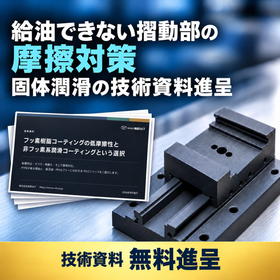
Friction countermeasures for non-lubricated sliding parts | Provision of technical materials on solid lubrication

Cannot be refueled, oil spillage is not allowed, exposed to high temperatures. Explanation of options for sliding parts where liquid lubrication cannot be used in technical documentation.

The basic principle of reducing friction is liquid lubrication using oil or grease, but there are situations where this cannot be used depending on the operating environment. ■ Cannot allocate maintenance man-hours or equipment downtime for regular lubrication ■ In environments like food processing, electronic components, and clean rooms, oil splatter directly leads to product defects ■ At high temperatures, viscosity decreases or carbonization occurs, making it impossible to use oil in the first place In such sliding parts, a viable option is lubrication coatings. They can maintain low friction without the need for lubrication. This document explains the characteristics and sliding mechanism of PTFE, a representative solid lubricant, as well as application examples of fluoropolymer coatings. It also covers the non-fluorinated lubrication coating 'FFLC series' that responds to high-temperature environments and is PFAS-free, all in 22 pages. Comparison data on the friction coefficients and temperature-dependent durability of fluoropolymer coatings (PTFE) and the FFLC series is also included. *For more details, please click on "PDF Download" to view.

  • Surface treatment contract service
  • Coating

Added to bookmarks

Bookmarks list

Bookmark has been removed

Bookmarks list

You can't add any more bookmarks

By registering as a member, you can increase the number of bookmarks you can save and organize them with labels.

Free membership registration

Water and oil repellent fluorosurf FG-5040 for dirt prevention.

High safety, low toxicity non-flammable solvent type *Sample available.

A fluorosurfactant that forms a water-repellent and oil-repellent film with a pencil hardness of 3H, capable of reducing dirt adhesion. 【Features】 ■ Forms a water-repellent and oil-repellent film with a pencil hardness of 3H, capable of reducing dirt adhesion. ■ Also functions as a moisture-proof and rust-proof coating. ■ The film has a low refractive index (1.41). By controlling the film thickness to about 0.1μ, it can also be used as a low-reflective surface coat. ■ When applied to transparent plates or lenses, light transmittance increases by 3-4%. ■ The effect is particularly enhanced when stacking multiple lenses. *If you would like a free sample, please include "Sample Request" in your inquiry.

  • Coating Agent
  • Coating

Added to bookmarks

Bookmarks list

Bookmark has been removed

Bookmarks list

You can't add any more bookmarks

By registering as a member, you can increase the number of bookmarks you can save and organize them with labels.

Free membership registration

[Example] Providing anti-fouling properties (fingerprint reduction) to optical films.

By adding a small amount to UV-curable acrylic hard coat agents, you can impart functionalities such as anti-fouling (fingerprint reduction), low refractive index, and slip properties.

FluoroSurf FS-702X series is a fluorine-based additive for UV-curable hard coatings. When processing UV-curable hard coatings on optical films, simply adding a small amount of FluoroSurf FS-702X to the hard coating can impart functionalities such as anti-soiling (fingerprint reduction), low refractive index, and slip properties. After addition, the fluorine component rises to the surface of the hard coating and exhibits its functions, and during UV irradiation, it co-polymerizes with the components of the hard coating to become integrated. By integrating, this product's functionality possesses abrasion resistance. *If you would like a free sample, please include "Sample Request" in your inquiry.

Added to bookmarks

Bookmarks list

Bookmark has been removed

Bookmarks list

You can't add any more bookmarks

By registering as a member, you can increase the number of bookmarks you can save and organize them with labels.

Free membership registration

Low reflection and anti-reflective coating example: FluoroSurf FS-702X

Introducing examples of how we have met the needs of customers from various industries with the UV-curable hard coat agent additive "FS-702X series."

The "FloroSurf FS-702X Series" is a product that can impart functionalities such as anti-fouling, low refractive index, slip resistance, and water and oil repellency by adding just a small amount to UV-curable acrylic hard coat agents. During drying, the fluorine component rises to the surface of the hard coat agent to exhibit its functions, and an addition amount of about 1-3% is sufficient. It offers good cost performance. When exposed to UV light, it co-polymerizes with the components of the hard coat agent, enhancing wear resistance as well. [Introduction to Background] ■ We want to impart anti-fouling and anti-reflective functions to optical films. *If you would like a free sample, please include "Sample Request" in your inquiry.

Added to bookmarks

Bookmarks list

Bookmark has been removed

Bookmarks list

You can't add any more bookmarks

By registering as a member, you can increase the number of bookmarks you can save and organize them with labels.

Free membership registration

[Anti-Soiling Example] Fluorine-based Anti-Soiling Coating Agent FluoroSurf

Strongly suppresses the adhesion of fingerprints and water stains on various materials! Wiping off becomes easy too.

Anti-fouling coating refers to a treatment that protects products from dirt. Cooking utensils and machinery accumulate various types of dirt over prolonged use. If this dirt is left unattended, it can hinder the product's original performance, and in the worst case, it may lead to product failure. However, by applying an anti-fouling coating, the removal of dirt becomes easier, thus reducing the hassle of daily maintenance. [Introduction to Background] ■ A durable anti-fouling coating agent is needed without changing the appearance. ■ Scale (white stains) adheres to metal surfaces and becomes difficult to remove. ■ Fingerprints are prominent on stainless steel control panels and inner doors. ■ Improvement of light transmittance and fingerprint prevention for films used on displays. *If you would like a free sample, please include "Sample Request" in your inquiry.

  • IPROS61567518649095654966.jpeg
  • Coating Agent
  • Coating

Added to bookmarks

Bookmarks list

Bookmark has been removed

Bookmarks list

You can't add any more bookmarks

By registering as a member, you can increase the number of bookmarks you can save and organize them with labels.

Free membership registration

[Example] I want to make the ink container's remaining amount visible.

When applied to the inner surface of the ink container, it becomes highly liquid-repellent, making the boundaries clearly visible. *Samples available for distribution.

Fluoropolymer FS-1600 series, a non-flammable type with ink (oil-based) resistance and long-lasting high liquid repellency. 【Purpose of Coating】 The inner surface of the container has been fluorine-coated to clearly indicate the remaining ink level in ink cartridges and oil-based pens. 【Challenges】 - Requires ink resistance (oil-based) and the ability to maintain liquid repellency over a long period. Other cases are also published! *If you would like a free sample, please include "Sample Request" in your inquiry.

  • IPROS61567518649095654966.jpeg
  • Coating Agent
  • Coating

Added to bookmarks

Bookmarks list

Bookmark has been removed

Bookmarks list

You can't add any more bookmarks

By registering as a member, you can increase the number of bookmarks you can save and organize them with labels.

Free membership registration