We have compiled a list of manufacturers, distributors, product information, reference prices, and rankings for microscope.
ipros is IPROS GMS IPROS One of the largest technical database sites in Japan that collects information on.

microscope Product List and Ranking from 171 Manufacturers, Suppliers and Companies | IPROS GMS

Last Updated: Aggregation Period:May 06, 2026~Jun 02, 2026
This ranking is based on the number of page views on our site.

microscope Manufacturer, Suppliers and Company Rankings

Last Updated: Aggregation Period:May 06, 2026~Jun 02, 2026
This ranking is based on the number of page views on our site.

  1. サーモフィッシャーサイエンティフィック株式会社/Thermo Fisher Scientific K.K. Tokyo//Testing, Analysis and Measurement
  2. null/null
  3. 一般財団法人材料科学技術振興財団 MST Tokyo//Testing, Analysis and Measurement
  4. 4 アズサイエンス 松本本社 Nagano//Trading company/Wholesale
  5. 5 レイマー Osaka//Optical Instruments

microscope Product ranking

Last Updated: Aggregation Period:May 06, 2026~Jun 02, 2026
This ranking is based on the number of page views on our site.

  1. Fluorescence microscope 'EVOS M5000 Imaging System' サーモフィッシャーサイエンティフィック株式会社/Thermo Fisher Scientific K.K.
  2. White interference microscope equipped with laser 'VK-X4000 series'
  3. White interference microscope equipped with laser microscope 'VK-X3000'
  4. 4 All-in-one fluorescence microscope 'BZ-X1000 Series'
  5. 5 All-in-one fluorescence microscope 'BZ-X800'

microscope Product List

631~660 item / All 663 items

Displayed results

Small Room of Nanomaterials: Clear Structural Color Due to Black Carbon Addition (2)

Lighting is important in the evaluation of photonic crystals! Here is some literature information that may be helpful.

The photos showing the structural color of the sample were taken with a digital camera and a digital microscope (KEYENCE VHX-500). For angle dependence, two types of illumination were used. The first type (diffused light) is illumination that does not come from a specific direction, and the sample is illuminated by several ceiling lights and secondary scattering from the walls. The second type is illumination via fiber (Olympus, LG-PS2). The illumination light is directed from approximately 50 degrees tilted from the normal direction. The arrangement of silica particles in the secondary particles was evaluated using an electron microscope. *For more detailed information, please refer to the related links. For further inquiries, feel free to contact us.

  • others
  • microscope

Added to bookmarks

Bookmarks list

Bookmark has been removed

Bookmarks list

You can't add any more bookmarks

By registering as a member, you can increase the number of bookmarks you can save and organize them with labels.

Free membership registration

[Column] The Difference Between Digital Microscopes and Laser Microscopes

To observe more reliably, let's firmly grasp the intended use of each direction!

Various optical instruments are used to observe the subject. Digital microscopes have the feature of allowing information sharing on a large monitor, while laser microscopes are characterized by their ability to observe at high resolution. In this column, we will introduce the features and differences of digital microscopes and laser microscopes. Let's check which one is more suitable for "observation" in your company. For more details, please refer to the related links. [Contents] ■ Features of digital microscopes and laser microscopes ■ Differences between digital microscopes and laser microscopes ■ Choose the one that suits each application *For detailed content of the column, you can view it from the related links. For more information, please feel free to contact us.

  • Microscope
  • microscope

Added to bookmarks

Bookmarks list

Bookmark has been removed

Bookmarks list

You can't add any more bookmarks

By registering as a member, you can increase the number of bookmarks you can save and organize them with labels.

Free membership registration

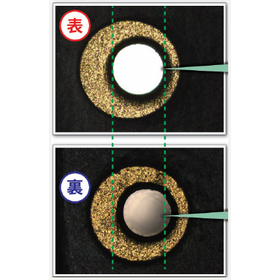
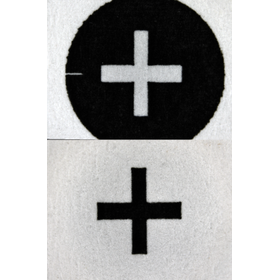
For inspecting front and back scratches on lenses and connectors! Illuminated dual-sided microscope system.

Achieving high-efficiency inspection through simultaneous observation of both sides. A microscope system that reliably captures scratches and misalignments on fine components such as lenses, LED chips, and communication parts!

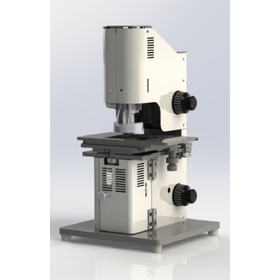
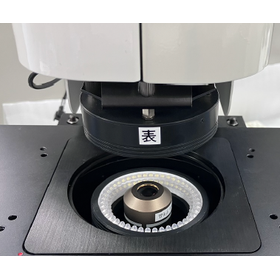
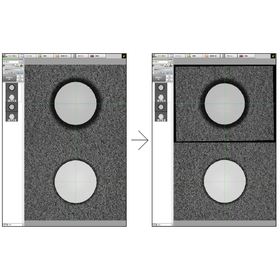
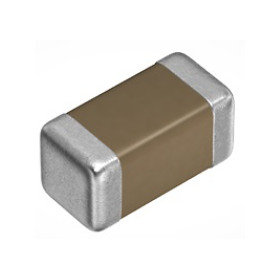
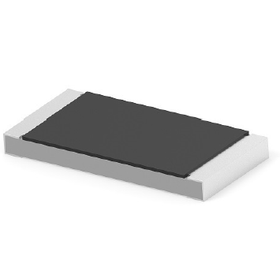
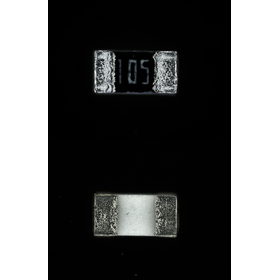
The "TOMOS-50R1" is a dual-sided microscope system equipped with wide-field ring lighting, capable of capturing images with a 1x field of view. It allows for the imaging of entire electronic components such as condensers, resistors, resin parts for communication devices, and lenses, enabling inspection of both sides for defects. 【Features】 ■ High-precision image processing correction for optical axis misalignment of the microscope, lens magnification errors, and camera θ misalignment. ■ Dimension measurement is possible without the hassle of flipping the sample over. ■ Simultaneous imaging of both sides of quartz oscillators, MEMS, holes in printed circuit boards, and electronic components. ■ Measurement of misalignment in patterns and alignment marks on both sides with a repeatability accuracy of ±0.010mm (※). ※ Measurement accuracy may vary depending on subject conditions, measurement conditions, objective lens magnification, measurement environment, etc. Please confirm with sample tests. \ For more details, please check "Download Catalog" /

  • スクリーンショット 2025-07-16 115536.png
  • スクリーンショット 2025-07-16 115551.png
  • スクリーンショット 2025-07-16 115628.png
  • スクリーンショット 2025-07-16 115641.png
  • スクリーンショット 2025-07-16 115654.png
  • スクリーンショット 2025-07-16 115716.png
  • スクリーンショット 2025-07-16 115725.png
  • Other microscopes
  • microscope

Added to bookmarks

Bookmarks list

Bookmark has been removed

Bookmarks list

You can't add any more bookmarks

By registering as a member, you can increase the number of bookmarks you can save and organize them with labels.

Free membership registration

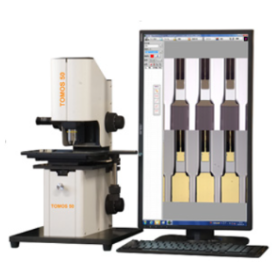
Dual-Sided Microscope System for Semiconductors 'TOMOS-50'

Supports foreign matter inspection in semiconductor manufacturing. Achieves high-precision measurement.

In the semiconductor industry, detecting foreign matter during the manufacturing process is crucial to ensure product quality. Foreign substances can lead to a decline in product performance and the occurrence of defective products. The dual-sided microscope system 'TOMOS-50' enables simultaneous imaging of both sides of semiconductor components, allowing for the detection of foreign matter with an accuracy of ±0.2μm or less. This enhances quality control in the manufacturing process and contributes to improved yield. 【Application Scenarios】 - Foreign matter inspection of semiconductor wafers - Foreign matter inspection of electronic components - Foreign matter inspection of MEMS devices 【Benefits of Implementation】 - Reduction of defective products due to foreign matter contamination - Increased efficiency in quality control - Improvement in product reliability

  • Other microscopes
  • microscope

Added to bookmarks

Bookmarks list

Bookmark has been removed

Bookmarks list

You can't add any more bookmarks

By registering as a member, you can increase the number of bookmarks you can save and organize them with labels.

Free membership registration

[Market Report] World Market for Scanning Electron Microscopes

The global market for scanning electron microscopes is expected to drive scientific discoveries and experience significant growth.

The global market for scanning electron microscopes (SEM) is at the forefront of scientific exploration, achieving approximately $3.83 billion in revenue in 2022. Industry experts predict that this market will reach $7.84 billion in sales by 2031. This forecast implies a compound annual growth rate (CAGR) of 8.3% during the forecast period from 2023 to 2031. Scanning electron microscopes serve as a window into the microscopic world, revealing complex details of structures and materials that are not visible to the naked eye. From fundamental research to advanced industrial applications, SEMs are essential tools for scientists, engineers, and researchers to unravel minute mysteries. For application methods, please check the [PDF download] button or apply directly through the related links.

  • others
  • microscope

Added to bookmarks

Bookmarks list

Bookmark has been removed

Bookmarks list

You can't add any more bookmarks

By registering as a member, you can increase the number of bookmarks you can save and organize them with labels.

Free membership registration

Olympus Stereo Microscope System

All products are sold individually as standard specification items. We provide short delivery times due to complete stock sales.

The Olympus stereo microscope system is arranged so that you can order a complete microscope system with a single product code, consisting of several common components for building the system, based on the company's SZ61 or SZX7 series microscopes. The camera system features a 5-megapixel USB 2.0 color camera and a basic stand with reflected illumination. The boom stand system uses a ball bearing boom stand (#54-121) to achieve high stability. The Olympus SZ6 series stereo microscope employs a Greenough optical system, providing high image quality and excellent flatness of the image field. The Olympus SZX7 series stereo microscope supports video connections and uses a Galileo optical system for high-resolution imaging. For the product lineup of standard specifications, their details, and sales prices, please refer to the relevant product page on the official website of Edmund Optics Japan Co., Ltd. (accessible from the product homepage linked above). *You can download the catalog from Edmund Optics Japan that includes this product from the link below.

Added to bookmarks

Bookmarks list

Bookmark has been removed

Bookmarks list

You can't add any more bookmarks

By registering as a member, you can increase the number of bookmarks you can save and organize them with labels.

Free membership registration

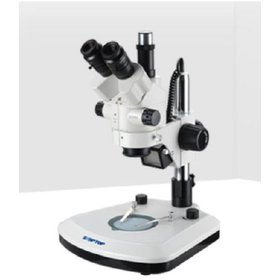
The scratches on the substrate and IC chips appear three-dimensional! Halation stereo microscope.

Even small scratches and dirt are immediately visible! A microscope that allows for three-dimensional observation of surface irregularities such as circuit boards and membranes.

The Halation Stereo Microscope "Model HSM-300D" is a microscope that allows for three-dimensional observation of scratches and dirt on ITO films, such as those used in touch panels, and IC chips (patent pending). It enables viewing flat substrates and films in a "three-dimensional" manner, making foreign objects, scratches, and surface irregularities immediately apparent. This significantly improves inspection efficiency and accuracy. 【Features】 ■ Clear identification of abnormal positions due to the three-dimensional image ■ Ability to observe deeper areas ■ Long-lasting LED lighting with no need for replacement ■ Can be connected to a monitor for observation ■ Usable as a general stereo microscope as well

  • Optical microscope
  • microscope

Added to bookmarks

Bookmarks list

Bookmark has been removed

Bookmarks list

You can't add any more bookmarks

By registering as a member, you can increase the number of bookmarks you can save and organize them with labels.

Free membership registration

Optical microscope and microscope peripheral equipment

We handle optical microscopes and microscope peripheral equipment from various manufacturers.

At Kyoritsu Electric, we handle optical microscopes and microscope peripheral equipment from the following manufacturers. Please feel free to contact us. 【Manufacturers we handle (excerpt)】 Carl Zeiss AG Yokogawa Electric Corporation Micro Support Co., Ltd. Olympus Corporation Leica Microsystems GmbH Hirox Co., Ltd. Keyence Corporation Nikon Corporation

  • Optical microscope
  • microscope

Added to bookmarks

Bookmarks list

Bookmark has been removed

Bookmarks list

You can't add any more bookmarks

By registering as a member, you can increase the number of bookmarks you can save and organize them with labels.

Free membership registration

Observation of surface roughness of rubber and elastomer products using a laser microscope (LM).

It is possible to evaluate the surface shape of rubber and elastomer materials, as well as analyze abnormal parts!

We conduct "surface roughness observation using a laser microscope (LM)" as part of morphological observation. The objective lenses are x5, x10, x20, x50, and x100, with an observation field of 100 to 1000 micrometers. The output types are color images, monochrome images, and 3D images. We can perform measurement analysis of the surface roughness of molded products, sheets, and films, as well as measurements of surface shapes of appearance anomalies, contaminants, and scratches. 【Device Overview】 ■ Objective Lenses: x5, x10, x20, x50, x100 ■ Observation Field: 100 to 1000 micrometers *Varies by objective lens magnification ■ Output Types: Color images, monochrome images, 3D images *For more details, please refer to the related links or feel free to contact us.

  • Contract Analysis
  • microscope

Added to bookmarks

Bookmarks list

Bookmark has been removed

Bookmarks list

You can't add any more bookmarks

By registering as a member, you can increase the number of bookmarks you can save and organize them with labels.

Free membership registration

[Column] What are the differences between digital microscopes and optical microscopes?

What are digital microscopes and optical microscopes? Let's choose the right one for each application.

Some people may find it difficult to understand the differences between optical microscopes and digital microscopes. In this column, we will clearly explain the features and differences of each, so please use it as a reference when considering the introduction of optical microscopes or digital microscopes. For more details, please see the related links. [Content Overview (Partial)] ■ Features of Digital Microscopes and Optical Microscopes ・What is a digital microscope? ・What is an optical microscope? ■ Differences between Digital Microscopes and Optical Microscopes ・Differences in ease of information sharing ・Differences in usability *You can view the detailed content of the column from the related links. For more information, please feel free to contact us.

  • Microscope
  • microscope

Added to bookmarks

Bookmarks list

Bookmark has been removed

Bookmarks list

You can't add any more bookmarks

By registering as a member, you can increase the number of bookmarks you can save and organize them with labels.

Free membership registration

[Column] The Difference Between Digital Microscopes and Electron Microscopes

What is the difference between a digital microscope and an electron microscope? It is important to choose the right equipment.

The electron microscope and digital microscope each have different areas of observation in which they excel. If you choose one without knowing their respective features and usability, you may not be able to conduct observations that align with your intentions. This column introduces the characteristics and differences between digital microscopes and electron microscopes. If you are unsure which one to implement, please use this as a reference. For more details, please see the related links. [Content Included] ■ Characteristics of digital microscopes and electron microscopes ■ Differences between digital microscopes and electron microscopes ■ Choose the one suited for each application *You can view the detailed content of the column (such as blogs) from the related links. For more information, please feel free to contact us.

  • Microscope
  • microscope

Added to bookmarks

Bookmarks list

Bookmark has been removed

Bookmarks list

You can't add any more bookmarks

By registering as a member, you can increase the number of bookmarks you can save and organize them with labels.

Free membership registration

For inspecting surface defects on electronic components such as capacitors and resistors! Dual-sided microscope system.

A low-magnification wide-field microscope that can simultaneously observe both sides of electronic components and printed circuit boards. Ideal for scratch inspection and measuring misalignment of alignment marks!

The "TOMOS-50R1" is a dual-sided microscope system equipped with wide-field ring lighting, capable of capturing images with a 1x field of view. It allows for the inspection of both sides of electronic components such as condensers and resistors, resin parts for communication devices, and entire pieces like lenses. 【Features】 ■ High-precision image processing correction for optical axis misalignment of the microscope, lens magnification errors, and camera θ misalignment ■ Dimension measurement is possible without the hassle of flipping the sample over ■ Simultaneous imaging of both sides of quartz oscillators, MEMS, holes in printed circuit boards, and electronic components ■ Measurement of misalignment in patterns and alignment marks on both sides with a repeatability accuracy of ±0.010mm (※) ※ Measurement accuracy may vary depending on subject conditions, measurement conditions, objective lens magnification, measurement environment, etc. Please confirm with sample tests. \ For more details, please check "Download Catalog" /

  • スクリーンショット 2025-07-16 115536.png
  • スクリーンショット 2025-07-16 115551.png
  • スクリーンショット 2025-07-16 115628.png
  • スクリーンショット 2025-07-16 115641.png
  • スクリーンショット 2025-07-16 115654.png
  • スクリーンショット 2025-07-16 115716.png
  • スクリーンショット 2025-07-16 115725.png
  • Other microscopes
  • microscope

Added to bookmarks

Bookmarks list

Bookmark has been removed

Bookmarks list

You can't add any more bookmarks

By registering as a member, you can increase the number of bookmarks you can save and organize them with labels.

Free membership registration