46~90 item / All 93 items
Displayed results
Filter by category

Added to bookmarks
Bookmarks listBookmark has been removed
Bookmarks listYou can't add any more bookmarks
By registering as a member, you can increase the number of bookmarks you can save and organize them with labels.
Free membership registration
Contact this company
Inquiry Form46~90 item / All 93 items
Filter by category

In this case study, we will introduce static magnetic field analysis of various models. "PHOTO-MAGTZ" does not require air mesh. Therefore, it is easy to create models with complex shapes. Additionally, by inputting the current value into the coil, it is possible to simplify the input of current density for coils with complex shapes. You can view the analysis results from the related links below. 【Case Overview】 ■Analysis Module: PHOTO-MAGTZ *For more details, please refer to the related links or feel free to contact us.
Added to bookmarks
Bookmarks listBookmark has been removed
Bookmarks listYou can't add any more bookmarks
By registering as a member, you can increase the number of bookmarks you can save and organize them with labels.
Free membership registration
Here is an example of nonlinear electric field analysis of cable joints. The electric field analysis software "PHOTO-VOLT" and "VOLTjω" can be selected from two modes: electric field analysis and current distribution analysis. This case uses current distribution analysis. In the electrical insulation design of joints for DC power cables, it is necessary to consider the nonlinear conductivity characteristics of the insulator. For detailed analysis results, please refer to the related links below. 【Case Overview】 ■ Software Used: PHOTO-VOLT or VOLTjω *For more details, please refer to the related links or feel free to contact us.
Added to bookmarks
Bookmarks listBookmark has been removed
Bookmarks listYou can't add any more bookmarks
By registering as a member, you can increase the number of bookmarks you can save and organize them with labels.
Free membership registration
There is a capacitive proximity switch that can detect both metal and non-metal objects without contact. This sensor detects objects by converting changes in capacitance into electrical signals. In this case study, we will analyze the capacitance between a grounded detection object (metal) and the electrodes within the sensor. We will also observe the changes in capacitance when the relative position of the electrodes is altered from the perspective of the detection object. 【Case Overview】 ■Software Used: PHOTO-VOLT or VOLTjω ■Analysis Type: 3D Electric Field Analysis *For more details, please refer to the related links or feel free to contact us.
Added to bookmarks
Bookmarks listBookmark has been removed
Bookmarks listYou can't add any more bookmarks
By registering as a member, you can increase the number of bookmarks you can save and organize them with labels.
Free membership registration
In this analysis case, we will introduce a comparison between the calculated values of the capacitance of a cylindrical capacitor and the theoretical solutions. We will analyze three conditions: "Cylindrical Capacitor (Air)", "Cylindrical Capacitor (Dielectric - Radial Two Layers)", and "Cylindrical Capacitor (Dielectric - Circumferential Two Layers)". Since this case involves electrostatic field analysis, it can be analyzed not only in VOLT but also in VOLTjω. For more details, please refer to the related links below. 【Case Overview】 ■ Software Used: PHOTO-VOLT or VOLTjω ■ Analysis Results - Cylindrical Capacitor (Air): 5.039E-11 - Cylindrical Capacitor (Dielectric - Radial Two Layers): 3.681E-10 - Cylindrical Capacitor (Dielectric - Circumferential Two Layers): 3.780E-10 *For more details, please refer to the related links or feel free to contact us.
Added to bookmarks
Bookmarks listBookmark has been removed
Bookmarks listYou can't add any more bookmarks
By registering as a member, you can increase the number of bookmarks you can save and organize them with labels.
Free membership registration
Here is an example of electric field analysis for a comb-type electrostatic actuator. Electrostatic actuators generate electrostatic force based on the sign of the charges present on opposing electrodes, so electric field analysis is applied. In "PHOTO-VOLT," it is possible to calculate the potential distribution, electric field distribution, and the electrostatic force acting on the electrodes. Additionally, we consider whether the order of the electrostatic force obtained from the analysis results is reasonable. For more details, please refer to the related links below. 【Case Overview】 ■ Software Used: PHOTO-VOLT ■ Analysis Results ・Electrostatic Force (per unit length): 0.792[N] *For more details, please refer to the related links or feel free to contact us.
Added to bookmarks
Bookmarks listBookmark has been removed
Bookmarks listYou can't add any more bookmarks
By registering as a member, you can increase the number of bookmarks you can save and organize them with labels.
Free membership registration
When a high voltage is applied to a coil, as in the case of surge voltage, a locally high electric field is generated, leading to discharge and damage to the coil's insulation. In this case, we analyze the electric field generated when a voltage is applied between insulated coil wires (cables). The electric field strength generated per 1[V] of voltage between the coil wires can be multiplied by the magnitude of the actual applied voltage to consider it as the maximum electric field strength. Please feel free to consult us regarding any concerns about electromagnetic field analysis. 【Case Overview】 ■ Software Used: PHOTO-VOLT *For more details, please refer to the related links or feel free to contact us.
Added to bookmarks
Bookmarks listBookmark has been removed
Bookmarks listYou can't add any more bookmarks
By registering as a member, you can increase the number of bookmarks you can save and organize them with labels.
Free membership registration
We analyzed the electric field distribution between the anode and cathode when 1V and -1V were applied, respectively, in a vacuum. It is assumed that the potential does not vary with time. The analysis module used is PHOTO-VOLT. Since the electrodes are conductors, the moment the potential is applied, charges move to the surface of the electrodes. Therefore, the potential is set on the electrode surface, and modeling the interior of the electrodes is no longer necessary. (Only the space in the vacuum is modeled.) For more details, please download the catalog.
Added to bookmarks
Bookmarks listBookmark has been removed
Bookmarks listYou can't add any more bookmarks
By registering as a member, you can increase the number of bookmarks you can save and organize them with labels.
Free membership registration
The analysis of capacitance is shown below with shape data created from planar elements for the outer surfaces of each component. The number of nodes is 1112, and the number of elements is 1064. Since the boundary element method is used, a mesh for air is not required. The analysis calculations were performed using the electric field analysis software PHOTO-VOLTBM. For more details, please download the catalog.
Added to bookmarks
Bookmarks listBookmark has been removed
Bookmarks listYou can't add any more bookmarks
By registering as a member, you can increase the number of bookmarks you can save and organize them with labels.
Free membership registration
The wound-type capacitor has a structure that alternately layers electrode foil and dielectric, featuring a compact design while increasing the surface area of the electrodes. In "PHOTO-VOLTBM," there is no need for air mesh, allowing for the easy creation of complex-shaped models in conjunction with programmatic mesh deformation. In this case study, we will conduct an electric field analysis of the wound-type capacitor. Additionally, we will compare the capacitance obtained from the analysis with the theoretical value. For detailed information on the analysis conditions and results, please refer to the related links below. [Case Overview] ■ Analysis Module: PHOTO-VOLTBM *For more details, please refer to the related links or feel free to contact us.
Added to bookmarks
Bookmarks listBookmark has been removed
Bookmarks listYou can't add any more bookmarks
By registering as a member, you can increase the number of bookmarks you can save and organize them with labels.
Free membership registration
We will introduce an analysis case that focuses on the boundary conditions used in thermal conduction analysis and compares the theoretical solution with simulation results. The thermal conduction analysis software "PHOTO-THERMO" can be used not only for coupled analysis using heat generation density obtained from electromagnetic field analysis but also as a standalone tool. In this case, we used a circular pipe model as shown in the left figure. We conducted thermal conduction analysis under three conditions: "constant temperature boundary condition," "heat generation density," and "heat transfer boundary condition." Since theoretical solutions can be obtained for all of these, you can evaluate the validity of the program by comparing the analysis results. 【Case Overview】 ■ Conditions for Thermal Conduction Analysis - Constant temperature boundary condition - Heat generation density - Heat transfer boundary condition *For more details, please refer to the related links or feel free to contact us.
Added to bookmarks
Bookmarks listBookmark has been removed
Bookmarks listYou can't add any more bookmarks
By registering as a member, you can increase the number of bookmarks you can save and organize them with labels.
Free membership registration
The number of nodes for the stress analysis of the elastic body is 2271, and the number of elements is 1400. For more details, please download the catalog.
Added to bookmarks
Bookmarks listBookmark has been removed
Bookmarks listYou can't add any more bookmarks
By registering as a member, you can increase the number of bookmarks you can save and organize them with labels.
Free membership registration
The analysis of induction heating shows an example of the eddy current and temperature field analysis (induction heating analysis) of a metal tube with a notch when a coil carrying an alternating current of 500 kW at a frequency of 800 kHz surrounds the metal tube. The analysis model is created to include the object of analysis and the surrounding air portion. For more details, please download the catalog.
Added to bookmarks
Bookmarks listBookmark has been removed
Bookmarks listYou can't add any more bookmarks
By registering as a member, you can increase the number of bookmarks you can save and organize them with labels.
Free membership registration
The analysis of induction heating of a steel plate (coupled analysis of magnetic field and heat) determines the distribution of heat generation due to eddy currents flowing in the steel plate created by a three-phase current magnetic field. Next, thermal conduction is analyzed based on the calculated heat generation. For more details, please download the catalog.
Added to bookmarks
Bookmarks listBookmark has been removed
Bookmarks listYou can't add any more bookmarks
By registering as a member, you can increase the number of bookmarks you can save and organize them with labels.
Free membership registration
The induction heating of gears for hardening was analyzed for cases where the relative permeability depends on temperature (strong coupling) and where it does not depend on temperature (weak coupling). For more details, please download the catalog.
Added to bookmarks
Bookmarks listBookmark has been removed
Bookmarks listYou can't add any more bookmarks
By registering as a member, you can increase the number of bookmarks you can save and organize them with labels.
Free membership registration
This is an example of heating the entire cylindrical conductor by moving it and using induction heating. By passing through the center of a coil connected to an AC power source, eddy currents flow on the surface of the conductor, generating heat. The temperature rises from the surface, and heat is conducted internally. Due to the axisymmetric shape of this model, it can be analyzed using 2D axisymmetric analysis. Therefore, plate elements are used. To understand the heat generation distribution and temperature distribution inside the cylindrical conductor, a magnetic-thermal coupled analysis using the finite element method is effective. [Case Overview] ■ Analysis Module: PHOTO - EDDYjω & THERMO *For more details, please refer to the related links or feel free to contact us.
Added to bookmarks
Bookmarks listBookmark has been removed
Bookmarks listYou can't add any more bookmarks
By registering as a member, you can increase the number of bookmarks you can save and organize them with labels.
Free membership registration
Copiers and printers utilize electrophotographic technology. In the electrophotographic process, the steps of "charging," "exposure," "development," "transfer," and "fixing" are followed, leading to paper output. Fixing is the process of solidifying the toner on the paper using heat and pressure. In fixing, energy efficiency and reduced warm-up time are required, and IH technology is used as a heating method. In this case, the heat generation density distribution obtained through magnetic field analysis is used in thermal conduction analysis to analyze the temperature distribution of the roller. The positions of the magnetic core and coil are fixed, and the analysis takes into account the rotation of the roller. For more details, please refer to the related links below. 【Case Overview】 ■ Analysis Type: 3D Analysis ■ Analysis Module: PHOTO - EDDYjω & THERMO *For more details, please refer to the related links or feel free to contact us.
Added to bookmarks
Bookmarks listBookmark has been removed
Bookmarks listYou can't add any more bookmarks
By registering as a member, you can increase the number of bookmarks you can save and organize them with labels.
Free membership registration
Using the heat generation density obtained from magnetic field analysis, thermal conduction analysis will be conducted, resulting in a temperature distribution. This is an example of magnetic field-thermal coupled analysis using temperature-dependent electrical conductivity. The heated object is a metal filled in a crucible. An alternating current flows through the coil, and the metal is heated by the eddy currents flowing through it. In induction heating analysis, the temperature distribution varies depending on the elapsed time and the location of the analysis target. When the electrical conductivity has temperature-dependent characteristics, the distribution of electrical conductivity changes by location, necessitating a close coupled analysis of the magnetic field and heat. [Case Overview] ■ Analysis Type: Axisymmetric Analysis ■ Analysis Module: PHOTO - EDDYjω & THERMO ■ Coil: Current Density Vector ■ Frequency: 3 [kHz] ■ Conductor: Temperature Dependence of Electrical Conductivity *For more details, please refer to the related links or feel free to contact us.
Added to bookmarks
Bookmarks listBookmark has been removed
Bookmarks listYou can't add any more bookmarks
By registering as a member, you can increase the number of bookmarks you can save and organize them with labels.
Free membership registration
PTC resin has the property of increasing electrical resistance as the temperature rises (temperature dependence). We conducted an analysis of a heater that utilizes this property. This heater has the characteristic that as the temperature rises, the inherent resistance of the PTC resin increases, limiting the current, so it does not exceed a certain temperature. We will perform a current distribution analysis when a voltage of 100[V] is applied to the electrode terminals of the heater. For more details, please download the catalog.
Added to bookmarks
Bookmarks listBookmark has been removed
Bookmarks listYou can't add any more bookmarks
By registering as a member, you can increase the number of bookmarks you can save and organize them with labels.
Free membership registration
A piezoelectric material is a dielectric that converts mechanical energy into electrical energy, or vice versa. In this case, force is applied to the upper surface of a cylindrical piezoelectric material, and the resulting voltage is analyzed. Since the equations related to "force" and "electricity" are different, these equations are coupled to analyze the piezoelectric element. Therefore, a coupled analysis of stress and electric field was conducted. The software used for stress analysis and electric field analysis is PHOTO-ELAS and PHOTO-VOLT, respectively. 【Case Overview】 ■ Software Used: PHOTO-ELAS and PHOTO-VOLT ■ Analysis Conditions - Relative Permittivity: 2000 - Young's Modulus: 5×10^10 - Poisson's Ratio: 0.35 - Analysis Modules: VOLT & ELAS *For more details, please refer to the related links or feel free to contact us.
Added to bookmarks
Bookmarks listBookmark has been removed
Bookmarks listYou can't add any more bookmarks
By registering as a member, you can increase the number of bookmarks you can save and organize them with labels.
Free membership registration
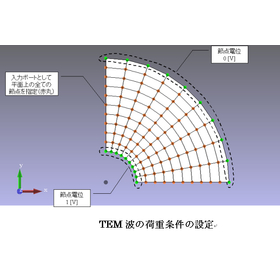
It was necessary to set an electric field (3 components) at the nodes or to set a current density (3 components) at the elements as load conditions. For example, as shown in Figure 1, when setting an electric field in a coaxial cable, it was necessary to set each electric field component based on the coordinate values of each node, which was a cumbersome task for the user. By adding a function to automatically set load conditions, users can specify a set of nodes that are on the same plane, and by simply inputting a few parameters, the program calculates the electric field at each node and sets it as the load condition.
Added to bookmarks
Bookmarks listBookmark has been removed
Bookmarks listYou can't add any more bookmarks
By registering as a member, you can increase the number of bookmarks you can save and organize them with labels.
Free membership registration
The "PHOTO series" offers analysis solvers that utilize the most suitable simulation methods for a wide range of target fields, from high-frequency electromagnetic waves to low-frequency electric and magnetic fields, based on the analysis theme. Unlike other commercial software packages that handle all phenomena with a single analysis solver, we use the most appropriate analysis solver for the purpose, ensuring high analysis accuracy and detailed responsiveness to needs. Additionally, you can select only the necessary modules suited to the problem, which helps keep the implementation costs economical. It is also easy to expand functionality by adding modules, and by combining them, it is possible to handle coupled analyses such as heat generation due to eddy currents and stresses or deformations caused by electromagnetic forces. All products are compatible with three-dimensional problems, and the transient response analysis module can handle nonlinear materials.
Added to bookmarks
Bookmarks listBookmark has been removed
Bookmarks listYou can't add any more bookmarks
By registering as a member, you can increase the number of bookmarks you can save and organize them with labels.
Free membership registration
3D High-Frequency Electromagnetic Field Analysis Software Using Finite Element Method (High-Frequency Electromagnetic Field Simulator) with a Module for Frequency Response Analysis ■□■Features■□■ ■Since it is integrated with the PHOTO series pre- and post-processing tools, data creation, analysis, and result processing can be performed as a continuous operation. ■It is integrated with other PHOTO series modules, allowing for easy coupled analysis, such as calculating temperature distribution from heat generation obtained through electromagnetic field analysis. ■A revolutionary speed-up has been achieved by combining the edge element method and ICCG method. Therefore, 3D electromagnetic wave analysis (high-frequency analysis) is now possible on a personal computer. ■Using the finite element method makes it suitable for analyzing closed regions, especially those involving multiple media. ■When coupled with the thermal conduction analysis software PHOTO-THERMO, it is possible to calculate temperature distribution from heat generation within dielectrics.
Added to bookmarks
Bookmarks listBookmark has been removed
Bookmarks listYou can't add any more bookmarks
By registering as a member, you can increase the number of bookmarks you can save and organize them with labels.
Free membership registration
The software for magnetic field analysis using the finite element method (magnetic field simulator) performs static analysis and transient response analysis. It can handle three-dimensional, two-dimensional, and axisymmetric problems. ■□■Features■□■ ■Since it is an integrated pre-post tool dedicated to the PHOTO series, data creation, analysis, and result processing can be performed as a series of operations. ■It is integrated with other PHOTO series modules, allowing for easy coupled analysis, such as deriving temperature distribution from heat generation obtained through electromagnetic field analysis. ■A revolutionary speedup has been achieved through the combined use of edge element method and ICCG method (tens of times faster than conventional finite element methods). ■The use of the finite element method ensures stable solutions, making it safe for beginners to use. ■When coupled with the thermal conduction analysis software PHOTO-THERMO, it is possible to calculate temperature distribution from Joule heating within conductors.
Added to bookmarks
Bookmarks listBookmark has been removed
Bookmarks listYou can't add any more bookmarks
By registering as a member, you can increase the number of bookmarks you can save and organize them with labels.
Free membership registration
Perform frequency response analysis Finite element method magnetic field analysis software (magnetic field simulator) ■□■Features■□■ ■Since it is integrated with the PHOTO series dedicated pre-post, data creation, analysis, and result processing can be performed as a series of operations. ■It is integrated with other PHOTO series modules, allowing for easy coupled analysis, such as obtaining temperature distribution from heat generation determined by electromagnetic field analysis. ■A revolutionary speedup has been achieved through the combined use of edge element method and ICCG method (dozens of times faster than conventional finite element methods). ■When a sine wave input is used and linear approximation holds, results can be obtained in a single calculation without the need for time-stepping calculations. ■Since it uses the finite element method, the solutions are stable, making it safe for beginners to use. ■Coupled calculations with thermal conduction analysis, stress analysis, and fluid analysis are easy.
Added to bookmarks
Bookmarks listBookmark has been removed
Bookmarks listYou can't add any more bookmarks
By registering as a member, you can increase the number of bookmarks you can save and organize them with labels.
Free membership registration
Analysis of two-dimensional axisymmetric and three-dimensional transient response of dynamic magnetic fields using the finite element method, considering motion (Dynamic Magnetic Field Simulator) ■□■Features■□■ ■Since it is integrated with other PHOTO series modules, coupled analysis, such as obtaining temperature distribution from heat generation calculated by electromagnetic field analysis, can be easily performed. ■A revolutionary speedup has been achieved by combining edge element method and ICCG method (dozens of times faster than conventional finite element methods). ■The use of the finite element method ensures stable solutions, making it user-friendly even for beginners. ■By incorporating a slide interface for two-dimensional, axisymmetric, and three-dimensional problems, the motion of objects can be easily handled. ■The motion of objects due to electromagnetic forces can be calculated in real-time by solving the equations of motion.
Added to bookmarks
Bookmarks listBookmark has been removed
Bookmarks listYou can't add any more bookmarks
By registering as a member, you can increase the number of bookmarks you can save and organize them with labels.
Free membership registration
■ Magnetic field/magnetic field analysis software (magnetic field simulator) using a combination of finite element method and H-method, capable of performing static analysis and transient response analysis. ■ Can handle three-dimensional problems. ■□■ Features ■□■ ■ Can create analysis models without creating air regions. ■ Integrated with the PHOTO series dedicated pre/post-processing, allowing data creation, analysis, and result processing to be performed as a single operation. ■ Achieves revolutionary speedup through the combination of edge element method and ICCG method (dozens of times faster than conventional finite element methods). ■ Provides stable solutions using finite element method, making it safe for beginners to use.
Added to bookmarks
Bookmarks listBookmark has been removed
Bookmarks listYou can't add any more bookmarks
By registering as a member, you can increase the number of bookmarks you can save and organize them with labels.
Free membership registration
■ Magnetic field/magnetic field analysis software (magnetic field simulator) using a combination of the finite element method and H-method, capable of performing static analysis and frequency response analysis. ■ Can handle three-dimensional problems. ■□■ Features ■□■ ■ Can create analysis models without creating air regions. ■ Integrated with the PHOTO series dedicated pre- and post-processing, allowing data creation, analysis, and result processing to be performed as a single operation. ■ Achieves revolutionary speedup through the combination of edge element method and ICCG method (dozens of times faster than conventional finite element methods). ■ Provides stable solutions using the finite element method, making it safe for beginners to use.
Added to bookmarks
Bookmarks listBookmark has been removed
Bookmarks listYou can't add any more bookmarks
By registering as a member, you can increase the number of bookmarks you can save and organize them with labels.
Free membership registration
Perform static analysis and transient response analysis Finite element method-based electric field analysis software (Electric field simulator) ■□■Features■□■ ■Since it is integrated with the PHOTO series dedicated pre- and post-processing tools, data creation, analysis, and result processing can be performed as a continuous operation. ■It is integrated with other PHOTO series modules, allowing for easy coupled analysis, such as deriving temperature distribution from heat generation obtained through electromagnetic field analysis. ■Using the ICCG method, calculations are fast, enabling analysis on a personal computer. ■Since it employs the finite element method, the solutions are stable, making it user-friendly even for beginners.
Added to bookmarks
Bookmarks listBookmark has been removed
Bookmarks listYou can't add any more bookmarks
By registering as a member, you can increase the number of bookmarks you can save and organize them with labels.
Free membership registration
Perform static analysis and frequency response analysis Electric field analysis software using the finite element method (Electric field simulator) ■□■Features■□■ ■Since it is integrated with the PHOTO series dedicated pre- and post-processing, data creation, analysis, and result processing can be performed as a continuous operation. ■It is integrated with other PHOTO series modules, allowing for easy coupled analysis, such as obtaining temperature distribution from heat generation determined by electromagnetic field analysis. ■Using the ICCG method, calculations are fast, enabling analysis on a personal computer. ■Since it uses the finite element method, the solutions are stable, making it safe for beginners to use.
Added to bookmarks
Bookmarks listBookmark has been removed
Bookmarks listYou can't add any more bookmarks
By registering as a member, you can increase the number of bookmarks you can save and organize them with labels.
Free membership registration
Three-dimensional electric field (electric field) analysis software using boundary element method for static analysis (electric field simulator) ■□■Features■□■ ■You can create an analysis model without creating an air region. ■Since it is integrated with the PHOTO series dedicated pre/post, data creation, analysis, and result processing can be performed as a series of operations. ■You can create display elements to evaluate the analysis values in the space.
Added to bookmarks
Bookmarks listBookmark has been removed
Bookmarks listYou can't add any more bookmarks
By registering as a member, you can increase the number of bookmarks you can save and organize them with labels.
Free membership registration
Magnetic field (magnetic field) analysis software (simulator) using finite element method for static analysis ■□■Features■□■ ■ Since it is integrated with the PHOTO series dedicated pre- and post-processing, data creation, analysis, and result processing can be performed as a series of operations. ■ It is integrated with other PHOTO series modules, allowing for easy coupled analysis, such as deriving temperature distribution from heat generation obtained through electromagnetic field analysis. ■ Revolutionary acceleration has been achieved through the combined use of edge element method and ICCG method. (Dozens of times faster than conventional finite element methods) ■ The use of finite element method ensures stable solutions, making it safe for beginners to use. ■ Coupled calculations with stress analysis and fluid analysis are easy to perform.
Added to bookmarks
Bookmarks listBookmark has been removed
Bookmarks listYou can't add any more bookmarks
By registering as a member, you can increase the number of bookmarks you can save and organize them with labels.
Free membership registration
Magnetic field (magnetic field) analysis software (simulator) using the magnetic moment method for static analysis ■□■Features■□■ ■ You can create an analysis model without creating an air region. ■ It is integrated with the PHOTO series dedicated pre-post, allowing for a seamless operation from data creation to analysis and result processing. ■ By setting the analysis type to inverse problem, you can infer the magnetization of magnetic materials from the magnetic flux density distribution file. ■ You can create display elements to evaluate the analysis values in space.
Added to bookmarks
Bookmarks listBookmark has been removed
Bookmarks listYou can't add any more bookmarks
By registering as a member, you can increase the number of bookmarks you can save and organize them with labels.
Free membership registration
2D Axisymmetric and 3D Heat Conduction Analysis Simulator using Finite Element Method ■□■Features■□■ ■ Since it is an integrated pre-post tool dedicated to the PHOTO series, data creation, analysis, and result processing can be performed as a series of operations. ■ It is integrated with other PHOTO series modules, allowing for easy coupled analysis, such as obtaining temperature distribution from heat generation calculated by electromagnetic field analysis. ■ It uses the ICCG method, making calculations fast and enabling analysis on a personal computer. ■ Since it employs the finite element method, the solutions are stable, making it user-friendly even for beginners. ■ Coupled calculations with stress analysis and fluid analysis are easy to perform.
Added to bookmarks
Bookmarks listBookmark has been removed
Bookmarks listYou can't add any more bookmarks
By registering as a member, you can increase the number of bookmarks you can save and organize them with labels.
Free membership registration
■ Features ■ ■ Uses the ICCG method, allowing for fast calculations and analysis on a computer. ■ Utilizes the finite element method, ensuring stable solutions that can be safely used by beginners. ■ Capable of coupled calculations with electromagnetic field analysis.
Added to bookmarks
Bookmarks listBookmark has been removed
Bookmarks listYou can't add any more bookmarks
By registering as a member, you can increase the number of bookmarks you can save and organize them with labels.
Free membership registration
3D Frequency Response Analysis Software (Simulator) ■□■Features■□■ ■ Uses the ICCG method, allowing for fast calculations and analysis on a PC. ■ Utilizes the finite element method, ensuring stable solutions that are safe for beginners to use. ■ Capable of coupled calculations with electromagnetic field analysis. ■ Can perform vibration analysis and acoustic field analysis simultaneously.
Added to bookmarks
Bookmarks listBookmark has been removed
Bookmarks listYou can't add any more bookmarks
By registering as a member, you can increase the number of bookmarks you can save and organize them with labels.
Free membership registration
This is a software for coupled analysis of magnetic fields/magnetic fields and heat conduction using the finite element method, capable of performing static analysis and transient response analysis. It can handle three-dimensional, two-dimensional, and axisymmetric problems. ■□■Features■□■ ■Since it is an integrated pre- and post-processor dedicated to the PHOTO series, data creation, analysis, and result processing can be performed as a series of operations. ■A revolutionary speedup has been achieved by combining edge element methods and ICCG methods (dozens of times faster than conventional finite element methods). ■The use of the finite element method ensures stable solutions, making it safe for beginners to use. ■Since EDDY (magnetic field analysis module) and THERMO (heat conduction module) are integrated, the transfer of heat generation density is automatically executed without the need for files. ■It is also possible to use EDDY and THERMO separately.
Added to bookmarks
Bookmarks listBookmark has been removed
Bookmarks listYou can't add any more bookmarks
By registering as a member, you can increase the number of bookmarks you can save and organize them with labels.
Free membership registration
This is a software for coupled analysis of magnetic fields/magnetic fields and heat conduction using the finite element method, capable of performing static analysis and frequency response analysis. It can handle three-dimensional, two-dimensional, and axisymmetric problems. ■□■Features■□■ ■Since it is integrated with the PHOTO series dedicated pre- and post-processing, data creation, analysis, and result processing can be performed as a series of operations. ■A revolutionary acceleration has been achieved through the combined use of edge element method and ICCG method (dozens of times faster than conventional finite element methods). ■Since it uses the finite element method, the solutions are stable, making it user-friendly even for beginners. ■The EDDYjω (magnetic field/magnetic field analysis module) and THERMO (heat conduction analysis module) are integrated, allowing for automatic transfer of heat generation density without the need for files. ■It is also possible to use EDDYjω and THERMO independently.
Added to bookmarks
Bookmarks listBookmark has been removed
Bookmarks listYou can't add any more bookmarks
By registering as a member, you can increase the number of bookmarks you can save and organize them with labels.
Free membership registration
The software for electric field analysis using the finite element method (electric field simulator) performs static analysis and transient response analysis. It can handle 3D, 2D, and axisymmetric problems. - Since it is integrated with the PHOTO series dedicated pre- and post-processing tools, data creation, analysis, and result processing can be performed as a series of operations. - Because it is integrated with other PHOTO series modules, coupled analysis, such as calculating temperature distribution from heat generation obtained through electric field analysis, can be easily performed. - A revolutionary speedup has been achieved through the combined use of edge element method and ICCG method (tens of times faster than conventional finite element methods). - The use of the finite element method ensures stable solutions, making it safe for beginners to use. - It can be coupled with the thermal conduction analysis module PHOTO-THERMO to calculate temperature distribution from Joule heating within conductors. - Since VOLT and THERMO are integrated, the transfer of heat generation density is automatically executed without the need for files. - It is also possible to use VOLT and THERMO independently.
Added to bookmarks
Bookmarks listBookmark has been removed
Bookmarks listYou can't add any more bookmarks
By registering as a member, you can increase the number of bookmarks you can save and organize them with labels.
Free membership registration
The software for electric field analysis using the finite element method (electric field simulator) performs frequency response analysis. It can handle 3D, 2D, and axisymmetric problems. 【Features】 - It is integrated with the PHOTO series dedicated pre- and post-processing tools, allowing for a seamless operation from data creation to analysis and result processing. - Since it is integrated with other PHOTO series modules, coupled analyses, such as deriving temperature distribution from heat generation obtained through electric field analysis, can be easily performed. - A revolutionary speedup has been achieved through the combined use of edge element method and ICCG method (tens of times faster than conventional finite element methods). - The use of finite element method ensures stable solutions, making it user-friendly even for beginners. - It can be coupled with the thermal conduction analysis module PHOTO-THERMO to calculate temperature distribution from Joule heating within conductors. - Since VOLTjω and THERMO are integrated, the transfer of heat generation density is automatically conducted without the need for files. - It is also possible to use VOLTjω and THERMO independently.
Added to bookmarks
Bookmarks listBookmark has been removed
Bookmarks listYou can't add any more bookmarks
By registering as a member, you can increase the number of bookmarks you can save and organize them with labels.
Free membership registration
The software for 3D high-frequency electromagnetic field analysis using the finite element method (high-frequency electromagnetic field simulator) performs frequency response analysis. It can handle three-dimensional problems. 【Features】 - Since it is an integrated pre- and post-processor dedicated to the PHOTO series, data creation, analysis, and result processing can be performed as a continuous operation. - A revolutionary speedup has been achieved through the combined use of edge element method and ICCG method (dozens of times faster than conventional finite element methods). - The use of the finite element method ensures stable solutions, making it safe for beginners to use. - It can be coupled with the thermal conduction analysis module PHOTO-THERMO to calculate the temperature distribution of heat generation due to dielectric loss. - Since WAVEjω and THERMO are integrated, the transfer of heat generation density is automatically conducted without the need for files. - It is also possible to use WAVEjω and THERMO separately.
Added to bookmarks
Bookmarks listBookmark has been removed
Bookmarks listYou can't add any more bookmarks
By registering as a member, you can increase the number of bookmarks you can save and organize them with labels.
Free membership registration
The software for magnetic field analysis using the finite element method (magnetic field simulator) performs static analysis and transient response analysis. It can handle three-dimensional problems. 【Features】 - Since it is integrated with the PHOTO series dedicated pre- and post-processing tools, data creation, analysis, and result processing can be performed as a single operation. - Because it is integrated with other PHOTO series modules, coupled analysis, such as calculating displacements from nodal forces obtained through electromagnetic field analysis, can be easily performed. - A revolutionary speedup has been achieved through the combined use of edge element method and ICCG method (tens of times faster than conventional finite element methods). - The use of the finite element method ensures stable solutions, making it safe for beginners to use. - Since EDDY and ELAS are integrated, the transfer of nodal forces is automatically conducted without the need for files. - It is also possible to use EDDY and ELAS separately.
Added to bookmarks
Bookmarks listBookmark has been removed
Bookmarks listYou can't add any more bookmarks
By registering as a member, you can increase the number of bookmarks you can save and organize them with labels.
Free membership registration
The software for electric field analysis using the finite element method (electric field simulator) performs static analysis and transient response analysis. It can handle three-dimensional problems. 【Features】 - Since it is integrated with the PHOTO series dedicated pre- and post-processing tools, data creation, analysis, and result processing can be performed as a continuous operation. - It is integrated with other PHOTO series modules, allowing for easy coupled analysis, such as calculating displacements from the electric field strength obtained through electric field analysis using the piezoelectric strain tensor. - A revolutionary speedup has been achieved through the combined use of edge element method and ICCG method (tens of times faster than conventional finite element methods). - The use of finite element method ensures stable solutions, making it user-friendly even for beginners. - Since VOLT and ELAS are integrated, the transfer of electric field strength is automatically executed without the need for file transfers. - It is also possible to use VOLT and ELAS separately.
Added to bookmarks
Bookmarks listBookmark has been removed
Bookmarks listYou can't add any more bookmarks
By registering as a member, you can increase the number of bookmarks you can save and organize them with labels.
Free membership registration
The electromagnetic field analysis software "PHOTO-Series" is a simulation tool that can visualize magnetic field distributions and eddy current density distributions. It also analyzes the eddy current deep flaw detection method, which is one of the non-destructive testing methods for detecting the presence of defects. 【Features】 ● Each product is low-cost, allowing for the construction of systems composed of numerous modules, including coupled problems of electromagnetic field analysis, heat conduction, stress, and fluid analysis, at a low price. ● Each product is integrated with dedicated pre- and post-processing tools, equipped only with the necessary functions for electromagnetic field analysis, making it easy for beginners to operate smoothly. ● Academic pricing is available for use in educational institutions (half the regular price). ◆ If you are interested, please contact us via the 'Inquiry Form'.
Added to bookmarks
Bookmarks listBookmark has been removed
Bookmarks listYou can't add any more bookmarks
By registering as a member, you can increase the number of bookmarks you can save and organize them with labels.
Free membership registration
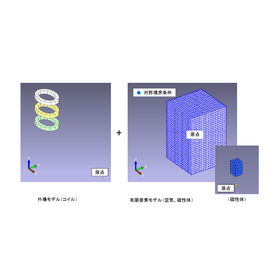
In the PHOTO series, you can set the current density for models such as coils and perform coupled analysis with finite element models (such as magnetic materials) that are influenced by it, using it as an external field model.
Added to bookmarks
Bookmarks listBookmark has been removed
Bookmarks listYou can't add any more bookmarks
By registering as a member, you can increase the number of bookmarks you can save and organize them with labels.
Free membership registration
The magnetic field and thermal coupled analysis system "PHOTO-Series" is a dedicated module for magnetic field-thermal coupled analysis that combines dynamic magnetic field analysis and thermal conduction analysis. Since the transfer of heat generation density is automatically performed without the need for files, even beginners can confidently conduct strong coupled analysis (bidirectional). 【Examples of Applications】 ◆ Quenching of gears by induction heating ◆ Induction heating analysis of steel plates (coupled analysis of magnetic field and heat) ◆ Analysis of induction heating, etc. 【For more details, please download the catalog or feel free to contact us】 ↓ ↓ ↓ ↓ ↓ ↓
Added to bookmarks
Bookmarks listBookmark has been removed
Bookmarks listYou can't add any more bookmarks
By registering as a member, you can increase the number of bookmarks you can save and organize them with labels.
Free membership registration